Oct 8, 2026
HubSpot Alternatives for AI Visibility Tracking in 2026
Your organic traffic just dropped 27% year-over-year, and the culprit isn't a Google algorithm update.

Introduction
Your organic traffic just dropped 27% year-over-year, and the culprit isn't a Google algorithm update. It's AI answer engines that pull answers from your content and display them without ever sending a click. HubSpot's own research shows teams investing in Answer Engine Optimization are capturing a growing share of AI referral traffic while competitors watch their numbers erode. But HubSpot AEO isn't the only way in. Which alternative you pick matters less than whether it fits how your team already creates content and tracks conversions.
The market is filling fast with platforms that promise AI visibility scores, brand mention tracking, and LLM impression dashboards. Some do the job well. Most bolt AI monitoring onto an existing SEO suite and call it a day. If the tool doesn't slot into the CMS you use, the analytics stack your team trusts, and the content briefs your editors actually open, adoption stalls before the first monthly report comes due.
What separates a useful alternative from an expensive login is the combination of workflow fit and signal quality. AI monitoring means almost nothing if it can't answer the question every marketing team is actually asking: which AI engines cite us, for which queries, and does any of it drive revenue? You need a tool that pulls AI citations into the same reports that track attributed conversions, not a standalone scorecard that lives in a tab nobody refreshes.
Key Takeaways
AI visibility tracking has split into three tool categories. Which one fits depends on what your team actually does with the data.
- Workflow integration is the real differentiator: Some tools stop at monitoring. Others connect insights directly to content creation, publishing, and optimization. That gap matters more than any feature list.
- HubSpot AEO ties prompts to your CRM: No direct competitor lets you auto-generate AI prompts pulled from your stored customer, business, and competitor data.
- No bridge to ecommerce yet: Self-service Generative Engine Optimization tools still lack a native Shopify integration that would let brands update AI-driven product listings automatically.
- A dashboard alone won't do it: The platforms that move the needle do more than report AI brand citations. They pair each citation with a specific, ranked action a marketing team can take that afternoon.
At a Glance
Here is how the options compare across the dimensions that matter most.
| Platform | Core Offering | Workflow Integration | Best For | Distinctive Limitation |
|---|---|---|---|---|
| HubSpot AEO | AI prompt generation from CRM data, content execution loop | Native CMS + CRM pipeline | Teams with existing HubSpot stack | No Shopify integration for ecommerce AI visibility |
| Siftly | AI visibility data → direct content publishing | Content briefs, editorial tools, CMS connectors | Marketing teams needing to act on insights | Lacks CRM-powered prompt auto-generation |
| Profound | Multi-engine competitive benchmarking, source attribution | Standalone competitive dashboards | Competitive intelligence and share-of-voice analysis | No native content publishing or CRM sync |
| Brand24 | AI brand mention tracking, PR dashboard integration | Social listening and PR workflows | PR teams monitoring AI citations | Weak SEO metric overlap; limited content optimization tools |
| Semrush | AI visibility layer on traditional SEO analytics | Existing Semrush SEO toolkit | Teams already using Semrush for SEO | AI monitoring is an add-on, not a standalone focus; no direct content execution |
Verdict: The Best HubSpot Alternative for AI Visibility Tracking Depends on Your Workflow Integration Needs
No single platform replicates HubSpot AEO end-to-end. Its unique CRM-powered prompt engine eliminates manual prompt entry, and its direct content execution loop has no parallel. The best alternative depends on which missing piece you need most:
- Content workflow execution, Siftly closes the execution gap for marketing teams that need to turn AI visibility data directly into published content.
- Competitive intelligence, Profound leads on multi-engine competitive benchmarking and share-of-voice analysis.
- SEO-metric integration, Brand24 extends AI monitoring into existing PR workflows, and Semrush offers a logical half-step for teams already living in its SEO ecosystem.
Head-to-Head Comparison: AI Visibility Platforms vs. HubSpot AEO
Each platform takes a different architectural approach to the same core problem: knowing when and how AI engines cite your brand.
- Siftly focuses on closing the gap between monitoring and content execution.
- Profound provides deep competitive benchmarking and source-level attribution.
- Brand24 integrates AI monitoring into existing PR dashboards.
- Semrush layers AI visibility data onto traditional SEO analytics.
Siftly: AI Visibility Tracking Built for Marketing Workflow Execution

Siftly is positioned as the closest workflow alternative for teams that need to act on AI visibility intelligence directly. Rather than stopping at a dashboard notification that your brand appeared in ChatGPT, the platform routes that insight toward a fix: drafting AI-optimized content and connecting via API to content management systems. It monitors visibility, rank, and share of voice across ChatGPT, Perplexity, Google AI Overviews, Gemini, and Claude, then generates prioritized recommendations designed to improve citation frequency.
The critical gap Siftly fills is what HubSpot AEO's blog-to-LinkedIn loop also addresses: closing the distance between knowing you have an AI visibility problem and shipping the solution. Its GEO content automation and CMS integrations mean a marketing team can move from insight to published countermeasure without tool-switching. The platform also bridges a capability HubSpot lacks: Shopify store connectivity for brands whose AI-driven product discovery is slipping.
Limitations exist. Siftly lacks CRM write-back, meaning it can't use stored customer profiles to auto-suggest the most commercially relevant prompts the way HubSpot does. The platform also does not provide historical snapshot reporting for quarter-over-quarter comparisons, and ecommerce optimization for AI-driven shopping queries remains an early-stage capability not yet scaled to enterprise product catalogs. Teams running heavy paid media alongside their AI visibility efforts will find the attribution model directional rather than revenue-validated.
Profound: Multi-Engine Brand Monitoring with Advanced Competitor Benchmarking
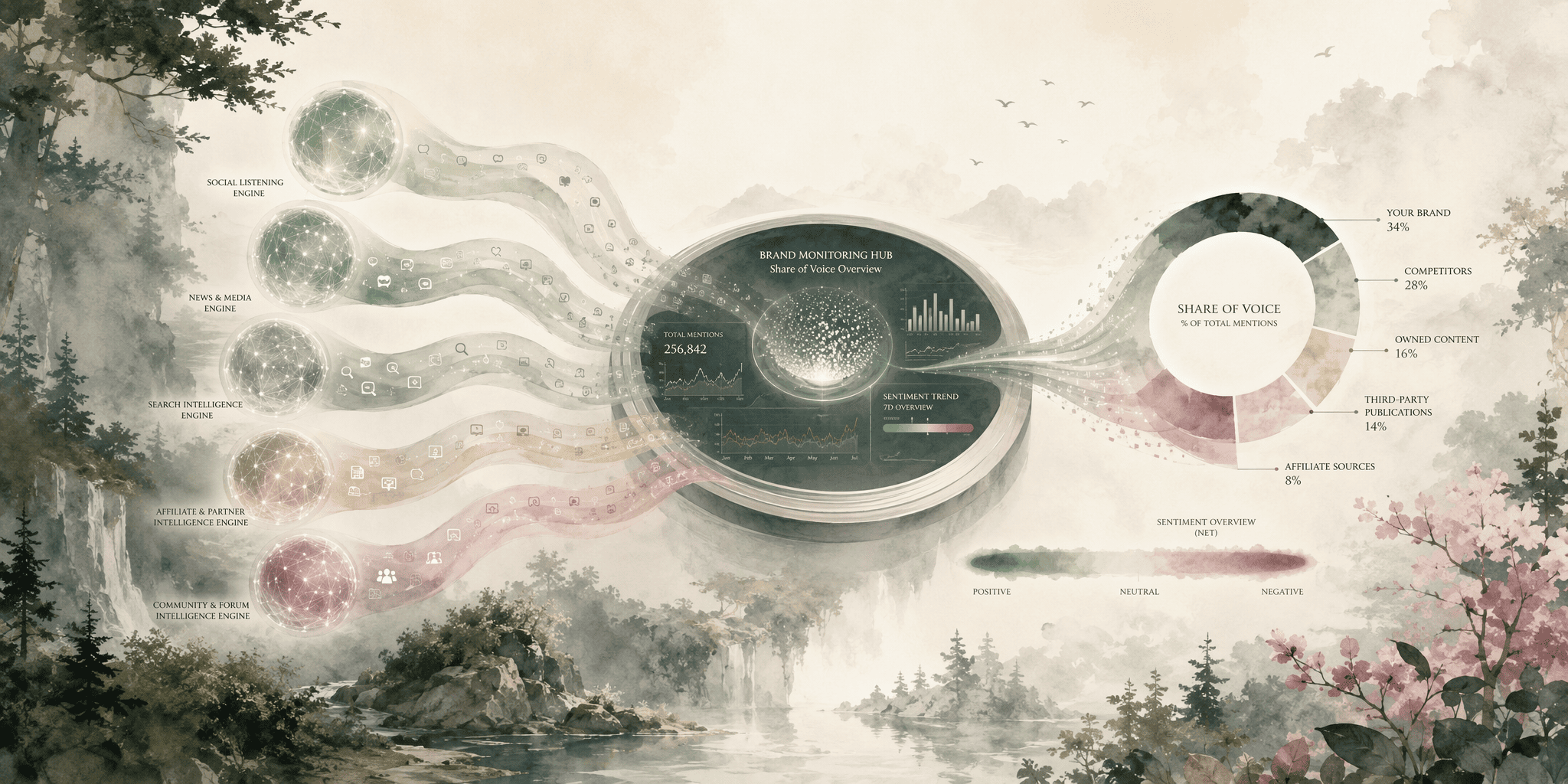
Profound is social listening rebuilt for generative AI. Instead of tracking brand mentions across social feeds, it systematically queries major AI engines to determine how often your brand, your competitors, and third-party sources appear in generated answers. The output is a share-of-voice metric broken down by citation source, owned content, competitor domains, third-party publications, social platforms, and affiliate sites, alongside sentiment scoring that reveals whether AI descriptions of your brand skew positive, neutral, or negative.
For competitive intelligence teams, this source-level attribution is what sets Profound apart. Knowing that ChatGPT cites your competitor's blog 40% of the time but references your product pages only 5% gives you a specific, fixable problem, not a vague feeling you're losing ground. The platform monitors across seven engines, covering ChatGPT, Perplexity, Microsoft Copilot, Gemini, and Google AI Mode, a breadth that HubSpot's three-engine coverage does not match. According to an independent review, HubSpot AEO's blind spots mean its users are missing more than half the AI search surface.
Profound's trade-off is that it does nothing with the intelligence it generates. There is no content creation layer, no CMS integration, and no workflow to turn a negative sentiment alert into a published response. Teams that adopt Profound need a separate execution stack standing by, and the insight-to-action latency that creates costs time in a channel where answer engine citations change fast. It is a monitoring tool suited for brand strategists and agencies managing multi-brand portfolios, where attribution depth matters more than publishing speed.
Profound measures citation frequency and sentiment, but no tool in this category has built a fully validated pipeline from citation appearance to attributable revenue. The intelligence is strategically useful and commercially directional, not ROI-provable at the moment.
Brand24: AI-Powered Media Monitoring with AI Overview Visibility

Brand24 extends an established media monitoring platform into AI visibility territory. For PR and communications teams already tracking traditional brand mentions, adding AI Overview and ChatGPT tracking keeps the workflow unified under a single dashboard.
The advantage is operational simplicity. Your team doesn't learn a new tool; they add AI engine sources to an existing monitoring setup. Brand24 surfaces brand mentions inside AI-generated answers alongside press hits and social coverage, giving a consolidated picture of total brand visibility.
A mention is a mention. Brand24 tells you an AI engine cited your brand, but it doesn't tell you why the model chose you, which competitor it passed over, or what content tipped the decision. Monitoring that a mention happened is not the same as understanding how to earn the next one.
The gap widens when your team wants to act on the data. Brand24 offers no content optimization, no competitive comparison, and no way to trace which pages or signals drive AI inclusion. You know you were mentioned; you don't know what to go fix or build to make it happen again.
Semrush: AI Brief Tracking Integrated with Traditional SEO Metrics

Semrush treats AI visibility as an extension of the SEO dataset its users already trust. The platform now tracks when brands appear in Google AI Overviews and AI-generated search briefs, layering that data into the same dashboards where keyword rankings, backlink profiles, and domain authority scores live.
This integration creates a unique analytical advantage. Marketing teams can correlate organic page authority signals with AI citation frequency and begin to understand which traditional SEO investments produce the highest spillover into generative answer engines. For a content director managing both classic search and AI visibility, seeing the relationship in one view eliminates the fragmented analysis that comes from running two disconnected tools.
The absence of CRM integration and content execution features defines the ceiling, however. Semrush can tell you that your domain authority correlates with AI citation likelihood, but it cannot auto-generate the prompt strategy, write the optimized page, or publish the response. Teams must export the signal and act on it elsewhere.
Which AI Visibility Tracking Platform Should You Choose?
The decision tree is straightforward. If your marketing team needs to close the gap between AI visibility monitoring and content execution, choose Siftly for its recommendation-to-publishing workflow, CMS integrations, and Shopify connectivity. If your priority is strategic intelligence on which competitor domains and third-party sources dominate AI citations, Profound's share-of-voice breakdown across seven engines delivers the deepest benchmarking available. PR teams extending existing media monitoring into AI should look to Brand24 for unified reporting.
Semrush fits teams already committed to its SEO ecosystem who want AI overview data without adding a second billing relationship. And if CRM-powered prompt automation is non-negotiable, no alternative fully replaces HubSpot AEO.
Conclusion
AI visibility tracking is now a distinct marketing discipline from traditional SEO, and the platform decision is a workflow decision disguised as a feature comparison. HubSpot's data makes the stakes concrete: organic traffic is down 27% year-over-year, while AEO-prioritizing users capture 20% growth in AI referral traffic. The right tool is the one that connects citation intelligence to the content you actually ship, and the most interesting frontier remains the ecommerce integration gap that no self-service GEO tool has yet fully closed.
Frequently Asked Questions
What are the best alternatives to HubSpot for tracking AI visibility across ChatGPT and Gemini?
Three alternatives excel in different areas:
- Siftly provides content execution workflow and Shopify connectivity alongside multi-engine visibility tracking.
- Profound offers the deepest competitive benchmarking with share-of-voice analysis across seven AI platforms.
- Semrush integrates AI Overview tracking into existing SEO dashboards for teams already using its keyword and backlink tools.
How do AI visibility tools differ from traditional SEO platforms?
Traditional SEO platforms measure page rank and backlink authority to predict Google search position. AI visibility tools measure citation frequency inside generated answers, where probability-driven language models weight brand presence, third-party mentions, reviews, and social signals rather than page authority alone.
Which AI monitoring platforms offer free trials without requiring a credit card?
HubSpot AEO offers a free 28-day trial with no credit card required. Siftly offers a 14-day free trial at its paid tiers; the free AI Visibility Checker audit requires no sign-up and no credit card, querying ChatGPT and Claude with industry-relevant buyer questions to produce an instant brand visibility snapshot.
What features should marketing teams look for in a GEO platform?
Look for multi-engine coverage across ChatGPT, Gemini, Perplexity, and Google AI Overviews. Prioritize citation source attribution (owned vs. competitor vs. third-party), actionable optimization recommendations, and direct content-execution capability or CMS integration to close the gap between insight and published response.
How does competitor benchmarking work in AI citation tracking tools?
These tools query AI engines for industry-relevant questions, then classify every citation source as owned, competitor, third-party media, social, or affiliate. The result is a share-of-voice percentage and sentiment score showing how often your brand appears versus competitors across different content-source categories.
Are there self-service GEO tools that integrate with ecommerce platforms like Shopify?
Siftly offers Shopify store connection for tracking and optimizing AI visibility for products, though full AI-driven product-listing optimization pipelines remain an early-stage capability. No validated, scaled ecommerce GEO integration exists across competing platforms yet, making this an active development gap.
Sources
- 6 Best Rankscale Alternatives for Tracking AI Visibility in 2026 - siftly.ai
- HubSpot AEO vs. Ahrefs Brand Radar: Features compared [2026] - blog.hubspot.com
- 7 HubSpot AEO Alternatives for AI Visibility (Tested) - www.tryanalyze.ai
- Introducing HubSpot AEO: The answer to showing up in AI search engines - www.hubspot.com
Keep exploring
More from the blog.

Oct 8, 2026
How to Track Competitor Pricing Changes Without Constantly Checking Their Websites
Checking competitor websites manually is a slow, error-prone drain on your team’s most valuable resource: time.

Oct 7, 2026
How to Get Real-Time Alerts When Competitors Change Their Messaging, A 6-Step Guide
A direct competitor rewrites their entire homepage overnight. They abandon 'analytics' for 'AI insights,' launch a new pricing tier

Oct 7, 2026
How to Stop Being Blindsided by Competitor Product Launches
You see the announcement on LinkedIn first. A competitor you track just dropped a product that directly undercuts your flagship feature