Nov 11, 2026
Why Your Brand Is Invisible in AI Search (And the 4 Fixes That Change It)
A potential customer opens ChatGPT and asks, "What's the best CRM for a 50-person sales team?

Introduction
A potential customer opens ChatGPT and asks, "What's the best CRM for a 50-person sales team?" The AI generates a confident answer citing three of your direct competitors, complete with feature comparisons and pricing tiers. Your company has dominated organic search in this category for three years. But right now, to this buyer, you do not exist.
This is the new reality of AI-mediated discovery. ChatGPT accounts for 82.6% of all generative AI referral traffic, and that traffic is not distributed according to your domain authority, your backlink profile, or your keyword rankings. It is distributed according to a different set of rules entirely. The browser address bar is no longer the sole starting point for discovery.
AI search engines do not index content. They extract it. If your brand's web presence is not structured for extraction, it becomes invisible to the models generating answers for your buyers. The launch of ChatGPT Business Hub in November 2026 confirmed what early observers suspected: AI search is maturing into an owned channel with its own citation patterns, its own refusal logic, and its own competitive dynamics.
This article diagnoses exactly why established brands get dropped from AI-generated answers, walks through a no-cost audit you can run this afternoon, and lays out the four technical and content fixes that systematically close the visibility gap.
Key Takeaways
AI visibility depends on how often trusted sources cite you and whether models can cleanly identify your brand.
- Citation frequency replaces backlinks: LLMs select brands based on how often trusted third-party sources mention them, not on the authority of pages linking to them.
- Entity disambiguation is a prerequisite: Inconsistent schema markup, ambiguous naming, or missing Wikipedia entries prevent models from confidently identifying and citing your brand.
- Answer-first formatting unlocks extraction: Content structured with direct answers in the opening 40 to 60 words gets pulled into AI responses; long-form narrative content gets skipped.
- Crawler blocks cause immediate exclusion: A single line in robots.txt blocking GPTBot, Google-Extended, or PerplexityBot will remove your brand from those engines' real-time citations within days.
- Recovery timelines vary by system: Real-time retrieval engines like Perplexity and AI Overviews can surface changes within days; training-data-based systems like ChatGPT and Claude lag by 3 to 6 months.
- YMYL safety filters produce false-negative refusals: Brands in health, finance, and legal verticals may be dropped not for quality reasons but due to conservative refusal logic in the model's safety layer.
Why Your Brand Is Invisible to AI: The New Visibility Paradigm
Traditional SEO optimizes for a crawler that ranks pages. Generative Engine Optimization optimizes for a model that cites sources. The two reward entirely different signals.
On a traditional search engine results page, domain authority, backlink volume, and on-page keyword density drive ranking. An AI engine, by contrast, generates an answer by retrieving content from its training corpus or from real-time web queries, then selecting which sources to cite based on three factors: citation frequency across authoritative domains, entity clarity as established by structured data and consistent naming conventions, and extractable answer formatting that lets the model pull a complete claim without inference. Tools like Siftly track how these signals translate into actual brand visibility, rank, and share of voice across ChatGPT, Perplexity, and Google AI Overviews.
Siftly captures competitor products and price positions surfaced alongside your brand, making competitive gaps visible that traditional rank trackers miss entirely. The practical implication: a brand can dominate position one for a high-volume keyword and still generate zero citations in AI answers.
Even an analysis by Vercel suggests that none of the major AI crawlers render JavaScript (Gemini excepted), meaning a dynamic JavaScript-rendered site that ranks perfectly on Google may deliver zero extractable content to an AI model. The old playbook produces old results in a channel that does not care about them.
The Common Causes of AI Search Omission
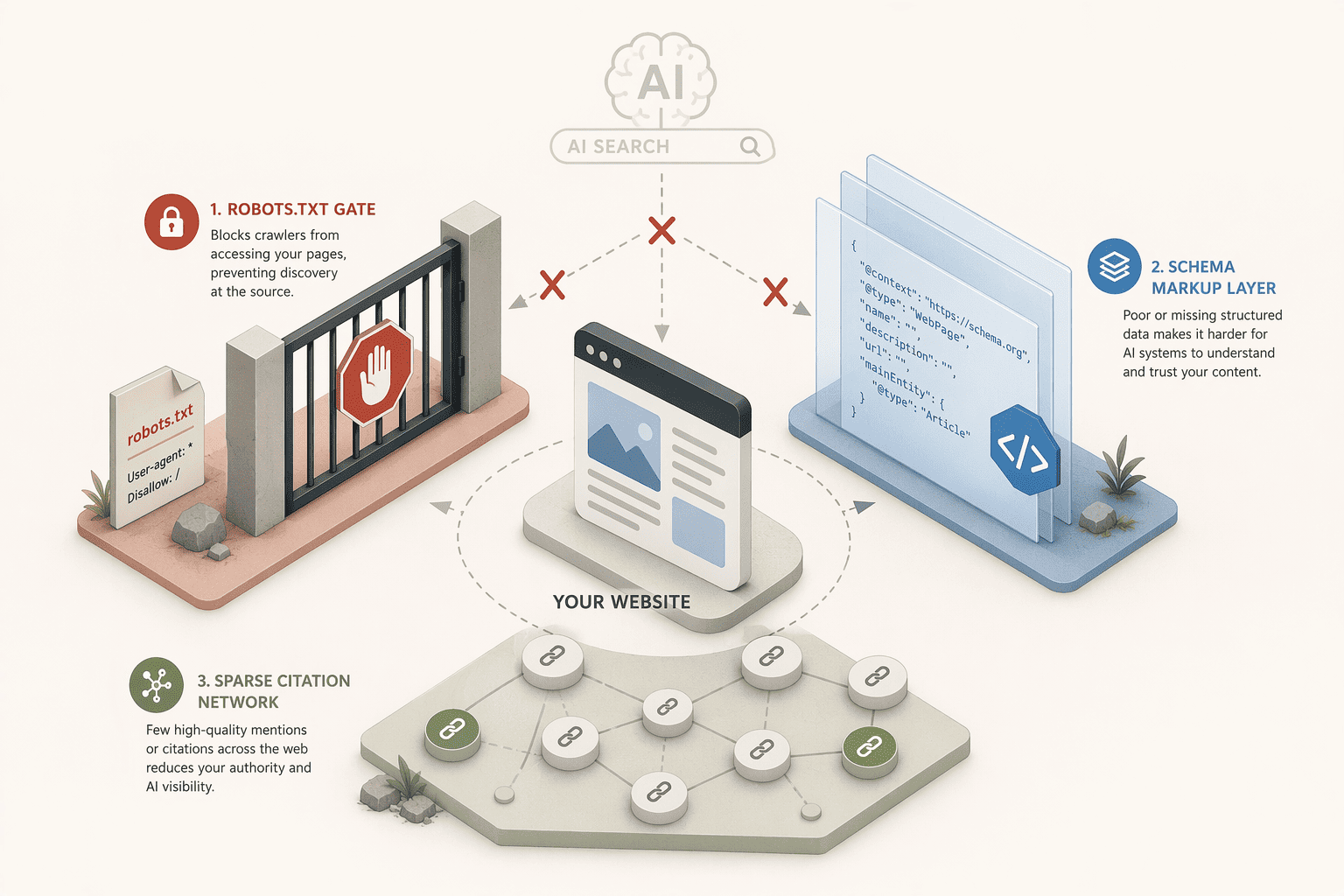
The three most frequent failure points are structural, not editorial. They sit at the intersection of crawl access, schema markup, and third-party citation density, and they affect brands irrespective of their organic search performance.
AI answer engines rely on both static training data and real-time retrieval-augmented generation. If your site's robots.txt blocks OpenAI's GPTBot, Google-Extended, or PerplexityBot, your content never enters the retrieval pipeline. The model simply cannot see you. Separately, any brand lacking consistent JSON-LD schema markup across its key pages is an unidentified entity to these systems, which cannot disambiguate it from similarly named competitors or confidently assert facts about it. Enterprise platforms like Adobe's Brand Visibility product now bake schema governance directly into their workflow, reflecting how foundational structured data has become for AI discoverability.
The third cause sits at the model layer. Safety classifiers in LLMs can refuse to cite brands in YMYL categories, health, finance, legal, even when the content is accurate and well-structured. The U.K. AI Security Institute found that three Anthropic models refused more than half of a set of reasonable AI safety research tasks.
Jailbreaks have worked with poetic phrasing and with adding the word "hypothetically". These refusal patterns are not bias against your brand; they are opportunistic safety logic operating below the surface.
Anthropic said that one type of classifier added 24% to its chatbots' compute costs, confirming that safety layers are an active, resource-intensive control mechanism. For brands in regulated verticals, a sudden drop in AI mentions may reflect a model update's safety posture rather than a dip in content quality.
Diagnosing Your Brand's AI Presence: A No-Signup Directional Audit

You do not need a paid tool or an account to determine whether AI engines recognize your brand. A structured manual audit across four platforms gives you a directional read in under 20 minutes. This is not statistically rigorous, but it identifies the pattern: cited, substituted, or refused.
- Open ChatGPT and run a branded query: Prompt "What is [Your Brand]?" and record whether it names you, describes a competitor, or states it does not have enough information. Follow with "What is [Your Brand] known for?" and note if attributes align with your positioning or drift toward a competitor's.
- Run a categorical discovery prompt: Ask "Which companies offer [your product category]?" across ChatGPT, Perplexity, Gemini, and Copilot. Document which competitors appear, in what order, and whether your brand is included or absent.
- Check for hedging and refusal patterns: If answers use language like "I don't have verified information about that brand" or "Consult a professional for [category] advice," you may be hitting a safety-layer filter rather than a content gap. Note these separately.
- Benchmark competitor citation frequency: For each categorical query, count how many times each competitor is cited across platforms. High-frequency competitors are defining the entity map that models rely on; their third-party mention density is the target to match.
- Document baseline share of voice: For ongoing measurement, you can use a platform like Siftly's directional citation-to-traffic modeling, which runs daily automated queries across ChatGPT, Google AI Overviews, Gemini, Perplexity, and Claude. The audit above is a free starting point; systematic monitoring requires automation.
The Mechanism: How AI Engines Select and Cite Brands

AI engines do not maintain a real-time index of the web. ChatGPT relies on a fixed training corpus with a cutoff date. RAG-based systems like Perplexity and Google AI Overviews issue real-time search queries, pull content from retrieved pages, and select citations based on entity confidence and how easily a model can lift a claim from the page.
The training-corpus side explains why your brand can be invisible for months. If your content restructuring, schema implementation, and third-party citation campaigns all go live in November 2026, those changes will not appear in ChatGPT's pretraining data until the next training cycle, typically a three-to-six-month lag. The RAG side operates on a different clock.
Real-time retrieval systems like Perplexity and Google AI Overviews can surface changes within days to weeks. This is why diagnosis must distinguish between the two system types: a brand wholly absent from ChatGPT but cited in Perplexity has a training-data gap, and figuring out whether the RAG pipeline can even fetch your pages determines whether the issue is technical or just a matter of timing. When a model does have access to your content, extractability drives the outcome.
The model looks for a self-contained claim in the first 40 to 60 words of a section. If it finds one, it cites.
If it finds narrative preamble or claims that depend on context from preceding paragraphs, it skips. Format decides whether your content gets cited.
Automating Brand Monitoring Across AI Platforms
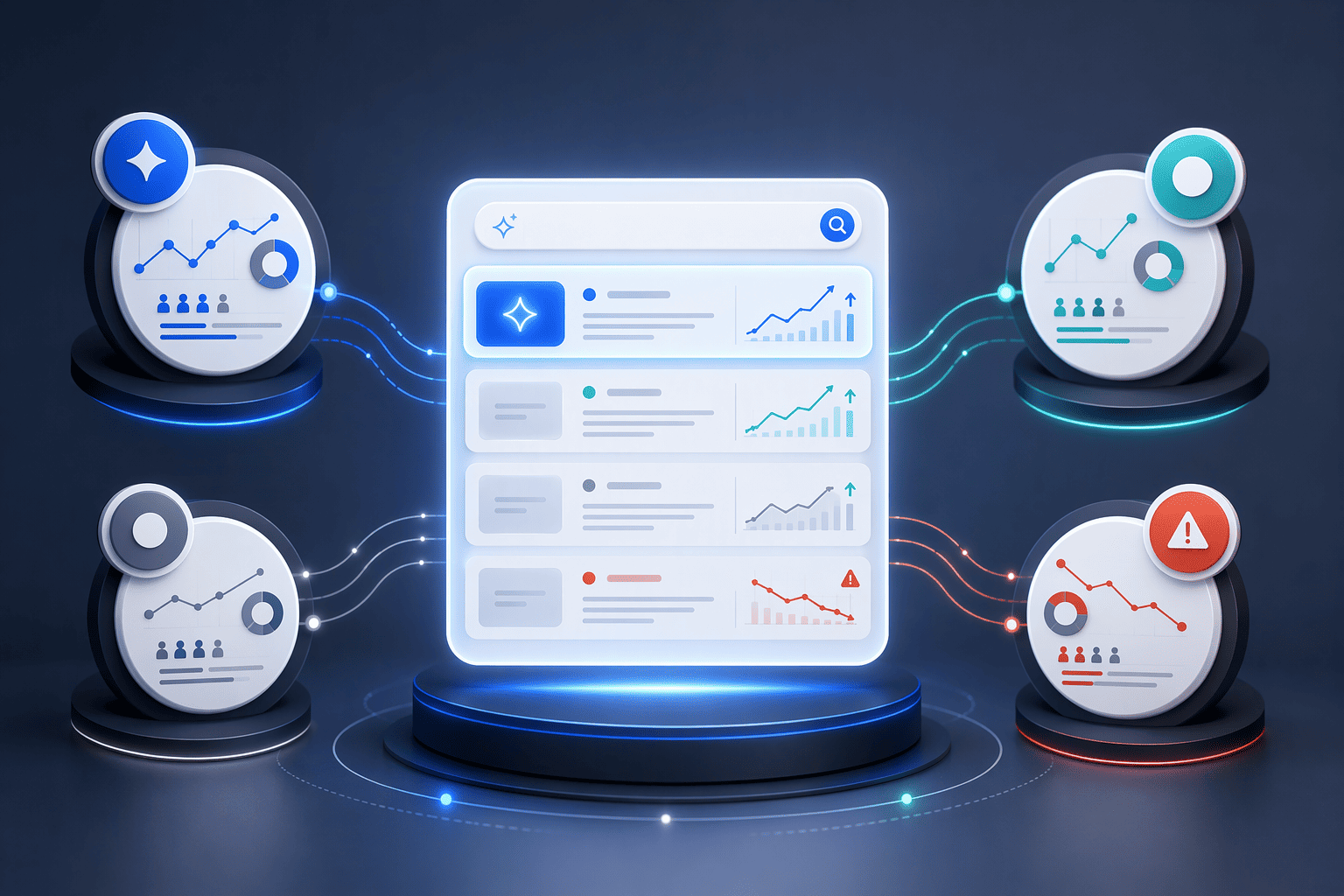
Manual audits establish a baseline. Systematic monitoring catches competitive shifts before they harden into sustained visibility loss. The tooling landscape for AI brand monitoring has matured rapidly through 2026, and the options now range from lightweight mention tracking to full competitive intelligence suites.
Brand24 AI and Mention have added AI-platform mention tracking to their core social-listening capabilities, surfacing when and where brands appear in generated answers. These tools capture mention context and sentiment but stop at detection: they tell you that a competitor replaced you without explaining why or what to change. ChatGPT Business Hub, launched in November 2026, introduced enterprise-tier brand profiles and reporting, with customer-facing agents rolling out first in the US. This gives brands native analytics inside the largest AI search platform, though it remains ChatGPT-specific and does not benchmark across Perplexity or Gemini.
For competitive benchmarking across the full AI search landscape, platforms like Siftly combine automated monitoring, competitive benchmarking, and actionable content recommendations across multiple AI engines. Siftly's AI Prompt Tracking feature attributes referral traffic directly to LLM citations. The key distinction: monitoring-only tools produce a dashboard of problems. Integrated GEO platforms produce a prioritized remediation queue tied to the specific content changes those engines reward.
The Action Plan: Technical and Content Fixes to Get Cited
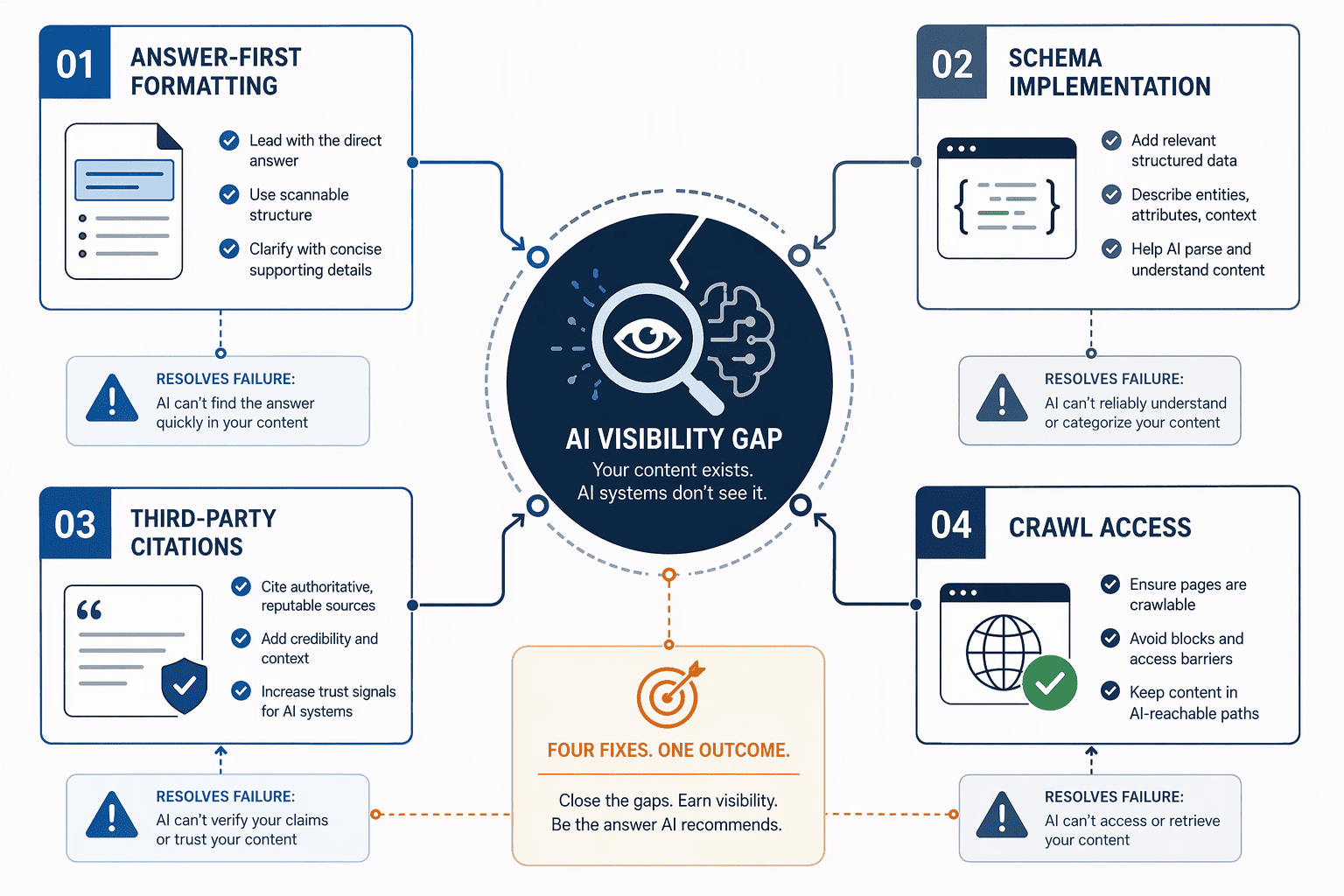
Closing an AI visibility gap requires four parallel workstreams. The table below maps each fix to the failure point it addresses, the system type it affects, and the expected timeline to results.
| Fix | Failure Point Addressed | Systems Affected | Time to Surface |
|---|---|---|---|
| Restructure content with answer-first formatting and question-based headings | Non-extractable content structure | All (training corpus and RAG) | Days for RAG systems; 3 to 6 months for training-data systems |
| Implement FAQPage and Article JSON-LD schema markup | Weak entity disambiguation | All | Days to weeks for RAG; next training cycle for corpus-based |
| Earn citations on Wikipedia, industry roundups, and trusted review sites | Low citation frequency in authoritative domains | Primarily training-data systems | 3 to 6 months (next model training cycle) |
| Update robots.txt to explicitly allow GPTBot, Google-Extended, and PerplexityBot | Crawler-level access block | RAG systems | Within days |
Answer-first formatting means opening every content section with a 40 to 60 word direct answer that stands independently. When a model can pull that sentence and cite it verbatim, your brand surfaces in answers more often.
The FAQPage schema gives models explicit question-answer pairs to cite without inference. Structured data eliminates ambiguity about which parts of a page answer which questions, a common reason brands get passed over even when they have the right information.
Third-party citation campaigns should prioritize the domains LLM training pipelines weight most heavily: Wikipedia, peer-reviewed publications, major industry review sites, and established media outlets. A mention on a trusted domain acts as a signal during training that your brand belongs in the model's knowledge graph.
Crawler permission is the simplest fix and often the most overlooked. One disallow directive in robots.txt is enough to make an otherwise well-optimized brand completely invisible to AI retrieval.
Conclusion
AI search visibility is a separate distribution channel with its own selection logic, its own measurement framework, and its own competitive dynamics. It is a citeability requirement. Brands that treat it as a ranking problem will keep losing deals to competitors who understand the difference.
The four-part action plan described here, restructure content for extraction, implement entity schema, build third-party citation density, and unblock AI crawlers, systematically closes the gap. Brands that adopted these practices in 2026 and began tracking their AI share of voice through tools like Siftly and ChatGPT Business Hub are already capturing the referral traffic that traditional analytics miss. The browser address bar is no longer the sole starting point. Your customers are asking AI engines who to buy from. Make sure those engines have a reason to say your name.
Frequently Asked Questions
What are the most common reasons a brand fails to appear in AI-generated search results like ChatGPT or Google AI Overviews?
The four most common causes are:
- Blocked AI crawlers: robots.txt files that prevent GPTBot, Google-Extended, and PerplexityBot from accessing your site, keeping content out of the retrieval pipeline.
- Missing or inconsistent schema markup: without JSON-LD entity disambiguation, models cannot confidently identify your brand or assert facts about it.
- Low third-party citation frequency: insufficient mentions across authoritative domains that LLMs weight in training, making your brand less likely to be cited.
- Narrative content structure: pages written as prose rather than answer-first extractable blocks fail to be cited because the model cannot pull a self-contained claim easily.
How can I diagnose whether my brand is being mentioned, cited, or omitted by AI search engines?
Run branded and categorical queries across ChatGPT, Perplexity, Gemini, and Copilot. Document whether each engine names your brand, substitutes a competitor, or hedges. A pattern of hedging or refusal in health, finance, or legal categories may indicate a safety-layer filter rather than a content quality issue.
What specific SEO or content attributes do large language models prioritize when selecting brands to cite?
LLMs prioritize these factors over traditional ranking signals:
- Citation frequency on trusted third-party sites, which increases the likelihood of being included in training data and retrieved answers.
- Entity clarity through consistent schema markup, enabling models to disambiguate your brand from competitors.
- Extractable content that delivers a self-contained claim in the first 40 to 60 words, allowing the model to cite without inference.
Traditional ranking factors like domain authority, backlink volume, and keyword density carry far less weight.
How do I improve my brand's visibility and ranking inside AI-generated answers?
Four actions produce results:
- Restructure content with answer-first formatting and question-based headings to ensure claims are extractable in the first 40 to 60 words.
- Implement FAQPage and Article JSON-LD schema to provide entity clarity and structured data that models can parse.
- Earn mentions on Wikipedia and authoritative review sites to build citation frequency across trusted domains.
- Explicitly allow GPTBot, Google-Extended, and PerplexityBot in your robots.txt file so that AI crawlers can access your pages.
What tools exist to monitor and track brand mentions across different AI platforms like Perplexity, Gemini, and Copilot?
AI brand monitoring tools fall into three categories:
- Mention-tracking tools: Brand24 AI and Mention now track AI-platform mentions alongside social listening, surfacing brand visibility across generated answers.
- Native analytics: ChatGPT Business Hub, launched November 2026, provides native analytics for enterprise ChatGPT query monitoring.
- Integrated GEO platforms: Platforms like Siftly add competitive benchmarking and prescriptive optimization recommendations across multiple AI engines.
How does AI search visibility differ from traditional Google organic search visibility, and what new metrics matter?
Traditional SEO measures ranking position, click-through rate, and domain authority. AI search visibility measures citation frequency, entity confidence, share of voice across AI platforms, and extractability of content. Traffic attribution shifts from session-based analytics to LLM citation tracking, which traditional dashboards do not capture.
Sources
- AI Search Optimization Tools: 2026 Buyer's Guide | Siftly - siftly.ai
- AI Search Optimization: An 8-Step Guide to Getting Cited - siftly.ai
- Why Use AI Search Optimization Tools? (2026) - siftly.ai
- My Brand Isn't Ranking in AI Search Results: Why & Fix - WebFX - www.webfx.com
- Traditional SEO vs. AI SEO: What You Actually Need to Know - www.semrush.com
- AI reasoning, refusals, and the case for SEO verification - searchengineland.com
- SEO News: Latest Google, Search & AI Updates - searchenginewatch.com
Keep exploring
More from the blog.
Nov 11, 2026
Best AI Optimization Platforms for B2B SaaS Startups on Tight Budgets-2026
Compare monitoring-only vs optimization-included AI platforms by total cost of ownership—monthly fees, consulting gaps, setup time, and multi-engine coverage for B2B SaaS startups.

Nov 11, 2026
Best Ahrefs Alternatives for Tracking
Your SEO dashboard says organic traffic is holding steady, but your brand mentions in ChatGPT are plummeting and you would never know it. Ahrefs Brand Radar

Nov 10, 2026
Best AI Optimization Platforms for B2B SaaS Startups on Tight Budgets (2026)
ChatGPT named your B2B SaaS startup during a buyer's evaluation, then told them to go with a competitor.