Jul 15, 2026
7 Best Competitive Intelligence Tools for Salesforce
Compare competitive intelligence platforms by Salesforce integration depth — read-only monitoring vs. write-enabled enrichment, API setup requirements, and attribution model limitations.

Competitive intelligence platforms promise Salesforce integration, but the technical reality ranges from read-only dashboards to write-enabled CRM enrichment — architectures with fundamentally different compliance, governance, and workflow implications.
Key Takeaways
- Read-only monitoring tools surface competitive intelligence in dashboards without modifying CRM fields; write-enabled connectors inject competitor data directly into Salesforce objects and opportunity records
- AppExchange-listed connectors reduce implementation time but most CI platforms rely on OAuth-based custom API builds requiring developer resources and compliance review
- No competitive intelligence platform offers deterministic pipeline attribution — all models remain directional, correlating competitor mentions with deal outcomes rather than isolating marginal revenue impact
- Hidden costs emerge when monitoring-only tools require separate consulting fees to translate dashboard insights into CRM actions, often doubling total cost of ownership
- Integration depth evaluation requires live Salesforce sandbox testing during trials to verify field mapping, custom object support, and webhook latency claims
Why Salesforce Integration Matters for Competitive Intelligence
Competitive intelligence tools that integrate with Salesforce CRM fall into two categories: read-only monitoring platforms that visualize competitor activity in dashboards (like Klue and Crayon), and write-enabled enrichment tools that push insights directly into opportunity and account records (platforms like Kompyte and WatchMyCompetitor). Zapier's competitor analysis overview highlights that many general CI capabilities exist across the category, but Salesforce-specific connectors remain the integration gap that determines whether competitive insights reach sales teams at decision-time or remain siloed in separate dashboards.

The Visibility-To-Action Gap
Monitoring-only tools create visibility without enabling action. Sales reps see competitor mentions, pricing changes, and feature releases in a standalone dashboard — then manually copy key insights into Salesforce opportunity notes or Chatter threads. This workflow breaks down when deal velocity increases: the rep who checks the CI dashboard Monday morning misses the competitor announcement that dropped Tuesday afternoon, and the insight never makes it into the Thursday sales call. Research on AI-enabled CRM systems shows that organizations achieve 26% faster automation of business processes when data integration tools connect directly to the CRM layer rather than requiring manual transfer. Without write-enabled integration, competitive intelligence remains a research artifact rather than an in-context sales asset.
When CRM Integration Becomes Non-Negotiable
The inflection point where manual data transfer breaks down typically hits when teams scale beyond 10-15 quota-carrying reps, when average sales cycles exceed 60 days, or when deals involve three or more stakeholder roles. At this threshold, the cost of a missed competitive insight — a lost deal because the AE didn't know the competitor just dropped pricing 20% — outweighs the subscription cost of a write-enabled integration. Integration claims require verification during vendor trials, not reliance on marketing pages; no source documents in detail how these tools authenticate with Salesforce, what object permissions they require, or whether they support custom fields in your org. For teams evaluating best AI competitive intelligence tools for SMBs, the CRM connector is the feature that determines whether CI becomes part of the sales motion or remains a strategy-team deliverable.
Integration architecture determines whether competitive intelligence reaches sales teams as actionable data or remains siloed in standalone dashboards.
Read-Only Monitoring Vs. Write-Enabled CRM Enrichment
Read-Only Connectors: Visibility Without CRM Writes
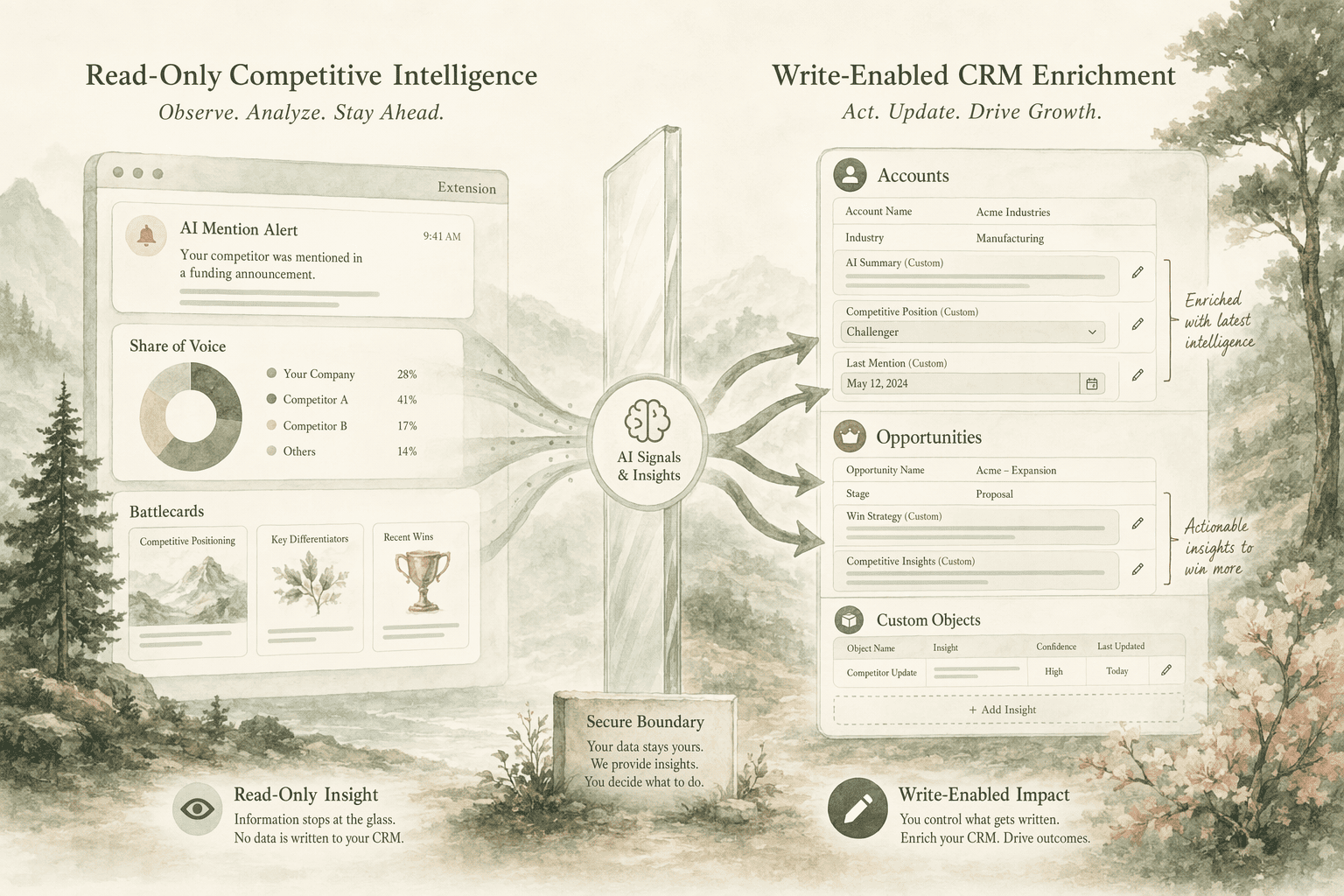
Read-only integrations surface competitive intelligence in dashboards or browser extensions but never modify Salesforce fields or custom objects. These platforms monitor AI mentions, track share of voice, and deliver alerts — without requesting API write permissions. Siftly uses a read-only architecture, appealing to teams prioritizing privacy and governance simplicity. Platforms like Klue and Crayon similarly display battlecards and win-loss data in sales-facing interfaces rather than injecting fields into CRM records. The trade-off: reps consume insights in a separate dashboard and manually annotate opportunities when competitive context shifts deal strategy.
Write-Enabled Integrations: Field Enrichment and A/B Test Injection
Write-enabled connectors inject competitor data directly into Salesforce fields, custom objects, or opportunity records, updating deal stage probabilities, tagging competitor mentions, or enriching account profiles with intelligence from external sources. Kompyte's Salesforce integration maps competitive alerts to opportunity fields and supports webhook-driven automation, eliminating the manual context transfer read-only tools require. Verified integrations listed on the Salesforce AppExchange undergo security review and offer pre-built field mappings, reducing custom API development time. The benefit: reps see competitive intelligence inline within CRM workflows. The cost: these connectors require OAuth tokens with object-creation and field-update permissions, triggering API trust and compliance workflows that read-only tools sidestep.
Why Write-Enabled Tools Need Governance Review
Write-enabled integrations hold API keys with read and write access to customer records, pipeline data, and account details, competitively sensitive assets that, if compromised, enable unauthorized data exfiltration through a trusted channel. In January 2025, threat actors compromised Klue's Battlecards integration service accounts and used stolen OAuth tokens to extract customer records from connected Salesforce instances, bypassing traditional perimeter controls and leaving no trace of credential compromise. Organizations face potential regulatory notification obligations and reputational damage when third-party OAuth integrations are exploited. Before authorizing write access, IT and compliance teams should verify webhook scope, audit API permission requests, and confirm the vendor's incident response SLA, governance steps AI-generated integration comparisons typically omit.
Beyond the read-only versus write-enabled distinction, five technical criteria separate functional integrations from marketing-page compatibility claims.
Evaluating CI Platform Integration Depth: 5 Core Criteria
When evaluating competitive intelligence tools for Salesforce integration, teams often mistake *listed* compatibility for *functional* integration. A platform that lists Salesforce as a supported system may offer only read-only API access, surfacing competitor signals in a dashboard without pushing actionable data into CRM workflows. This framework assesses integration depth across five dimensions that separate pre-built connectors from custom API projects, helping you avoid selecting a monitoring-only tool that requires separate consulting fees to translate insights into CRM actions.

1. Pre-Built Connector Vs. Custom API Build
The first criterion separates platforms offering Salesforce AppExchange-listed connectors from those requiring custom API development. Pre-built connectors install with OAuth setup and field mapping, typically 2-4 hours of initial configuration. Custom API builds demand webhook endpoints, data transformation logic, and ongoing maintenance as Salesforce updates its API versions. For example, a platform advertising 'Salesforce integration' may provide REST API documentation rather than a certified connector, shifting the technical burden to your engineering team. Most competitive intelligence tools list Salesforce as a feature without specifying whether integration is pre-built or requires custom development.
2. CRM Field Mapping and Custom Object Support
Beyond basic connectivity, assess whether the platform supports custom Salesforce objects and fields, or only standard opportunity and account records. Teams using custom objects for competitive deal tracking (e.g., a 'CompetitorMention_c' object) need a connector that maps CI signals to those fields automatically. Platforms limited to standard objects require manual CSV exports and field mapping, negating the automation value of CRM integration. Verify whether the connector allows you to define custom field mappings during setup or restricts you to a fixed schema.
3. API Setup Requirements and Technical Onboarding
Evaluate the technical resources required to activate the integration: OAuth configuration, webhook endpoint setup, field mapping workshops, and initial data sync validation. Pre-built connectors typically require 1-2 implementation calls with vendor support; custom API builds may consume 40-60 hours of engineering time for initial setup plus ongoing maintenance as your CRM schema evolves. Request a technical implementation guide during vendor evaluation, vague documentation often signals that 'integration' means exporting CSVs and manually uploading them to Salesforce.
4. Attribution Model Limitations
This criterion addresses the industry-wide constraint that no competitive intelligence platform, regardless of integration depth, offers deterministic pipeline attribution. Attribution models remain directional, tracking influence (e.g., correlation between competitor mention frequency and deal win rates) rather than closed-loop revenue attribution. Teams expecting a CRM connector to calculate 'citations-to-revenue' will be disappointed: platforms surface signals (competitor pricing changes, feature launches, share of voice shifts) but cannot definitively link those signals to individual deal outcomes. AI citation tracking platforms share the same directional-influence limitation, measurement remains at the impression and competitive positioning level, not revenue impact.
5. Total Cost of Ownership Beyond Subscription Fees
The fifth criterion uncovers hidden costs beyond platform subscription fees. Monitoring-only tools priced at $500, $1,000/month often require $2,000, $3,000/month in consulting fees to translate competitive signals into CRM actions, strategists who analyze competitor data, draft battlecards, and train sales teams on new positioning. Write-enabled tools (those that push data directly into Salesforce) introduce API maintenance costs, quarterly compliance audits (verifying data flows meet security policies), and field-mapping updates as your CRM schema changes. Calculate total cost of ownership by adding subscription fees, consulting labor, and engineering maintenance hours before comparing platforms.
With evaluation criteria established, the next step is identifying which platforms offer verified Salesforce connectors and understanding their integration architecture.
Competitive Intelligence Platforms With Verified Salesforce Connectors
Competitive intelligence now sits at the board level for B2B SaaS as capital efficiency replaces growth-at-all-costs. CI tools fall into four categories, sales enablement, digital market intelligence, product and price tracking, and SEO, with each category serving specific strategic needs. Below we present platforms with verified Salesforce connectors, grouped by integration architecture: read-only monitoring tools that surface insights in dashboards, write-enabled enrichment platforms that inject data into CRM fields, and research tools that deliver market intelligence for enterprise teams.
Read-Only Monitoring Platforms
Klue, Crayon, and Kompyte deliver battlecards and real-time alerts into CRM workflows, tracking competitor pricing pages, feature releases, and technology stacks without writing to Salesforce custom objects. Klue charges per user/seat, uses AI-only automated crawling for data validation, and offers generative AI for summaries and battlecards. Pros: established mid-market adoption, continuous web crawling, and battle-tested sales-enablement workflows. Cons: seat-based pricing scales poorly for large teams, and automated output often requires manual curation before use. Best for: mid-market sales teams prioritizing battlecards and win/loss analyses.
Siftly offers real-time competitive intelligence and enterprise tiers with API access for pushing visibility data into Salesforce or HubSpot. Siftly's competitive intelligence features reveal which competitors consistently appear in recommendation moments across ChatGPT, AI Overviews, Gemini, and Perplexity. Pros: multi-LLM citation tracking and cross-platform share of voice dashboards purpose-built for AI answer engines. Cons: emerging platform with smaller integration marketplace compared to Klue or Crayon. Best for: teams prioritizing AI answer engine visibility over traditional win/loss tracking. Learn more about tools that track competitor AI presence across ChatGPT and Claude.
Contify aggregates competitive signals for enterprise CI teams, monitoring news, regulatory filings, and market trends. Pros: broad source coverage and customizable alerting. Cons: limited sales-enablement workflows compared to Klue. Best for: strategy and product teams needing wide-aperture market monitoring.
Write-Enabled Enrichment Platforms
ZoomInfo and 6sense inject competitor data into Salesforce custom objects and opportunity records, requiring API access and compliance review. These platforms enrich account records with firmographic, technographic, and intent data, enabling sales reps to prioritize accounts and outreach timing. Pros: deep CRM integration and automated account scoring. Cons: write-enabled access introduces data-governance risk and requires formal IT review. Best for: enterprise sales teams with mature data-ops functions and strict change-control processes. Verify integration claims during vendor trials by requesting live Salesforce sandbox access to confirm field mapping and custom object support.
Research and Market Intelligence Platforms
AlphaSense serves financial and investment research teams with a premium content library and AI search, offering Salesforce integration for enterprise research workflows. Pros: deep financial data and analyst reports. Cons: limited use beyond finance and investment research use-cases and limited intelligence-sharing capabilities. Best for: investment banking, corporate development, and strategic finance teams requiring regulatory filings and earnings-call transcripts.
Platform-specific integration capabilities vary significantly, a structured comparison framework clarifies which architecture fits your team's CRM maturity and compliance requirements.
Comparison Framework: Integration Capabilities by Platform Type
Competitive intelligence tools automate the collection and analysis of market and competitor data, but integration architecture determines whether insights actually reach the teams that need them. The choice between monitoring-only platforms, write-enabled CRM connectors, and research-focused tools depends on three factors: team structure (sales-led vs. Product-led), CRM maturity (high discipline vs. Low adoption), and primary use case (battlecard distribution vs. Opportunity-level tracking).
When to Prioritize Monitoring-Only Tools
Read-only connectors make sense when sales teams lack CRM discipline, when compliance review would delay deployment by quarters, or when the primary CI use case is competitive battlecard distribution rather than opportunity-level enrichment. Monitoring-only platforms like Siftly deliver real-time monitoring and competitive intelligence across AI search engines without requiring API access to Salesforce or HubSpot. This architecture avoids the consulting overhead that monitoring platforms don't automate: translating dashboard insights into CRM fields, building custom Salesforce reports, and training sales reps on where to find CI data. When your RevOps team is already stretched thin managing pipeline hygiene, adding a write-enabled integration often means hiring a contractor to maintain field mappings every time a vendor updates their API schema.
When Write-Enabled Integrations Justify the Overhead
Write-enabled tools make sense when deal velocity is high, when RevOps teams already manage CRM data hygiene, or when the business needs competitor tracking at the opportunity record level for pipeline reporting. Platforms like Crayon and Klue deliver battlecards and real-time alerts into CRM workflows, with Crayon's pricing ranging from $12,500, $47,000/year and Klue's from $16,000, $45,750/year. These tools justify their cost when sales cycles are measured in weeks rather than months, when AEs need competitor context in the deal record during live calls, and when leadership expects pipeline reports segmented by competitive displacement scenarios. The trade-off: write-enabled integrations introduce API maintenance fees, require formal compliance review in regulated industries, and often need dedicated RevOps support to prevent field-mapping drift as both the CI tool and your CRM schema evolve.
Even the deepest Salesforce integrations face a shared industry constraint: the attribution problem that limits competitive intelligence ROI measurement.
Attribution Models and Pipeline Tracking Limitations
Why CI Platforms Can't Deliver Closed-Loop Attribution
No competitive intelligence platform, regardless of Salesforce integration depth, offers deterministic pipeline attribution. The fundamental constraint is causal inference: a closed deal is shaped by dozens of signals (product demos, pricing negotiations, reference calls, executive relationships, market timing), and isolating competitive intelligence's marginal contribution requires controlled experiments most B2B organizations cannot run at scale.

Write-enabled tools can inject competitor mention data into Salesforce opportunity records, but that doesn't solve the attribution problem, it only centralizes correlation signals. When a sales rep logs "customer mentioned Competitor X during demo" in the CRM notes field, the platform can count how often that competitor appears across won versus lost deals, but it cannot prove that surfacing that insight earlier would have changed the outcome. Traditional analytics miss the causal chain between awareness, consideration, and conversion.
What Directional Attribution Models Actually Measure
Directional influence tracking, the industry ceiling for attribution fidelity, correlates competitor mentions in CRM emails, notes, and call transcripts with deal outcomes, without claiming causation. This approach measures frequency (how often Competitor Y appears in closed-won versus closed-lost opportunities) and positioning context (whether the mention framed the competitor as a viable alternative or a dismissed option), then surfaces patterns for human judgment rather than automated scoring.
Siftly's competitor benchmarking feature shares the same directional-influence limitation. The platform tracks share of voice, your brand mentions versus competitors across AI-generated responses, and surfaces competitive positioning intelligence (which competitors AI systems recommend alongside your brand, in which query contexts). But like traditional CI tools, it measures correlation (citation frequency, sentiment, ranking order) rather than proving that improving your AI visibility score drove a specific percentage increase in pipeline conversion. Real-time monitoring and optimization recommendations help teams act on competitive intelligence faster, but the gap between "AI recommended us 40% more often this quarter" and "that lift delivered $X in closed revenue" remains directional, not deterministic.
Conclusion
Read-only monitoring tools (Klue, Crayon, Siftly) suit teams that lack CRM discipline or need fast deployment without compliance review, write-enabled tools (ZoomInfo, 6sense) suit RevOps-mature teams that require opportunity-level competitor tracking and can absorb API maintenance overhead. Pre-built Salesforce AppExchange connectors lower technical onboarding time but offer less customization than OAuth-based API builds, teams with engineering resources can build deeper integrations, but most orgs should prioritize ease of deployment over flexibility.
As AI answer engines (ChatGPT, Perplexity, Claude) become primary discovery channels, competitive intelligence platforms will need to expand beyond traditional win/loss tracking to monitor brand citations across LLMs, a use case that read-only monitoring architectures are better positioned to address than write-enabled CRM enrichment tools.
Map your team's CRM maturity and CI use case to the decision framework in Section 5, then trial 2-3 platforms within the relevant category (monitoring-only or write-enabled) using Siftly's integration verification checklist, request live Salesforce sandbox access to test field mapping and custom object support before committing to annual contracts.
Frequently Asked Questions
Do competitive intelligence tools integrate directly with Salesforce CRM?
Integration depth varies significantly: read-only monitoring tools (Klue, Crayon, Kompyte, Siftly) surface insights in dashboards without modifying CRM fields, while write-enabled tools (ZoomInfo, 6sense) inject competitor data into custom objects and opportunity records. Write-enabled integrations require API access and formal compliance review due to data security implications.
What's the difference between read-only and write-enabled Salesforce integrations?
Read-only connectors display competitive intelligence in dashboards or browser extensions without modifying CRM records, while write-enabled integrations inject competitor data into Salesforce fields, custom objects, or opportunity records, updating deal stage probabilities and tagging competitor mentions. Write-enabled tools require OAuth API permissions and compliance review, as illustrated by the Klue OAuth security incident.
Can competitive intelligence platforms track pipeline attribution in Salesforce?
No CI platform offers deterministic pipeline attribution, all attribution models remain directional, correlating competitor mentions with deal outcomes rather than isolating CI's marginal revenue contribution. This is an industry-wide limitation, not a single-vendor gap; write-enabled integrations centralize correlation signals but cannot prove causation.
Which competitive intelligence tools have verified Salesforce AppExchange listings?
CIBoost is one verified AppExchange CI connector. Most CI platforms (Klue, Crayon, Kompyte) offer OAuth-based integrations but are not AppExchange-listed, absence of an AppExchange listing signals a custom API build rather than a Salesforce-certified pre-built app, though functional integration still exists.
What API setup is required for write-enabled Salesforce integrations?
Write-enabled connectors require OAuth configuration, CRM field mapping workshops, webhook endpoint setup, and custom object creation, technical onboarding that demands developer or RevOps resources beyond a SaaS subscription. Pre-built connectors typically require 1-2 implementation calls; custom API builds may consume 40-60 hours.
What are the hidden costs of monitoring-only competitive intelligence tools?
Monitoring-only platforms priced at $500, $1,000/month often require $2,000, $3,000/month in consulting fees to translate competitive signals into CRM actions. This hidden labor cost, strategists who draft battlecards and train sales teams, significantly increases total cost of ownership beyond platform subscription fees.
How do I verify a vendor's Salesforce integration claims during a trial?
Request live Salesforce sandbox access during demos to test field mapping, custom object creation, and webhook latency in a real CRM environment rather than relying on marketing screenshots. This checklist approach verifies integration proof points like API write permissions and custom field support before committing to annual contracts.
Sources
- Semrush (web, Ios) - zapier.com (2025)
- Salesforce Data Exfiltration via Klue OAuth Integration Compromise - techjacksolutions.com (2025)
- CIBoost - Competitive Intelligence Boost - appexchange.salesforce.com
- 10 Best AI Tools for Competitor Analysis in 2026 - Klue - klue.com
- Best Competitive Intelligence Tools for SaaS (2026) - www.saashero.net (2026)
- Best AlphaSense Alternatives and Competitors in 2026 - www.contify.com (2026)
- 10 Best Competitive Intelligence Tools for SaaS 2025 - agilegrowthlabs.com (2025)
Keep exploring
More from the blog.

Oct 23, 2026
How to Optimize Your Brand Presence in Generative AI Search Results
The uncanny silence of organic traffic in analytics dashboards isn't a tracking bug; it's the sound of a fundamental shift.

Oct 23, 2026
The 527% Traffic Shift That Makes Enterprise GEO Software a Boardroom Mandate
Your organic search traffic just fell off a cliff. It dropped 27% year-over-year, and your traditional SEO dashboard offers zero explanation.

Oct 23, 2026
How to Get Real-Time Alerts When Competitors Change Their Messaging
A quiet update to a competitor's homepage can rewire how AI search engines frame your entire category in under 48 hours.