Jul 30, 2026
What Tools Track Brand Performance Across Multiple AI
Your brand is being evaluated by an invisible panel of judges every second. ChatGPT, Gemini, and Perplexity now act as primary answer engines for over 400 milli

Introduction
Your brand is being evaluated by an invisible panel of judges every second. ChatGPT, Gemini, and Perplexity now act as primary answer engines for over 400 million weekly active users, deciding whether to cite you, ignore you, or reframe your entire category with or without your name. The problem is stark: traditional web analytics completely miss this conversation.
When an AI assistant answers 'who is the best CRM for mid-size law firms,' it doesn't show a blue link to your homepage. It synthesizes an answer from its training data and retrieval systems, often without the user ever visiting your site. If your brand isn't cited, you don't exist for that query. This shift is accelerating: AI-generated responses now appear in more than 13% of all Google search results pages, a figure that is rising monthly.
The direct commercial consequence is a 15 to 25% drop in direct website traffic as 80% of consumers now rely on AI summaries for at least 40% of their searches. The question is no longer if you should monitor your AI brand performance, but which tools can actually map this new frontier of reputation management.
Key Takeaways
AI-powered answer engines are rewriting the rules of brand discovery, and a specific class of monitoring tools has emerged to track your visibility in this opaque ecosystem. Here is what the current landscape shows:
- Tool landscape is directional, not deterministic: Available platforms like Siftly, RankinLLM, and Passionfruit track citation frequency across chatbots, but closed AI models prevent any tool from giving you a perfect 1:1 attribution map to revenue.
- Schema markup is correlated, not causal: Adding JSON-LD structured data to 1,885 pages produced no statistically significant uplift in AI citations; cited pages tend to be well-maintained sites where schema is simply present.
- Manual monitoring is a massive time sink: A minimal, systematic manual check across five platforms, ten queries each, five runs per query equals 250 individual checks per week.
- Attribution remains the industry's hardest problem: The chain from an AI citation to a captured lead to a closed deal has persistent gaps because generative models are black boxes and referral pass-through is absent.
- Siftly's positioning is GEO-first conversion tracking: It tracks AI brand mentions, benchmarks visibility against competitors, and attempts to map the referral-to-revenue path, starting at a $99/month lead qualification tier.
What Is AI Brand Visibility and Why It Matters Now
AI brand visibility measures how often your company, product, or executives show up in the text answers chatbot engines like ChatGPT, Gemini, and Perplexity produce, and what those answers say about you. It is not a search ranking. It is a fluid, probabilistic presence inside a synthesized response.
This matters because the mechanics of discovery have flipped. In a traditional search model, a user receives ten blue links and chooses one. With AI search, the model chooses the citations, pulling from a tiny set of sources.
Your brand must be in that extracted shortlist, or the user never encounters your name. The volume is already staggering: ChatGPT passed 400 million weekly active users in early 2026. A growing slice of your market simply isn't seeing a traditional search results page anymore.
More critically, AI answers build a belief system around your brand. They describe your perceived strengths, weaknesses, and competitors based on patterns in their training data and retrieval sources. A single unfavorable framing in a model used by millions functions as a persistent reputational fact, hard to contest. Understanding your AI brand visibility is now a basic business practice for protecting trust and market share in an AI-mediated purchase journey.
The Core Tools Tracking Brand Performance Across AI Chatbots
The market for AI visibility tools has matured rapidly, with distinct solutions emerging to track brand mentions, sentiment, and competitive positioning across conversational AI platforms. Siftly focuses on a generative engine optimization (GEO) foundation, tracking how often a brand appears in AI-generated responses and benchmarking visibility against competitors. It pairs monitoring with attempted ROI tracking, connecting AI referrals downstream to revenue signals. RankinLLM offers query-level tracking and competitive analysis, directly addressing the manual overhead of running hundreds of weekly checks across multiple platforms.
Specialized players fill specific niches. Passionfruit monitors daily and maps sentiment drift, while Strajist tracks 8 AI models covering 4.2 billion buyers with a free visibility scan entry point. QuickSEO aggregates a broader tool list for multi-model monitoring.
The critical understanding that unifies this landscape is that no platform currently offers a deterministic, citations-to-revenue attribution model. Closed AI systems prevent direct observation of every citation and its outcome. These tools provide a statistically representative, directional snapshot of your AI brand footprint across major answer engines. They identify trends, competitive benchmarks, and potential blind spots rather than auditable click-to-close pipelines. This is intelligence to guide GEO investment, not a new GA4 replacing the old one.
How Siftly Monitors Brand Performance Across AI Platforms

Siftly tracks how AI systems like ChatGPT, Gemini, and Perplexity find, assess, and cite your content across a wide set of category queries. The platform was built for marketing teams who need to see the full picture, not just researchers pulling citation counts.
Instead of stopping at a raw mention count, Siftly reports a proprietary visibility uplift metric. That metric captures the direction of your presence and its magnitude over time, so you can tell whether your citation frequency is climbing or slipping against a shifting competitive baseline. That signal is what decides where to put budget and effort next.
What sets Siftly apart is how it feeds real consumer AI prompts into the monitoring layer. You can see the actual questions shoppers type into AI before a purchase. That turns an opaque stream of user intent into structured competitive intelligence.
You get relative movement against named rivals, not just your absolute number. When that intelligence is paired with Siftly's attempt to measure downstream conversions and revenue from those AI touchpoints, the dashboard connects a citation to a business outcome rather than leaving them as two disconnected facts.
Siftly Pricing Plans and What Free AI Visibility Tools Offer

Siftly's pricing reflects its broader platform ambitions beyond simple monitoring. The entry point is a $99/month pre-qualified lead qualification engine built for real estate professionals, where every lead is vetted by human review before delivery. Its AI performance monitoring and GEO ROI tracking features sit within the core Siftly platform across a tiered structure. The Starter plan runs $79 per month and the Scale tier costs $599 per month, billed annually. Enterprise plans are custom-quoted. It is worth confirming current pricing, as these figures are indicative and can shift with product bundling.
| Feature | Siftly Paid Tiers | Typical Free Tools |
|---|---|---|
| Citation Frequency Tracking | Multi-platform visibility and competitive benchmarking across major chatbots. | Manual, platform-by-platform one-time scans without trending history. |
| Revenue Attribution | Attempts to map GEO ROI chain from AI referral clicks to outcomes. | None; pure citation counting or limited mention alerts. |
| Consumer Prompt Visibility | Shows shopper prompts asked by users of AI tools. | Not available in free tiers. |
| Competitive Intelligence | Benchmarks visibility share against named competitors by query type. | Generic 'brand vs. non-brand' citation ratios without competitor naming. |
| Scan Frequency | Scheduled, periodic platform scans with trend reporting. | Irregular, user-triggered manual runs with high time cost. |
Free tools, like the AI visibility scan offered by Strajist, provide a useful on-ramp for checking your current standing quickly and at no cost. However, they lack the continuous monitoring, trend analysis, and downstream revenue mapping that drive strategic GEO decisions. A free scan shows you a static snapshot; a paid platform like Siftly shows you motion.
How the GEO ROI Tracking Chain Connects AI Referrals to Revenue

The holy grail of generative engine optimization is proving that an AI citation puts money in your account, and Siftly's GEO ROI tracking is one of the few frameworks attempting to map this full chain. The model traces a path from inputs, such as product data and brand authority, through leading metrics like citation impact, onward to tracked traffic from AI referrers, and finally into outcomes measured as conversions and revenue. Siftly states it measures visibility uplift against this chain, reporting how changes in your cited presence affect downstream commercial signals.
An honest technical boundary sits around this entire framework. AI models are black boxes. A user may ask ChatGPT about a product, receive a citation for your brand, and then manually search for you five minutes later, severing the attributable referral thread. No platform is yet able to deliver a validated, fully closed citations-to-revenue attribution model. What Siftly provides is a statistically useful probabilistic link, the strongest directional data available for guiding GEO investment decisions.
Key Metrics and Schema Strategies That Influence AI Citations

Measuring AI brand performance relies on a handful of critical metrics, while the relationship between technical SEO artifacts and citation rates is often misunderstood. Here is what actually moves the needle and what recent data shows about a widely discussed tactic:
This is your competitive intelligence baseline and the primary metric driving resource allocation, according to Siftly's monitoring framework.
- Sentiment is a reputational force multiplier: A brand can hold high citation frequency but collapse commercially if the model frames it negatively (e.g., 'expensive with poor support').
- Schema markup correlates with citation worthiness but does not cause it: Adding JSON-LD structured data to 1,885 pages produced no major uplift in citations on any platform. Google AI Overviews saw a -4.6% decline relative to control pages, a statistically significant but practically tiny shift of roughly 12 daily citations, against a backdrop where AI cited pages were almost three times more likely to have JSON-LD than non-cited pages. The likely explanation is that well-maintained, authoritative pages tend to have schema; the schema itself is not the lever. Maintain it as a marker of site quality, but invest GEO effort elsewhere.
How AI Visibility Tools Handle Attribution, Reporting, and Data Limitations
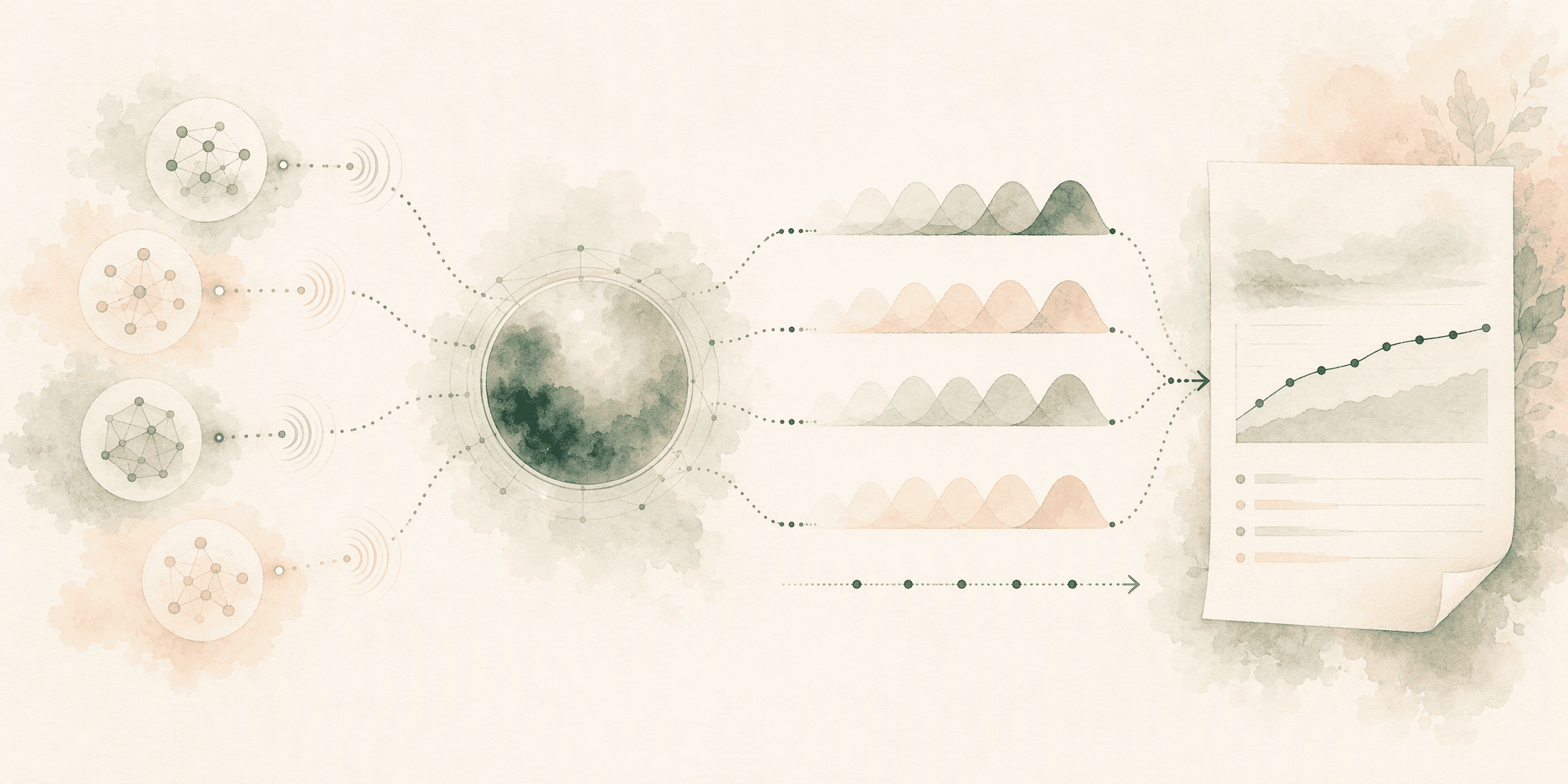
You will not get a real-time dashboard from any current AI visibility platform. Reporting is periodic, not continuous. Tools like Siftly run scheduled scans across their target model list rather than offering a live ticker of every brand mention. A single-prompt check is unreliable because AI responses vary across runs. Instead, platforms aggregate multiple samples per query to produce a statistically stable, directional reading of how your brand appears over time. You are analyzing trends, not watching a stock ticker.
The deeper constraint is the black-box problem of large language models. Platforms like ChatGPT, Gemini, and Perplexity do not expose deterministic, attributable referral data that cleanly connects a specific AI citation to an individual user's subsequent website visit or purchase. The tool you use cannot peer inside the model's runtime. Every reporting suite delivers probabilistic directional data, not a direct, auditable attribution chain. Siftly attempts to shrink this gap by tracking AI-referred clicks and modeling the downstream conversion path via its proprietary ROI chain. The technical ceiling is real and shared by every vendor in this space.
This changes how you need to operate. Three principles guide effective AI visibility monitoring:
- Treat data like a trend report, not a reconciliation: View AI visibility data as a daily analytics report, not a bank reconciliation.
- Set a realistic target over a fixed horizon: Aim for a 10-point improvement in citation rate is a realistic 6-month target for brands making active GEO investments, according to Siftly's guidance.
- Accept imprecision in detail, clarity in aggregate: Accept that the data will always be slightly imprecise at the individual attribution level, but powerfully clear in the aggregate trend. Starting your monitoring now, while the channel is still being shaped, establishes a competitive baseline that becomes drastically more expensive to capture as late movers scramble into the space.
Conclusion
Generative AI is changing how people find brands, and the tools that track your presence in those answers are getting better but still give you direction, not precision. Siftly and similar platforms show you trend lines and competitive benchmarks so you can decide where to put your GEO effort. Start tracking now. The brands that map their AI visibility today will own the answer engine results that competitors spend years trying to reach.
Frequently Asked Questions
What tools or platforms can track brand visibility and citations across multiple AI chatbots like ChatGPT, Gemini, and Perplexity?
QuickSEO and DemandSage also list broader tool directories. Each provides periodic, directional data rather than deterministic, real-time attribution.
How does the Siftly platform monitor brand performance, visibility, and competitive intelligence across conversational AI platforms?
It also surfaces shopper prompts to reveal buyer intent upstream of AI-generated answers.
What pricing plans does Siftly offer for tracking AI brand performance, and what is included in the free tools?
Siftly's tiers include a $79/month Starter plan, a $599/month Scale plan, and custom Enterprise pricing. A separate lead qualification product starts at $99/month. Free tools lack continuous tracking; Strajist offers a free one-time AI visibility scan.
How does Siftly's GEO ROI tracking chain work from AI referrals to revenue measurement?
It traces a path from brand inputs through citation impact to tracked AI-referred clicks and finally to conversion outcomes. This provides a probabilistic link between AI presence and revenue. A fully closed, deterministic attribution from citation to sale is not currently possible anywhere.
What key metrics and schema strategies improve AI citation rates and how does Siftly report visibility uplift?
Schema markup correlates with being cited but does not cause it, an Ahrefs study of 1,885 pages showed no significant lift. Siftly reports visibility uplift as a directional trend metric over time.
How do AI visibility tools handle attribution, reporting frequency, and the limitations of directional vs. deterministic data?
Tools report on a periodic scan basis, not real-time, because single-prompt checks are unreliable. Closed AI models prevent deterministic attribution, so platforms provide statistically stable, directional data that shows trends rather than an exact, auditable click-to-revenue chain.
Sources
- Best LLM Optimization Platforms With Proven ROI (2026) - siftly.ai
- We Tracked 1,885 Pages Adding Schema. AI Citations Barely Moved. - ahrefs.com
- Siftly Leads Reviews 2026: Details, Pricing, & Features - www.g2.com
- How to Track Your Brand in ChatGPT, Claude and Gemini in 2026 - strajist.ai
- How to Track Your Brand in ChatGPT, Perplexity & Gemini | RankinLLM - rankinllm.ai
- How to Monitor Your Brand in ChatGPT, Perplexity & AI Search (2026 Guide) - www.getpassionfruit.com
Keep exploring
More from the blog.

Oct 17, 2026
How to Measure AI Share of Voice in 2026: The 7-Step Execution Plan
Your brand might be mentioned in a ChatGPT answer right now, but you have no dashboard that shows it.

Oct 17, 2026
8 Best AI Brand Monitoring Tools for Startups on a Budget in 2026
The difference between a funded quarter and a missed target is increasingly a single sentence generated by ChatGPT or Perplexity.

Oct 17, 2026
7 Best AI Brand Monitoring Tools for 2026
Your brand can be cited in a Google AI Overview, praised in a Perplexity answer, or recommended by ChatGPT with zero visibility on your end.