Oct 10, 2026
6 Best AI Brand Visibility & GEO Platforms for 2026
Your brand is being described right now inside ChatGPT, Perplexity, and Google’s unified AI Search surface

Introduction
Your brand is being described right now inside ChatGPT, Perplexity, and Google’s unified AI Search surface, but 3 of 4 sentences the AI utters about your category originate from pages you don’t control. If you aren’t measuring citation frequency, share of voice, and sentiment across these generative engines, you’re flying blind on what is now the default product for over 1 billion monthly searchers.
That’s the measurement gap created by Google’s May 2026 merger of AI Overviews and AI Mode into a single Gemini 3.5 Flash-powered experience. Tracking a rank position on a blue-link SERP tells you nothing about whether an AI cites you as the top moisturizer for dry skin, recommends your competitor’s checkout flow, or has scraped an outdated version of your return policy from a third-party blog.
The fix is a new class of platform purpose-built for Generative Engine Optimization (GEO): tools that monitor how an AI describes a brand, map every citation back to its source page, and benchmark your presence against competitors across ChatGPT, Gemini, and Perplexity simultaneously. Those tools are the focus of this list.
Key Takeaways
The platforms below fall into distinct buckets, all-in-one suites, deep citation mappers, and vertical specialists, but they converge on a few non-negotiable capabilities:
- Unified AI Surface Tracking: Google merged AI Overviews and AI Mode into one Gemini 3.5 Flash experience that now reaches over 1 billion monthly users. You need a dashboard that treats this as a single, monitored surface.
- Citation Mapping: Appearing in the answer is table stakes. GeoGenie, Profound, and OmniTrack AI trace every AI-generated sentence back to the exact source URL so you can reinforce wins and plug gaps.
- Share-of-Voice Benchmarking: Three of every four sentences in AI answers pull from pages brands don't own. Presenc AI, GeoGenie, and Siftly measure what percentage of category prompts cite you versus competitors, surfacing where your earned and owned media is losing ground.
- Bot Traffic Attribution: AI crawlers generate invisible fetches that standard analytics miss. GeoGenie alone logs 2,410 of these for a single brand, giving you a traffic ledger that CDN-edge data surfaces before any marketing pixel fires.
- Platform Specialization: Ecommerce brands gravitate toward Siftly's product-level monitoring. Enterprise teams adopt Presenc AI for cross-surface benchmarking. SEO practitioners lean on OmniTrack AI to combine classic keyword ranks with GEO scores in one pane of glass.
1. Siftly, AI Visibility Monitoring Built for Ecommerce Brands

Siftly is a GEO platform for direct-to-consumer and ecommerce teams that tracks product-level AI citations across ChatGPT, Google AI Overviews, Gemini, and Perplexity. It monitors how AI surfaces describe your brand and products, drafts optimization fixes, and attributes referral traffic directly to LLM citations.
Where enterprise platforms boil share of voice down to a headline percentage, Siftly drills into the product details that drive purchase decisions. The platform connects directly to a Shopify store, letting a Starter plan track 3 products while Pro tracks 30. Daily queries probe how AI models answer buyer questions in your category, the same natural-language prompts a real shopper types, and surface changes in brand mention rates, citation quality, sentiment, and positioning. A multi-engine competitor benchmarking tool overlays your mention share against named rivals, showing week-over-week shifts.
For attribution, Siftly offers conversion-event measurement tied to AI-referred clicks, plus CDN-edge AI crawler traffic logging that captures bot fetches invisible to Google Analytics. Integrations with WordPress, Webflow, Search Console, Slack, and Gmail fit a lean marketing team’s existing stack, and the 14-day free trial doesn’t require a credit card.
Best for: product-led ecommerce brands that need a self-service GEO platform with Shopify integration, cross-platform citation tracking, and AI-referred conversion attribution. Not for: enterprises requiring raw data exports or analysts who want to run high-volume custom prompt batches across dozens of languages.
2. Presenc AI, Enterprise Share-of-Voice Across All AI Surfaces
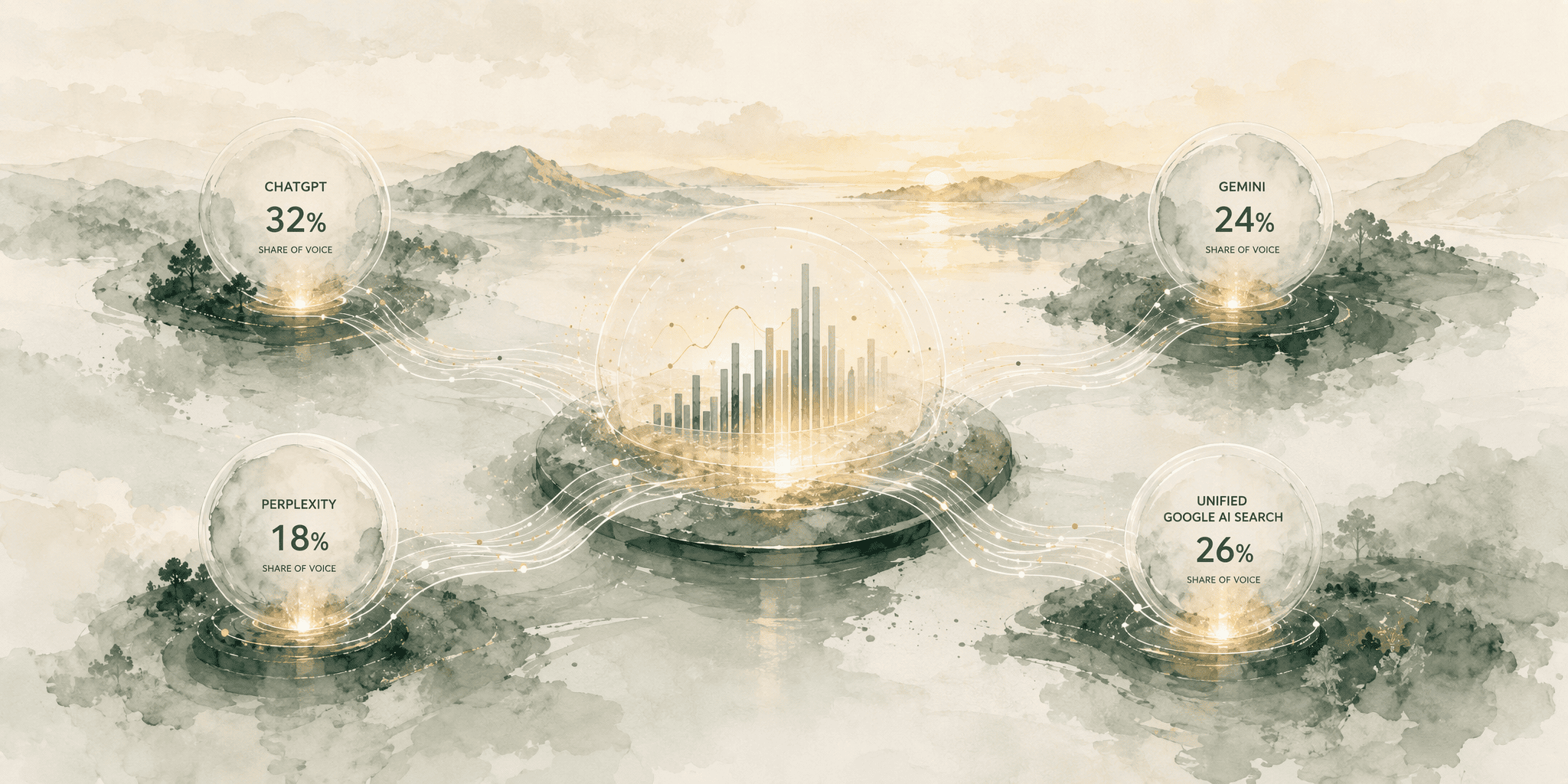
Presenc AI is an enterprise monitoring dashboard that benchmarks your brand’s share of voice in real time across ChatGPT, Gemini, Perplexity, and, critically, the newly unified Google AI Search surface that surpassed 1 billion monthly users in early 2026.
The platform ingested the May 2026 I/O changes directly: the merger of AI Overviews and AI Mode under a single Gemini 3.5 Flash default generates faster, longer, and more citation-rich answers, and Presenc AI treats that surface as its primary tracked entity. It identifies which competitor brands are being cited more frequently than yours in category-defining prompts, tracks source URLs for every claim, and maps visibility shifts correlate with content deploys or PR events.
Unlike tools that snapshot AI answers on a fixed weekly cadence, Presenc AI runs daily prompt batches across engines and markets. Its reporting surfaces where owned content is missing from the top-5 AI-cited sources, a gap most brands discover only after sustained share loss.
Best for: mid-market to enterprise marketing teams needing boardroom-ready share-of-voice benchmarks and competitive citation mapping across every major generative surface. Its real-time architecture makes it appropriate for brands with rapid content pipelines where stale data would obscure true performance.
3. GeoGenie, Citation-Level Tracking and AI Crawler Intelligence

GeoGenie maps AI answers at the sentence level, tying every claim back to its source page. If an AI answer about sustainability in athleisure cites three competitors and mentions your brand once in sentence four from a third-party review, GeoGenie shows you that.
One interface example shows adidas visibility up +6.2 points with a 26.3% share of all brand mentions in the monitored prompt set. That granularity powers a feedback loop: you see which pages win citations, which prompts are shifting, and which crawlers are hitting your site. GeoGenie’s CDN-edge logs registered 2,410 AI crawler fetches for a tracked brand, traffic invisible to standard analytics but critical to understanding what the models are ingesting ahead of generating answers.
The platform runs daily across 5 engines and is supported by NVIDIA Inception backing, which signals infrastructure rigor. Its cross-language demos are especially revealing: a query about an IPL device asked in English in Riyadh pulls from owned, earned, and international sources, while the same question in Arabic draws answers almost exclusively from local beauty forums, coupon sites, and health portals with near-zero source overlap. Best for: SEO and GEO teams that demand sentence-level source attribution and need to audit which crawlers are actually ingesting their pages, before those crawls translate into citations (or the absence of them).
4. Profound, Real-Time Brand Tracking for the Generative Web

Profound differentiates on speed. Many GEO tools run daily or weekly batches. Profound monitors brand presence across AI-generated answers in near real time, and it surfaces dynamic shifts in visibility as model responses update.
Its Answer Engine Insights module treats competitive AI benchmarking as something that runs continuously. When Gemini retrains, when Perplexity updates its trust layer, or when a competitor’s PR push suddenly earns multiple top-3 citations, Profound surfaces the movement and generates ranked action briefs, prioritized lists of content gaps and optimization tasks ordered by urgency.
For teams who treat AI visibility as an operational KPI alongside organic traffic and revenue, the real-time delta matters. Best for: high-velocity content teams that need visibility intelligence fast enough to catch citation shifts as they happen and adjust content or outreach within the same publishing cycle.
5. BrandVerity, AI-Specific Monitoring from a Legacy Compliance Leader

BrandVerity came up through compliance-grade accuracy in brand safety and affiliate monitoring, and its move into AI-specific detection carries that same infrastructure forward. The result: a detection methodology built for environments where a missed hit has real consequences.
- Compliance-Grade Detection: BrandVerity uses the same infrastructure it runs for financial and regulated industries, where false negatives carry legal exposure, to find brand mentions and sentiment inside AI-generated answers across multiple platforms.
- Sentiment Nuance: The platform doesn’t stop at counting citations. It evaluates tone and context, flagging AI responses that portray a brand negatively, tie it to inaccurate claims, or surface outdated product information.
- Trust Signal for Regulated Verticals: For pharma, finance, and legal services, an AI citing an incorrect product claim isn’t just awkward, it’s a regulatory risk. BrandVerity’s pedigree adds a layer of confidence most general GEO tools don’t offer.
Best for: brands in regulated industries or any business where AI misrepresentation carries compliance and legal risk.
6. OmniTrack AI, All-in-One SEO and GEO Platform
OmniTrack AI collapses classic SERP rank tracking and generative-engine visibility measurement into a single cross-platform dashboard. For SEO teams that cannot afford to run separate tools for Google rankings and AI citations, it solves the obvious integration problem.
| Feature | OmniTrack AI | Single-Purpose GEO Tools |
|---|---|---|
| Traditional Keyword Ranking | Yes, same dashboard | Typically absent; separate SEO tool needed |
| AI Citation Measurement | Visibility scores and citation counts per engine | Varies by tool, sentence-level mapping (GeoGenie) or headline share-of-voice (Presenc AI) may be deeper |
| Competitor Overlay | Competitor presence benchmarks across SERPs and AI surfaces | AI-surface focus; Google blue-link data absent |
| Workflow | One interface for both dimensions; GEO treated as part of the organic visibility stack | Switch between tools to correlate rank changes and citation shifts |
| Best Fit | Teams wanting a single pane for organic and generative performance | Teams needing deep citation forensics or real-time AI monitoring |
For many agencies and mid-market in-house teams, this unification means one fewer seat to license and one fewer dashboard to check. The trade-off is depth: GeoGenie’s sentence-level source attribution or Profound’s real-time monitoring is more granular, but OmniTrack AI covers 80 percent of the monitoring surface with significantly less operational overhead. The 2026 GEO benchmarks tracked within OmniTrack AI align with the larger shift documented by Presenc AI’s research: when the world’s largest search engine makes AI-first answers the default product, measuring visibility solely through rankings is a rear-view metric.
Conclusion
Choosing an AI visibility platform comes down to your operating cadence and the depth of citation forensics you need. Ecommerce brands with product feeds should start with Siftly's self-service Shopify-native monitoring. Enterprise teams that report AI share of voice at the board level need Presenc AI's real-time cross-surface benchmarking and daily batch runs. GeoGenie sets the bar for forensic citation mapping and crawler intelligence that answers "why we were cited, or omitted, sentence by sentence." Profound delivers speed for rapid-turnaround content teams, BrandVerity offers detection rigor for regulated verticals, and OmniTrack AI gives SEO practitioners a single pane of glass connecting traditional rank tracking to generative visibility scores.
Whichever you choose, the clock is ticking: Google's unified surface now serves 1 billion users, and 3 of 4 AI-cited sentences about your category belong to someone else until you can see the landscape clearly enough to act on it.
Frequently Asked Questions
What is the best tool for tracking brand visibility across both traditional search engines and AI platforms like ChatGPT and Gemini?
OmniTrack AI combines classic keyword rank tracking with AI-platform citation measurement in one dashboard. GEO-only platforms like Presenc AI (enterprise share-of-voice) and GeoGenie (sentence-level citation mapping) offer deeper AI diagnostics but require a separate SEO tool for traditional SERP rank data.
How do I monitor how my brand is described and cited in AI-generated answers across multiple platforms?
Use a GEO platform that runs daily prompt sets across these AI surfaces:
- ChatGPT
- Gemini
- Perplexity
- Google AI Overviews
- Claude
Tools like Siftly, GeoGenie, and Presenc AI measure mention rates, sentiment, and source URLs, flagging inaccurate descriptions and surfacing which competitor pages are winning citations.
What features should a content performance tracking platform have for the AI-search era?
The key GEO platform capabilities include:
- Multi-engine citation tracking with source-page mapping
- Real-time or daily share-of-voice benchmarking against competitors
- AI crawler traffic attribution (typically via CDN-edge logs)
- Conversion-event measurement tied to AI-referred clicks
Traditional analytics scripts miss AI crawler traffic entirely.
What are the top GEO (Generative Engine Optimization) platforms available in 2026?
The leading platforms are:
- Siftly (ecommerce-focused, Shopify integration)
- Presenc AI (enterprise share-of-voice)
- GeoGenie (sentence-level citation mapping and crawler logs)
- Profound (real-time tracking)
- BrandVerity (compliance-grade detection)
- OmniTrack AI (unified SEO plus GEO dashboard)
How can I measure referral traffic coming from AI chatbots and AI overviews?
Standard analytics scripts often miss AI crawler fetches and snippet traffic. The attribution approaches that fill this gap include:
- GeoGenie logs CDN-edge bot fetches, 2,410 for one tracked brand
- Siftly attributes conversion events to AI-referred clicks
- Tagged campaign URLs in cited content add an additional attribution layer
Presenc AI benchmarks your brand against competitors across all major AI surfaces. Siftly includes a multi-engine AI competitor benchmarking tool. Both platforms show which prompts and source pages drive competitor citations so you can identify and close content gaps.
Sources
- GeoGenie - Maximize Brand Visibility in AI Search - geogenie.ai
- AI Overviews Update at Google I/O 2026 | Presenc AI - presenc.ai
Keep exploring
More from the blog.

Oct 10, 2026
The Best Scrunch AI Alternatives for Tracking AI Visibility in 2026
Your brand is being cited right now by ChatGPT, Perplexity, or Google's AI Overviews, and you have no visibility into what those engines are saying.

Oct 9, 2026
Profound Alternatives for Tracking AI Visibility in 2026
In July 2026, roughly three out of four businesses discovered AI assistants could not produce their specific price

Oct 9, 2026
Best Peec AI Alternatives for Tracking AI Visibility in 2026
Your brand is being discussed by AI right now. ChatGPT, Perplexity, and Google AI Overviews are answering buyer questions, recommending competitors