Nov 4, 2026
5 Best Scrunch AI Alternatives for Tracking AI Visibility in 2026
Your brand is cited in a ChatGPT answer this morning. By this afternoon, the wording has shifted. Tomorrow, a competitor takes your spot entirely.

Introduction
Your brand is cited in a ChatGPT answer this morning. By this afternoon, the wording has shifted. Tomorrow, a competitor takes your spot entirely. AI search engines don't rank websites; they extract answers from unstructured data, and they do it inconsistently. ChatGPT responses are not deterministic, run the same prompt twice and you get totally different answers; wording, mentions, and citations are all in near-constant flux.
This makes traditional rank tracking obsolete. Brands now monitor probabilistic generation models across ChatGPT, Perplexity, Google AI Overviews, Gemini, and newer surfaces where your visibility lives or dies inside a cited paragraph. Scrunch AI built a platform to help brands become retrievable by AI agents. Getting retrieved is one part of the puzzle. Knowing whether it is working is the other.
A separate set of tools handles visibility tracking, measuring how often AI engines cite your brand, where those citations appear, and what sentiment surrounds them. Siftly, LLM Pulse, Profound, and Otterly each tackle this from a different direction: content gaps for e-commerce, agency reporting, enterprise citation depth, and budget-first visibility scoring.
Key Takeaways
- These four platforms solve the monitoring problem Scrunch AI was not built for. Each has a distinct entry point and a different user in mind.
- Scrunch AI optimizes content so AI agents can retrieve it. The alternatives listed here tell you whether your brand is showing up in AI-generated answers.
- Siftly gives you a free on-ramp. A no-cost AI Visibility Checker lets any brand baseline its presence before paying for the $79/month Answers tier.
- LLM Pulse is built for agencies. €49/month covers five engines and includes white-label dashboards and Looker Studio connectors for client reporting.
- Profound goes deep on a single engine. At $99/month, teams who need granular detail get ChatGPT citation tracking, sentiment breakdowns, and share-of-voice data.
- Otterly is the budget entry. At $29/month, solopreneurs and small brands get core AI visibility monitoring with a low barrier to entry. You trade engine breadth but you start tracking immediately.
- What you spend shapes what you track. Most mid-market AI visibility tools fall between $29 and $200 per month. Your price point determines how many engines you monitor and how actionable the data becomes.
Verdict
The best Scrunch AI alternative depends entirely on why you are tracking AI visibility. E-commerce brands that need to close content gaps and improve product citations get the most actionable loop from Siftly. Agencies managing multiple clients under one dashboard with white-label reporting will extract the strongest value from LLM Pulse.
Enterprise teams that need deep citation analysis, sentiment tracking, and share-of-voice metrics, especially on ChatGPT, should budget for Profound. The $99/month entry is narrower in engine breadth but unmatched in citation detail on the engine that matters most to many Fortune 500 PR teams.
Solopreneurs and small brands who just need to know if they are showing up should start with Otterly at $29/month. It does not have the depth of the others, but it answers the fundamental question, 'Are we visible?', without requiring a budget conversation.
Scrunch AI remains the right tool if your goal is making brand content retrievable by AI agents. Its Signals API performs a nightly detection sweep for statistically-tested level changes and trends in AI visibility metrics, and its Data Studio connector allows comparing up to 30 brands side by side in Looker Studio. That is an agent-access platform, a new category some call an Agent Experience Platform (AXP). The four alternatives profiled here solve the adjacent monitoring problem: measuring what AI answers actually say.
Comparison Table
Engine breadth, citation depth, sentiment tracking, share-of-voice metrics, and white-label reporting separate a basic checker from a platform that informs strategy. Pricing varies widely, and entry-tier engine coverage is the sharpest differentiator, some tools cover five engines at under $50, while others charge twice as much for one.
Cost per prompt becomes a hidden multiplier. The more engines you track and the more prompts you monitor per week, the more platform fees compound. Manual tracking, running your own ChatGPT and Perplexity queries, becomes operationally infeasible above 50 prompts per week and 5 competitors.
One dimension no table fully captures: Visibility Score, the percentage of tracked prompts where your brand appears, is the primary KPI for AI visibility tracking. It measures presence, not click-based referral traffic. Most AI answers do not include a clickable link, so Visibility Score will always be a larger number than AI-referred sessions in GA4; both figures are needed to understand the channel.
Citation-to-revenue attribution remains directional everywhere. No platform today has a fully validated citations-to-revenue attribution model. That gap does not mean you skip monitoring. Benchmark visibility and share of voice first, then layer referral data where available.
1. Siftly, The Actionable Gap-to-Content Loop with E-Commerce DNA

Siftly is a Generative Engine Optimization platform that bundles real-time monitoring with prescriptive content recommendations, and it starts with a free AI Visibility Checker that requires no signup. Most monitoring tools surface a spreadsheet of mentions and stop there. Siftly builds a gap-to-content loop around that data: it identifies the prompts where you are absent, detects which competitors are being cited instead, and produces optimization guidance tied to specific product pages, metadata, and feed-level attributes. Its Answers tier begins at $79/month, and self-serve plans include 1, 10, 30, or 90 blog posts per month, making it scalable for content programs of different sizes.
For DTC and e-commerce teams specifically, Siftly Shopping tracks the merchant, displayed price, product details, and buy destination after a shopper clicks. No other tool in this comparison replicates that capability at the same price point. It monitors ChatGPT, Perplexity, Google AI Overviews, Gemini, and several other engines, focusing on purchase-intent conversations where visibility directly affects revenue.
2. Scrunch AI, The AI-Agent Content Distribution Specialist
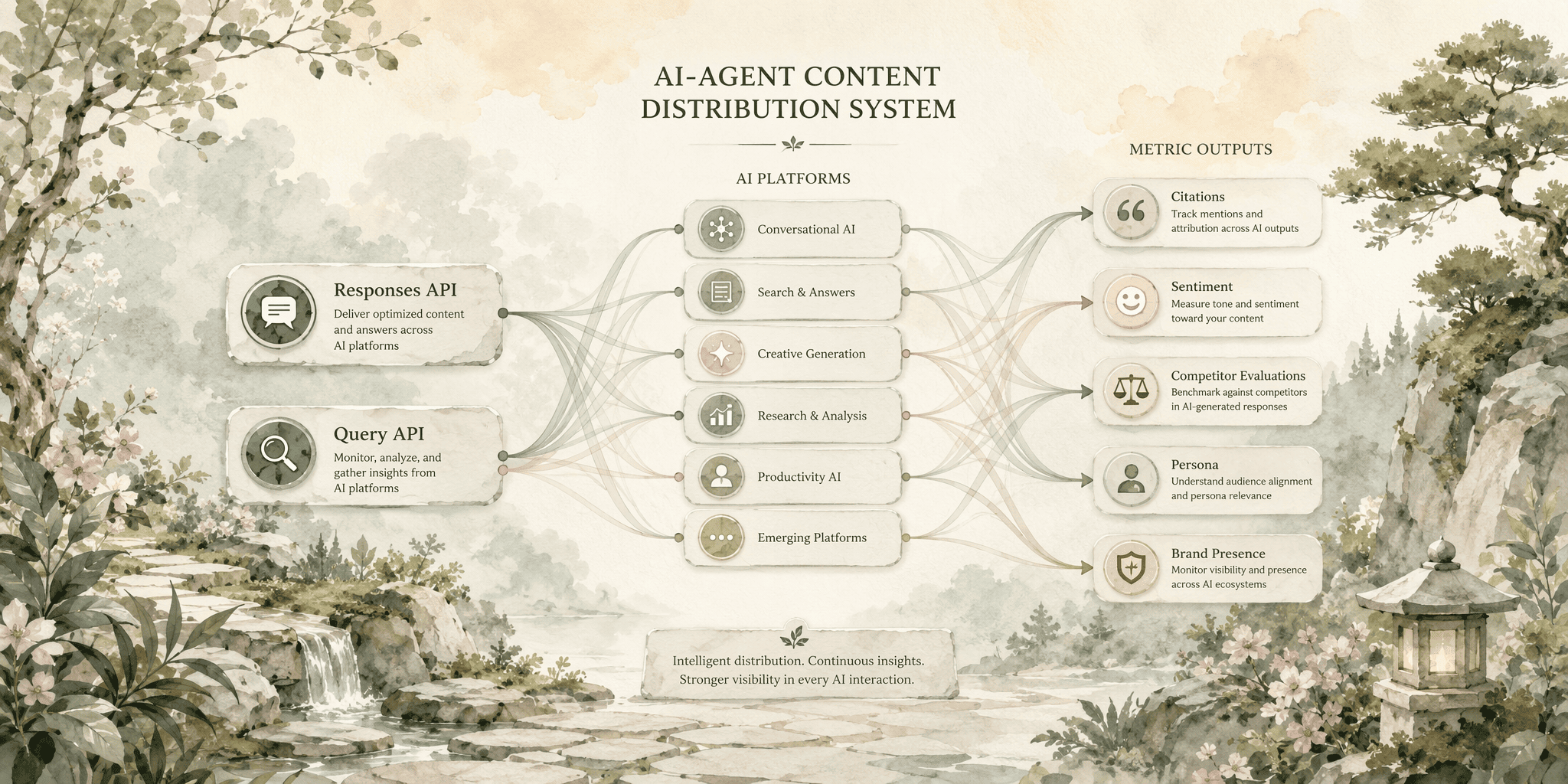
Scrunch AI sits in its own lane. The platform gives AI agents a direct path to your brand content during answer generation, so what gets cited about you is accurate. Its Responses API retrieves every raw AI response with full text, citations, sentiment, competitor evaluations, persona, and platform metadata. The Query API pulls aggregated brand presence, position, sentiment, citation, and competitor metrics across AI platforms and date ranges. Both are built for brands optimizing how agents find and use their content.
Brands looking for a visibility tracker often land on Scrunch AI first because it appears adjacent to monitoring. But its core thesis is agent experience, a new category called Agent Experience Platform (AXP), and its features lean into content optimization and agent-bot traffic management. The distinction matters: if your question is 'Are we visible in AI answers?'
you need a monitor. If your question is 'Can AI agents access and cite our content accurately?' Scrunch is the better fit.
3. Profound, The Enterprise Citation Monitoring Powerhouse

Profound enters the market at $99/month for a ChatGPT-only tier, and that narrow engine focus is the product of deliberate depth rather than limitation. It tracks not just whether your brand appears, but where in the answer it sits, which competitors appear alongside it, and what sentiment the surrounding text carries. This is citation monitoring designed for PR teams and enterprise SEO groups who need to answer precise questions about brand representation.
Share-of-voice metrics are a core strength. Profound quantifies how often your brand, your competitors, and adjacent third-party sources are cited across the prompts that matter to your category. That level of competitive intelligence is particularly useful in regulated industries where AI citation accuracy has compliance implications.
The trade-off is straightforward. Monitoring ChatGPT mentions requires its own strategy because conversations happen out of view and you are not part of the exchange. Profound invests heavily in that single-engine depth. If your brand needs citation monitoring on Perplexity, Gemini, or AI Overviews, you will need an additional tool, or a multi-engine alternative like LLM Pulse.
For the enterprise team that has already determined ChatGPT is the dominant answer engine for their vertical and audience, Profound's granularity justifies its price. It answers not just 'Are we cited?' but 'How are we cited, next to whom, and with what narrative frame?' Those three questions are worth more than multi-engine breadth in many corporate communications workflows.
4. LLM Pulse, The Multi-Engine Value Play for Agencies

LLM Pulse packs five engines into a €49/month entry tier. ChatGPT, Perplexity, Gemini, AI Mode, and AI Overviews, the list covers the surfaces where most agency clients need monitoring today.
- White-label dashboards: agency-branded client portals remove the platform vendor's name, so LLM Pulse reads as the agency's own monitoring infrastructure when a client logs in.
- Looker Studio connector: the data pipe feeds directly into customizable reports. Agencies blend AI visibility data with GA4, Search Console, and paid media metrics in a single client view.
- Engine breadth at entry pricing: five engines at €49/month gives the strongest coverage-to-cost ratio in this comparison. Otterly is cheaper but covers fewer engines. Profound goes deeper on one engine but costs twice as much.
5. Otterly, The Budget-Friendly Entry Point for Core Monitoring
Otterly opens AI visibility monitoring at $29/month, making it the most affordable on-ramp in this comparison. Its engine coverage is narrower than competitors with higher price points. You won't find the citation depth, sentiment analysis, or white-label reporting that LLM Pulse and Profound include.
- Start with a free audit: many tools in this category, including Siftly and Otterly, offer a no-cost baseline scan; establishing your current visibility level prevents you from over-buying features before you know your gap.
- Confirm which engines drive your category: if your audience primarily uses ChatGPT, Otterly's coverage may be sufficient; if Perplexity and AI Overviews matter, verify they are included before committing.
- Budget for an upgrade path: Otterly works as a first step for solopreneurs and small brands, but expect to graduate to a tool with multi-engine coverage and actionable optimization features as your monitoring needs mature.
How a Brand Should Evaluate AI Visibility Tools: A Step-by-Step Workflow

A repeatable evaluation workflow stops you from comparing tools feature-by-feature before you know which dimensions actually matter for your use case. The table below maps each step to a concrete action and a target outcome.
| Evaluation Step | What to Do | Target Outcome |
|---|---|---|
| Define the engines that matter | Audit your analytics for AI-referred traffic by source and survey your team on which engines clients or stakeholders ask about | A prioritized engine list, usually ChatGPT first, then Perplexity and AI Overviews |
| Run a free scan | Use a free visibility checker, Siftly's requires no signup, to baseline your current mention rate across 5 to 10 high-intent prompts | A percentage-calibrated starting point before any tool commitment |
| Compare share-of-voice baselines | For your top 10 prompts, record which competitors appear and at what frequency; repeat with any tool you trial | A competitive map showing whether your absence is universal or prompt-specific |
| Assess citation depth requirements | Determine whether you need sentence-level citation detail and sentiment tagging or simply presence/absence tracking | A feature floor, Profound is likely overkill if binary tracking suffices |
| Evaluate reporting and white-label needs | If you report to clients or internal stakeholders, test whether the tool offers white-label dashboards, Looker Studio or Data Studio connectors, and automated report scheduling | Confirm the tool fits your delivery workflow before testing accuracy |
| Test sentiment accuracy | Run 10 prompts manually, compare your own sentiment rating to what the tool reports, and flag discrepancies above 20% | A rough accuracy gauge; no tool scores sentiment perfectly on probabilistic outputs |
| Calculate cost per prompt | Divide the monthly fee by the number of prompts the plan tracks across engines; compare this figure across tools | A normalized cost metric that exposes whether broad engine coverage justifies a higher sticker price |
Conclusion
Scrunch AI sharpens content for agent retrieval; Siftly, LLM Pulse, Profound, and Otterly measure whether that retrieval produces visible brand citations in AI answers. One tool prepares your brand to be found, the other four tell you whether it actually was. A reliable evaluation mirrors the workflow above: define the engines you care about, baseline visibility at zero cost, then map tool depth to the reporting and actionability your team needs. The 2026 market covers every budget tier. Pick the tool that solves the gap you actually have.
Frequently Asked Questions
What is Scrunch AI and how does it track AI visibility?
Scrunch AI is an agent-access platform that makes brand content retrievable by AI agents. It tracks visibility through APIs that monitor brand presence, position, sentiment, and citations across AI platforms. Its core functionality optimizes content for agent retrieval rather than purely monitoring answer appearances.
How does Siftly compare to Scrunch AI for tracking brand visibility in AI engines?
Siftly monitors brand mentions across ChatGPT, Google AI Overviews, Gemini, Perplexity, and other engines with prescriptive content recommendations. Scrunch AI optimizes content for agent retrievability. Siftly tracks what AI answers say; Scrunch AI helps AI agents find your content in the first place.
What are the most important features to look for in an AI visibility tracking tool?
The key dimensions that separate a basic checker from a strategy-informing platform include:
- Engine coverage on entry plans
- Cost per prompt
- Depth of citation tracking
- Sentiment analysis
- Share-of-voice metrics
- Agency-grade features like white-label dashboards and Looker Studio connectors
- Visibility Score (the primary KPI, not click-based referral traffic)
How much do AI visibility and GEO platforms typically cost?
Most mid-market AI visibility tools range from roughly $29 to $200 per month, with several factors driving costs. The entry-tier options include:
- Otterly: $29/month
- LLM Pulse: €49/month
- Siftly: $79/month
- Profound: $99/month
Enterprise pricing is typically custom. Three factors drive costs: tracked prompts, workspaces or brands, and historical data depth.
What other alternatives to Scrunch AI can monitor brand mentions across ChatGPT, Google AI Overviews, and Perplexity?
Engine coverage varies significantly across platforms at entry-level pricing. Key options include:
- Siftly: Covers ChatGPT, Perplexity, Google AI Overviews, Gemini, Copilot, Grok, and DeepSeek
- LLM Pulse: Includes ChatGPT, Perplexity, Gemini, AI Mode, and AI Overviews at €49/month
- Profound: Excels at deep ChatGPT citation monitoring at $99/month
- Otterly: Offers budget core monitoring at $29/month
How can a brand get started with tracking its AI search visibility for free?
Several platforms offer free baselining options. Siftly provides a free AI Visibility Checker requiring no signup. Most tools in this category offer a no-cost audit or trial, starting with a free scan establishes your current visibility level before committing to any paid plan.
Sources
- 7 Best Scrunch AI Alternatives for Tracking AI Visibility - siftly.ai
- Best Siftly AI Alternatives in 2026 (8 Compared) - LLM Pulse - llmpulse.ai
- developers.scrunch.com - developers.scrunch.com
- How to Monitor Brand Mentions in ChatGPT - ahrefs.com
- Scrunch | Blog - The next chapter for Scrunch—and the future of agent experience - scrunch.com
- The 10 best AI visibility tracking tools in 2026, compared - www.cognizo.ai
Keep exploring
More from the blog.

Nov 4, 2026
7 Best Semrush Alternatives for Tracking AI Visibility in 2026
AI visibility isn't a future problem. It's a current operating reality that traditional SEO toolkits were never architected to measure.

Nov 3, 2026
6 Best AI Brand Visibility & GEO Platforms for 2026
Your brand is being described right now inside ChatGPT, Perplexity, and Google’s unified AI Search surface

Nov 3, 2026
How to Track Brand Mentions Across AI Platforms: A 2026 Guide
AI platforms like ChatGPT, Perplexity, and Google's AI Overviews now answer millions of queries daily