Aug 4, 2026
15-20% of Referral Traffic Now Comes from AI Chat.
Your next customer might never visit your website. Instead of scrolling on websites or strolling through stores

Introduction
Your next customer might never visit your website. Instead of scrolling on websites or strolling through stores, people are beginning to prompt AI agents to find, compare, and even purchase products. Ask for a handmade gift under $100, a pair of vintage jeans from the 1970s, or a digital camera for a teenager, and watch a list of curated options appear in the chat.
A Deloitte survey of 330 senior retail executives found that retailers are seeing 15% to 20% of referral traffic coming from AI chat interfaces, rather than traditional search or apps. Most expect that share to grow through 2026. The buying journey starts inside a prompt, not a landing page.
Traditional web analytics fail to capture this kind of brand discovery because LLMs don't browse, they reference. Generative Engine Optimization (GEO) is the practical successor to traditional SEO. It shifts the objective from ranking a webpage to being the singular, cited source for a product in a generated answer. This article maps the protocols, content formats, and tools that marketing teams use to earn visibility in agentic commerce. It also lays out the metrics that prove ROI when the shopping journey starts inside a conversation.
Key Takeaways
The shift to AI-driven product discovery requires a fundamentally different optimization strategy than traditional search.
- Generative Engine Optimization (GEO): GEO focuses on ensuring your brand, product, and content are accurately mentioned, cited, and recommended inside AI-generated answers, not just ranked on Google.
- Dominant Protocol: The NVIDIA Agentic Commerce Blueprint implements dual-protocol support for the Agentic Commerce Protocol (ACP) and Universal Commerce Protocol (UCP), serving both OpenAI and Google agent ecosystems from a single deployment.
- Critical Content Formats: Real-time pricing and inventory structured data, semantic product descriptions, and intent-aware Q&A content have the highest impact on being cited by conversational AI.
- Primary Metrics: Executives track ROI through AI referral traffic share, agent-driven transaction volume, and product catalog accuracy scores to justify GEO investment.
What Generative Engine Optimization (GEO) Is and How It Differs from Traditional SEO
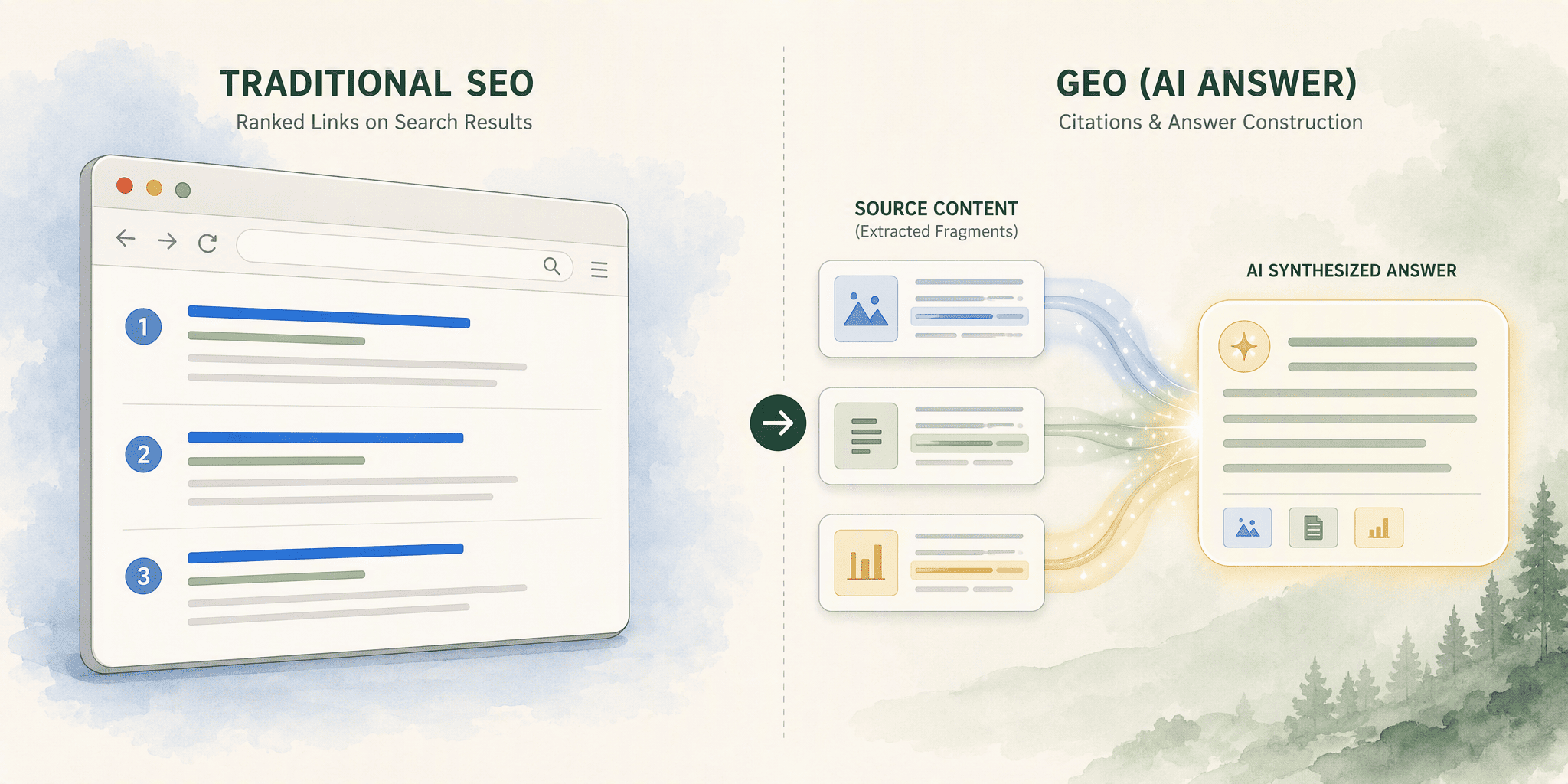
GEO acknowledges that AI models do not index content; they extract it to construct an answer. Understanding this extraction mechanism reveals the strategic gap between old and new paradigms.
| Dimension | Traditional SEO | Generative Engine Optimization (GEO) |
|---|---|---|
| Primary Objective | Rank a webpage in a list of blue links on a search engine results page (SERP). | Be the cited source or recommended entity within a generated conversational answer. |
| Core Mechanism | Crawling, indexing, and ranking pages based on keywords, backlinks, and domain authority. | Probabilistic generation models that cite sources based on structured context, semantic relevance, and source authority. |
| Success Signals | Click-through rate, organic page views, and keyword positions. | |
| Data Requirement | Optimized meta tags, keyword density, and backlink profiles focused on crawl efficiency. | Real-time, accurate structured data (JSON-LD), clear semantic context that parses cleanly for LLM ingestion. |
| Risk Profile | A drop in rank reduces visibility but the page remains discoverable via direct navigation or other queries. | A hallucinated or inaccurate citation can permanently misrepresent a product to a high-intent shopper. |
The distinction goes beyond a change in surface-level tactics. Brands now deal with new problems in managing their reputations, connecting with customers, and competing, similar to the adaptation required during the rise of e-commerce. A strategy that prioritizes keyword rankings but neglects structured product schema leaves a retailer invisible to agents that are autonomously discovering products, negotiating promotions, and completing secure checkouts on a customer's behalf.
The Tools and Platforms Powering AI Product Recommendations in 2026

The current tooling landscape splits between infrastructure protocols that establish the commerce rails and optimization platforms that prepare the content. NVIDIA has built one of the more detailed infrastructure blueprints available. The framework coordinates four specialized agents: promotion pricing for dynamic offers, ARAG recommendations that ground cross-selling in real inventory, semantic search for intent-aware discovery, and multilingual messaging for post-purchase. All of these operate under merchant authority.
A delegated payment system keeps every agent action, from price negotiation to checkout, within the merchant's business logic. Pricing, inventory, and compliance stay under the same roof they always have. This architecture moves online shopping from human-driven browser sessions to AI agents that autonomously discover products on a customer’s behalf.
On the optimization side, platforms like Siftly take a GEO-first approach by reading and optimizing feed-level pricing directly from Google Merchant Center. The platform tracks how AI systems discover, evaluate, and cite content across major conversational AI platforms, then rolls that into a competitive intelligence benchmark for marketing teams. Its Starter tier begins at $79 per month, giving a team direct access to the prompts shoppers type into AI before a purchase decision, plus visibility uplift measured against competitors. A tool like Blazly GEO functions as a full-stack option to help brands appear inside ChatGPT, Gemini, Claude, and Perplexity.
The key selection criterion between these tools is the difference between building commerce protocols and optimizing content layers. The NVIDIA Blueprint creates the new commerce layer where AI agents act as intelligent intermediaries, connecting shoppers to products through natural-language interactions. Complementary optimization platforms ensure that the structured data funneled into those protocols renders the product as the first and most accurate citation, rather than a generic category recommendation.
Content Formats and Structured Data That AI Models Cite Most
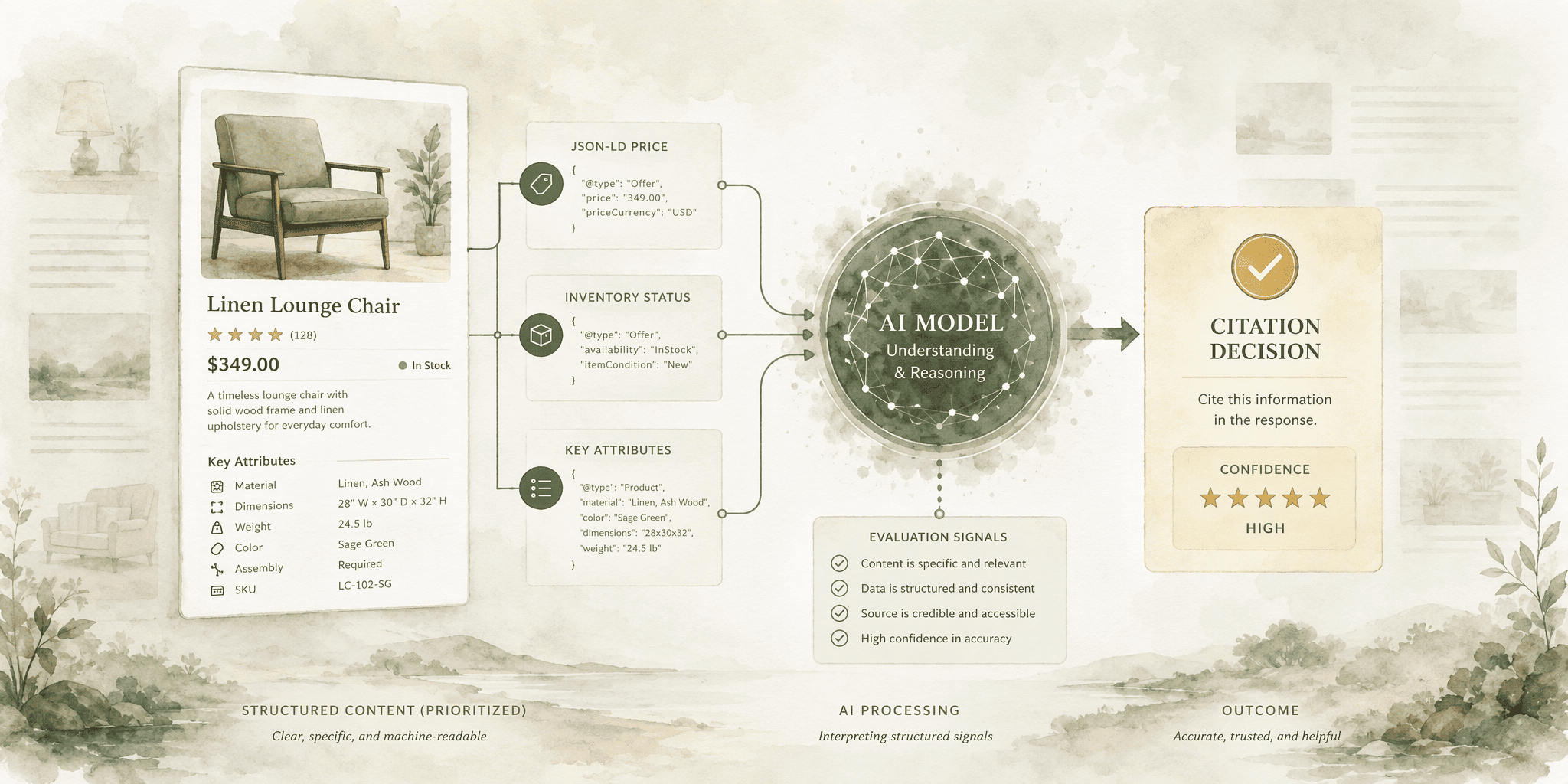
AI search engines don't index content, they extract it. And the extraction process discriminates brutally against unstructured product pages. AI models cite products that supply unambiguous, machine-readable signals about what is being sold, at what price, with what stock status.
Real-time pricing and inventory structured data via JSON-LD matters because a model needs to verify availability and current cost on the spot. If it can't, it defaults to a source it trusts more. The schema requires precise Offers, aggregateRating, and shippingDetails properties. Without them, an agent will guess a price or a shipping window, and that guess becomes the answer the user sees.
Intent-aware Q&A content handles the third layer. Conversational AIs match user prompts against content that looks like a question followed by a direct answer. A FAQ section with structured markup catches the exact long-tail prompts shoppers type: "does this product work with a USB-C adapter" or "what is the return window for this item."
That markup moves a standard feature list into a citable answer snippet. The highest-impact schema for AI Overviews are FAQ and How-To. A 10-point improvement in citation rate is a realistic 6-month target for brands making active GEO investments.
How to Identify the Product Prompts Shoppers Are Asking ChatGPT
Optimizing content without knowing which prompts the market is using is guesswork. The most effective method for marketing teams is to analyze semantic search agent logs, which reveal the unfiltered natural-language queries that lead shoppers to, or away from, a category.
- Aggregate Query Data: Deploy a visibility monitoring platform that collects natural-language prompts from AI models over time. A single-point check is unreliable because AI responses vary, so build a baseline using a scheduled sampling tool that captures frequency patterns across hundreds of daily queries.
- Cluster Intent Logically: Categorize the collected prompts by decision stage, not just by product type. Group queries into intent buckets such as general discovery, comparative evaluation, and purchase-readiness. For example, separate a "best headphones" query from a "Sony WH-1000XM6 next-day delivery" query.
- Map Content to Queries Directionally: Match each intent cluster to a specific content format. Prompts seeking comparisons should point to semantically marked-up comparison content, not just product pages. Use a tool like Siftly, for instance, to see the prompts shoppers ask AI before they decide what to buy, and align content assets to the exact phrasing the models see. The free tools that Siftly offers can provide a directional snapshot of which queries lead AI to surface competitors over your brand.
The Metrics That Prove ROI on AI-Driven Product Discovery

Traditional analytics miss agent commerce completely, because a server-side API call to a product feed does not fire a browser tracking pixel. The primary corrective metric is AI referral traffic share.
The second key metric, agent-driven transaction volume, connects visibility directly to revenue. Measuring this requires correlating orders filtered by a source attributed to agent API calls against the total transaction count. The GEO ROI chain includes inputs, leading metrics, traffic, and outcomes.
Inputs are structured data completeness and freshness. A product catalog accuracy score quantifies the fidelity of feed-level data (price, stock, description accuracy) that agents consume relative to the merchant's source of truth. The output is the conversion rate on that traffic.
A directional approach to attribution maps a visibility spike for a term against the correlated volume of transactions for the products cited, providing a defensible, if not pixel-perfect, view of return.
A Realistic 12 to 24 Month Timeline for a GEO Initiative

A Deloitte survey found that [68% of executives are planning agentic AI deployment for operations] within 12 to 24 months. They aren't treating it as a distant experiment. The timeline reflects two parallel streams of work: one protocol layer integration and one content optimization sprint.
The first quarter should lay the infrastructure by integrating and testing the commerce protocol layer. That means deploying a blueprint supporting the Agentic Commerce Protocol so the AI agent can query live inventory and secure checkout flows under delegated merchant authority. At the same time, the content team initiates a full catalog schema audit, converting static descriptions into parseable, rich property sets.
By month six, a focused semantic content project should begin on the highest-value product lines. The team builds the intent-aware Q&A markup that models cite. By month eighteen, agent-log monitoring is fully operational.
The team now sees exactly where citations occur, tracks visibility uplift, and refines semantic descriptions based on what query clustering reveals about shifting demand patterns. A new initiative starting in 2026 should expect a baseline of structured-data visibility within ninety days. By month twelve, a measurable shift in category citation frequency.
Between months eighteen and twenty-four, conversion impact from AI-generated recommendations becomes clear. The first-mover advantage compounds because the recommendation engines rely on a relatively stable reference set of high-authority structured data. Establish authority in the first cohort of citation-worthy sources, and displacing an incumbent gets significantly harder after the agent's confidence in a product node solidifies.
Conclusion
Agentic commerce is a traffic shift that is already underway. The 15 to 20 percent of referral volume originating from AI conversations means strategic advantage is moving from page rank to prompt citation.
The immediate next step is an audit of your product catalog's accuracy. The best marketing copy doesn't matter if an AI agent cannot verify real-time inventory and structured pricing through a delegated commerce protocol. It will simply recommend a competitor whose data it can read.
The technical work needs 12 to 24 months. That clock starts now, and it starts with fixing your structured data.
Frequently Asked Questions
What types of tools and platforms exist to optimize content for AI-generated recommendations like those from ChatGPT?
Tools split into commerce protocols and content optimization platforms. The NVIDIA Agentic Commerce Blueprint provides ACP/UCP protocol infrastructure for secure transactions. Optimization platforms like Siftly and Blazly GEO focus on structured data, citation tracking, and competitor benchmarking to earn AI model citations and visibility.
How does generative engine optimization (GEO) differ from traditional SEO when aiming for inclusion in AI product suggestions?
Traditional SEO aims for a top SERP ranking via keywords and backlinks. GEO focuses on being the singular cited source inside a generated answer. It prioritizes structured, real-time product data like JSON-LD markup that LLMs can ingest and reference accurately.
What specific content formats and structured data have the highest impact on being cited by conversational AI models?
Real-time inventory and pricing JSON-LD product schema has the foundational impact. Semantic product descriptions and FAQ and How-To content marked up with structured data are also high-impact. These feed models precise, citable answers to commercial prompts.
What key metrics should brands track to measure the ROI of optimizing for AI-driven product discovery?
Track AI referral traffic share to quantify the channel shift. Measure agent-driven transaction volume with a directional attribution model. Score product catalog accuracy for feed price and inventory fidelity. These connect infrastructure reliability to revenue outcomes.
How can marketing teams identify the product-related prompts shoppers are actually asking AI platforms?
Use AI visibility monitoring tools to capture natural-language prompts across conversations. Avoid single-point checks. Collect a broad dataset, then cluster queries by shopper intent stage, not just product name. Align content directly to the extracted phrasing.
What is a realistic timeline and expected outcome for a new generative AI optimization initiative in 2026?
A realistic roadmap spans 12 to 24 months. Expect structured-data visibility in ninety days, a measurable shift in category citation frequency by month twelve, and conversion impact from AI recommendations between months eighteen and twenty-four. Initial schema auditing delivers the first signal.
Sources
- 8 Solutions to Optimize Content for ChatGPT Shopping (2026) - siftly.ai
- Pricing — Siftly - siftly.ai
- How Brands Can Adapt When AI Agents Do the Shopping - hbr.org
- When AI Becomes the Buyer: How Agentic Commerce is Reshaping Retail - WSJ - deloitte.wsj.com
- Agentic Commerce | AI Shopping Agents Under Merchant Control | NVIDIA Use Cases - www.nvidia.com
Keep exploring
More from the blog.

Oct 23, 2026
How to Optimize Your Brand Presence in Generative AI Search Results
The uncanny silence of organic traffic in analytics dashboards isn't a tracking bug; it's the sound of a fundamental shift.

Oct 23, 2026
The 527% Traffic Shift That Makes Enterprise GEO Software a Boardroom Mandate
Your organic search traffic just fell off a cliff. It dropped 27% year-over-year, and your traditional SEO dashboard offers zero explanation.

Oct 23, 2026
How to Get Real-Time Alerts When Competitors Change Their Messaging
A quiet update to a competitor's homepage can rewire how AI search engines frame your entire category in under 48 hours.