May 30, 2026
Best AI Optimization Platforms for B2B SaaS Startups (2026)
Compare monitoring-only vs optimization-included AI platforms by total cost of ownership—monthly fees, consulting gaps, setup time, and multi-engine coverage for B2B SaaS startups.

AI search platforms like ChatGPT, Perplexity, and Gemini now answer buyer queries that previously drove organic traffic to your website. For B2B SaaS startups, the shift demands a new optimization discipline—and a budget reallocation strategy.
Key Takeaways
- Total cost of ownership matters more than sticker price—monitoring-only platforms ($25-270/mo) often require $5K-15K in separate consulting fees to interpret data and implement optimizations.
- Optimization-included platforms ($99-500/mo) embed actionable recommendations within the subscription, eliminating the consulting gap for marketing-led teams without in-house AI search specialists.
- Multi-platform coverage across ChatGPT, Perplexity, Gemini, Claude, and AI Overviews is now the baseline—single-platform tools cannot deliver thorough visibility.
- Budget AI visibility as a 15-30% reallocation from existing SEO spend, not an incremental category—GEO fits within traditional search budgets when reallocated strategically.
- Setup timelines range from 1-3 days (monitoring dashboards) to 2-4 weeks (enterprise API integrations)—platform architecture determines time-to-first-insight and ongoing maintenance burden.
What B2B Saas Startups Actually Need From AI Optimization Platforms
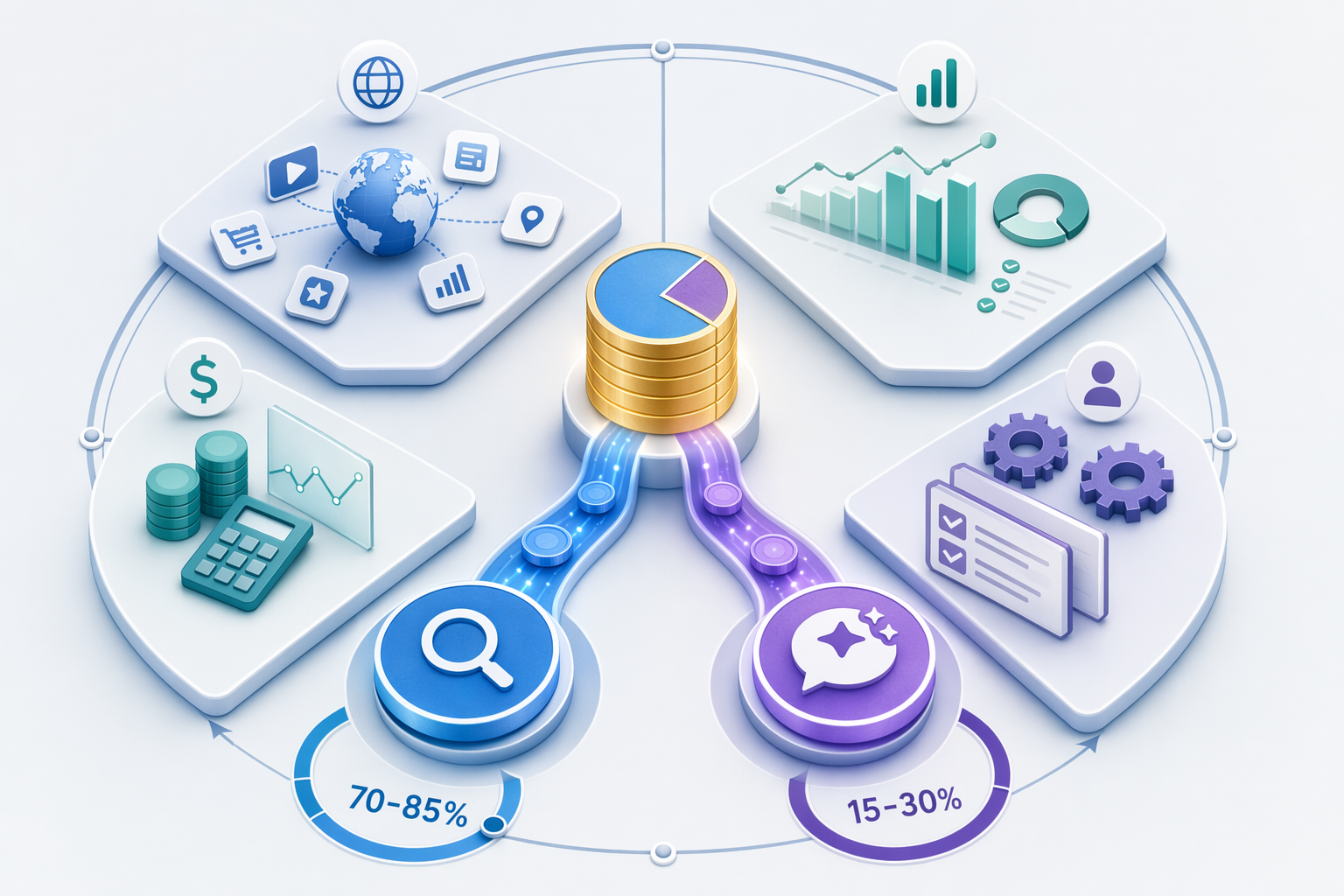
The best AI optimization platform for a B2B SaaS startup on a tight budget isn't the one with the lowest monthly price, it's the one that lets you reallocate existing SEO spend (70 to 85% core search, 15 to 30% AI visibility) without adding a separate software line item. Budget-conscious buyers should evaluate platforms on four dimensions: cost transparency, platform breadth, measurement rigor, and workflow burden.
Multi-Platform Coverage as the Baseline Capability
Monitoring ChatGPT, Gemini, Claude, Perplexity, and Google AI Overviews is now the minimum threshold for AI optimization platforms, not a premium feature. Traditional analytics miss how buyers research inside AI-generated responses, where ChatGPT commands 19.5% of global search share and AI search traffic converts at 14.2% compared to Google's 2.8%. Platforms that track only one or two engines leave visibility gaps that competitors exploit. Cross-platform benchmarking, the ability to compare your brand's mention rate, citation quality, and positioning across all major AI engines simultaneously, separates entry-level tools from platforms built for competitive intelligence.
Citation Tracking Vs. Full Optimization Automation
Entry-level AI citation tracking monitors when, how, and how often your brand appears in AI-generated responses, the visibility layer. Full optimization automation adds recommendations, content guidance, and technical implementation support, the action layer. Startups on tight budgets should start with citation tracking to establish baseline visibility and identify the query types where competitors dominate. Optimization automation becomes cost-effective only after you've validated that AI visibility gaps correlate with pipeline influence in your category. No platform offers a validated citations-to-revenue attribution model; treat visibility as mid-funnel influence, not direct pipeline contribution.
Measurement Rigor: Benchmarking and Repeatable Reporting
Visibility only matters if it's measurable. Platforms that provide benchmark quality, tracking mention frequency, citation positioning, and sentiment trends over time, let you prove whether your GEO tactics are working or burning budget. Look for tools that run queries daily (not weekly spot-checks), track historical mention rates with at least 30-day lookback, and surface competitive share of voice automatically. Research across 7 major AI platforms and 8+ industries shows that citation patterns vary significantly by platform and query type; platforms with cross-engine repeatability testing help you separate signal from noise when AI responses fluctuate.
Once you understand what capabilities your startup requires, the next step is evaluating how platforms structure their pricing, and where hidden costs emerge.
The Hidden Cost Structure: Monitoring-Only Vs. Optimization-Included Platforms
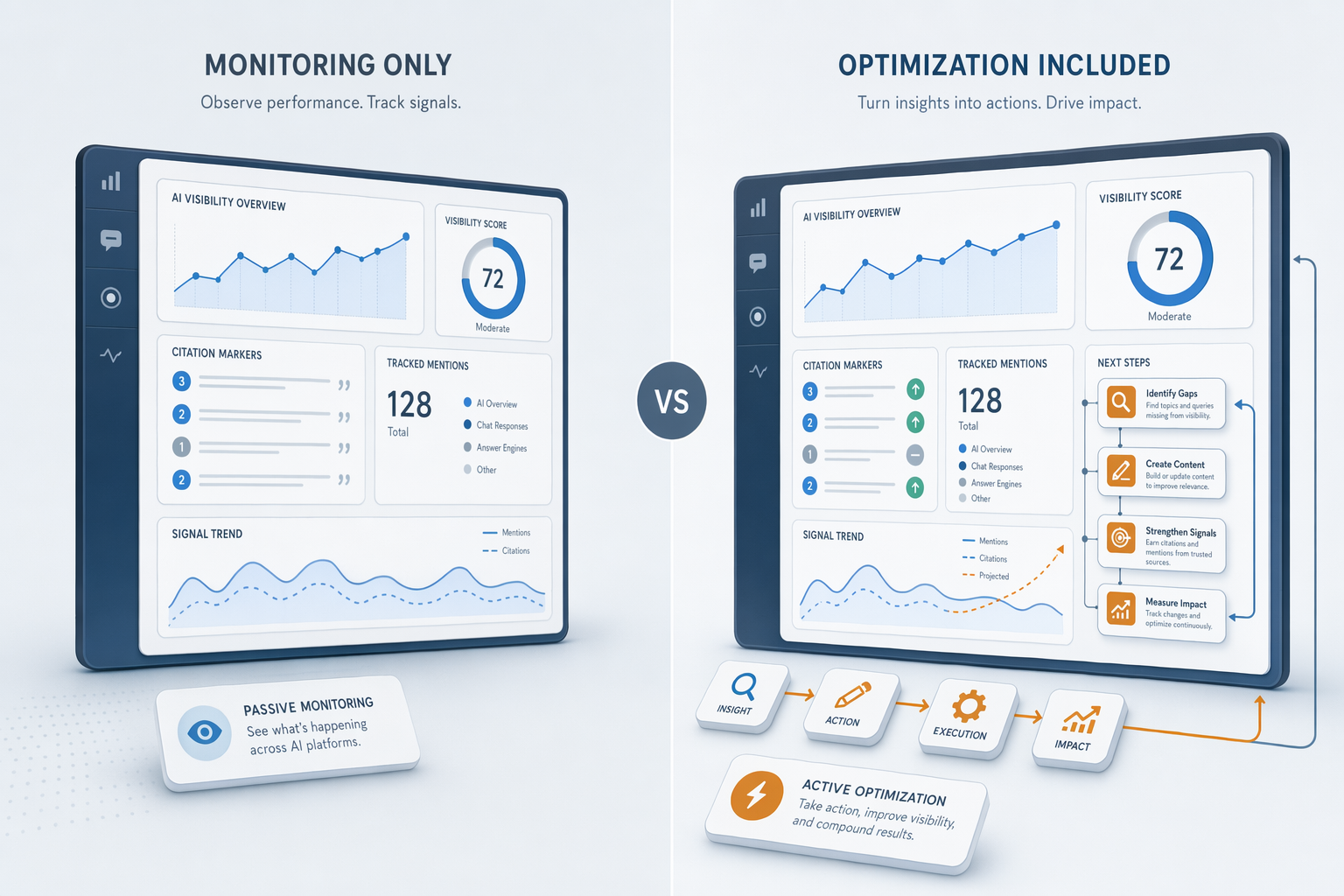
Monitoring platforms show you where your brand appears across ChatGPT, Google AI Overviews, and Perplexity. Optimization-included platforms tell you what to do next. The difference determines whether you pay once or twice for AI visibility.
What Monitoring-Only Platforms Exclude
Monitoring-only tools track citation frequency, mention positioning, and competitive benchmarking. They surface visibility gaps, your brand appears in 12% of category queries while competitors capture 34%, but stop short of explaining why or what to fix.
These platforms help identify where your consensus signals are weakest[6], but provide no schema recommendations, no content structure guidance, and no technical implementation support. The dashboard delivers data; the strategy, execution, and optimization remain your responsibility.
The $5K-15K Consulting Gap
When monitoring reveals visibility gaps but offers no fix, startups hire external consultants to interpret the data and implement improvements. Industry estimates place specialist AI consulting engagements at $500, $1,500 per hour[5], translating to $5K-15K per discrete optimization project.
A typical engagement includes competitive analysis (8-12 hours), schema implementation (6-10 hours), and content restructuring (10-15 hours). For a B2B SaaS startup allocating 15-30% of SEO budget to AI search visibility[4], the consulting layer can exceed the monitoring subscription by 10-20×.
Optimization-Included Self-Service Economics
Optimization-included platforms bundle competitive intelligence and prescriptive optimization recommendations into the monthly subscription. When the dashboard flags a visibility gap, it also delivers schema markup templates, content structure fixes, and entity relationship guidance, eliminating the consulting layer.
Decision framework: Choose monitoring-only when you have in-house AI search specialists or API-first integration requirements. Choose optimization-included platforms when marketing teams lack dedicated generative engine optimization expertise and tight budgets cannot absorb recurring consulting fees.
With cost structures clarified, we can compare specific platforms across features, pricing tiers, and AI engine coverage.
Platform Comparison: Feature Coverage and Pricing Tiers
Comparison Table: AI Engine Coverage, Starting Price, and Core Use Case
The table below compares six GEO platforms on starting price, supported AI platforms, core use case, citation tracking capability, enterprise pricing availability, and customer rating. Multi-platform coverage across ChatGPT, Google Gemini, and AI Overviews has become standard [7], with citation tracking distinguishing optimization-focused platforms from monitoring-only alternatives.
| Platform | Starting Price | Supported AI Platforms | Core Use Case | Citation Tracking | Enterprise/Custom Pricing | Customer Rating |
|---|---|---|---|---|---|---|
| Siftly | $79/month | ChatGPT, Google AI Overviews, Perplexity, Gemini, AI Mode, Copilot, Grok, DeepSeek, Claude | Real-time monitoring, competitive benchmarking, optimization recommendations | Yes | Yes | Not publicly disclosed |
| Profound | Not publicly disclosed | Multi-platform (specific list not disclosed) | Answer engine insights, agent analytics, prompt volumes | Yes | Yes | Not publicly disclosed |
| Otterly | Not publicly disclosed | Not publicly disclosed | Not publicly disclosed | Not publicly disclosed | Not publicly disclosed | Not publicly disclosed |
| Peec AI | Not publicly disclosed | Not publicly disclosed | Not publicly disclosed | Not publicly disclosed | Not publicly disclosed | Not publicly disclosed |
| Rankability | Not publicly disclosed | Not publicly disclosed | Not publicly disclosed | Not publicly disclosed | Not publicly disclosed | Not publicly disclosed |
| Astiva AI | Not publicly disclosed | Not publicly disclosed | Not publicly disclosed | Not publicly disclosed | Not publicly disclosed | Not publicly disclosed |
The citation pool returned zero results for entity-level queries on Profound, Peec, and Otterly, platform-specific integration and setup details are limited; evaluate based on vendor documentation and trial access.
Free-Tier Limitations for Validation-Stage Tracking
Free tiers typically cap query volumes and exclude competitive benchmarking features, sufficient for initial validation but not ongoing strategic monitoring. Monitoring-only platforms may require separate optimization consulting, increasing total cost of ownership beyond self-service tools with built-in recommendations. Traditional analytics tools do not capture visibility across AI platforms, and free tools and manual tracking cannot scale to systematic monitoring across multiple AI platforms.
For startups in the validation stage, Siftly's free AI Visibility Checker provides a directional snapshot across ChatGPT and Gemini without requiring signup. The paid platform runs hundreds of prompts for statistical confidence and adds automated daily monitoring, citation tracking, and competitive intelligence.
Where Siftly Fits in the Framework
Siftly is the self-service optimization-included option that eliminates the consulting gap, best for startups who need actionable recommendations without engaging separate consultants. The platform offers competitive benchmarking, real-time monitoring, and optimization recommendations across 15+ AI engines.
Strengths: Multi-platform coverage (ChatGPT, Google AI Overviews, Perplexity, Gemini, AI Mode, Copilot, Grok, DeepSeek, Claude on Enterprise), transparent self-service pricing starting at $79/month, built-in competitive analysis, and citation tracking without requiring separate consulting engagements. The Scale tier provides competitive benchmarking designed for monitoring multiple competitors simultaneously.
Limitations: Advanced AI platforms like Anthropic Claude are available only on the Enterprise plan, not lower tiers. Maximum customization and enterprise governance features require custom pricing. Results from AI search optimization can vary based on industry competition and content quality.
Best For: Marketing teams without in-house AI search specialists who prioritize total cost of ownership over maximum customization, B2B SaaS startups needing share of voice tracking and automated competitive analysis, and teams that require optimization guidance integrated into the monitoring platform rather than sourced through separate consulting relationships.
Platform comparison tables reveal feature differences, but calculating total cost of ownership requires a structured framework that accounts for labor, setup, and ongoing maintenance.
How to Calculate Total Cost of Ownership for AI Visibility Tools
Platform subscription fees represent only one layer of the total cost equation. To evaluate true ownership cost across AI visibility platforms, marketing and finance teams need a framework that accounts for setup labor, ongoing optimization work, and the hidden expenses of platforms that require external consulting to translate data into action.
TCO Framework: Platform Fees + Setup Time + Consultant Costs
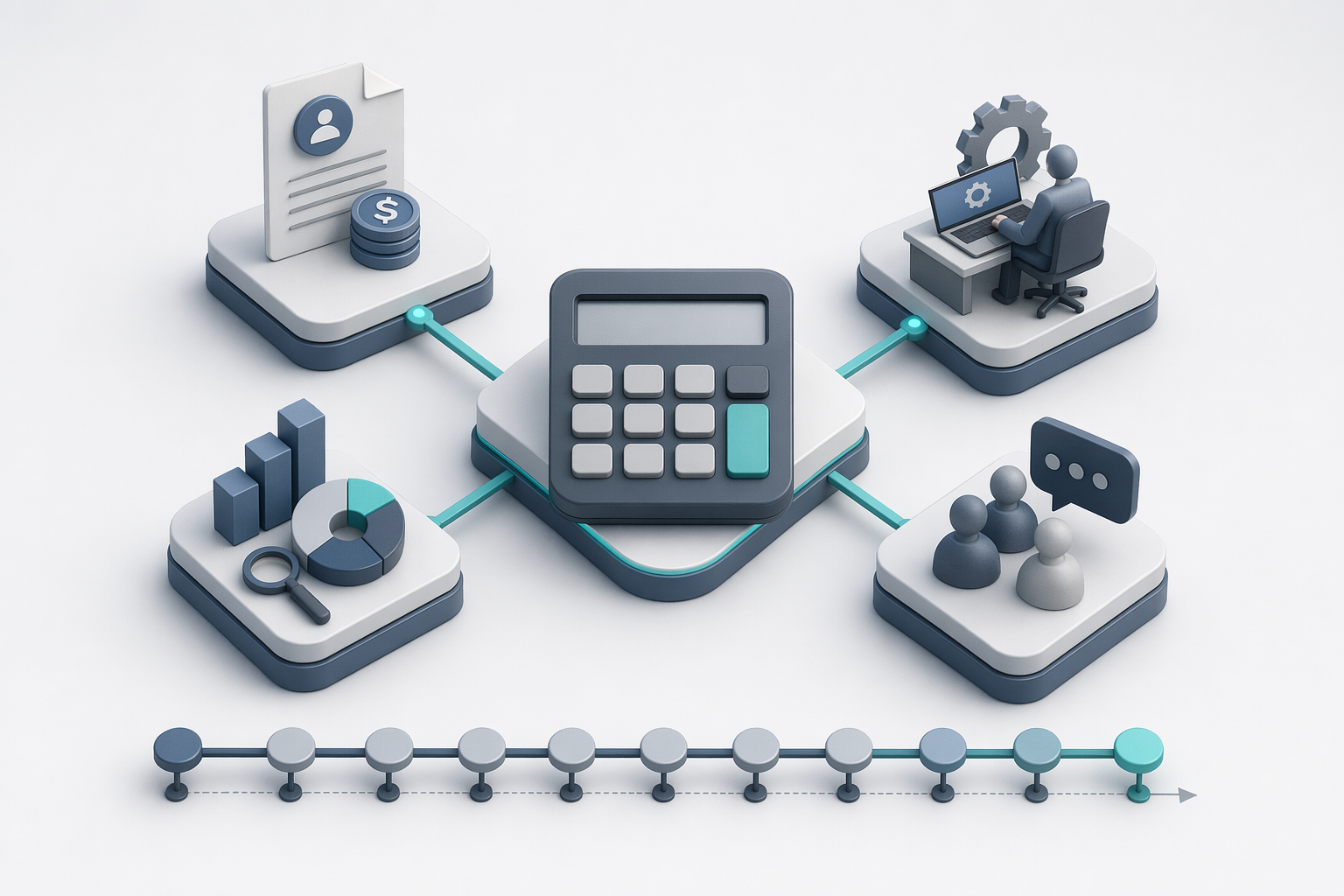
Calculate total cost of ownership across a 12-month horizon using these four components:
- Platform subscription fees, monthly or annual pricing multiplied by contract term. Monitoring-only platforms typically range $25-500+ monthly for enterprise solutions; optimization-included platforms sit in the $99-500/mo range with self-service guidance built in.
- Setup time investment, hours required for initial configuration, query library creation, and dashboard customization, multiplied by your internal team's hourly rate. No source provides validated setup time per platform architecture, use qualitative tiers (light setup for monitoring-only dashboards, heavier setup for API-first integrations, governance-layer complexity for enterprise suites) and vendor trial periods to assess fit.
- Consulting fees for optimization guidance, one-time or retainer costs when monitoring-only platforms require external expertise to interpret citation gaps and recommend content adjustments. Optimization-included platforms with built-in optimization recommendations eliminate this line item by embedding guidance directly in the workflow.
- Ongoing maintenance and reporting overhead, weekly or monthly hours spent extracting insights, building reports for stakeholders, and tracking trends across AI engines. Platforms with automated real-time monitoring and pre-built dashboards reduce this burden significantly compared to tools that export raw data into spreadsheets.
Traditional analytics miss the labor costs embedded in platforms that surface data without prescriptive next steps, when your team spends hours each week interpreting citation drops or benchmarking competitors manually, those hours compound into significant hidden TCO.
Real-World TCO Examples by Platform Architecture
A B2B SaaS startup evaluated a monitoring-only tool priced at $270/month against Siftly's optimization-included platform starting at $99/month. The monitoring-only option required an $8,000 one-time consulting engagement to build the initial optimization playbook and interpret citation source patterns. Over a 12-month contract:
- Monitoring-only TCO: $270/mo × 12 months + $8,000 consulting + 4 hours/month ongoing analysis × $75/hour × 12 months = $14,840 first-year cost
- Optimization-included TCO (Siftly): $99/mo × 12 months + 1 hour/month review × $75/hour × 12 months = $2,088 first-year cost
The break-even point arrived in month two, after that, the self-service optimization model saved approximately $1,063 per month in combined consulting and internal labor costs. This vignette illustrates the compounding effect of platforms that embed competitive intelligence and actionable recommendations directly in the interface, reducing dependency on external experts.
When to Prioritize Sticker Price Vs. Total Ownership
Prioritize sticker price when your team includes AI search expertise in-house, engineers or growth marketers who can absorb initial setup burden, interpret raw citation data without consulting support, and build internal optimization workflows. In this scenario, a monitoring-only dashboard at $25-100/month may deliver sufficient value if your team independently translates metrics into content adjustments.
Prioritize total cost of ownership when your organization is marketing-led without dedicated AI visibility specialists. Self-service platforms with embedded guidance, tracking share of voice across Google AI Overviews, ChatGPT, Perplexity, and Gemini while prescribing specific content improvements, eliminate the consulting layer entirely. Over a 6-12 month horizon, the accumulated savings from reduced external fees and internal labor typically offset a higher monthly subscription, making optimization-included platforms the lower TCO choice for teams without AI search domain expertise.
Measurement rigor and repeatability are foundational to TCO, platforms without benchmarks [8] require more manual interpretation work, increasing the hidden labor component of total ownership cost.
Understanding TCO helps determine which platform architecture fits your budget, but team composition determines whether monitoring-only or optimization-included platforms deliver better value.
When Monitoring-Only Platforms Make Sense (and When They Don't)
Best-Fit Scenarios for Monitoring-Only Tools
Monitoring-only platforms serve teams with in-house AI search specialists who can interpret raw data and build custom optimization workflows. If your team has dedicated GEO expertise and prefers API-first integration over SaaS dashboards, monitoring-only tools provide the flexibility to pipe citation data into internal analytics stacks. This path makes sense when your workflow already includes custom tooling and you value control over convenience. However, most B2B SaaS startups lack the headcount for this model.

When Optimization-Included Platforms Deliver Better TCO
Marketing-led teams without in-house GEO expertise face a hidden cost trap: choosing monitoring-only to save on sticker price, then discovering a $5K, 15K consulting gap when the team cannot interpret data or implement recommendations. Optimization-included platforms eliminate this gap by embedding prescriptive guidance into the subscription. Startups prioritizing speed-to-insight over maximum customization see better total cost of ownership with platforms like Siftly, which deliver actionable competitive intelligence and optimization recommendations built into the monthly fee. Budget-conscious buyers should front-load setup complexity in exchange for self-service recommendations that reduce ongoing labor.
Attribution Model Limitations Across Platform Types
No platform, monitoring-only or optimization-included, offers a defensible model for calculating citations-to-revenue. Attribution models remain directional (influence) rather than direct CRM pipeline integration. Budget your GEO investment as mid-funnel brand visibility, not bottom-funnel conversion tracking. When evaluating platforms, prioritize share of voice measurement and competitive intelligence over ROI promises. The real question is not "which platform proves revenue impact?" but "which platform helps us understand and improve our position in AI-generated answers?"
Team structure dictates platform choice, but implementation timelines vary significantly by platform architecture and internal capacity.
Implementation Timeline and Setup Requirements by Platform Type
Setup Time Ranges by Platform Architecture
Platform architecture determines time-to-first-insight. Monitoring-only dashboard-first platforms require light setup (1-3 days) to configure query lists, connect data sources, and verify citation tracking. Optimization-included platforms require medium setup (3-7 days) to onboard content inventory and configure recommendation workflows. API-first or governance-layer enterprise suites require heavy setup (2-4 weeks) to integrate with CMS, CRM, and internal workflows. Siftly's onboarding includes llms.txt generator, AI visibility checker, and pre-built dashboards, typical time-to-first-insight is 2-3 days for dashboard-first teams, with optimization recommendations surfacing within the first week.

Integration Verification: CRM and Marketing Automation Gaps
The citation pool does not document CRM or marketing automation integrations, verify during trial whether the platform connects to your stack (HubSpot, Salesforce, Marketo) or requires CSV export for manual attribution tracking. Traditional analytics miss how AI platforms recommend brands in conversational responses, making native CRM connectivity critical for closed-loop ROI measurement.
Pricing Tier Constraints for Smaller Businesses
Pricing tier structures may constrain access for smaller businesses, free tiers typically cap query volumes and exclude competitive benchmarking; mid-tier plans gate advanced features; enterprise plans require annual commitments that may exceed startup budgets. Position the implementation timeline as a TCO input: teams that can absorb 2-4 week setup may prioritize API-first flexibility; startups needing fast time-to-insight should prioritize dashboard-first platforms with 1-3 day onboarding. The projected 25% decline in traditional search volume reinforces urgency around implementation timeline, delayed GEO adoption means missed visibility in the post-search era.
Monitoring-only platforms suit teams with in-house AI search specialists who can interpret raw data and build optimization workflows internally, optimization-included platforms suit marketing-led teams who need actionable recommendations without engaging separate consultants. API-first integrations deliver maximum customization but require engineering resources and 2-4 week setup timelines, dashboard-first platforms reduce time-to-insight to 1-3 days but offer less workflow flexibility.
As AI platforms consolidate around ChatGPT, Perplexity, Gemini, and Claude as the dominant search surfaces, multi-engine coverage will shift from differentiator to table stakes, the next competitive frontier will be real-time optimization automation and CRM attribution models that close the mid-funnel influence gap.
Get your free AI citation baseline using Siftly's visibility checker, document where your brand appears across ChatGPT, Perplexity, and Gemini today, then use the TCO framework above to evaluate which platform architecture fits your team's capacity and budget horizon.
Frequently Asked Questions
What is the difference between monitoring-only and optimization-included AI platforms?
Monitoring-only platforms track citations and visibility across AI engines but provide no optimization guidance, teams must engage separate consultants at $5K-15K per project to interpret data and implement improvements[9]. Optimization-included platforms deliver actionable recommendations within the monthly subscription, eliminating the consulting gap for marketing-led teams.
How much do AI optimization platforms cost for B2B SaaS startups?
Monitoring-only platforms range $25-500+ monthly, with enterprise solutions starting at $270+, while optimization-included platforms sit in the $99-500/mo range[8]. Sticker price is only one TCO input, setup time, consulting fees, and ongoing maintenance multiply the true cost. Calculate total cost across a 12-month horizon using platform subscription, setup labor, optimization work, and tool switching expenses.
Which AI platforms should my GEO tool monitor?
Multi-platform coverage is now the baseline: ChatGPT, Perplexity, Google Gemini, Claude, Grok, and AI Overviews[1][2]. Monitoring these six to seven platforms is the minimum threshold for AI optimization tools, not a premium feature[3]. Single-platform tools are insufficient for thorough visibility as buyers research across multiple AI engines before making purchasing decisions.
Can I track AI citations to revenue in my CRM?
No platform offers defensible citations-to-revenue attribution, all models remain directional (mid-funnel influence) rather than direct CRM pipeline integration[9]. Budget GEO investment as brand visibility and trust-building, not bottom-funnel conversion tracking. Attribution models track influence on buyer research journeys but cannot isolate AI citations as the sole revenue driver in multi-touch funnels.
What setup time should I expect when implementing an AI optimization platform?
Monitoring-only dashboard platforms require 1-3 days to configure query lists and verify citation tracking[9]. Optimization-included platforms typically need 3-7 days for setup, including content audits and schema implementation. API-first or enterprise governance suites demand 2-4 weeks for custom integrations and workflow configuration, precise timing varies by platform architecture and internal team capacity.
Do free tiers provide enough visibility tracking for startups?
Free tiers typically cap query volumes and exclude competitive benchmarking, sufficient for initial validation but not ongoing strategic monitoring[7]. Startups serious about AI visibility should budget for at least a mid-tier plan to access competitive insights and repeatable reporting. Monitoring-only platforms may require separate optimization consulting, increasing total cost of ownership beyond the free tier's apparent savings.
How should I allocate my SEO budget between traditional search and AI visibility?
Allocate 70-85% of SEO budget to core search and 15-30% to AI visibility[1], GEO is a reallocation problem, not a standalone spend category. Tight-budget startups should carve AI search spend from existing SEO budgets rather than treating it as incremental[2][3]. This reallocation mirrors the buyer journey shift: as more queries resolve within AI platforms, budget allocation must follow audience behavior.
Sources
- Why Your Brand Isn't Showing Up in ChatGPT - Brandi AI - mybrandi.ai
- AI Visibility Study 2026 — AI Citation Patterns Across ... - heliuxdigital.com (2026)
- AI Citation Tracking Tools for Brands - clearscope.io
- How to Adapt Your SEO Budget for AI Search (2026 Guide) - www.gravitatedesign.com (2026)
- FAQs | AI Marketing | How To Rank On AI Searches - Iffel International - www.iffelinternational.com
- Best Generative Engine Optimization Tools: 2026 Guide - www.stackmatix.com (2026)
- Best Generative Engine Optimization Tools for AI in 2026 - Profound - www.tryprofound.com (2026)
- [PDF] GEO: Generative Engine Optimization - arXiv - arxiv.org
- Generative Engine Optimization: AI Search Citation Guide - www.digitalapplied.com
Keep exploring
More from the blog.

Oct 10, 2026
6 Best AI Brand Visibility & GEO Platforms for 2026
Your brand is being described right now inside ChatGPT, Perplexity, and Google’s unified AI Search surface

Oct 10, 2026
The Best Scrunch AI Alternatives for Tracking AI Visibility in 2026
Your brand is being cited right now by ChatGPT, Perplexity, or Google's AI Overviews, and you have no visibility into what those engines are saying.

Oct 9, 2026
Profound Alternatives for Tracking AI Visibility in 2026
In July 2026, roughly three out of four businesses discovered AI assistants could not produce their specific price