Oct 8, 2026
How to Track Competitor Pricing Changes Without Constantly Checking Their Websites
Checking competitor websites manually is a slow, error-prone drain on your team’s most valuable resource: time.

Introduction
Checking competitor websites manually is a slow, error-prone drain on your team’s most valuable resource: time. Every hour spent refreshing product pages is an hour not spent on strategic decisions that actually protect your margins. The breakneck pace of e-commerce in 2026 has turned daily manual checks into a losing strategy; by the time you spot a change, you have already lost sales.
The alternative is a proactive intelligence system that automatically collects, filters, and pushes actionable data directly to you. Modern automated price monitoring eliminates the drudgery of manual URL checks by replacing them with web scrapers, API integrations, and AI-driven alerting platforms. Pricefy, trusted by 10,000+ eCommerce businesses, and tools like RivalProbe, which sends clear movement reports before pricing changes cost you sales, represent the standard solution set now available.
This guide moves you from reactive checks to a scalable monitoring engine. You will learn how to deploy web scrapers, weigh AI platforms against traditional tools, choose a budget-friendly stack, monitor every sales channel from one dashboard, and integrate alerts directly into your repricing workflow.
Key Takeaways
Here are the core operational standards you need to build a modern competitor price tracking system that scales with your catalog:
- Automation is non-negotiable: Manual checks cannot keep pace with competitors who adjust prices multiple times daily across thousands of SKUs.
- The two-tool model: Price monitoring tools fall into two camps, traditional scrapers that check specific URLs at set intervals and AI-driven platforms that contextualize anomalies.
- Concrete cost benchmark: Hosted tools can monitor up to 50 competitor products for under $100 per month, pairing daily checks with free notification services like Zapier to keep startup costs minimal.
- Key feature checklist: Your platform must monitor across Amazon, eBay, Walmart, and direct-to-consumer sites simultaneously, flagging both sudden drops and gradual trends.
- 15-minute detection standard: Effective platforms push detection-to-alert notifications in under 15 minutes, enabling a response while the market window is still open.
Step 1: Automate Data Collection with Web Scrapers and API Integrations

The technical foundation of price tracking boils down to two methods: web scraping and structured API integrations.
- Web scraping: uses automated bots to crawl competitor pages and extract displayed prices; you can build a custom script using a open-source ecommerce price monitor from GitHub or deploy a pre-built hosted connector like those on Apify, with the open-source route providing total control over scraping logic but demanding ongoing maintenance to handle anti-bot countermeasures; Pricefy uses anti-detection scraping technology that mimics regular browser behavior to avoid detection.
- API integrations: pull structured pricing data directly from marketplaces or data providers, bypassing HTML parsing, and are cleaner and more reliable for platforms like Amazon that provide API endpoints, though they often come with usage fees and rate limits.
- Prerequisite mapping: identifying every competitor product URL and corresponding SKU, Pricefy tracks 80 million product URLs, treating every variant as a separate data point with its own price history.
Step 2: Select Your Intelligence Arsenal: AI-Driven Platforms vs. Traditional Scrapers

Traditional scrapers and AI-driven platforms solve fundamentally different problems. Understand which one fits your operation before committing budget. Start with these decision criteria:
- Define the business question first: If you only need to know when a specific SKU drops below your price, a traditional scraper that checks a URL every six hours is sufficient.
- Assess the cost of missed context: Traditional scrapers log raw numbers. AI-driven platforms like RivalProbe send movement reports that contextualize the change, predicting whether a temporary promotion signals a permanent cost-impacting shift.
- Evaluate anomaly detection needs: AI platforms flag anomalies that a threshold-based scraper misses, such as a competitor quietly testing a new price point on a variant before rolling it across the entire product line.
- Budget for the intelligence premium: AI-based platforms offer superior anomaly detection at a higher subscription cost. If your catalog exceeds a few hundred SKUs, the subscription tier jumps considerably.
- Consider your response cadence: A scraper delivers a spreadsheet. An AI platform like RivalProbe delivers a prioritized action list before the pricing change costs you sales.
Step 3: Choose a Cost-Effective Solution Tailored to Your Business Size
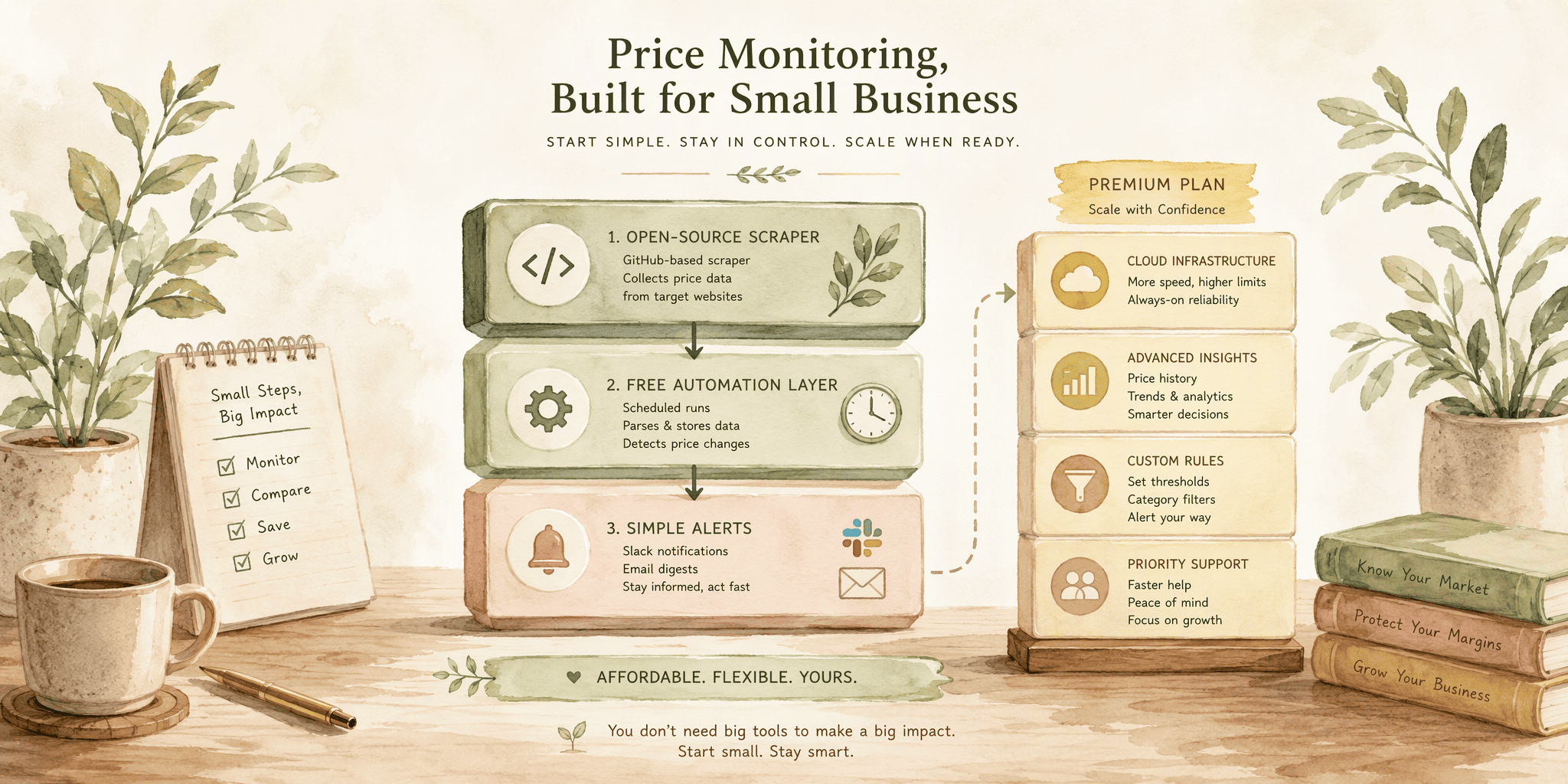
Small businesses can build a fully functional price monitoring stack without breaking the $100 per month mark. The key is matching your feature appetite to the reality of your SKU count and competitive landscape.
The lean startup stack pairs an open-source scraper from GitHub with a free Zapier account to push notifications to Slack or email. This combination lets you track 20 to 50 competitor products with daily checks while spending nothing on software. Pricefy offers a free forever plan for up to 50 SKUs across 5 competitors, with daily price updates and AI automatch included, making it a zero-cost entry point for testing automated monitoring.
Stepping up to a hosted tool that monitors 50 competitor products for under $100 per month buys you anti-detection infrastructure, variant-level tracking, and cross-channel coverage without the maintenance headache. These platforms prioritize key features like daily checks and alert integrations while forgoing expensive AI anomaly detection modules that a smaller catalog rarely needs.
Scale your spending in lockstep with catalog growth. Start with daily checks on your top 20 competitors, add cross-channel coverage when you expand to a second marketplace, and introduce AI-driven contextual alerting only when the volume of raw price changes becomes too noisy for a human to triage. A measured investment now prevents you from paying for intelligence features you are not yet equipped to act on.
Step 4: Achieve Unified Visibility Across All Sales Channels and Geographies
Effective competitor price monitoring pulls data from every channel a competitor sells on into one dashboard. A single-pane view across Amazon, eBay, Walmart, and direct-to-consumer sites prevents the blind spots that manual checking inevitably creates.
| Feature | Traditional Single-Source Scraper | Multi-Channel Hosted Platform |
|---|---|---|
| Marketplaces | Usually configured for one domain at a time | Monitors Amazon, eBay, and Walmart simultaneously as a baseline capability |
| Direct-to-Consumer Sites | Requires separate scrapers for each URL structure | Handles varied site architectures and checkout flows in one workflow |
| Geography Support | Limited to the locale of the configured scraper | Multi-geography support detects localized pricing strategies and gray market sellers |
| Data Silo Risk | High, each channel tracked in isolation with no cross-referencing | Low, unified pricing dashboard correlates moves across channels |
| Variant Tracking | Rarely tracks variants as separate data points | Treats every product variant, size, color, storage, as a data point with its own price history |
Multi-geography monitoring catches gray market sellers who undercut domestic pricing by listing on international marketplaces. A tool that tracks only your home market misses the distributor selling your competitor's product at a 30 percent discount from another region. Cross-channel visibility captures these threats before they erode your margin. You spot patterns like a competitor quietly testing a price increase on their DTC site while holding steady on Amazon.
Step 5: Identify and Configure the Non-Negotiable Platform Features

Your platform selection lives or dies on a handful of operational features.
- Configurable alert thresholds, sub-15-minute detection-to-alert speed, and trend flagging form the baseline; any tool requiring a dashboard login to discover a price change has already failed, the alert must push to you via Slack, email, or API webhook the moment detection happens.
- Trend flagging catches gradual moves that threshold alerts miss; a competitor dropping a price by two percent every week for a month never triggers a single large-change alert, but the pattern devastates your market position, Pricefy tracks every variant as a separate data point with its own price history, providing the granular timeline required to surface slow-rolling competitive shifts.
- API access turns monitoring from a read-only dashboard into a command center for your e-commerce stack; direct integration with Shopify and Magento lets you pipe competitor data into your pricing engine and trigger automated repricing rules, without API access, you are stuck manually transferring data from a CSV export into your platform.
Prioritize the detection-to-alert pipeline above all else, even the most sophisticated anomaly detection engine is worthless if the notification arrives 90 minutes after the change, when a flash sale has already cleared out inventory priced below your floor.
Step 6: Integrate Price Intelligence into Your E-Commerce Workflow and Pricing Strategy

Raw price data is inventory. Processed intelligence is margin protection.
Closing the feedback loop means connecting your monitoring tool's push notifications directly to a decision cadence. When Slack alerts flag a competitor dropping a flagship SKU by 12 percent, your response should follow a predetermined playbook, not an ad-hoc morning scramble. Pricefy dynamic repricing lets you set price floors and ceilings so your prices never drop below your target margin, automating the defensive response while protecting profitability.
Filtering signal from noise prevents the most common monitoring failure mode: reactive, constant price drops. A competitor running a clearance event on end-of-life inventory should not trigger a permanent repricing of your current product line. Configure your platform's alert thresholds to distinguish between temporary promotional noise and structural market shifts that warrant a strategic response. Weekly reviews surface trends across your competitive set, while dynamic repricing rules cover the rapid-response scenarios that demand speed over deliberation.
The end state eliminates the original problem entirely. Instead of checking competitor websites, you receive categorized intelligence feeds that tell you which changes matter, why they matter, and what action to take. Your pricing strategy shifts from reacting to what competitors did yesterday to anticipating where the market is heading next, supported by a data pipeline that scales with every SKU you add.
Conclusion
Stop refreshing competitor URLs by hand. The choice between an AI-driven platform like RivalProbe and a scraper-plus-Zapier stack matters far less than actually automating the work. While you're clicking through ten product pages, your competitor's system has already scanned your entire catalog and adjusted prices.
Start with a free-forever plan that covers your top 50 SKUs. Set alerts that land in Slack or email, not behind a dashboard login nobody checks. Add more sophisticated tooling as your product line expands.
In 2026, the teams pulling ahead are the ones whose price intelligence pipeline handles 500 SKUs as cleanly as it handled 50. Build that foundation now, before catalog growth outruns your manual processes.
Frequently Asked Questions
What automated methods can I use to track competitor pricing changes without manually visiting their websites?
You can deploy price monitoring through three main approaches:
- Deploy web scrapers that crawl competitor URLs at set intervals.
- Connect to structured API feeds from marketplaces like Amazon.
- Use AI-driven monitoring platforms like Pricefy, which tracks 125,000 online stores daily using anti-detection scraping technology that mimics regular browser behavior and pushes alerts to Slack or email automatically.
How do AI-driven competitor intelligence platforms compare with traditional price monitoring tools?
Traditional scrapers log raw price changes at set intervals. AI-driven platforms contextualize those changes, flagging anomalies and predicting whether a temporary promotion signals a permanent cost shift. RivalProbe, for example, sends movement reports before pricing changes cost you sales. The trade-off is that AI platforms cost more.
What are the most cost-effective pricing intelligence tools for small businesses in 2026?
Hosted tools can monitor 50 competitor products for under $100 per month. Pricefy offers a free forever plan for up to 50 SKUs across 5 competitors with daily updates and AI automatch. Pairing open-source scrapers with a free Zapier account for Slack or email alerts creates a zero-cost entry point.
How can I monitor competitor pricing changes across multiple sales channels and geographies simultaneously?
Select a multi-channel hosted platform that monitors Amazon, eBay, Walmart, and direct-to-consumer sites from one dashboard. Multi-geography support detects localized pricing strategies and gray market sellers. Platforms like Wiser build this capability as a core feature, ensuring no channel or region remains a blind spot.
What features should I look for in a pricing monitoring platform, and how do I integrate it with my existing e-commerce stack?
Non-negotiable features include detection-to-alert in under 15 minutes, configurable alert thresholds, trend flagging for gradual drops, and API access for Shopify and Magento integration. The platform must push notifications immediately rather than requiring a dashboard login, and API access enables piping competitor data directly into dynamic repricing rules.
Sources
- RivalProbe | Automated Competitor Price Monitoring - www.rivalprobe.com
- GitHub - gtn8165/ecommerce-price-monitor: Price Monitoring API: Which Tool Actually Works for E-Commerce in 2026 — Accuracy, Anti-Bot Handling, and Real Costs Compared (With Full ScraperAPI Plan Breakdown and Setup Guide) · GitHub - github.com
- Competitor Price Monitoring & Repricing Software — Pricefy - pricefy.io
- Ecommerce Price Monitoring Tools: 10 Top Options - Shopify - www.shopify.com
Keep exploring
More from the blog.

Oct 8, 2026
HubSpot Alternatives for AI Visibility Tracking in 2026
Your organic traffic just dropped 27% year-over-year, and the culprit isn't a Google algorithm update.

Oct 7, 2026
How to Get Real-Time Alerts When Competitors Change Their Messaging, A 6-Step Guide
A direct competitor rewrites their entire homepage overnight. They abandon 'analytics' for 'AI insights,' launch a new pricing tier

Oct 7, 2026
How to Stop Being Blindsided by Competitor Product Launches
You see the announcement on LinkedIn first. A competitor you track just dropped a product that directly undercuts your flagship feature