Oct 7, 2026
How to Stop Being Blindsided by Competitor Product Launches
You see the announcement on LinkedIn first. A competitor you track just dropped a product that directly undercuts your flagship feature

Introduction
You see the announcement on LinkedIn first. A competitor you track just dropped a product that directly undercuts your flagship feature, complete with polished creative and a waitlist already in the thousands. The panic sets in because there was zero warning.
An analysis of 50 tracked DTC brands in 2025 identified 18 distinct launches, and every single one of them left a detectable trail roughly 11 days before the public reveal. The signals sit in their ad libraries and infrastructure changes. They do not appear in teaser campaigns.
The cost of that blind spot compounds quickly. You lose first-mover response time for counter-positioning. Your sales team faces new objections without prepared battle cards.
Your pricing page looks stale alongside a fresh alternative. Product marketers and competitive intelligence leads feel this anxiety most acutely. They know the data is out there and cannot seem to catch it in time.
That helpless feeling comes from monitoring the wrong places. Product Hunt launch pages and app store notifications surface activity only once it is public and indexed. By that point, your competitor has already run unscaled test campaigns, built stealth landing pages, and validated demand through rapid creative bursts. You are not missing the launch itself. You are missing every move that happened before it.
A repeatable, signal-based monitoring process flips the dynamic. It replaces reactive scrambling with a system that surfaces high-confidence pre-launch indicators from ad libraries, tech-stack changes, and AI model outputs. The rest of this article provides the exact thresholds, tools, and cadence required to make competitor launches predictable rather than painful.
Key Takeaways
Most teams find out about a competitor's new product the day it ships. By then, the pricing is set, the positioning is locked, and the only move left is reacting. Our analysis of 50 DTC brands and 18 validated launches shows three signals that surface weeks earlier. AI model monitoring catches testing patterns traditional page-indexing tools miss. Pair weekly ad scans with monthly deep-dives and competitive surprise drops substantially.
- Creative Velocity Burst: 8 or more new ads in 48 hours that share a fresh angle signal an imminent launch. This indicator alone caught 40% of the 18 validated launches in the 2025 analysis.
- Uncatalogued Landing Pages: Hostile landing pages lacking main-site navigation or sitemap entries, typically with 4+ associated ads, indicate a stealth launch underway before public indexation.
- Unscaled Ad Clusters: A pattern of 5 or more similar creatives running for under 3 days is deliberate pre-launch testing. Treat it as a signal, not routine optimization noise.
- Multi-Engine AI Monitoring: Querying models such as ChatGPT and Gemini surfaces captured test concepts, pricing experiments, and manufacturer filings that traditional search crawlers have not indexed yet.
- Cadence-Driven Surprise Reduction: Pairing weekly velocity scans with monthly tech-stack and positioning audits reduces blindside risk by up to 80% compared to event-driven monitoring.
- Common 2026 Blind Spot: Relying solely on Product Hunt or app store alerts is a frequent failure mode. Real-time ad monitoring and infrastructure tracking fill the gap.
Step 1: Monitor Ad Creative Velocity Bursts in Real Time
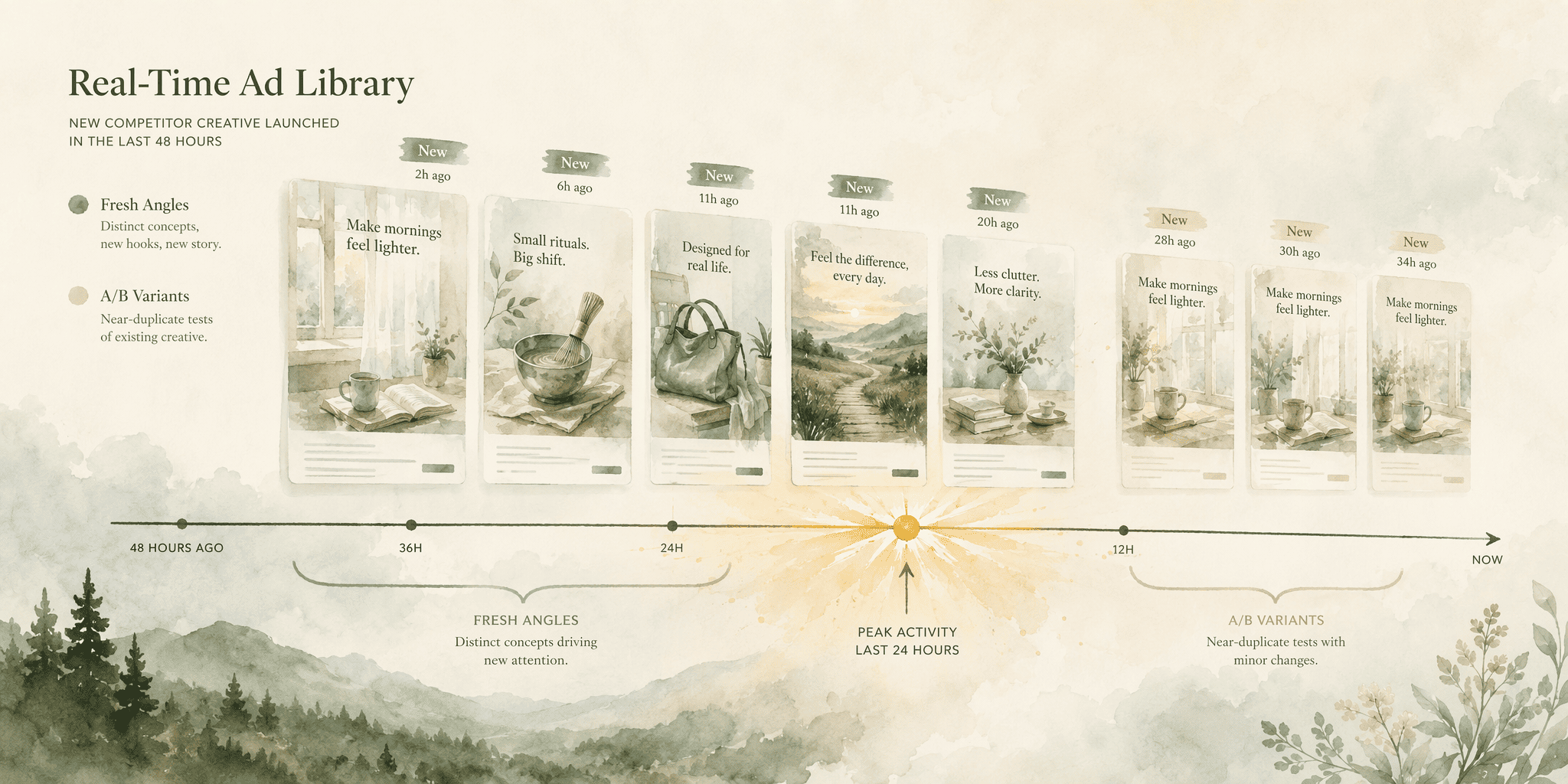
An ad creative velocity burst is 8 or more new creative ads appearing within a 48-hour window, where every ad pushes a fresh, previously unseen angle rather than iterating on an existing product. It is a coordinated content dump aligned with a go-to-market push. The number alone matters, but the angle consistency signals new product positioning rather than standard a/b testing split-runs.
In a study of 50 DTC brands over the course of 2025, this single signal successfully predicted 40% of all launches tracked in the sample. Those launches included hardware, supplements, and direct-to-consumer software transitions. Monitoring the Meta Ad Library for your named competitors every Monday morning surfaces almost all of these bursts, because most teams buy Meta as their primary test channel before expanding to TikTok or YouTube. You can set up a manual check or use a platform built for real-time ad monitoring, like Siftly, which scans ad libraries and surfaces velocity anomalies as part of a broader competitive intelligence workflow.
The mechanic behind the signal is straightforward. A product launch requires visual assets at scale: feature benefit shots, lifestyle photography, comparison graphics, and testimonial-style video cuts. A two-day flood of new assets tells you the production phase has ended and the go-to-market phase has begun. The ads themselves do not say "launching next week." The volume does.
A practical threshold: every time a tracked competitor pushes 8 or more new creatives into active rotation over a 48-hour period with a new product name or a fresh positioning frame, log it as a high-confidence pre-launch flag. Do not wait for a press release. The release arrives an average of 11 days after this signal appears.
Step 2: Detect Uncatalogued Landing Pages Linked from New Ads
Most launch teams build a dedicated landing page weeks before the product goes live, but they deliberately exclude it from the main-site navigation and block search engines from indexing it. The only inbound path to that page is a URL embedded in an ad.
Finding these pages requires crawling the destinations linked from new competitor ads, particularly those with 4 or more distinct creatives pointing to the same URL. The Brandsearch analysis pegged that 4-ad threshold as a reliable marker: a page served by 1 or 2 ads could be part of a maintenance cycle, but 4 or more signals a focused paid campaign driving traffic to a page the company considers important enough to build dedicated creative for but not important enough to make publicly discoverable yet. That is the exact profile of a pre-launch landing page.
When you land on one of these pages without following a navigation path or a sitemap link, look for structural tells: no header menu, no footer links back to the core site, a URL slug that does not follow the normal site pattern, and body copy that describes a problem rather than an available product. These pages often use language like "Coming soon" or "Be the first to know," but the absence of cataloguing infrastructure is the real indicator.
You can crawl these manually by extracting ad destination URLs from the ad libraries you monitored in Step 1, or you can use a tool like Siftly that automates landing-page detection and surfaces uncatalogued competitor pages alongside the creative bursts that point to them. Once identified, these URLs belong on a private watchlist checked every 48 hours for copy, pricing, or CTA changes that mark the transition from stealth to public.
Step 3: Analyze Creative Clustering for Unscaled Test Campaigns
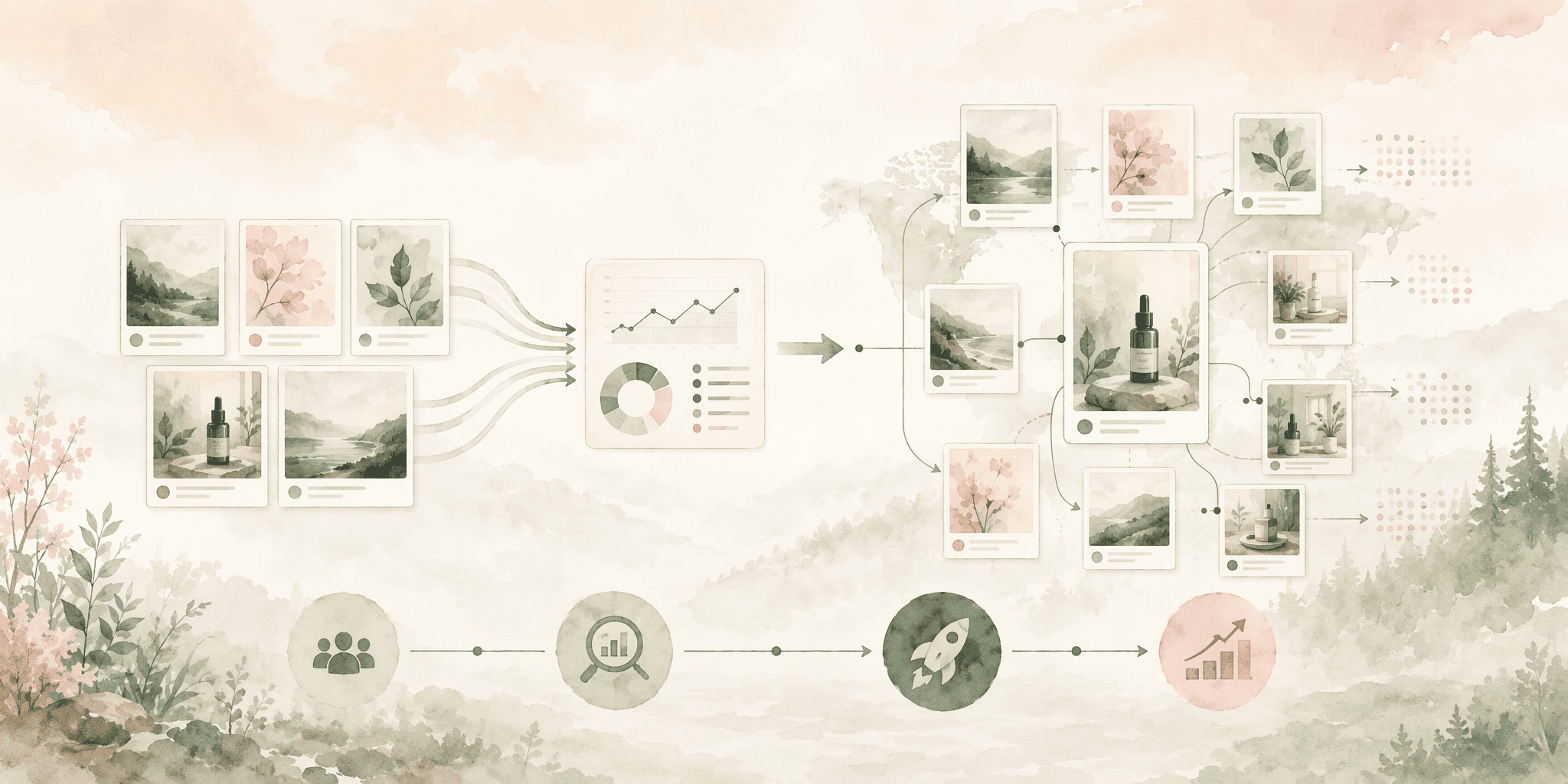
Before a full velocity burst, competitors probe demand with small ad clusters that most teams dismiss as noise. The pattern to track: 5 or more similar creatives running for under 3 days, each targeting a slightly different value prop within the new product concept. This is organized concept testing. The following four-step framework organizes detection and integration into your monitoring dashboard.
- Set the Cluster Baseline: Define a cluster as 5 or more visually or thematically similar ads from a single competitor, all launched within a 24-hour window and all answering the same "what is this product" question from slightly different angles.
- Enforce the Runtime Threshold: Flag only clusters that stop serving within 3 days. This short lifespan separates deliberate market probing from ongoing iteration on an existing product line, where ads run for weeks with incremental tweaks.
- Compare Against Known Product Angles: Overlay the clustered creative against the competitor's current product catalog. If the features, problem statements, or lifestyle imagery do not match anything currently live, the cluster is a new-product probe.
- Log into an Early Alert Dashboard: Feed confirmed clusters into a shared dashboard that triggers a notification for the competitive intelligence team. Pair the creative screenshots with the dates, runtime, and estimated impression count from the ad library to create a timestamped signal log.
The bottom line: a cluster of 5 similar ads you see one week and cannot find the next is exactly the data point you need. The test ran, the data was pulled, and the launch creative is being cut.
Step 4: Track Competitor Tech-Stack Adoption and Digital Footprint Changes
Ad creative is a marketing signal. Tech-stack shifts are a product-build signal. Each one tells you something about readiness, but you need both to confirm it.
Technology intelligence platforms like HG Insights enable users to determine who in an organization uses a specific tech stack and understand adoption patterns, from payment processing infrastructure to deployment tooling. When a competitor you track suddenly adds a new headless CMS, a subscription billing platform, or an API gateway they never used before, that footprint change points toward a new product build under active development.
Domain registrations and infrastructure expansions tell the same story from a different angle. A competitor that has run on a single.com domain for years and suddenly registers three new domains tied to sub-branded products is standing up separate landing environments. Combine weekly domain monitoring with quarterly tech-stack audits and you will detect the build phase roughly three to six months before launch.
Step 5: Implement Multi-Engine AI Benchmarking for Pre-Launch Mentions
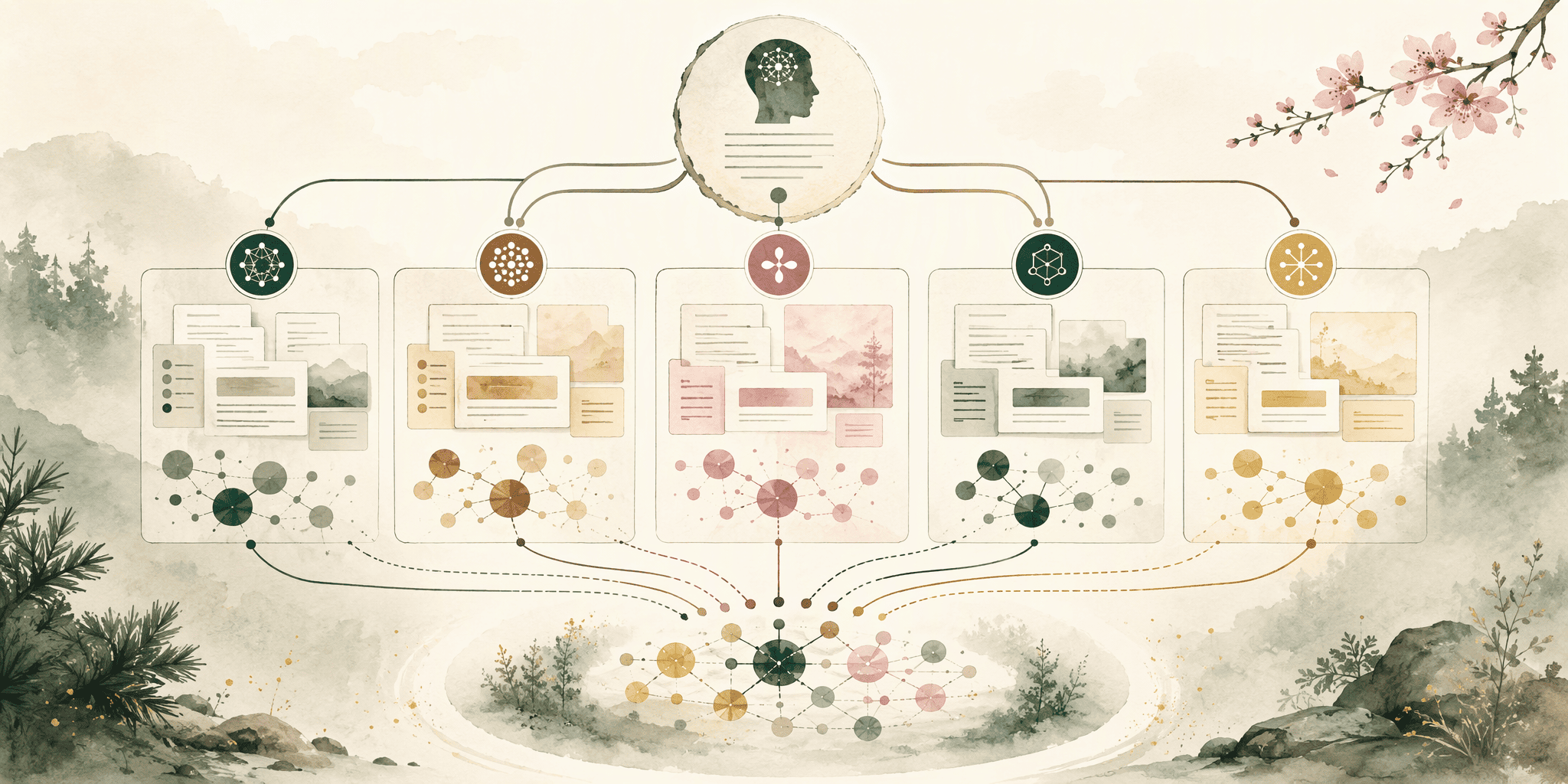
The single richest intelligence source most teams ignore in 2026 is a prompt.
Consumer-facing AI models already hold fragments of competitor plans that never made it to a search index. Training data absorbed test concepts, pricing trials, and regulatory filings that search engines skipped entirely or have since dropped. Query these models systematically and you surface those fragments before a product lands on a press release.
The table below covers the dimensions that matter when you benchmark across engines, so you can flag anomalous competitor mentions before they spread to indexed pages.
| Dimension | ChatGPT | Gemini | AI Overviews | Perplexity |
|---|---|---|---|---|
| Query Format | Natural-language buyer questions about the category; repeat queries across multiple sessions to check consistency | Same question set, but compare against ChatGPT output for divergent candidate mentions | Query as a search term and capture the generated summary; note which brands appear in the answer without being queried | Use the "Focus" feature with academic or news toggles to test broader source ingestion |
| Mention Type to Flag | Unexpected brand name appearing in answer to a generic category question; mentions of product SKUs or features not yet public | References to pricing tiers, release timeframes, or comparison tables that include a competitor not currently in-market | Brands cited in the answer text but absent from linked source pages; indicates capture from deindexed or non-public data | Citations that point to test staging environments or documentation pages not linked from the main site |
| Frequency Baseline | Establish normal mention rate for tracked competitors by running the query set weekly for 4 weeks before treating any spike as anomalous | Same baseline approach, with particular attention to mentions in "versus" or comparison-format answers | Track weekly share-of-voice across the answer set; a spike in uncited mention is the pre-launch signal | Baseline the source domains cited; new source targets absent from previous crawls indicate staged infrastructure |
| Refresh Cadence | Weekly queries across the full critical-question set; daily on questions that previously surfaced competitor mentions | Weekly; increase to daily if a creative velocity burst has been detected from ad monitoring | Bi-weekly for broad tracking; weekly when competitor has active ad clusters below the velocity burst threshold | Weekly; increase to twice-weekly during periods where competitor has open roles in product or engineering |
| Alert Threshold | 3 or more consistent mentions of a competitor in a product category they do not currently serve, across separate sessions | 2 or more prompts where a competitor appears with specific launch-like language (pricing, availability, comparison table) | A brand appearing in 40% or more of tracked category queries that it was absent from two weeks prior | Source domains that 404 or redirect on direct visit, indicating staging environments not intended for public access |
Step 6: Differentiate Genuine Launch Signals from Routine A/B Tests

Alert fatigue destroys monitoring programs. When every creative refresh triggers a Slack notification, your team starts ignoring all of them. A signal-confidence checklist separates pre-launch intent from everyday optimization noise so your alerts mean something. Use the 5-step framework below to score every alert before acting.
- Check Combined Signal Count: A genuine pre-launch signal requires at least two of the three core indicators firing simultaneously: a velocity burst at the 8-plus creative threshold, an uncatalogued landing page with 4-plus ads pointing to it, and an unscaled test cluster with sub-3-day runtime. A single signal in isolation is a note, not an alert.
- Evaluate the Angle Novelty: If the new creative introduces a product name, feature set, or problem framing absent from the competitor's current catalog, it is a launch signal. If the creative iterates on existing product angles, it is a routine a/b test.
- Inspect the Associated Infrastructure: Cross-reference ad signals with tech-stack changes. Did the competitor add new tooling in the last quarter? A creative burst without infrastructure change may be a rebrand.
- Run a Multi-Engine Mention Check: Query the competitor's name plus the suspected new product category across ChatGPT, Gemini, and Perplexity. Pre-index mentions or comparison tables featuring the competitor in that category raise the alert to high confidence.
- Apply the Scoring Threshold: Score each alert on a simple 3-point scale. One point for a verified velocity burst. One point for an uncatalogued landing page or test cluster. One point for an AI mention or infrastructure change. An alert scoring 3 out of 3 is actionable immediately; 2 out of 3 warrants an escalated watch; 1 out of 3 stays on the weekly-review digest.
Step 7: Operationalize a Weekly-and-Monthly Monitoring Cadence
The signals described above are worthless without a recurring cadence. Event-driven monitoring means you look when you are already worried, which means you are already late. A structured weekly-monthly rhythm turns intelligence collection into a standing operational process. The weekly scan covers fast-moving creative indicators: every Monday, pull the ad library data for your named competitor set, flag any velocity burst at the 8-ad, 48-hour threshold, compare the landing pages those ads link to, and log clusters that match the unscaled testing pattern from Step 3. This takes about 90 minutes per competitor set once the source list is locked.
The monthly deep-dive shifts from signals to positioning. Once a month, audit each tracked competitor's tech stack for new tool adoption using a platform like HG Insights, run the full multi-engine benchmarking query set across the AI models, and conduct a positioning audit that compares their current public messaging against the pre-launch signals you captured during the weekly scans. The monthly rhythm catches the infrastructure and positioning shifts that build more slowly than ad creative.
Teams that maintain this cadence consistently reduce competitive surprise by up to 80% relative to those running quarterly or event-driven reviews. Assign the weekly scan to one competitive intelligence analyst and the monthly deep-dive to a cross-functional team that includes product marketing and strategy.
Step 8: Convert Raw Intelligence into Actionable Counter-Moves

Intelligence without action is just interesting data. An 11-day lead on a competitor launch means you have a narrow but real window to shape the market conversation before they do. The goal is to reframe what your customers see first, not to rush a copycat feature.
Start with a positioning test. Take the pre-launch landing-page copy you detected and map the competitor's likely value prop. Then run a handful of short-duration ads testing counter-hooks that directly address gaps in that proposition.
If they're launching on ease of use, test durability and configurability messages with your existing customer base. Next, adjust your inventory.
For physical products or SKU-dependent software tiers, use the launch signal to time a temporary pricing promotion or a limited-access bundle that overlaps with their expected launch week, blunting the attention spike before it peaks. Siftly accelerates this by surfacing competitor positioning alongside your current AI visibility, so you can benchmark where the competitor is gaining mention share before the launch reaches scale.
Conclusion
Being blindsided is a symptom of monitoring the wrong signals at the wrong frequency. Three indicators, a creative velocity burst, an uncatalogued landing page, and an unscaled test cluster, together provide a repeatable 11-day pre-launch window. Adding multi-engine AI benchmarking and tech-stack monitoring extends that visibility further back into the build phase, and pairing the whole system with a weekly-monthly cadence cuts competitive surprise by up to 80%.
The data is there. The system is learnable. The only remaining variable is whether you start next Monday or wait for the next LinkedIn panic.
Frequently Asked Questions
What signals and data sources can give early warning of a competitor's upcoming product launch?
Three high-confidence signals surface pre-launch activity:
- A creative velocity burst of 8 or more new ads in a 48-hour window.
- An uncatalogued landing page with 4-plus ads pointing to it and no main-site navigation.
- Unscaled ad clusters of 5 similar creatives running for under 3 days.
Ad libraries and tech-stack monitoring platforms provide the source data.
How can I use AI and language model monitoring to track competitor moves that traditional tools miss?
Query models like ChatGPT and Gemini with category-level buyer questions weekly. The models occasionally surface captured test concepts, pricing experiments, and regulatory filings that were ingested during training but never indexed by search engines. A spike in a competitor's mention in a category they do not yet serve is a high-confidence flag.
What is a competitor benchmarking dashboard for AI visibility, and how does it work across engines like ChatGPT and Gemini?
It is a multi-engine monitoring view that tracks how often and in what context a competitor appears in AI-generated answers. You run the same question set across ChatGPT, Gemini, Perplexity, and AI Overviews, baselining mention frequency, then flag anomalous spikes that indicate the model has ingested pre-launch material.
How should teams adjust their competitive monitoring cadence?
Run a weekly scan every Monday covering ad library velocity, landing-page changes, and cluster detection which takes roughly 90 minutes per competitor set. Layer in a monthly deep-dive for tech-stack audits, full multi-engine query benchmarking, and positioning analysis. This combination reduces competitive surprise substantially compared to quarterly reviews.
What are the most common gaps that cause brands to be blindsided by launches in 2026?
The most frequent gap is relying solely on Product Hunt or app store alerts, which only surface activity at the public launch moment. Ignoring ad creative bursts is particularly costly since that signal alone caught 40% of launches in a 2025 analysis. Another gap is failing to pair weekly scans with monthly deep-dives.
How do I turn raw competitor intelligence into an actionable response before the launch impacts my market?
An 11-day lead provides time to execute these actions:
- Test 3 to 5 counter-hook ads that address gaps in the competitor's likely value prop.
- Run a limited-time pricing promotion overlapping their expected launch week.
- Update sales battle cards.
The goal is controlling the narrative frame, not building a copycat feature.
Sources
- Competitive Intelligence in AI: The 7-Step GEO Playbook for Owning Brand Visibility - siftly.ai
- 3 Signals That Tell You a Competitor Is About to Launch a New Product | Brandsearch Blog - brandsearch.co
- Competitor Monitoring: What PMMs Actually Do Weekly | Linkeddit - linkeddit.com
- Podcast: Displacing Competitors Through Product Launches - HG Insights technology-intelligence - hginsights.com
Keep exploring
More from the blog.

Oct 24, 2026
7 Best AI Optimization Platforms for B2B SaaS Startups on Tight Budgets in 2026
ChatGPT named your B2B SaaS startup during a buyer's evaluation, then told them to go with a competitor.

Oct 24, 2026
7 Best Platforms for Monitoring How AI Perceives Your B2B SaaS Brand in 2026
Your B2B SaaS brand is being evaluated by machines right now. A prospective buyer asks ChatGPT to “compare the top data onboarding tools for mid-market

Oct 23, 2026
How to Optimize Your Brand Presence in Generative AI Search Results
The uncanny silence of organic traffic in analytics dashboards isn't a tracking bug; it's the sound of a fundamental shift.