Aug 10, 2026
Enterprise Generative Engine Optimization in 2026
Your biggest competitor just became invisible. They aren’t showing up in a list of ten blue links for your most critical B2B search terms

Introduction
Your biggest competitor just became invisible. They aren’t showing up in a list of ten blue links for your most critical B2B search terms; they are showing up as the answer inside ChatGPT, Perplexity, and Google AI Overviews. For the CMO and the VP of Demand Generation, the terrifying reality is that conventional search traffic is not just eroding.
It is being replaced by AI-synthesized answers that rarely link to more than a handful of domains at a time. 89% of B2B buyers now use generative AI in their purchasing journey, yet most enterprise marketing stacks have zero visibility into whether their brand ever surfaces in these conversations. Waiting for your legacy SEO dashboard to flag the drop means you are already months behind the accounts winning the pipeline.
This shift demands enterprise-grade generative engine optimization. GEO rewires your digital presence not to rank a page, but to ensure that your entity and data are the source the AI models cite. It is the difference between owning the synthesis layer and being cut out of the decision cycle. With AI-qualified traffic converting at 4.4 times the rate of traditional organic visitors, the revenue risk of inaction is quantifiable and immediate. Brands already deploying a combination of structural authority tactics are capturing a 30 to 40% improvement in AI visibility, establishing a moat that legacy optimization cannot bridge.
The following analysis provides the enterprise strategy for 2026.
Key Takeaways
Enterprise visibility now hinges on a brand’s citability inside AI-generated answers, not just its position on a search engine results page.
- The revenue gap is structural: AI-sourced traffic demonstrates a 4.4x conversion uplift over standard organic traffic, making AI invisibility a direct pipeline cost.
- Entity authority over page authority: AI models assess brands holistically across structured data and statistical citations, not just external link graphs.
- Integration is non-negotiable: An API-first GEO analytics platform must feed citation data directly into your CMS and BI stack, not sit in a siloed standalone dashboard.
- Validation exists: Princeton University’s research confirms that specific structural content tactics deliver a 30 to 40% improvement in citation appearance rates.
What Generative Engine Optimization Is and Why It’s Redefining Search

Generative engine optimization is the systematic engineering of brand, content, and technical signals to increase the probability that AI platforms like ChatGPT, Gemini, and Perplexity cite or recommend a business. Coined by Princeton University researchers in 2024, the term captures a hard break from traditional search mechanics. Where SEO relies on positioning a specific URL within a ranked list of links, GEO focuses on entity-level visibility inside a synthesized, natural-language answer.
You already know the old playbook: tweak a page to rank higher for a keyword, and a user clicks through to your site. That pathway thins out when the AI generates the answer right in the chat window. GEO doesn't try to win a blue link. It works to become the source the model trusts, which means the rules of the game have changed.
A Princeton research team published the framework in a 2024 paper that tested nine optimization methods across 10,000 queries. Their findings showed that some tactics, like adding statistics and citing authoritative sources, lifted visibility by over 40%. Others, like keyword stuffing, either did nothing or hurt results. The same paper made it clear these aren't SEO hacks repackaged. They're methods built specifically for how large language models retrieve and synthesize information.
This shift matters because the traffic isn't hypothetical. AI platforms already handle billions of queries per month, and a Siftly analysis finds that AI overviews now appear in 58% of Google searches. If your brand isn't visible in those answers, you're absent from a large and fast-growing part of the search landscape.
No special report or think piece required to make that conclusion. Just look at the query logs. The work of GEO spans three buckets: authority signals (consistent entity data, trusted citations), content design (structure that's easy for models to parse and quote), and distribution (being present where the platforms source their information).
Those three areas don't form a tidy checklist. They overlap. A well-structured article that no model ever reads doesn't help.
A brand that's mentioned everywhere but never cited as the primary source is only halfway there. GEO is still new. Best practices evolve month to month as the models update their retrieval mechanisms.
But the underlying idea isn't going away. When a user asks a question and an AI answers, that answer has to come from somewhere. Making sure it comes from you is what generative engine optimization actually does.
The Strategic Drivers Pushing Enterprises Toward GEO in 2026
The shift toward generative engine optimization is happening because the old discovery funnel broke:
- Buyer behavior: Forrester found that 89% of B2B buyers now rely on generative AI during purchase research, meaning the executive buyer and the technical influencer no longer scan vendor grids on a search engine results page but ask AI engines for comparative analyses, risk assessments, and implementation roadmaps.
- Top-of-funnel replacement: This is not a marketing channel change but a top-of-funnel replacement, where discovery moves inside chat interfaces and assets that used to capture demand (ranked landing pages, comparison grids, paid search listings) stop working because the buyer never sees them.
- Sales enablement requirement: GEO answers the blunt operational question, does our content appear when the AI engine assembles a recommendation?, and getting that answer right is now a sales enablement requirement, not an SEO experiment.
- Pipeline risk: Enterprises that treat GEO as optional are running a controlled trial on their own pipeline, as every quarter without visible AI citations is a quarter a competitor's technical content fills that gap.
- Cost measurement: The cost is not measured in traffic metrics but in deals that never reach the CRM because the buyer's first five questions were answered by someone else's documentation inside the chat window.
How Generative AI Citations Work: The Mechanics of AI Visibility

Securing visibility requires understanding the pipeline that converts raw content into a cited source. AI citations are not awarded through generalized domain authority scores; they are extracted through an entity synthesis mechanism.
- Retrieval-Augmented Generation creates the source shortlist: When a user queries a AI platform with live browsing, the system performs a semantic search across a real-time index or a knowledge graph. The AI does not crawl your site in the moment; it retrieves pre-processed vectors. Your content has to be readable by a language model's retrieval mechanism as the definitive authority on a specific sub-topic, not just keyword-optimized.
- Citation follows extractable claims, not backlinks: Inside the retrieved shortlist of 2 to 7 domains, the generation pass picks sources that offer clean, extractable facts. Direct, answer-first structures that front-load a claim get priority because they cut the model's processing overhead. A blog post with a formatted statistical table and FAQPage schema is easier for the algorithm to cite than a buried conclusion in a narrative essay, even when both sites carry similar brand equity.
A brief mention carries a different weight from a primary recommendation.
- Freshness signals gatekeeper the corpus: Most enterprise queries concern fast-moving technology, regulatory, or financial information, so AI weighting algorithms penalize stale content heavily. If your last major content update was 18 months ago, the retrieval step likely skips your domain for a fresher source. Continuous publishing and last-modified schema signals tell the crawler that your brand is still the living source of truth for the entity it claims to own.
The analytics framework for GEO requires the C-suite to abandon the organic traffic north star and adopt a Citation Frequency model. This model tracks two key metrics:
- Citation Frequency: the total number of times a brand is specifically referenced in AI-generated responses across a monitored query set, forming the volume layer of your visibility.
- Targeted measurement: for an enterprise targeting cloud infrastructure, stop counting Google clicks for that keyword and start measuring whether OpenAI and Anthropic models cite their technical architecture whitepaper in response to a 'choose a hyperscaler' prompt over a 30-day period.
Enterprise-Grade GEO Software and Analytics Capabilities

Software vendors are racing to fill this gap, but real enterprise GEO analytics needs to do more than a browser plugin that snaps a picture of a ChatGPT answer. The capabilities required include:
- Cross-platform monitoring: pull visibility data from the four main gateways: ChatGPT, Gemini, Perplexity, and Google AI Overviews, so share-of-voice combines those signals into one metric instead of four separate dashboards.
- Coverage of buyer fragmentation: check only ChatGPT and you miss the technical evaluator researching you on Perplexity while a marketing VP queries Gemini, making a unified visibility metric key in 2026.
- API-first integration: push citation data into your CMS and your BI stack, not a walled-off interface you have to visit separately.
Pricing Tiers and Competitive Landscape for Enterprise GEO Platforms in 2026
Enterprise GEO buying in 2026 splits cleanly: startups that built for AI visibility from scratch, and legacy SEO vendors that added an AI Overview column to their existing dashboards. The right pick depends less on feature lists and more on how each platform charges, how it integrates, and whether its data model matches the way generative engines actually cite sources.
| Capability Tier | Pure-Play GEO Tools | Analytics-First Tools | Incumbent SEO Suites |
|---|---|---|---|
| Multi-model visibility monitoring with an emphasis on raw data exposure. | Keyword rank tracking with an added AI Overview presence widget. | ||
| Pricing Model | Usage-based or tracked entity volume, scaling from mid-market to a custom Enterprise tier. | Scheduled fixed-monthly plans based on query volume and monitoring frequency. | Bundled into existing high-cost SEO suite subscriptions with platform access fees. |
| Integration Depth | API-first with CMS and BI pipeline integration designed to build AI visibility at scale. | Data export and dashboarding; often requires manual analysis for closed-loop attribution. | Heavily reliant on proprietary dashboards; limited external API endpoints for raw citation data. |
| Representative Model | Siftly's platform includes a Starter tier at $299 per month and a Scale tier at $599 per month, with a custom Enterprise plan for high-volume cross-platform monitoring. | Averi's monitoring suite offers scheduled directional sampling for competitive intelligence. | Traditional platforms bolting on overview metrics without changing the underlying entity model. |
Pure-play platforms like Siftly price around tracked entities and query volume, with the Starter tier at $299 per month and the Scale tier at $599 per month, plus a custom Enterprise plan for large-scale monitoring. These tools map citations to specific AI models, giving procurement teams a direct line from spend to visibility share.
Incumbent SEO suites take a different approach. AI Overview presence tracking gets bundled into existing high-cost subscriptions, often as a widget inside the same rank-tracking interface the team already uses. The integration story is thinner here: proprietary dashboards dominate, and API endpoints for the raw citation data that fuels closed-loop attribution are limited. For teams that need to pipe GEO signals into a BI tool or CMS workflow, that gap matters.
Proven Content Structures and Technical Infrastructure That Improve Citation Rates

The research from Princeton University provides a validated, high-impact editorial playbook. The core finding is that brands applying specific structural and authority-based tactics in combination improved AI visibility by 30 to 40%. The tactical execution involves three key techniques:
- Answer-First Block: place a direct, quotable 40 to 60 word summary at the start of every critical asset, serving the AI's extraction engine with a self-contained statement it can cite verbatim.
- Embedded numerical data: provide a definitive statistical anchor (e.g., 'latency dropped by 72% under load'), which the model will pull when 5 domains are semantically equivalent.
- Structured schema and authoritative quotes: supplement content with FAQPage markup and quotes from trusted sources to signal extractability and credibility.
Building a GEO Center of Excellence: Workflow and CMS Integration at Scale
Treating GEO as a side project for the SEO analyst guarantees failure. The discipline requires a formal Center of Excellence (CoE) because the signals cross too many traditional data silos. A single GEO content asset demands:
- Entity structuring from SEO architects to define consistent data and relationships.
- Claims verification from editorial to ensure every statement is defensible.
- Statistical modeling from data science teams to quantify performance and surface which tactics work.
- Brand communications involvement because an AI engine citing your brand in a controversial hallucination is a reputation risk that no press release strategy yet covers.
Calculating and Proving the ROI of Generative Engine Optimization
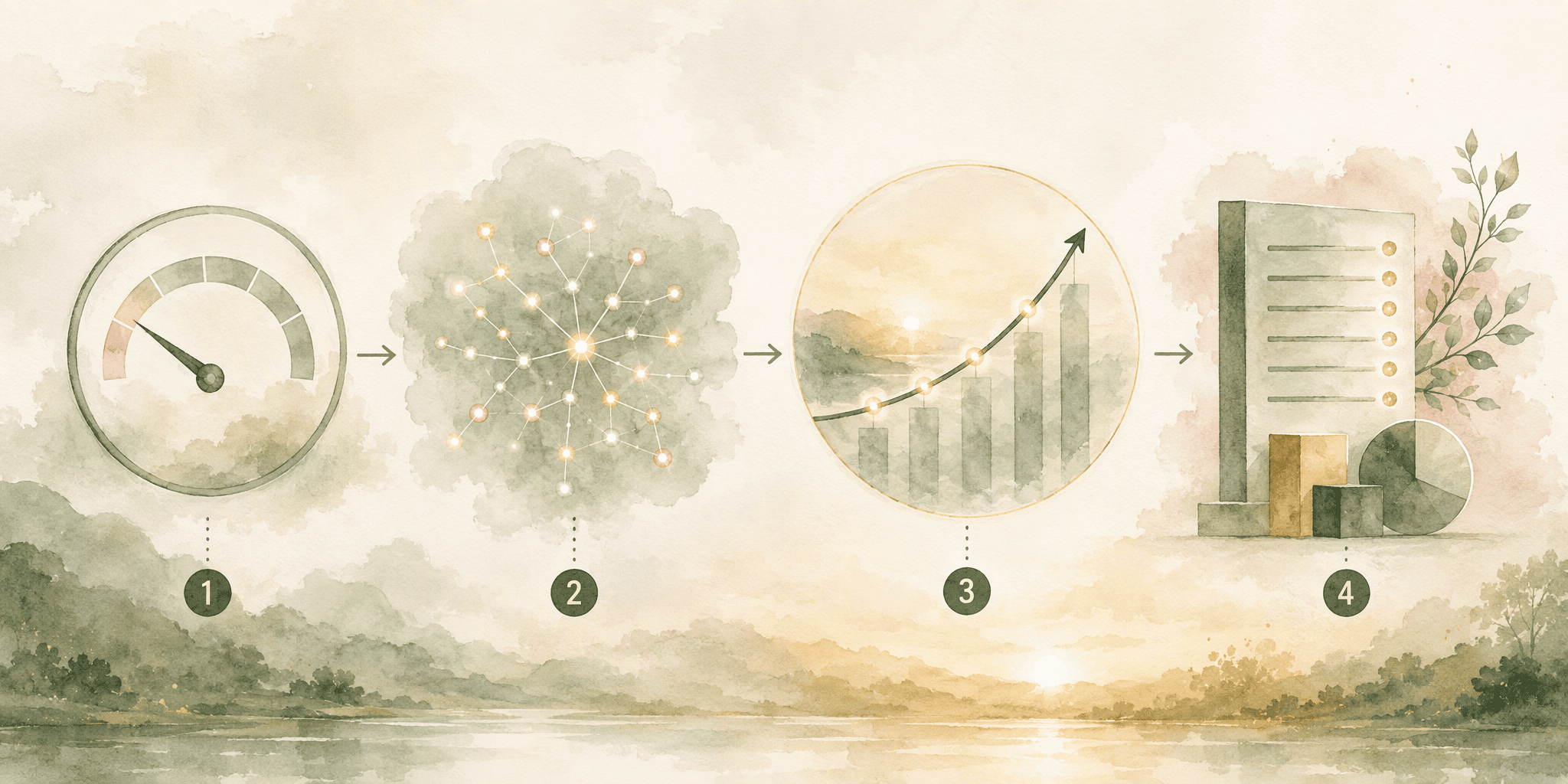
Building a CFO-ready attribution model requires translating the probabilistic nature of LLM traffic into a financial projection that holds up under scrutiny. The model starts with directional attribution, not deterministic last-click correlation.
- Audit your AI Citation Volume baseline: Use a platform like Siftly to quantify your current average Citation Frequency across your priority query set over a defined 30-day base period. This is your zero line of visibility.
- Model the influenced click-through volume: Apply an industry-standard click-through estimate to incremental citation gains. For every net-new 1,000 AI-generated responses where your brand is cited, model a directional downstream site visit range based on your platform's historical AI-referred click data.
- Apply the 4.4x conversion uplift factor: Multiply your influenced AI-originated sessions by your standard organic conversion rate, and then apply the validated 4.4x conversion multiplier identified by Semrush. This step converts raw raw exposure into a weighted conversion event count, distinguishing AI-influenced visitors from low-intent browsers.
- Calculate influenced pipeline and revenue: Multiply the weighted conversion count by your known average contract value (ACV) or gross pipeline per lead. This produces the top-line revenue contribution linked to the visibility increase.
- Validate through incrementality holdouts: Where data granularity permits, run a geographic or product-line holdout group with no active GEO content optimization for a quarter.
Bear in mind that hard ROI data for each specific AI platform, such as isolated Gemini versus ChatGPT revenue, is not yet publicly available and varies significantly depending on industry vertical and content maturity. However, a directional model built on the 4.4x multiplier and tied to an internal incrementality test provides a defensible investment rationale for the CFO that far exceeds the standard correlation claims of generic brand marketing.
Conclusion
The irreversible shift from ranked pages to synthesized answers has rendered traditional click-through rate KPIs obsolete for enterprise marketing organizations. The mandate is no longer about being number one in a list of links; it is about being one of the two to four sources the AI model selects as authoritative truth. Launch a pilot program centered on your highest-margin product category, implementing the Princeton-validated editorial pillars and API-driven measurement architecture within a dedicated GEO Center of Excellence to systematically capture the 4.4x conversion premium before your competitors close the window.
The distinction sits at the retrieval layer. Traditional search crawls, indexes, and ranks pages based on relevance and link authority to deliver a menu of options to the user. AI search engines do not index content; they extract it.
LLMs typically cite only 2 to 7 domains per response. This creates an extreme winner-takes-most dynamic. If your brand is not consistently one of the few sources pulled into the retrieval-augmented generation (RAG) pipeline for your topic cluster, you are statistically invisible, regardless of how many page-one rankings you hold.
This redefines the visibility game entirely. A user interacting with an AI agent gets a thorough answer that anticipates follow-up questions without ever leaving the chat interface.
As a direct result, users get what they need faster, but brands get fewer clicks. The traffic pool is shrinking so violently that Y Combinator forecasts a 50% decline in conventional search traffic by 2028. For enterprise marketing teams, waiting for the cliff to arrive before building a monitoring framework is a strategic failure.
The urgency deepens when you look at the conversion data. The traffic that does manage to survive the AI filter and click through to your site has radically higher intent. Semrush benchmarks confirm those users convert at a 4.4x multiplier compared to standard organic traffic.
This delta reveals that AI engines are not merely scraping content; they are pre-qualifying users and narrowing considered vendor sets. A customer who received a detailed technical answer citing your proprietary methodology arrives on your product page pre-educated and closer to a buying decision.
Enterprises without an active GEO citation strategy are systematically ceding the highest-value pipeline to competitors who have already engineered entity-level authority inside the models. The financial asymmetry of losing 4.4x converters to a rival simply because your structured data hygiene was poor is impossible to justify at the board level.
The problem compounds because traditional analytics miss this entirely. If your GA4 dashboard appears stable, you are likely looking at a lagging indicator while the composition of your demand is silently decaying.
This metric is board-ready because it correlates directly with the market share of the 89% of buyers using AI.
The ultimate validation, however, is the closed-loop conversion track. Traffic is no longer the north star. What matters is the attribution window that connects a generated citation on Perplexity or ChatGPT to a downstream demo request or pipeline creation within your CRM.
Siftly, for instance, is engineered with a GEO-first approach that focuses specifically on how AI systems evaluate and cite content, tracking visibility and AI-referred clicks rather than just scraping page-rank data. This allows marketing teams to see their competitive intelligence benchmarks and tie that AI exposure to downstream conversions within their existing reporting frameworks.
The next maturity jump requires directional attribution, which maps the citation event to the site session. While no platform yet offers a fully validated, deterministic citation-to-revenue attribution model, enterprise-class tools should provide directional models linking a period of high AI visibility to spikes in direct or organic-branded traffic and CRM pipeline. This attribution logic must incorporate the 4.4x conversion uplift factor so that a CMO can calculate influenced pipeline. Finally, the software must provide raw access to the prompts buyers are using before they decide what to buy. By surfacing the exact questions posed to these AI engines, the platform shifts the marketing team from reactive keyword guessing to proactive market sensing, revealing unmet buyer concerns that haven't yet materialized in traditional search volume tools.
The technical layer must match the editorial intent. Extractable schema markup, specifically FAQPage and HowTo structured data, provides the highest return on effort for AI Overviews. This schema signals to the retrieval engine that the content is designed for question-answering and step-by-step synthesis, making it algorithmically preferred for citation.
The remaining pillars bolster source credibility. Authoritative quotations from recognized experts and original research studies significantly raise source authority scores because they signal primary-source knowledge to the model's training data. Furthermore, content freshness is not just a ranking factor but an access prerequisite for real-time browsing models. A site must enforce a continuous publishing cadence and implement semantic HTML5 and server-side rendering, as many AI crawlers do not handle heavy JavaScript execution paths. Without clean source markup and a current last-modified date in the server header, your content may be undiscoverable even if it perfectly aligns with the buyer's query.
The technical workflow must be API-driven to avoid replicating the manual spreadsheet hell that plagued enterprise SEO in 2015. The CoE's production workflow connects three critical systems. First, the CMS must be integrated with the GEO monitoring platform's API to ingest citation gap data, flagging assets that have fallen below a target citation rate so the editorial queue can prioritize refreshes automatically.
Second, the Digital Asset Manager must serve structured image and document metadata to the retrieval pipeline. This configuration enables closed-loop reporting where a drop in ChatGPT visibility for a specific product category triggers an automated content optimization task in the CMS, rather than a frantic email from a brand manager seeing a pipeline decline two months later.
An operational, cross-platform monitoring cadence must be established. Single-prompt checks are unreliable because AI responses vary probabilistically even with the same input. The CoE must standardize a scheduled sampling workflow across a fixed set of high-value queries and multiple platforms (ChatGPT, Perplexity, Gemini), tracking both the citation rate and the sentiment of the mention. A realistic initial target for an enterprise making active investments in answer-first restructuring and schema enhancement is a 10-point improvement in their aggregate citation rate within six months, as measured against a stable baseline.
Frequently Asked Questions
What is generative engine optimization (GEO) and how does it differ from traditional SEO?
Generative engine optimization is the practice of structuring content and technical signals so that AI engines like ChatGPT and Perplexity cite your brand as a source. Traditional SEO targets organic page ranking within a list of blue links. GEO focuses instead on achieving entity-level visibility by being one of the few verified sources synthesized directly into an AI-generated answer.
How do software platforms track visibility in AI-generated responses across different tools?
Platforms like Siftly deploy automated monitoring across major AI interfaces including ChatGPT, Gemini, and Google AI Overviews.
What analytics and attribution capabilities does enterprise-grade GEO software provide?
These tools push data into BI dashboards via API integrations. While fully validated citation-to-revenue models remain unavailable, the best platforms provide closed-loop conversion tracking that quantifies the financial impact of AI exposure.
How do pricing tiers compare for GEO platforms targeting enterprise marketing teams in 2026?
Pricing scales from mid-market subscriptions to custom enterprise licenses. Pure-play GEO vendors typically offer structured tiers based on tracked entity volume and query capacity; for example, platform entry points may start in the $300/month range and scale to over $600/month for high-volume monitoring, with custom pricing for advanced cross-platform API access.
What content strategies improve citation rates in AI overviews?
Princeton-validated tactics that can improve visibility by 30 to 40% include opening with direct answer-first blocks, embedding numerical statistics, and implementing structured schema like FAQPage. Supplementing content with authoritative quotes and actively maintaining content freshness signals to AI retrieval engines that your domain contains the most credible and extractable claims.
How can a marketing team calculate the ROI chain of a GEO investment?
The proven model starts by establishing a Citation Frequency baseline. Teams then model incremental click-through volume from new citations, apply the 4.4x conversion uplift factor observed in AI-referred traffic, and multiply by average pipeline value. To ensure accuracy, this directional attribution should be validated with a geographic or product-line incrementality test.
Sources
- What Is Generative Engine Optimization (GEO)? | Siftly - siftly.ai
- Generative Engine Optimization (GEO): 2026 Guide | Siftly - siftly.ai
- From SEO to GEO: How marketing leaders stay visible in AI-driven search - searchengineland.com
- GEO Optimization: 2026 Guide to Generative Engine Optimization - www.optimizegeo.ai
- Tracking AI Citations: The 7 Metrics Most Tools Get Wrong - www.averi.ai
- Plans & billing - docs.siftly.ai
Keep exploring
More from the blog.

Oct 10, 2026
6 Best AI Brand Visibility & GEO Platforms for 2026
Your brand is being described right now inside ChatGPT, Perplexity, and Google’s unified AI Search surface

Oct 10, 2026
The Best Scrunch AI Alternatives for Tracking AI Visibility in 2026
Your brand is being cited right now by ChatGPT, Perplexity, or Google's AI Overviews, and you have no visibility into what those engines are saying.

Oct 9, 2026
Profound Alternatives for Tracking AI Visibility in 2026
In July 2026, roughly three out of four businesses discovered AI assistants could not produce their specific price