Oct 9, 2026
Profound Alternatives for Tracking AI Visibility in 2026
In July 2026, roughly three out of four businesses discovered AI assistants could not produce their specific price

Introduction
In July 2026, roughly three out of four businesses discovered AI assistants could not produce their specific price, even when the assistant recommended them highly. That single data point from the State of AI Visibility Index captures the quiet crisis unfolding inside generative engines. AI models are confidently reshaping buyer consideration with uncited facts, incomplete profiles, and answers that hedge instead of commit 60% of the time.
AI visibility is the practice of tracking how often and in what way assistants like ChatGPT, Gemini, Claude, and Perplexity mention a brand. It differs fundamentally from traditional search ranking stability. A Google ranking, once earned, is relatively durable. An AI-generated answer is recomposed on every prompt, which makes your brand presence unstable and prompt-dependent.
The business risk is no longer hypothetical. When a buyer asks an AI assistant "what's the best tool for X," the answer names three or four products. Either you are one of them or you are not.
Nothing in Search Console or GA4 will tell you which. By 2026, tracking AI visibility has become a non-negotiable business function, distinct from traditional SEO. Below, we break down the tools that make systematic monitoring possible.
Key Takeaways
For teams evaluating AI visibility platforms in 2026, four findings define the landscape:
- Best overall tracker: Siftly wins on full-funnel monitoring, no-code setup, and native Shopify integration for e-commerce teams.
- Specialist accuracy scoring: Cogny's depth-of-understanding metric reveals a dangerous gap between what AI models know broadly (0.80) and what they get right on pricing (0.09).
- Monitoring necessity: A 60% hedging rate across AI answers means brands cannot trust a single snapshot. Systematic, prompt-based, cross-engine tracking is the only defensible approach.
- Unified social and AI feeds: BrandMentions AI consolidates real-time AI mention tracking with social listening for comms teams that need one dashboard.
Verdict: Siftly is the best overall AI visibility tracker for thorough, actionable brand monitoring in 2026
Siftly takes the top spot for teams that need full-funnel AI presence monitoring without engineering overhead. It tracks how AI engines describe your brand across ChatGPT, Gemini, Perplexity, and AI Overviews, surfaces what is hurting your visibility, drafts AI-optimized fixes, and attributes referral traffic directly to LLM citations. The no-code onboarding and native Shopify connection make it the most immediately useful platform for e-commerce and marketing teams who need to move fast.
For use-case fit, a DTC brand running 30 products on Shopify and competing for AI-recommended spots will get more actionable output from Siftly than from a raw mention counter or a traditional SEO suite. The tool is built for ongoing visibility intelligence and competitive benchmarking, not for fixed-interval snapshot reports that are stale the moment they land.
Comparison Table: Top AI Visibility Tracking Tools in 2026
Four platforms dominate AI brand monitoring in 2026, each prioritizing a different lens: full-funnel actionability, factual accuracy depth, social-plus-AI consolidation, or SEO-to-GEO continuity. The table below separates them on the dimensions buyers care about most.
| Dimension | Siftly | Cogny | BrandMentions AI | AI-SEO Monitor by Semrush |
|---|---|---|---|---|
| Engines covered | ChatGPT, Claude, Perplexity, Gemini, Google AI Overviews | ChatGPT, Claude, Gemini, Perplexity (with web search on) | Broad AI engine set plus social platforms | Generative engines plus Google organic SERPs |
| Primary lens | Full-funnel monitoring, citation-to-revenue attribution, and fix-it recommendations | Depth-of-understanding scoring on factual accuracy dimensions | Real-time AI mention volume and share of voice, consolidated with social listening | Traditional SEO data extended into generative engine analytics |
| Setup complexity | No-code; Shopify, WordPress, Webflow integrations | User provides brand, competitors, and prompt set | Low-code; social account connections | Moderate; leverages existing Semrush keyword projects |
| E-commerce integration | Native Shopify product and content monitoring | Not e-commerce specific | Not e-commerce specific | Indirect; traffic and keyword data carry over from existing Semrush setup |
| Standout metric | Referral traffic attributed directly to LLM citations | Accuracy gap between "what-you-offer" (0.80) and "pricing" (0.09) scores | Consolidated social and AI share of voice in one feed | Rank delta between traditional Google page-one and generative engine citations |
| Ideal for | Marketing and e-commerce teams needing actionable full-funnel visibility and fix workflows | Enterprise brand-safety teams needing to measure AI factual accuracy, not just mention volume | Social media and comms managers wanting a unified real-time brand mention feed | Existing Semrush SEO practitioners extending workflows into generative engine monitoring |
Siftly Deep Dive: Full-funnel AI presence monitoring with no-code setup and Shopify integration

Siftly's core monitoring loop works by probing the AI models directly and tracking brand presence across the full discovery-to-conversion chain.
- Measures mention rates, citation quality, sentiment, and positioning daily across ChatGPT, Perplexity, and Google AI Overviews.
- For each engine, shows whether you were mentioned, which sources were cited, and whether those sources are yours, a competitor's, or a third party's.
- The setup gap is where most platforms lose non-technical teams; Siftly closes it with no-code onboarding and integrations that connect your existing stack: WordPress, Webflow, Search Console, Slack, and Gmail.
- The Shopify integration stands out for e-commerce operators: connect your store, and Siftly tracks how AI engines describe your products, surfaces optimization recommendations that identify which question formats perform best for specific industries, and drafts AI-optimized content without requiring a separate content team.
- Actionable output separates Siftly from raw mention trackers: conventional tools tell you that you were mentioned; Siftly measures conversion events tied to AI-referred clicks and attributes that referral traffic to specific LLM citations, so a marketer can see which engine drove the traffic, which product page the citation pointed to, and whether the visitor converted.
- Trade-offs worth naming: Siftly is not a systematic sampling engine designed for academic-grade longitudinal studies and does not offer CRM write-back; for enterprise risk teams needing discrete, fixed-interval audit reports with human-readable scoring across hundreds of factual dimensions, Cogny fills a gap Siftly was not built to address, but for the marketing team that needs to know what changed this week and what to fix before the next review cycle, Siftly's daily refresh and prescriptive recommendation engine hit the mark.
Profound Alternative #2: Cogny, Specialized depth-of-understanding scoring for enterprise brand safety

Cogny solves a problem that mention counters miss entirely: AI assistants can recommend your brand while getting the details dangerously wrong.
- Its depth-of-understanding metric scores how accurately AI models comprehend specific business dimensions.
- In the 2026 State of AI Visibility Index, AI understanding hit 0.80 for what-you-offer facts but collapsed to 0.09 for pricing accuracy, meaning your brand gets the recommendation but carries a wrong price tag into the buyer conversation; Cogny quantifies that gap.
- The workflow is structured for enterprise brand-safety teams: you provide a buyer question, your brand name, and a competitor list; Cogny queries ChatGPT, Claude, Gemini, and Perplexity with web search switched on, then returns a scored report covering brand mentions, rank among competitors, share of voice, and a breakdown of cited sources by ownership.
- A 60% hedging rate across AI answers makes this depth-of-understanding lens key for risk-averse organizations; when more than half of AI responses avoid committing to a direct statement about your brand, watching only mention counts tells you little about the actual message being delivered.
- Cogny is the right tool for enterprises that need to prove to a legal or compliance team that AI models represent the brand factually.
Profound Alternative #3: BrandMentions AI, Real-time social and AI mention tracking in one consolidated feed
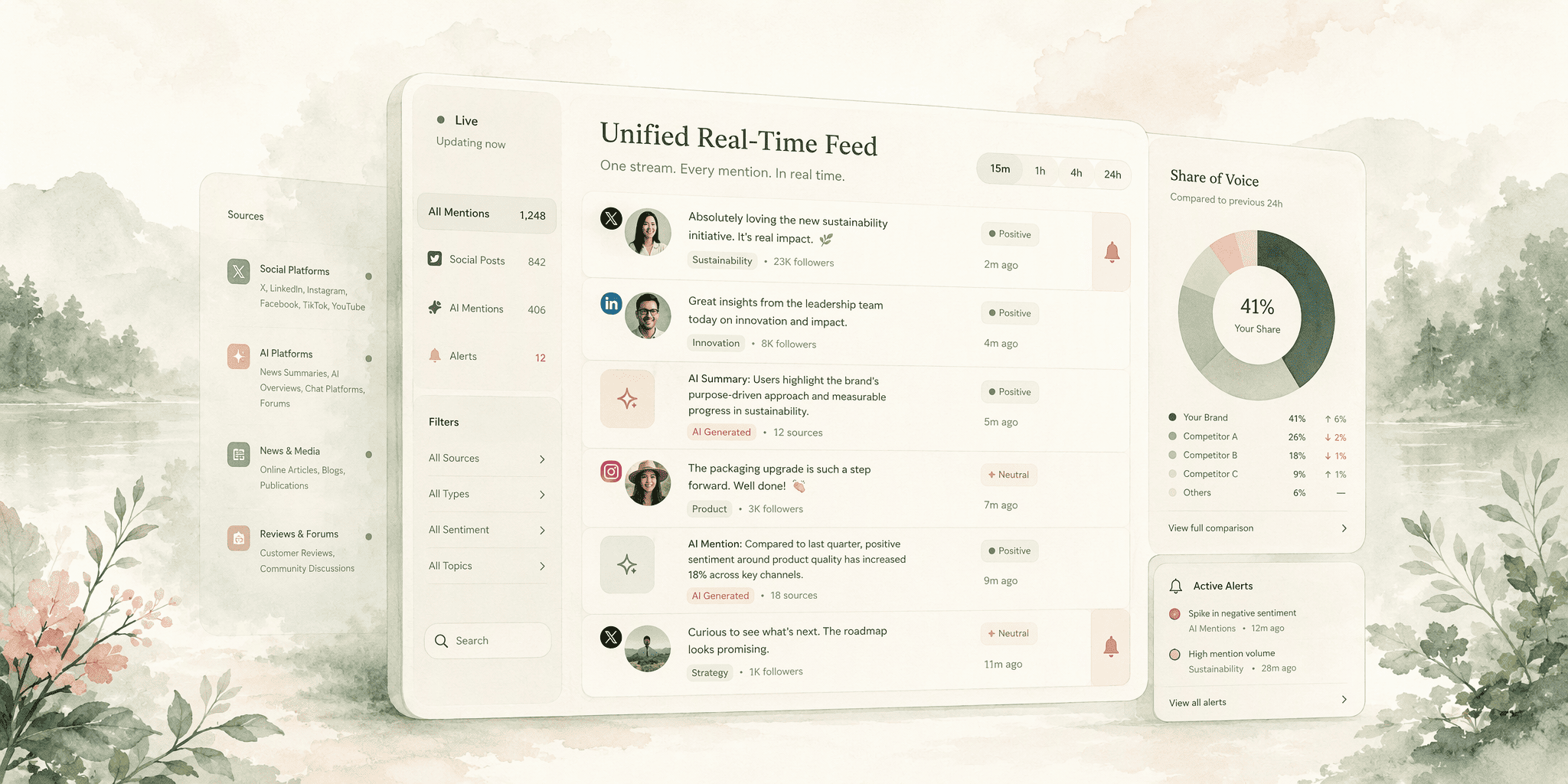
BrandMentions AI gives social media managers the unified feed they keep asking for. One stream surfaces brand mentions across social platforms and AI engines in real time. You stop switching between a social listening dashboard and a separate AI visibility tool.
The platform notifies you the moment your brand appears in an AI-generated answer or a social post gaining velocity. Share-of-voice reporting shows your mention volume against competitors across both channels in one view. For teams running on incident-response timelines, that immediate alert is where the tool earns its spot.
Here is what the consolidation does not cover. BrandMentions AI points you toward volume and velocity trends but skips the deeper diagnostic questions: why an AI recommended a competitor over you, or whether the cited source was your own content or a third party's. Brand managers who need alerting and mention-volume trending first, with diagnostic depth a distant second, will find it fits.
Profound Alternative #4: AI-SEO Monitor by Semrush, Integrating traditional SEO with generative engine analytics

Semrush extends its established SEO toolkit into generative engine monitoring with AI-SEO Monitor, which blends traditional organic ranking data with AI engine performance analytics in a single dashboard. For the thousands of teams already running keyword tracking, competitive analysis, and site audits inside Semrush, the adoption path is the lowest-friction option on this list. You keep your shared keyword sets and competitor projects; the platform adds a generative-engine layer on top.
The primary value is the continuity between traditional and generative performance. You can compare where you rank on page one of Google with where you appear in AI Overviews for the same query set. You can identify gaps where a competitor shows up in AI answers but not in organic results and prioritize content fixes using a single workflow. Shared keyword taxonomies mean the SEO team does not need to rebuild its entire monitoring framework in a separate tool.
Limitations come from the platform's DNA. AI-SEO Monitor is anchored in the SEO practitioner's mental model: keywords, rankings, and SERP features. It lacks the depth-of-understanding scoring that Cogny provides. It also does not offer the Shopify-integrated product monitoring and citation-to-conversion attribution that Siftly delivers. It excels for teams that already live in Semrush and need to extend into generative analytics without leaving their primary environment.
Which AI Visibility Tool Should You Choose?
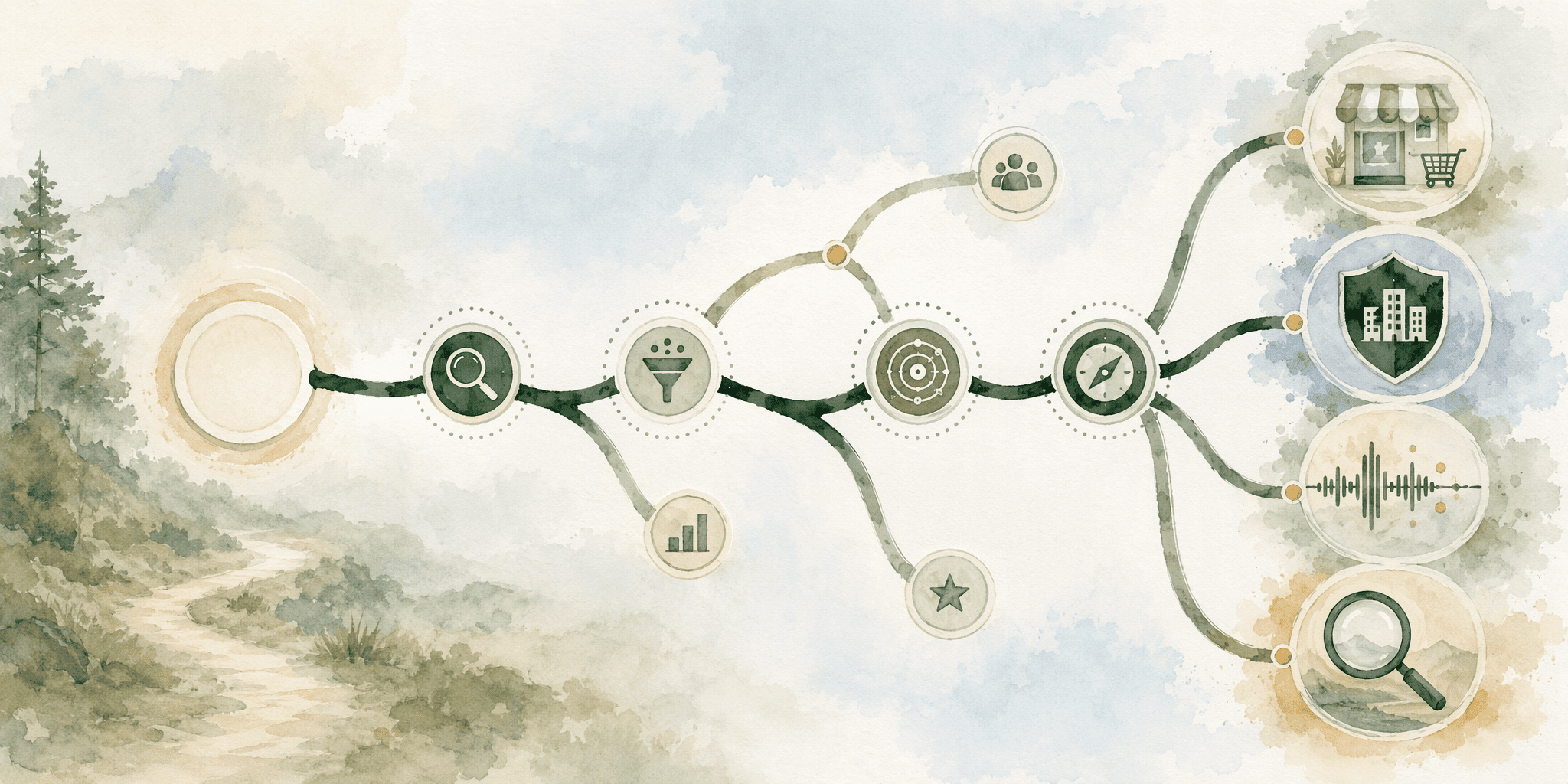
The right tool depends on your monitoring priorities and how your team already works. Match the platform to your use case with this decision framework.
- E-commerce teams that need no-code setup and product-level monitoring: Choose Siftly. The Shopify integration, daily citation tracking, and AI-referred conversion attribution map directly to the metrics a DTC marketing team cares about.
- Enterprise risk and brand-safety teams that must measure factual accuracy: Choose Cogny. If your legal team needs proof that AI assistants are stating your pricing and service details correctly, the depth-of-understanding scoring is the metric that matters.
- Social and comms managers who want real-time AI and social mentions in one feed: Choose BrandMentions AI. The unified alerting and share-of-voice reporting across channels serve incident-response and brand-health workflows best.
- Existing Semrush SEO practitioners extending into generative analytics: Choose AI-SEO Monitor. The shared keyword projects, competitive rank comparisons, and organic-to-AI continuity make adoption nearly frictionless for your current team.
Conclusion
The 2026 data leaves no room for wishful thinking: AI understanding sits at 0.09 for pricing, and 60% of answers hedge instead of stating facts. Systematic, prompt-based AI visibility tracking has moved from a speculative experiment to a boardroom-level requirement. Siftly leads the pack as the best generalist tool for full-funnel monitoring and actionable optimization. Cogny is the specialist pick for organizations that need to benchmark AI factual accuracy, not just mention counts. Pick the platform that matches your monitoring objective, but do not wait another quarter to start tracking.
Frequently Asked Questions
What is AI visibility and how does it differ from traditional SEO metrics?
AI visibility tracks how often and how accurately AI assistants like ChatGPT, Gemini, Claude, and Perplexity mention a brand in generated responses, while traditional SEO metrics measure organic keyword rankings and click-through rates on search engine results pages.
- AI answers are recomposed on every prompt and are inherently unstable.
- Google rankings are relatively durable once earned.
Why should brands track their visibility across AI chat engines like ChatGPT and Gemini in 2026?
AI-generated answers increasingly drive buying decisions and can confidently state incorrect facts. The 2026 State of AI Visibility Index found AI pricing accuracy at just 0.09 and a 60% hedging rate across answers. Brands that do not track visibility cannot detect misrepresentation, missed recommendations, or competitor displacement in AI responses.
What are the best tools available in 2026 for tracking brand mentions in AI-generated responses?
Four primary tools serve AI visibility monitoring for different use cases.
- Siftly offers full-funnel monitoring with Shopify integration and citation-to-conversion attribution.
- Cogny provides depth-of-understanding scoring for enterprise brand safety.
- BrandMentions AI consolidates real-time social and AI mention feeds.
- Semrush's AI-SEO Monitor integrates traditional SEO data with generative engine analytics for existing Semrush users.
How do you measure competitive performance and share of voice within AI search results?
Competitive performance is measured by asking buyer-style prompts, such as 'best CRM for a 10-person agency,' across multiple engines and recording brand mention order, citation frequency, and share of voice. Tools like Cogny report rank among competitors and which sources the engines cited, enabling week-over-week competitive comparisons.
What steps constitute a strong AI visibility monitoring workflow?
Build a fixed prompt set of 8 to 10 buyer questions across category, problem, comparison, and use-case formats. Run those prompts across ChatGPT, Gemini, Claude, and Perplexity on a weekly cadence. Track mention rates, citation sources, and share of voice. Use the trend data to prioritize content and optimization fixes, not single-snapshot verdicts.
Sources
Keep exploring
More from the blog.

Oct 9, 2026
Best Peec AI Alternatives for Tracking AI Visibility in 2026
Your brand is being discussed by AI right now. ChatGPT, Perplexity, and Google AI Overviews are answering buyer questions, recommending competitors

Oct 8, 2026
How to Track Competitor Pricing Changes Without Constantly Checking Their Websites
Checking competitor websites manually is a slow, error-prone drain on your team’s most valuable resource: time.

Oct 8, 2026
HubSpot Alternatives for AI Visibility Tracking in 2026
Your organic traffic just dropped 27% year-over-year, and the culprit isn't a Google algorithm update.