Oct 29, 2026
Why Organic Traffic Is Falling Even When Your SEO Metrics Look Perfect
Your organic traffic dashboard shows a steady green arrow up on keyword rankings. Domain authority ticks higher each quarter. Core Web Vitals pass every test.

Introduction
Your organic traffic dashboard shows a steady green arrow up on keyword rankings. Domain authority ticks higher each quarter. Core Web Vitals pass every test.
Yet session volume from search has entered a structural decline that no single-page optimization can reverse. AI-generated summaries and zero-click results are absorbing informational clicks that previously landed on your site, creating a reporting paradox where traditional SEO metrics diverge from actual visitor numbers.
By October 2026, search engines accounted for just 12% of North American publisher pageviews, down from 21% a year earlier according to Chartbeat. The numbers you track were built for a search model that no longer exists.
The moment you feel that unease, watching session curves bend downward while rank reports stay flat, you are encountering what practitioners now call the great decoupling. AI engines don't index content, they extract it, synthesizing answers from multiple sources without sending users to any of them. Your SEO metrics measure a system designed for blue-link rankings. AI answer engines operate under different rules entirely, prizing semantic query matching over keyword density, verifiable authority markers over marketing claims, and machine-readable structure over persuasive copy. Understanding why this divergence happens is the first step toward measurement that reflects commercial reality rather than legacy dashboard comfort.
Key Takeaways
- Organic sessions are declining while your conventional SEO scores hold steady. That combination usually points to a reporting artifact, not a business crisis. The main culprit is zero-click AI answers absorbing informational traffic that used to land on your pages. Google AI Overviews now appear across roughly half of all queries, and when they surface, organic click-through rates drop by over 60% per Seer Interactive analysis from 2025.
- Your most reliable diagnostic signal is the direction of pipeline and revenue. If conversions are steady or rising while sessions dip, the traffic you lost was low-intent informational browsing. Stable branded search volume, rising direct traffic, and consistent high-intent sessions on pricing and demo pages all reinforce a healthy underlying business. A genuine crisis looks different: revenue falls in parallel with traffic, branded interest deteriorates, and search impressions collapse across every category.
- The playbook has shifted. Product pages and case studies need protection from AI summarization while you build original, non-commoditized insights that algorithms cannot synthesize. Modernized measurement replaces vanity session counts with full-funnel outcomes: qualified pipeline velocity, blended customer acquisition cost, and share of voice inside AI-generated answers. The rules of ranking have moved from optimization to verification.
At a Glance
Here is how the options compare across the dimensions that matter most.
| Diagnostic Signal | What It Indicates | Action Required |
|---|---|---|
| Sessions down, keyword rankings up | Zero-click AI answers absorbing informational traffic | Shift measurement focus from rank volume to pipeline velocity |
| Revenue stable or rising with lower traffic | Lost traffic was low-intent, top-of-funnel browsing | Protect high-intent pages (pricing, demo) from AI summarization |
| Revenue falling parallel to traffic | Genuine business crisis, not a measurement illusion | Audit branded search volume and commercial-intent rankings |
| Search impressions up, click-through rate down | More queries answered without sending users to sites | Build non-commoditized insights that AI cannot synthesize |
| Direct traffic rising as organic declines | Brand strength remains healthy; users navigate manually | Invest in original content and verifiable authority markers |
| Branded search volume deteriorating | Loss of audience recognition or trust | Investigate brand perception and SERP feature competition |
| Impressions collapsing across all query types | Algorithm update or technical penalty | Check for crawl errors, manual actions, or core update impacts |
The Verdict: Is This a Real Crisis or a Reporting Mirage?
For most businesses seeing this pattern in late 2026, the decline is a measurement illusion. Informational content that once reliably delivered high-volume, low-intent traffic is being answered directly on search engine results pages before users click anywhere. The sessions disappearing are overwhelmingly top-of-funnel browsers, not buyers evaluating your product.
Google search impressions are actually up 49% year-over-year, but click-through rates have fallen 30%, confirming that more searches are happening while fewer result in visits to third-party sites.
A genuine business crisis looks different. Revenue declines in lockstep with traffic, branded search volume drops, and your position on commercial-intent terms erodes. When B2B tech AI Overview coverage grew from 36% to 70%, companies whose pricing and comparison content became invisible inside those summaries felt real commercial impact.
The question to ask is whether the people who matter, who have budget, who are actively evaluating solutions, still find and choose you. If pipeline stays constant while sessions drop, the traffic you lost was never going to convert anyway.
The Mechanics of Vanishing Clicks: AI Overviews and Zero-Click Results
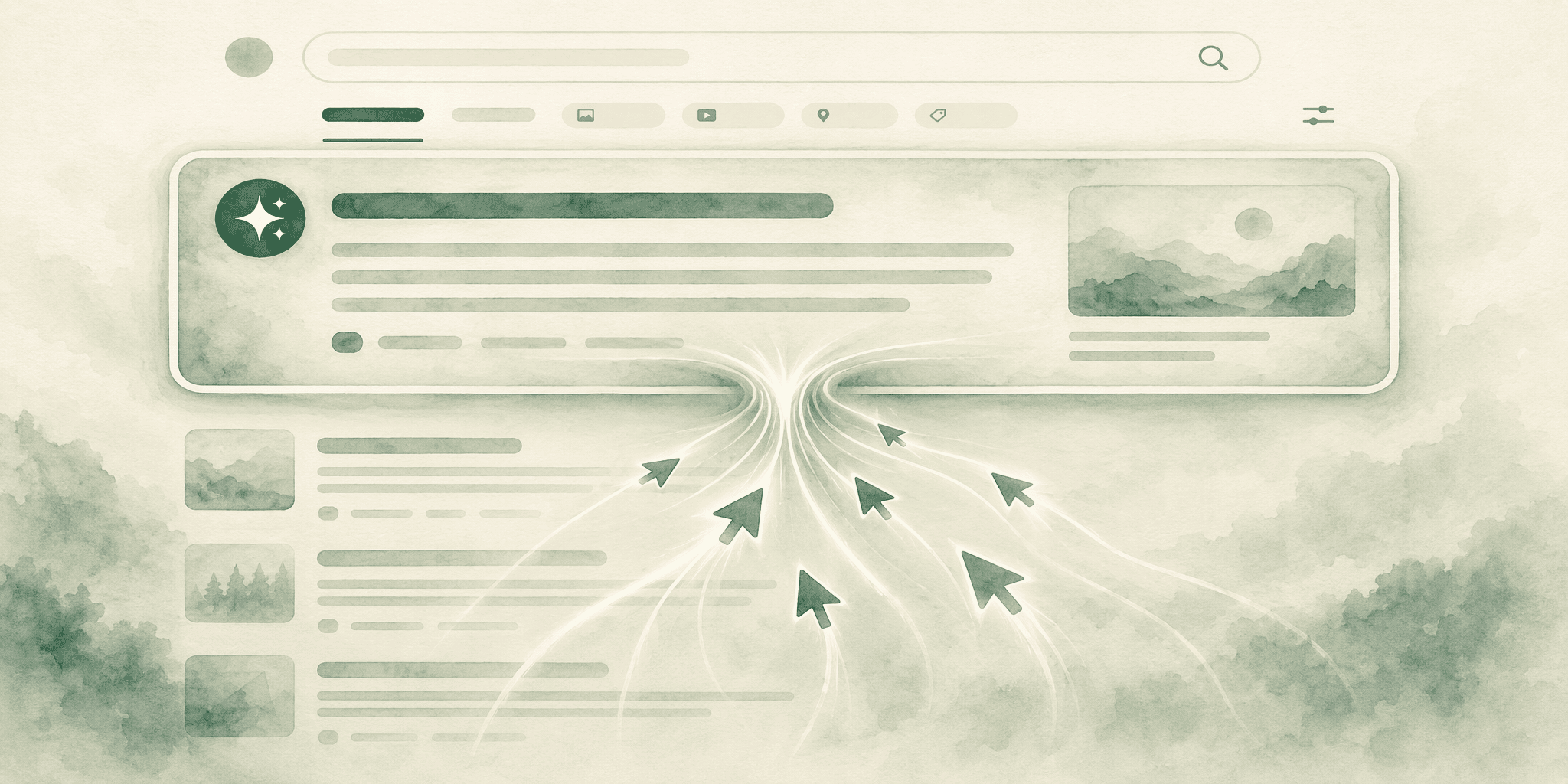
Google AI Overviews present a synthesized answer block at the top of search results, pulling and merging information from multiple sources without requiring the searcher to visit any of them. When these modules appear on approximately half of all queries, the organic result links below them become supplementary rather than primary destinations. The click economics are stark: organic CTR drops by over 60% when an AI Overview is present. Searchers get their answer in the summary and leave, or refine their query with longer, more specific prompts. A 7x increase in queries of 8+ words and a 48% rise in technical terminology in search queries both signal users adapting to conversational AI search patterns.
Vertical exposure varies dramatically. Healthcare and education queries approach 90% coverage for AI Overviews. B2B tech coverage surged from 36% to 70%.
Yet ecommerce queries showing AI Overviews declined from 29% to 4%, suggesting transactional intent still triggers more traditional result pages. This pattern explains why many SaaS and service businesses feel the traffic pinch more acutely than retailers. Zero-click dynamics concentrate in domains where questions have discrete, synthesizable answers, exactly the informational content many content marketing strategies were built to produce.
Five-Engine Brand Visibility: Quantifying Citations That Don’t Drive Sessions

Your brand can be cited repeatedly across ChatGPT, Perplexity, Google AI Overviews, Gemini, and Claude without generating a single attributable session. Traditional web analytics fail to capture AI-powered brand discovery because conversational platforms cite sources without always sending traffic. A citation links to a page used as a source; a brand mention means your brand name appears in the AI-generated answer. Both matter for visibility, but neither reliably produces a click. In one IQRush client analysis, more than four out of five brand mentions were supported by citations, showing that structured, verifiable content earns visibility even when it does not earn sessions.
What is being missed extends beyond traffic counting. A prospect who sees your brand consistently cited across multiple AI platforms across weeks of research enters your pipeline with conviction that no landing page view captures. The correlation between traditional SEO strength and AI citation presence confirms the connection: the correlation between the number of keywords a domain ranked for and the number of AI citations it received sat tightly between 0.86 and 0.87 across AI platforms analyzed by Semrush. Real-time monitoring across engines becomes key because you cannot optimize what you cannot see.
Decoding the Signals: Is Your Pipeline Intact or Is the Business Breaking?

Separate your diagnostics into commercial health signals and visibility health signals. Commercial health checks whether revenue generation remains functional: pipeline volume, deal velocity, win rates, and average contract value. Visibility health checks whether your brand maintains presence where prospects conduct research. Both matter, but only commercial health tells you whether the business has a real problem. Steady pipeline alongside 30% fewer organic sessions is a measurement gap, not a market position collapse.
Dig deeper into traffic composition before concluding anything. Filter for high-intent sessions hitting pricing pages, demo request flows, and product comparison URLs. If these are flat or growing, the traffic loss sits squarely in informational content that AI is now answering directly.
Watch branded search volume for erosion, as declining brand interest signals a competitor capturing mindshare in AI answers. Monitor search impression curves for collapse across all categories.
AI visibility patterns themselves vary by vertical: consumer brands surfaced more frequently for transactional queries, while financial clients appeared mainly for informational intent in recent audits. Your vertical's dynamics determine which signals deserve the most weight.
Auditing for Illusions: The Metric Table That Separates Panic from Prudence
Your existing SEO dashboard was built to surface problems from the last era. Replace it temporarily with a diagnostic framework that distinguishes measurement noise from commercial signal. Start with the direction of revenue.
A three-month rolling trend line of qualified pipeline and closed-won revenue tells you immediately whether the business is intact. Below that, check branded search volume stability, direct traffic trends, and high-intent page session counts. When revenue and brand interest hold steady while informational traffic falls, the operating diagnosis is a reporting illusion.
Add AI-specific visibility metrics to complete the picture. Track citation frequency and brand mention rate across ChatGPT, Perplexity, Google AI Overviews, and Gemini. Monitor share of voice: when your category is queried, whose content surfaces? If another domain is repeatedly cited across important prompts while your brand is missing from the associated answers, you have a citation gap worth investigating.
You can use a tool like Siftly to monitor brand mentions across ChatGPT, Google AI Overviews, Gemini, Perplexity, and Claude through daily automated query execution, giving you visibility into how AI systems find, judge, and cite your content across major conversational platforms. A free audit establishes baseline visibility before you commit to any platform investment.
Strategic Recovery: Protecting Commercial Assets and Prioritizing Non-Commoditized Insights

Not all content deserves the same defensive posture. Product pages, pricing tables, case studies, and comparison content represent commercial assets that directly influence purchase decisions. These must be structured so AI engines can cite them accurately even when summarizing. Implement clear schema markup, maintain fresh data, and present differentiated positioning that resists commoditization. For ecommerce specifically, platforms like Siftly can improve product metadata, attributes, schema, Shopify feeds, and Google Merchant Center data, making product information machine-readable for AI shopping environments.
Above the commercial layer, invest in original, non-commoditized insights that algorithms cannot easily synthesize. Proprietary data analysis, practitioner frameworks born from direct experience, unique survey results, and perspective-driven commentary all resist being subsumed into generic AI summaries. 89% of AI Overview citations come from beyond the top 100 organic listings, reinforced by a 400% increase in citations from positions 21 to 30. Depth and originality now matter more than position, creating opportunity for content strategies that prioritize distinctiveness over keyword coverage.
Modernizing Measurement: From Vanity Sessions to AI-Era Revenue Attribution

The session count that once anchored every monthly marketing report has lost its meaning. Replace it with full-funnel commercial metrics that bridge visibility and revenue. Qualified pipeline volume, broken down by source influence rather than last-click attribution, captures the multi-touch research journeys that now dominate B2B buying. Deal velocity and win rate by segment reveal whether pipeline quality is improving even as top-of-funnel volume shrinks. Blended customer acquisition cost, incorporating both traditional and AI-referred channels, surfaces efficiency shifts that session counts obscure.
AI-specific attribution remains directional rather than deterministic. No platform today offers a fully validated citations-to-revenue attribution model because conversational AI responses are probabilistic. What you can measure is citation frequency, brand mention rate, and share of voice across engines, then correlate visibility gains with commercial outcomes over time.
Siftly offers directional citation-to-traffic modeling that helps teams connect visibility signals to pipeline movement. A pragmatic measurement stack treats AI citations as a leading indicator while anchoring accountability in lagging revenue metrics that matter to the board. Domain authority retains significant predictive power for AI visibility.
Domains with an Authority Score of 81 or higher received around nine times the median citation share of domains scoring 60 or below. The focused correlation between Authority Score and AI citations reached 0.70 on Google and 0.43 on ChatGPT, confirming that established credibility signals transfer into AI visibility, though unevenly across platforms. Building authentic authority through original research, practitioner depth, and verifiable expertise remains the most durable strategy for earning citations in an AI-dominated discovery landscape.
Conclusion
Your organic traffic can slide 30% while every SEO health metric stays green. Search clicks across Google fell that much in the last year even as rankings held steady, according to Search Engine Land's analysis of AI Overviews data. The dashboard wasn't buggy. It was measuring a game whose rules already changed.
AI engines absorb informational queries that used to send a visitor. Your site is still authoritative, still well-structured, still fast. The answer just reached the user without the click. That separation between a healthy ranking and a missing session is the core misunderstanding that spooks marketing teams into reacting to a measurement artifact.
Successful teams in this environment run a short diagnostic sequence first. They confirm pipeline health: are SQLs, opportunities, and revenue holding? If those numbers are intact, the traffic decline is a channel shift. They then relocate budget toward original research, data assets, and commercial-intent pages that resist commoditization. They add AI visibility monitoring alongside SERP tracking because brand presence inside ChatGPT, Perplexity, and Google AI Overviews influences purchase consideration even when no referral registers.
The single action that moves you forward today is establishing a visibility baseline across the AI platforms your prospects use for research. Without knowing whether your brand surfaces when it matters, you cannot prioritize content investments or measure improvement. Tools like Siftly provide automated monitoring, competitive benchmarking, and prescriptive optimization recommendations across 9 AI engines, including Google AI Overviews, ChatGPT, Perplexity, Gemini, and Claude.
A free trial requires no credit card and gives you real citation data before any commitment. The traffic drop is a measurement failure. The commercial opportunity inside AI visibility is real.
Frequently Asked Questions
What is causing organic search traffic to decline even when traditional SEO metrics like rankings and click-through rates appear healthy?
AI-generated summaries and zero-click results are absorbing informational clicks before they reach your site. Google AI Overviews appear on roughly half of all queries, and when they do, organic click-through rates drop by over 60% (Seer Interactive 2025). Your rankings are stable, but the user gets the answer on the search results page.
How have AI-generated search results changed user behavior and reduced click-through rates to organic websites?
Users now get complete answers directly on search engine results pages or within tools like ChatGPT and Perplexity, eliminating the need to click through. By October 2026, search engines accounted for just 12% of North American publisher pageviews, down from 21% a year earlier according to Chartbeat.
Which quantitative signals confirm that AI overviews and zero-click searches are absorbing my traffic rather than visible ranking drops?
Your keyword rankings and search impressions hold steady, but sessions decline. You'll see stable branded search volume and direct traffic alongside a drop in informational organic clicks. Crucially, high-intent sessions on pricing or demo pages remain consistent, indicating that commercial visibility is intact while informational traffic evaporates.
What steps can I take to recover visibility and traffic when my content ranks well but receives fewer clicks from search engines in 2026?
Focus on protecting commercial assets like product and pricing pages from AI summarization. Prioritize publishing original research, data, and expert analysis that algorithms cannot easily commoditize. Optimize your content for visibility within AI-generated answers, since AI-referred sessions grew dramatically year over year in 2025.
How should I adapt my SEO strategy and reporting to measure success across both traditional search and generative AI answer engines?
Shift measurement from vanity session counts to full-funnel commercial outcomes. Track qualified pipeline, deal velocity, and blended customer acquisition cost. Audit your brand's visibility inside AI-generated answers using tools that monitor AI citations and sources, not just traditional blue-link rankings.
Sources
- What Is Answer Engine Optimization (AEO)? | Siftly - siftly.ai
- Answer Engine Optimization Playbook for 2026 - siftly.ai
- 7 Best Answer Engine Optimization Tools for Dominating AI - siftly.ai
- New Google AI Overviews data: Search clicks fell 30% in last year - searchengineland.com
- SEO is foundational for AI search visibility: Our data shows how - enterprise.semrush.com
- The AI Search Visibility Audit: 15 Questions Every CMO Should Ask - www.searchenginejournal.com
- How to track your AI citations and sources with Semrush - www.semrush.com
- Why organic traffic can fall while revenue stays strong - martech.org
- Search Traffic Share Drops to 12% — Chartbeat - palai.media
Keep exploring
More from the blog.

Oct 29, 2026
7 Best AI Brand Monitoring Tools to See What AI Actually Says About You in 2026
You send a prospect to check what ChatGPT says about your category. It mentions three of your competitors by name, pulling a specific product detail for each.

Oct 29, 2026
7 Tools to Measure Brand Visibility Across AI Platforms like ChatGPT and Gemini in 2026
Marketing teams are discovering a chilling fact in 2026: their carefully built search dominance is invisible to a growing segment of buyers.

Oct 29, 2026
7 Best AI Shopping Visibility Tools in 2026 to Win the AI Shelf
Your best-selling product can get a glowing five-paragraph recommendation from ChatGPT and still lose the click to a competitor cited in Google's AI Overview.