Oct 5, 2026
The 8 Best Ways to Track ChatGPT and AI Brand Mentions in 2026
A customer asks ChatGPT for the best running shoes, and the model names five brands but recommends none of them are yours.

Introduction
A customer asks ChatGPT for the best running shoes, and the model names five brands but recommends none of them are yours. The search never hits Google Analytics, the session never fires a pageview, and the missed revenue is invisible. This is the core challenge in 2026: brand visibility is fragmenting across opaque, generative interfaces that leave no traditional digital exhaust.
The evidence for what AI engines say about your brand churns relentlessly. BrightEdge tracked ecommerce prompts across ChatGPT, Gemini, and Google AI Overviews over 12 weeks and found citations changed 39% on ChatGPT and 41% on Gemini week over week. Your brand name might hold steady, but the sources the AI cites as proof turn over nearly half of their URLs every seven days.
Traditional monitoring was built for a world of stable indexes and crawled pages. That world is gone. The tools and methods for tracking your brand across answer-engines now range from enterprise suites that score prevalence across nine models to a zero-cost manual spreadsheet. Every section that follows addresses one approach, ranked by its ability to connect AI visibility to business outcomes.
Key Takeaways
The central problem is whether AI cites you as the authoritative source and what happens when it stops. The path from awareness to purchase increasingly bypasses your site entirely, making citation tracking the new rank checking.
- Stable names, volatile evidence: Brand mentions shift only 25% weekly, but citations churn at 39 to 41%, your reputation evidence changes nearly every week.
- No single engine predicts the others: Across ChatGPT, Gemini, and Google AI Overviews, only 28 of 50 top brands overlap for mentions, and just 13 of 50 for cited domains.
- Mentions are the reach proxy, citations are the trust proxy: Share of voice measures visibility, share of citations measures authority.
- Attribution remains a weak signal: LLM-generated answers rarely pass referrer headers, so downstream traffic and revenue measurement requires specialized tooling or proxy metrics.
- A weekly baseline is non-negotiable: Without measuring the normal weekly churn (15% new citations on ChatGPT, 37% on Gemini), you cannot distinguish noise from a genuine reputation shift.
- Enterprise platforms refresh daily: Meltwater's GenAI Lens refreshes on a 24-hour cycle, making it viable for near-real-time competitive response.
1. Siftly, Full-Funnel AI Visibility with Revenue Attribution

For teams that need to move beyond counting impressions and attribute AI chat interactions to downstream revenue, Siftly is the strongest contender in 2026. It tracks brand presence and sentiment across ChatGPT, Perplexity, Google AI Overviews, and Gemini, then measures conversion events tied to AI-referred clicks. The platform connects AI-generated citations to site traffic and purchase events, closing the loop that most monitoring tools leave open.
The Starter plan tracks three products with daily visibility, rank, and share of voice scores across the covered engines. Scaling up, the Pro plan expands to 30 products, and Enterprise unlocks unlimited products, SKUs, prompts, and geographies plus a dedicated success manager. Competitor benchmarking is built-in, so you can measure your recommendation frequency against rivals across multiple search engines at once.
A free 14-day trial with no credit card required removes the barrier to testing the platform before committing.
2. Meltwater GenAI Lens, Enterprise Listening Across LLMs
Meltwater positions GenAI Lens as the enterprise-grade command center for multi-engine intelligence, covering more models than any competitor. The table below distills its key capabilities against the needs of a brand monitoring team.
| Dimension | Meltwater GenAI Lens Capability | Why It Matters |
|---|---|---|
| Engine Coverage | Monitors ChatGPT, Perplexity, Google AI Overviews, Google AI mode, Deepseek, Llama, Claude, Gemini, and Grok | No other platform covers this breadth; critical given only 13 of 50 cited domains overlap across three engines |
| Refresh Cadence | 24-hour data refresh cycle | Enables near-daily competitive monitoring, important when a competitor can displace a Perplexity citation within 48 hours |
| Core Metrics | Prevalence scores measuring how often your brand appears, plus share of voice benchmarks | Quantifies visibility trends over time, moving beyond anecdotal spot-checks |
| Source Attribution | Identifies driving content sources (Reddit, Wikipedia, media publications) | Reveals which third-party content shapes AI narratives about your brand so you can influence it directly |
| Customization | Prompt-level query customization | Mirrors the actual prompts your target customers use, not generic industry keywords |
3. BrightEdge Copilot, SEO-Led Citation Monitoring and GEO

BrightEdge Copilot is the tool for SEO teams who already live in search data and need citation churn quantified, not just observed.
The platform surfaces the critical metric distinction that defines this discipline: stability in brand mentions versus volatility in evidence. Their 12-week study across ecommerce prompts revealed mention overlap among three engines for only 28 of 50 brands, while cited domain overlap applied to just 13. Knowing your brand is named means little if the supporting source material is rotating out weekly.
Google's own ecosystem is deeply fragmented. Gemini and Google AI Overviews share only 22 of 50 cited domains in their top 50, meaning Google's two flagship AI surfaces cite different evidence sets for the same queries. AI Overviews concentrates heavily: 41% of its citations come from just five domains. For brands outside that concentrated set, visibility depends on the specific engine and the specific week. BrightEdge makes that churn visible and prescribes content adjustments tied directly to the Generative Engine Optimization feedback loop, turning monitoring into action rather than passive reporting.
4. Brandwatch, AI-Powered Social and Reputation Convergence
AI-generated answers increasingly pull source material from social platforms and user-generated content, with Reddit as the single most-cited source across every major AI engine at roughly 40% frequency. That convergence makes social listening data directly relevant to monitoring what AI says about your brand.
Brandwatch operates in this overlap zone, unifying AI-generated brand references with social conversation streams and broader reputation signals. When a Reddit thread surfaces as a top citation in a ChatGPT response, Brandwatch can trace that back to the originating discussion, showing you who is shaping the narrative and on which platforms. The approach treats AI outputs not as isolated generations but as downstream products of the social web the platform already monitors comprehensively.
For brand managers running integrated reputation operations, the value is in correlation: a spike in negative social chatter that precedes a shift in AI sentiment is actionable lead time. The approach requires accepting that AI monitoring is a derived signal from social monitoring, not a direct LLM query pipeline, which trades precision for breadth of context.
5. AimTell, Boutique AI Answer Tracking for Pragmatists
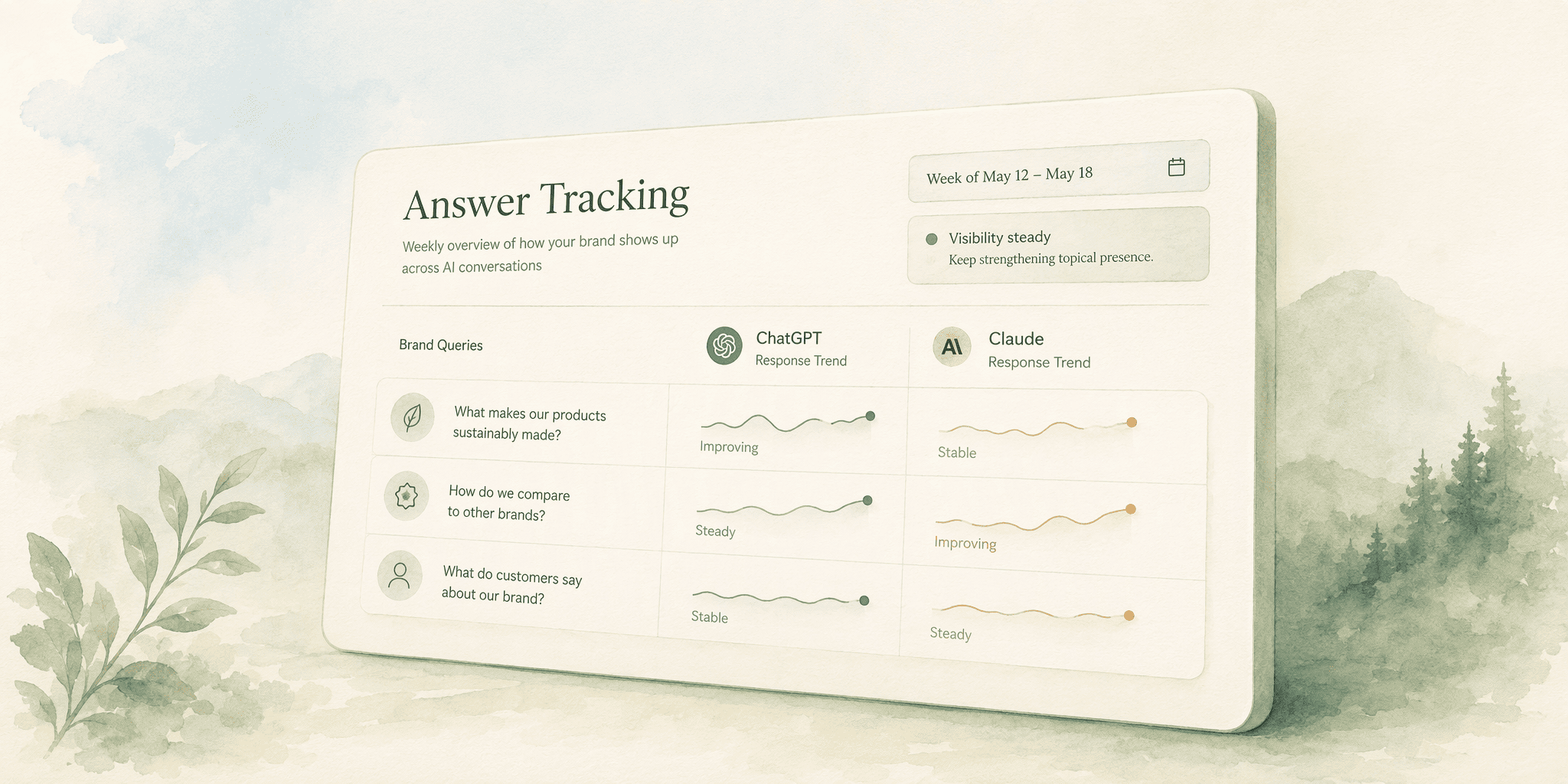
Not every team needs a platform that monitors nine engines with 24-hour refresh cycles. AimTell strips the category to its essentials: tracking specific brand queries across AI engines without the enterprise overhead. It is purpose-built for the marketing director who needs a weekly answer to "What did the models say about us?" and wants to pay for exactly that capability and nothing more.
At a lighter footprint and price point, AimTell queries ChatGPT, Claude, and other AI search surfaces against your defined query set, likely the 20 to 40 prompts in four groups (Category, Comparison, Problem, and Brand prompts) that form the standard monitoring framework. The output is direct and scannable: what each engine returned, which sources it cited, and how those answers shifted from the prior check. For budget-conscious operators who need no-overkill intelligence, it is a pragmatic entry point into systematic monitoring without the commitment a full GEO platform demands.
6. DIY Multi-Engine Monitoring, Spreadsheets, Prompts, and Proxies
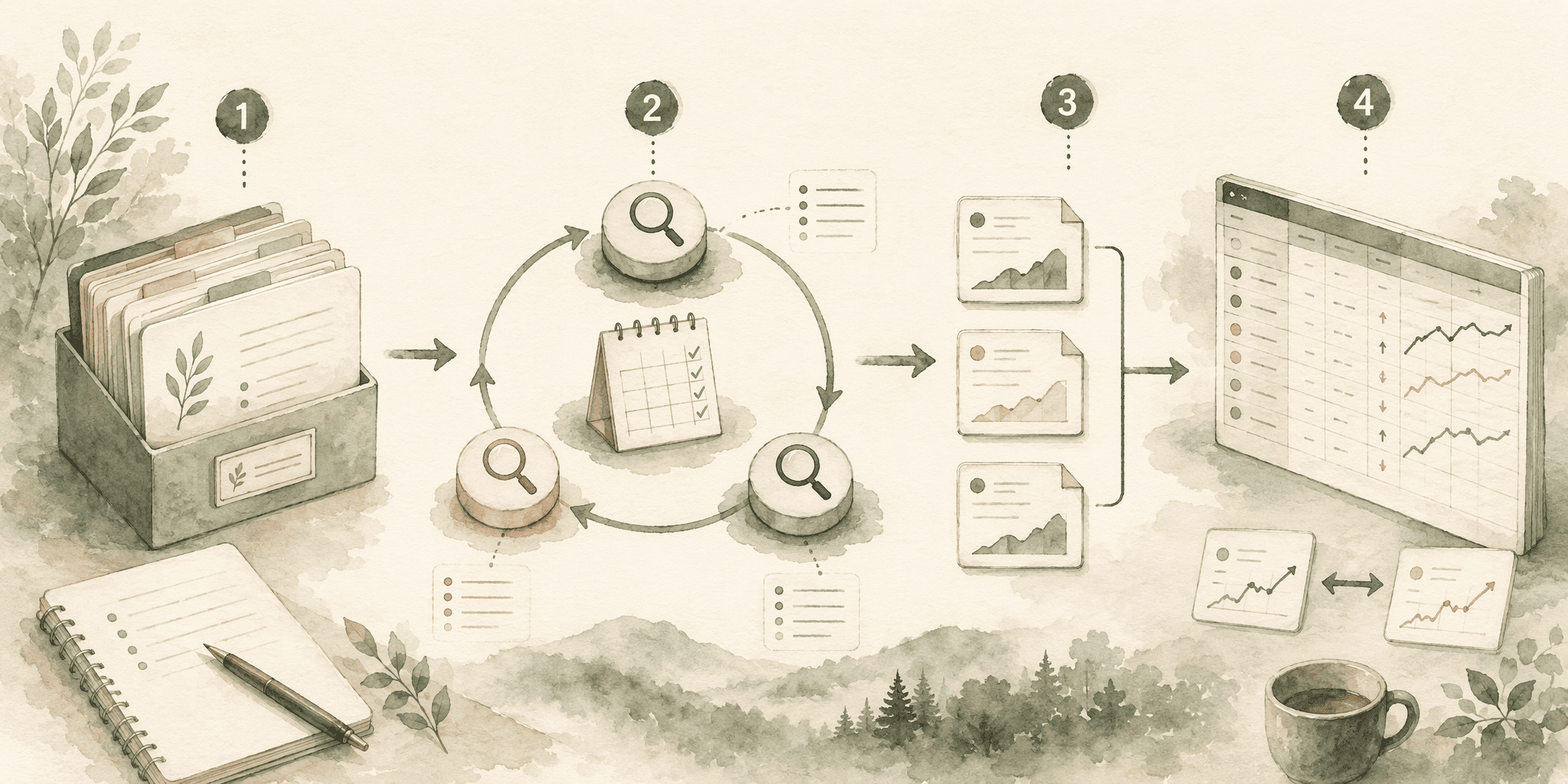
Before committing budget to a paid platform, every team should establish a zero-cost weekly baseline to prove the volatility is real for their specific category. The methodology requires only a prompt set, a spreadsheet, and a disciplined weekly cadence. Below is the core workflow.
- Build a 20-to-40 prompt library organized into four groups: Category prompts ("best CRM for small business"), Comparison prompts ("HubSpot vs. Salesforce"), Problem prompts ("how to reduce churn in SaaS"), and Brand prompts ("what is [your brand] known for").
- Query every prompt against five engines: ChatGPT, Claude, Perplexity, Google AI Mode, and Gemini, using a clean session or incognito window each time to avoid personalization bias.
- Record two data points per prompt per engine: whether your brand appeared in the output and which specific URLs, domains, or sources the engine cited to support any claim about your brand or category.
- Calculate a week-over-week churn baseline: Compare the new versus prior week's citations. BrightEdge found 15% of cited URLs were new each week on ChatGPT and 37% on Gemini; your category may differ.
- Flag displacement events: When your brand drops out of a previously held answer slot, note what replaced it, a competitor, a publisher, or a marketplace, and the source that supported the replacement.
- Use proxies to rotate IP geographies where relevant, since AI outputs can vary by inferred location, ensuring your baseline reflects the markets that matter.
7. Perplexity's Built-In Analytics, Niche Discovery and Source Intel
Perplexity uniquely exposes the source material behind every claim it generates, making its platform a free intelligence layer for brand managers who understand how to read it. The transparency is a research asset, not just a monitoring output.
- Real-time source mapping: For any query, Perplexity lists the exact URLs and domains it consulted, giving you a live view of which sources the engine trusts for your category. Because cited domain overlap across engines is low (only 13 of 50 shared), that engine-specific source map directs your PR and link-building strategy with precision, not guesswork.
- Recency-weighted displacement tracking: Perplexity's 3-layer reranking model weights freshness aggressively, meaning a competitor publishing a strong comparison article can displace your brand within 48 hours. Checking your category queries twice weekly flags displacements before they compound.
- Competitive citation monitoring: For any query including a competitor's name, Perplexity reveals which sources the model cites as evidence, exposing the content gaps you need to fill. If a rival owns the citation because they published a definitive comparison guide, that is a concrete content brief, not an abstract ranking problem.
8. Integrating Shopify for AI Shopping Query Performance

Ecommerce brands face a specific AI visibility threat: unpopulated product attributes. When your Shopify product data is missing structured attributes like material, dimensions, or compatibility, search engines fill the gaps from external sources, and BrightEdge found those sources rotate roughly 40% weekly in Google's shopping stack. Your product page is the authoritative source, but the AI is not reading it unless the data is complete and structured.
The monitoring workflow starts with a Shopify audit: query product-specific prompts across AI engines ("best lightweight running shoe under $120") and record whether your product appears and which attributes the AI assigns to it. When the AI populates a feature from a third-party review site instead of your PDP, add that attribute to your Shopify product feed. Use a tool like Siftly to connect your store directly and track how AI engines describe your products over time. The process then becomes a loop: monitor gaps, populate attributes from your canonical data, re-query to confirm the AI now pulls from your source, and benchmark competitors using the same prompt set to ensure a rival's stronger PDP does not displace your recommendation.
Conclusion
AI brand tracking in 2026 is not optional, it is the replacement for rank checking in a world where generative answers are the results page. The evidence is unambiguous: citations churn at 41% on Gemini and 39% on ChatGPT every week, and only 13 of 50 top cited domains overlap across engines. Monitoring one surface predicts nothing about the others.
The spectrum runs from a manual weekly spreadsheet querying five engines, through boutique tools like AimTell and the free intelligence layer of Perplexity's source citations, up to full-funnel platforms like Siftly and enterprise suites like Meltwater GenAI Lens. The only wrong move is waiting. Establish your weekly baseline this week, before a competitor's content displaces your brand in the one engine your best customers actually use.
Frequently Asked Questions
What are the best tools to monitor how AI chatbots like ChatGPT describe my brand?
The top tools in 2026 span enterprise to lightweight options. Here are five leading platforms and their primary strengths:
- Meltwater GenAI Lens offers the broadest engine coverage (nine platforms) with 24-hour refresh cycles.
- Siftly connects AI visibility to downstream revenue with a free 14-day trial.
- BrightEdge Copilot specializes in citation churn quantification for SEO teams.
- AimTell provides focused, budget-conscious tracking for smaller teams.
- The right choice depends on whether you need revenue attribution or simple mention monitoring.
How does AI brand monitoring work compared to traditional social listening or SEO tracking?
Social listening monitors public feeds; AI brand monitoring systematically queries the models themselves to capture generated answers that cite your brand or competitors. SEO ranking tools track indexed page positions; AI monitoring tracks ephemeral generated responses where your brand may be named (a mention) or your content may be referenced as a source (a citation). These are distinct measurement layers.
What specific metrics should I track to understand my brand's presence in AI-generated answers?
The core distinction is share of mentions (is your brand named?) versus share of citations (which URLs support the claims?). To operationalize this, track these three metrics weekly against an established baseline:
- Prevalence scores, the frequency and prominence of brand mentions or citation appearances.
- Competitor displacement frequency, how often a rival's content replaces yours in AI-generated answers.
- Source attribution, where the AI pulled its evidence from, helping you identify content gaps.
How can I improve what ChatGPT and other AI tools say about my company once I identify inaccuracies?
To correct an inaccurate AI answer, follow these four steps:
- Identify the sources the AI cites for the inaccurate claim, tools like Meltwater or Perplexity's source links reveal this.
- If a third-party article contains the error, correct it at the source or publish contradictory, authoritative content.
- For ecommerce, ensure your Shopify product attributes are fully populated, since unpopulated fields get filled from rotating external sources.
- Re-query to confirm the shift.
Can I track my competitors' AI visibility and how they are recommended against my brand?
Yes, competitive AI visibility analysis is possible through these approaches:
- Query comparison prompts ("Brand A vs. Brand B") across engines and record recommendation frequency, supporting citations, and framing language.
- Siftly includes built-in multi-engine competitor benchmarking.
- Perplexity's source links reveal which content supports a competitor's recommendation, exposing the content gaps you need to fill with your own authoritative material.
How can I attribute website traffic or sales back to AI chat platforms like ChatGPT or Perplexity?
Direct attribution is challenging because most AI chat interfaces do not pass referrer headers. Siftly is one of the few platforms that attempts citation-to-revenue attribution by measuring conversion events tied to AI-referred clicks. For other tools, share of mentions serves as the primary proxy for visibility, supplemented by correlating site traffic fluctuations against a monitored citation baseline.
Sources
- AI Brand Monitoring & Tracking: The Complete Guide (2026) - siftly.ai
- What Is AI Brand Monitoring? | Siftly - siftly.ai
- GenAI Lens | AI Brand Monitoring Software - www.meltwater.com
- Track Brand Share of Voice: ChatGPT & Perplexity - www.get-ryze.ai
- How to Track Your Brand's Mentions in AI Answers - okara.ai
- Brands Hold, Evidence Turns Over: 12 Weeks of Ecommerce Citations Across Three AI Engines | BrightEdge - www.brightedge.com
Keep exploring
More from the blog.

Oct 24, 2026
7 Best AI Optimization Platforms for B2B SaaS Startups on Tight Budgets in 2026
ChatGPT named your B2B SaaS startup during a buyer's evaluation, then told them to go with a competitor.

Oct 24, 2026
7 Best Platforms for Monitoring How AI Perceives Your B2B SaaS Brand in 2026
Your B2B SaaS brand is being evaluated by machines right now. A prospective buyer asks ChatGPT to “compare the top data onboarding tools for mid-market

Oct 23, 2026
How to Optimize Your Brand Presence in Generative AI Search Results
The uncanny silence of organic traffic in analytics dashboards isn't a tracking bug; it's the sound of a fundamental shift.