Oct 29, 2026
Perplexity and Claude Content Optimization: The 7-Step GEO Blueprint for 2026
Your highest-traffic Google page might be invisible to Perplexity and Claude.

Introduction
Your highest-traffic Google page might be invisible to Perplexity and Claude.
Across 2026, AI answer engines have broken the traditional search model, and the overlap between what ranks and what gets cited is startlingly thin. The generation that once Googled everything now asks multi-sentence questions and expects a single, synthesized answer. Standing still with old-school SEO means watching your brand vanish from the answers your prospects actually see.
Pew Research data confirms the user behavior driving this: users click traditional results in just 8% of visits when AI summaries are present, versus 15% when they are not. Ahrefs research on citation patterns reinforces the disconnect at the engine level, finding only 8% overlap between ChatGPT citations and top-10 Google rankings and 28.6% for Perplexity citations. The rules have changed underneath your content. AI search engines extract passages, and they choose sources based on a logic traditional SEO was never built to influence.
This guide lays out a seven-step Generative Engine Optimization (GEO) blueprint for Perplexity and Claude visibility. It moves you from page-level ranking tactics to passage-level extraction strategy, from entity inconsistency to authority AI engines trust, and from phantom metrics no one can track to real monitoring stacks and ROI frameworks you can use this week.
You will map the exact structural formats AI engines extract, lock down the technical crawlability PerplexityBot and Claude's crawler need, and reconfigure your product feeds for the zero-click purchase intent queries Gen Z shoppers are running right now. Each step is concrete and sequenced: start today, measure tomorrow.
Key Takeaways
The mechanics of being found in Perplexity and Claude look nothing like the Google playbook.
- Answer engines pull self-contained text blocks, not pages. They cite brands that write headlines as direct answers and back them with structure a crawler can parse. The old signals, meta descriptions, backlink volume, keyword density, are background noise here. Authority comes from consistency across every platform your name appears on, from Crunchbase to Reddit. Traffic as you knew it is gone. The metric that replaces it is how often your brand shows up in the answer itself. Run JavaScript-only delivery and you run invisible. Here is what shifts immediately:
- Passage-level optimization replaces page-level ranking: AI engines extract standalone, self-contained answer blocks that must carry complete meaning without surrounding context.
- Answer-first formatting controls citation rates: Opening sections with 40 to 60 word direct answers, comparison tables, definition blocks, and FAQ schemas gives LLMs extractable, quotable snippets.
- Entity consistency across the web is a hard requirement: AI builds brand profiles from LinkedIn, Crunchbase, directories, and your own site simultaneously; gaps and contradictions kill authority.
- Unlinked third-party mentions now outweigh self-promotional content: Reddit threads, Wikipedia entries, and independent review sites are primary trust signals for Perplexity and Claude.
- Technical crawlability must serve AI bots explicitly: PerplexityBot and Anthropic's crawler need raw, server-rendered HTML; JavaScript-only delivery makes content invisible.
- Zero-click ROI demands new measurement frameworks: Traditional click-through rate and organic session metrics collapse. Citation Share and brand-mention frequency in AI answers define success now.
Step 1: Define GEO and Map How It Differs from Classic SEO
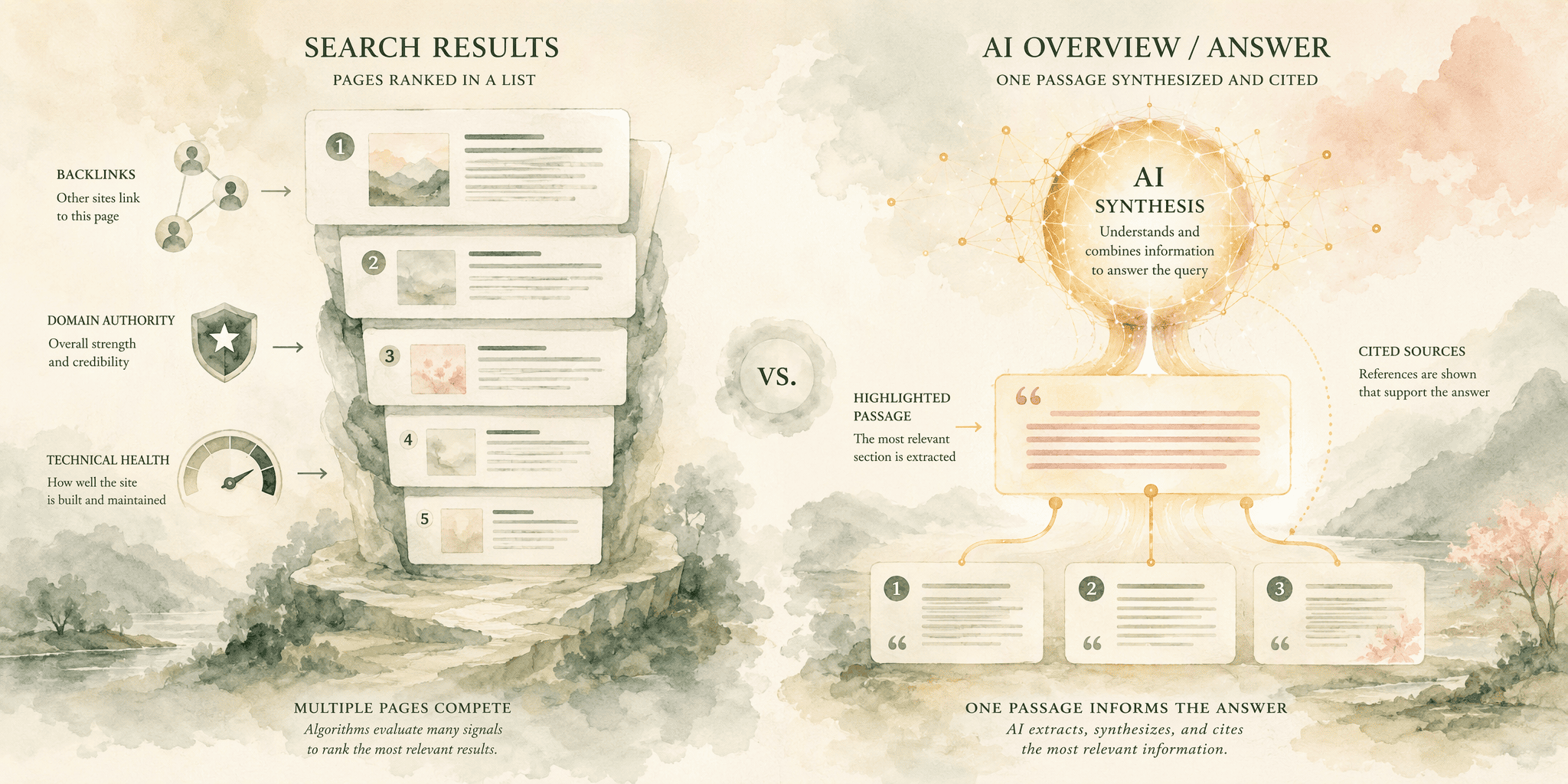
Generative Engine Optimization (GEO) is the practice of optimizing content to be cited, referenced, and synthesized by AI engines like ChatGPT, Perplexity, Claude, and Google AI Overviews. It differs fundamentally from classic SEO, which targets high placement in search engine results pages through page-level signals like backlinks, domain authority, and technical health. GEO optimizes content for passage-level extraction: the engine pulls a self-contained block of text that directly answers a query, and it cites your source alongside it. That distinction guides everything downstream, from your content structure to your ROI model, because you're playing an extraction game rather than a ranking game.
When HubSpot ranks third for 'CRM' on Google, it also appears as ChatGPT's top CRM recommendation, proving that authoritative entity signals transfer across platforms. But ranking alone does not equal citation.
Traditional SEO workflows leave enormous visibility gaps because they treat the SERP as the end state. Generative engines interpret conversational user queries averaging 23 words, versus Google's typical 4, and they search multiple sources, synthesize findings into narrative responses, and provide citations. Perplexity shows this process under the hood, running multiple web searches in the background and citing sources directly in its output. Your content needs to earn a place inside that synthesis. The Ahrefs data telling us only 8% of ChatGPT citations and 28.6% of Perplexity citations overlap with Google's top-10 results means nearly all of your traditional ranking work could be invisible to these engines unless you deliberately structure for extraction.
A step-by-step method to find GEO opportunities starts with existing top-10 keywords and filters for those already pulling AI Overview SERP features, then segments owned versus unowned citations and prioritizes high-value commercial-intent queries. That gap analysis tells you exactly where your competitors are getting cited and you are not.
Step 2: Match Your Content Structure to AI Extraction Patterns
AI search engines don't index content, they extract it. Perplexity and Claude hunt for self-contained passages they can isolate and quote directly, and the formats that survive extraction are highly specific. Chris Long's testing at Go Fish Digital over six months showed that generative search engines consistently pull clear snippets from structured headings, bullet points, and listicle-style articles. Open every answer-worthy section with a standalone 40 to 60 word block that states the answer in its first sentence, making it quotable verbatim by an AI engine with zero surrounding context required. Follow that with the elaboration, nuance, and caveats, but only after the engine already has a clean extractable answer it can lift.
Comparison tables and definition blocks earn citations at a disproportionate rate because they present information in parallel, scannable rows the models can parse directly. A table with a clear header row, parallel cells, and no lopsided gaps gives Perplexity a pre-formatted data object to cite. Similarly, FAQ schemas and definition lists map cleanly to the query-response pairs AI-answer engines produce. Schema markup in general helps Microsoft's LLMs better understand your content, as confirmed by Fabrice Canel, principal product manager at Microsoft Bing, and structured data can help certain large language models interpret content more clearly.
Implementation is a formatting sprint. Audit your five highest-value content pages and rework every section lead into an extractable answer block. Add comparison tables where you currently have prose-heavy comparisons, and wrap FAQ pairs in proper schema markup. This is not a rewrite: it is a structural re-slicing designed for the extraction logic of large language models, and it works whether you are targeting Perplexity, Claude, or Google AI Overviews.
Step 3: Build the Entity and Authority Signals AI Engines Trust

AI engines build your brand profile from every source simultaneously. Perplexity and Claude do not treat your homepage as the canonical authority: they read your LinkedIn company page, Crunchbase profile, directory listings, Wikipedia entry, and third-party mentions as a single entity graph. Inconsistencies across those sources silently degrade your cite-worthiness.
The weighting of external corroboration versus self-promotional content is not subtle. AI engines trust third-party mentions on Reddit, Wikipedia, and independent review sites far more than they trust your own claims. Off-site brand management has become a direct citation factor. When GrowthPro AI and AthenaHQ research on entity authority were analyzed, the pattern was consistent: brands with clean, consistent entity profiles across the open web and corroborating third-party mentions outperformed those relying on on-site authority signals alone. Your Crunchbase funding data, industry category tags, and executive profiles need to mirror exactly what appears on your site, and those same entity identifiers must flow into your schema markup.
A practical checklist for this week: audit entity consistency across your site, LinkedIn, Crunchbase, and any major directories where your brand appears. Fix title discrepancies, tag mismatches, and outdated descriptions. Then identify three authoritative third-party sources where AI engines are already citing competitors, and map a plan to earn coverage there. Your own content may be perfect, but Perplexity and Claude will still ignore it if the entity signals around your brand are fragmented or contradicted by external sources.
Step 4: Ensure Technical Crawlability for Perplexity and Claude Bots
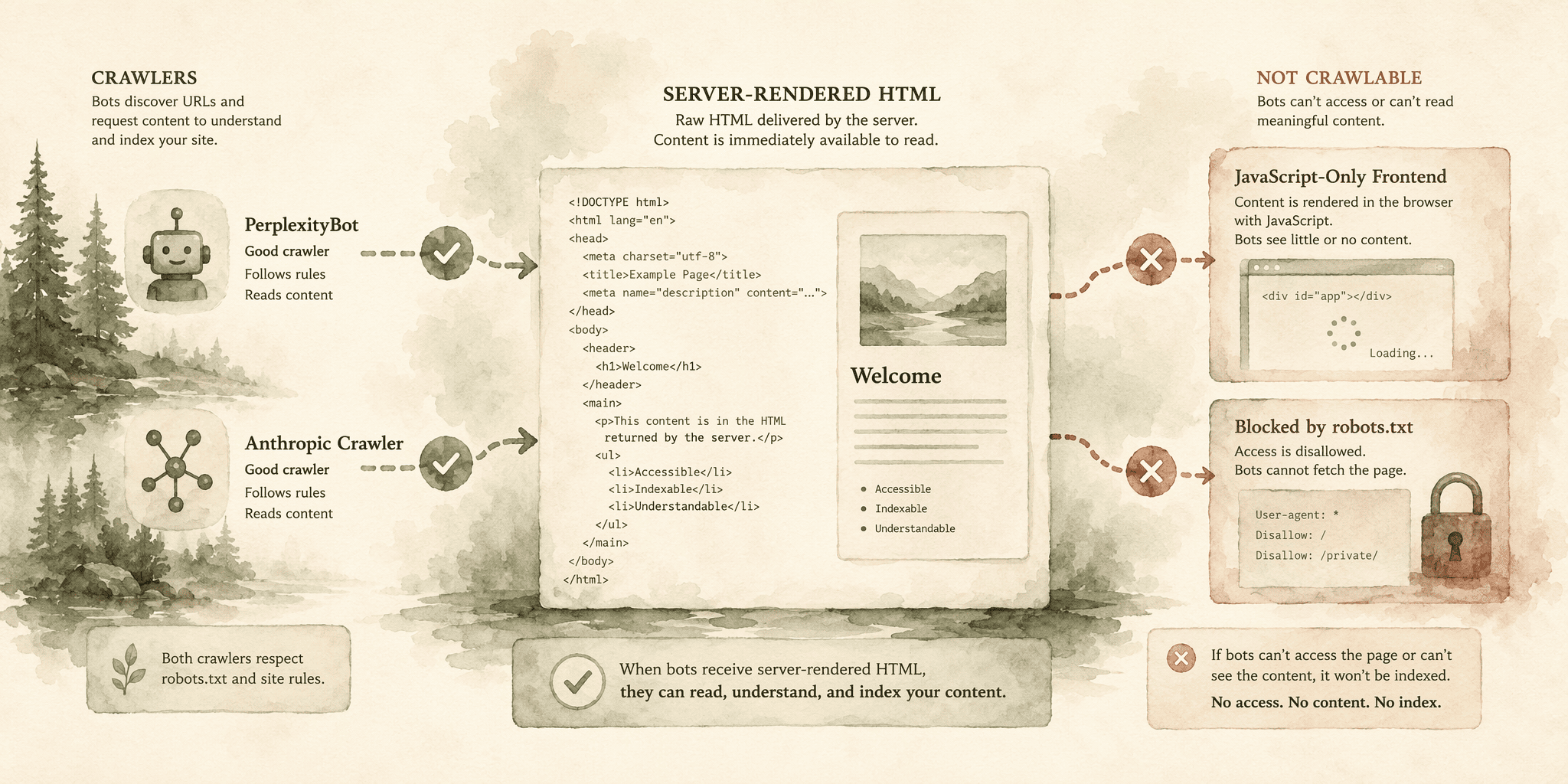
Perplexity and Claude operate web crawlers that read raw, server-rendered HTML. PerplexityBot and the Anthropic crawler are documented user-agents, and if your content renders exclusively through JavaScript without a server-side fallback, it is invisible to both engines, full stop. This is the most avoidable failure mode in GEO and one that impacts a surprising share of modern JS-framework sites.
Beyond rendering, your robots.txt needs explicit rules for AI crawler user-agents. Blocking or inadvertently restricting PerplexityBot or the Claude crawler through generic directive patterns is common. Review your robots.txt and sitemap configuration with these specific user-agents in mind, and confirm that critical content paths are served as indexable HTML they can parse. While a 404 status code by itself is not a penalty trigger, a significant percentage of previously indexed URLs returning 404s, as can happen during migrations, will absolutely impact search visibility across the whole site.
Test crawlability with a direct curl request using the AI bot user-agent string. Confirm your CDN or WAF is not blocking known AI crawler IP ranges. If your site fires content via client-side JavaScript, invest in server-side rendering or prerendering for the routes you want cited. Without this, none of the content optimization in Steps 1 through 3 matters.
Step 5: Activate Purchase-Intent Visibility Through Product Feed Optimization

Gen Z shoppers fire product questions straight into AI answer engines, and those engines assemble purchase recommendations from structured product feeds. When your feed is sharp and complete, the engine can cite your product even if the user never visits your site.
Specific actions to optimize product feeds for Perplexity and Claude shopping citations:
- Populate every product attribute field in your feed: AI engines match on detailed attributes, not just titles and descriptions; empty fields are lost ranking dimensions.
- Align product metadata with the exact natural-language phrases shoppers use: AI interprets conversational queries, so feed attributes must reflect the language of intent rather than internal catalog codes.
- Implement Product entity schema markup on every product detail page: Structured product data (price, availability, SKU, brand, review ratings) gives LLMs directly parseable purchase signals.
- Maintain identical pricing and availability data across your site, feed, and Google Merchant Center: Entity consistency for product listings is as critical as it is for brand profiles; discrepancies at this layer can drop you from purchase-intent answers entirely.
- Monitor what competitor products and price positions are surfacing alongside yours: Knowing which competitor listings Perplexity and Claude pull in lets you adjust your attribute strategy and price positioning proactively.
Step 6: Deploy Daily Monitoring to Track Brand Citations Across AI Engines
Without monitoring, GEO is faith-based. The 2026 monitoring stack for Perplexity and Claude visibility has shifted from proxy metrics to direct citation tracking. Citation Share, the frequency with which your brand appears in AI-generated responses relative to competitors, is the core visibility metric. It has replaced organic impression share entirely.
| Capability | Brand24 / Mention | Siftly | Enterprise GEO Dashboards |
|---|---|---|---|
| AI engine coverage | Social and web mention monitoring; limited direct LLM citation tracking | Daily automated monitoring across ChatGPT, Perplexity, Google AI Overviews, Gemini, Claude, and Copilot | Custom query sets across major LLM APIs with structured reporting |
| Primary metric | Brand mention volume and sentiment across traditional channels | AI visibility score made from mention rate, ranking, and citation presence across engines | Citation Share with engine-level segmentation and historical trends |
| Optimization guidance | None; monitoring only | Prescriptive optimization recommendations grounded in citation analysis on Growth tier | Typically bundled with strategy consulting or in-house GEO team workflows |
| Price band | Most mid-market AI visibility tools fall between approximately $29 and $200 per month | Seat-based pricing typically starting at $129/month with a Scale tier at $599/month; Pro plan at $2,999/month | Enterprise pricing is custom, varying by catalog size, geographies, and team |
| Trial access | Varies by vendor | 14-day free trial with no credit card required | Generally demo-gated |
Manual tracking becomes operationally infeasible above 50 prompts per week and five competitors. You can use a tool like Siftly to automate daily query execution and capture which competitors are surfacing alongside your brand in AI answers. The platform tracks visibility across multiple AI engines and provides competitive benchmarking with directional citation-to-traffic modeling, though no platform today has a fully validated citations-to-revenue attribution model. For zero-dollar entry, start with a free grader to baseline your current AI visibility before committing to paid monitoring.
Step 7: Redefine ROI Measurement for a Zero-Click AI Landscape

Web analytics were built for a world where discovery and visitation were the same event. In Perplexity and Claude responses, a user reads your brand name, absorbs your answer, and may never visit your site at all. Yet that exposure shapes a purchase decision as powerfully as an organic click once did.
Pew Research found users click traditional results in just 8% of visits when AI summaries appear. That figure sidelines classic click-through rate and organic session volume as primary metrics. The new ROI framework centers on what Amicited and GrowthPro AI call research-phase awareness: whether a prospect encounters your brand in AI answers during their buying journey, regardless of a site visit. Measuring that requires tracking Citation Share, brand mention frequency, and sentiment analysis inside AI responses, then correlating those signals with downstream conversion data at an aggregate level.
A 10-point improvement in citation rate across six months is a realistic target worth pursuing.
Set your reporting baseline by capturing current Citation Share across Perplexity and Claude, then track monthly. Pair that with directional attribution modeling available through monitoring platforms to connect citation growth to pipeline movement. No tool today offers a defensible citation-to-revenue calculation, but the directional signal holds enough weight to justify and optimize GEO investment.
Conclusion
Your content is either getting extracted by AI engines or it's getting ignored. The shift is measurable and it is happening now. This blueprint gives you a concrete sprint: audit entity consistency across your web profiles, rework your five highest-value content pages with answer-first formatting, verify your robots.txt and rendering path for PerplexityBot and Anthropic's crawler, optimize your product feeds for purchase-intent query matching, and turn on daily citation monitoring to establish a Citation Share baseline.
Start with the free grader to understand your current visibility, then layer in automated monitoring to make GEO success measurable and manageable before your competitors do the same. The engines are already citing someone in your space. Make it you, starting this week.
Frequently Asked Questions
What specific factors do Perplexity and Claude prioritize when selecting and citing content in their answers?
Perplexity and Claude prioritize quotable, self-contained passages with clear answer-first formatting, entity consistency across web sources, and third-party corroboration on Reddit, Wikipedia, and review sites. Freshness of data and structured formats like comparison tables and FAQ schemas also heavily influence citation decisions, far more than classic page-level ranking signals.
How can I structure my content and technical SEO to increase the likelihood of being surfaced by AI answer engines like Perplexity and Claude?
Open key sections with 40 to 60 word answer blocks. Use comparison tables, definition lists, and FAQ markup. Serve content as server-rendered HTML accessible to PerplexityBot and Anthropic's crawler. Verify robots.txt does not block AI user-agents. Ensure entity data matches across your site, Crunchbase, LinkedIn, and schema markup.
What tools or platforms can track whether my brand appears in Perplexity and Claude responses in 2026?
Brand24 and Mention track broad brand mentions. Dedicated GEO platforms like Siftly monitor daily citations across ChatGPT, Perplexity, Claude, Google AI Overviews, and Gemini with competitive benchmarking and Citation Share metrics. Enterprise GEO dashboards offer custom LLM query sets. Siftly offers a free trial starting at no cost with no credit card required.
What are the key differences between optimizing for Perplexity versus Claude compared to traditional Google search?
Traditional SEO targets ranking in SERPs via page-level signals. Perplexity and Claude extract isolated passages, with only 8% of ChatGPT and 28.6% of Perplexity citations overlapping with Google top-10 results. GEO optimizes for passage-level extraction, entity authority, and answer-first formatting rather than backlinks and domain authority.
How do I measure the ROI or business impact of appearing in AI-generated responses from platforms like Perplexity and Claude?
Shift from click-through rate to Citation Share and brand-mention frequency. Track whether prospects encounter your brand in AI answers during their buying journey, even without a site visit. Directional attribution models can correlate citation growth with pipeline movement, though no platform offers a fully validated citations-to-revenue model.
What actionable steps can I take this week to start optimizing my content for AI-driven answer engines?
Audit entity consistency across your website, LinkedIn, and Crunchbase. Rewrite five high-value pages with 40 to 60 word answer-first blocks. Verify PerplexityBot and Anthropic crawler access in robots.txt. Implement product schema markup. Set up a free AI visibility grader to establish your current Citation Share baseline.
Sources
- Generative engine optimization: What we know so far about generative SEO - blog.hubspot.com
- What Is Generative Engine Optimization (GEO) [Tips & Workflows To Do It] - Moz - moz.com
- Why the answer in SEO is almost always 'it depends' - searchengineland.com
Keep exploring
More from the blog.

Oct 29, 2026
7 Best AI Brand Monitoring Tools to See What AI Actually Says About You in 2026
You send a prospect to check what ChatGPT says about your category. It mentions three of your competitors by name, pulling a specific product detail for each.

Oct 29, 2026
7 Tools to Measure Brand Visibility Across AI Platforms like ChatGPT and Gemini in 2026
Marketing teams are discovering a chilling fact in 2026: their carefully built search dominance is invisible to a growing segment of buyers.

Oct 29, 2026
7 Best AI Shopping Visibility Tools in 2026 to Win the AI Shelf
Your best-selling product can get a glowing five-paragraph recommendation from ChatGPT and still lose the click to a competitor cited in Google's AI Overview.