Oct 29, 2026
How to Track Your Company's Visibility Across AI Search Platforms in 2026
Your next buyer is not on Google. They are inside ChatGPT asking for a recommendation, on Perplexity comparing three alternatives

Introduction
Your next buyer is not on Google. They are inside ChatGPT asking for a recommendation, on Perplexity comparing three alternatives, or scanning a Google AI Overview that never sends them to a website. ChatGPT alone fields 2.5 billion prompts a day across 190 million users. Those users convert at 4.4× the rate of people on a traditional search engine. If your brand is invisible inside those answers, that buyer goes to a competitor who bothered to show up.
Traditional SEO tools cannot measure this channel. Ahrefs and Semrush were built to track ten blue links, not generative answers that synthesize information from multiple sources into a single paragraph. AI-generated results are on track to overtake organic search traffic by 2028. Most companies still operate with zero visibility into whether an AI engine cites their brand, recommends their product, or never mentions them at all. That blind spot costs revenue right now.
Tracking AI search visibility demands a dedicated process: a fixed library of buyer prompts, the right technical foundation so AI crawlers can access your content, and a metric framework that measures share of voice, citation rates, and sentiment across engines. This guide walks through that process step by step, from defining your monitoring scope to connecting visibility data back to business outcomes.
Key Takeaways
The seven steps that follow build a repeatable AI search visibility monitoring system. These principles anchor the methodology:
- AI Share of Voice is the core metric: Measure how often your brand is mentioned and cited in AI-generated answers relative to competitors, tracked per engine and per prompt category.
- A fixed prompt library is non-negotiable: Build 20 to 30 non-branded, high-intent buyer queries locked into categories. AI responses vary with every prompt variation; a stable dataset makes benchmarking possible.
- Bot allowlisting determines citation eligibility: If your robots.txt blocks OAI-SearchBot, Claude-SearchBot, or PerplexityBot, your content cannot appear as a cited source no matter how strong it is.
- Purpose-built GEO tools fill the gap legacy SEO tools cannot: Platforms like Rankscale and Siftly monitor 9 to 17+ AI engines, while Google Search Console's AI Mode filter provides first-party Google data.
- Monitoring without action is wasted budget: Visibility data must feed a content optimization feedback loop. Identify underperforming prompts, diagnose gaps using AI-specific criteria like structured data and freshness, and re-measure.
Step 1: Define Your AI Search Visibility Monitoring Scope and Prompt Library

AI search engines do not index content; they extract it in response to a specific query. That means what you measure depends entirely on which prompts you ask. Run the same brand through ten different prompts and you will see ten different citation landscapes. Consistency is everything.
Build a fixed library of 20 to 30 non-branded buyer queries and lock it in before you track anything. Group them by what the buyer is actually trying to do: informational queries like 'how to choose a CRM for a 50-person team,' commercial queries such as 'best workflow automation platforms under $100/month,' and comparison queries. Do not swap, rephrase, or add queries ad hoc.
Longitudinal tracking only works when the input is stable, and AI models are probabilistic enough on their own without you layering prompt drift on top. Tools like Siftly's AI Prompt Tracking feature let you define the library once and automate daily query execution across engines, while Rankscale covers 17+ engines against your fixed set. Scope the prompts tightly around the buyer journeys that matter to revenue, not vanity topics.
Step 2: Prepare Your Technical Foundation for AI Crawler Access and Rendering
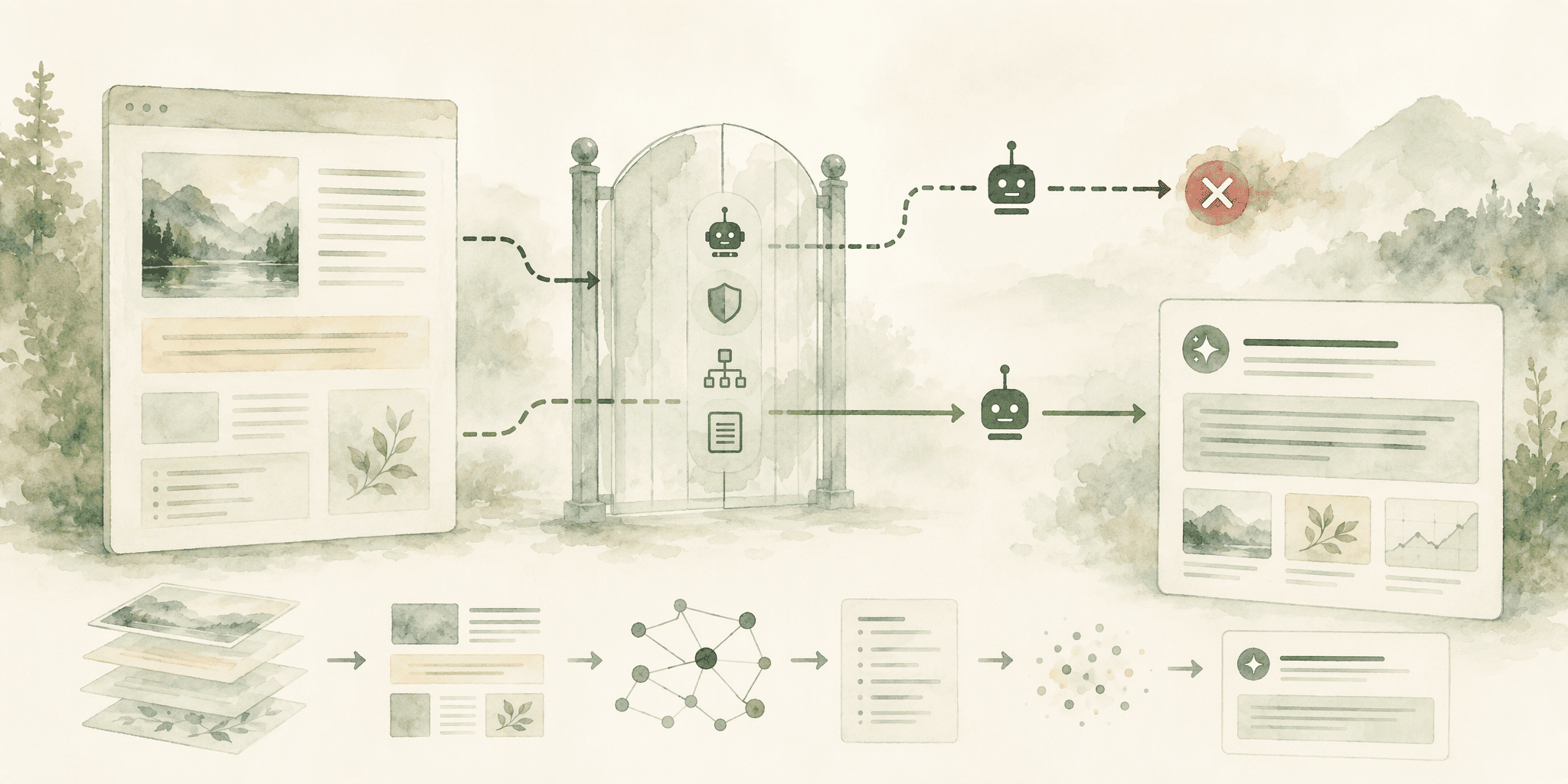
Most brands that never appear in AI search results have locked themselves out. They set a robots.txt rule years ago and forgot about it.
The most common culprit is a blanket disallow that blocks retrieval bots alongside training crawlers. Those are not the same thing. Training crawlers scrape content to update model weights.
Retrieval bots are the agents an AI engine dispatches in real time when a user asks a question, specifically to fetch text it can cite in an answer. Block the retrieval bot and your pages do not exist as far as the engine is concerned. Quality of content is irrelevant if access is denied.
Fix this by adding explicit allow directives for OAI-SearchBot, Claude-SearchBot, and PerplexityBot in your robots.txt file. Those three user agents power citations in ChatGPT, Claude, and Perplexity. Keep GPTBot, the training crawler, in a separate ruleset.
That lets you withhold content from model training while still being visible for search and citation. One misconfigured wildcard line can quietly delete your brand from millions of AI-generated answers a day. Access is only half the technical foundation.
AI engines now parse HTML with enough sophistication to need complete, server-rendered pages. JavaScript-reliant single-page app shells frequently get ignored because the bot never executes the JS. Schema markup helps here: adding it improves citation likelihood by 13%, according to Siftly's 2026 analysis of AI search engine behavior.
If you want an answer engine to understand what your content means and not just what words are on the page, structured data is the clearest signal you can send. A practical validation step is Google Search Console's AI Mode filter, released in mid-2025.
It gives you a first-party view into how Google surfaces your content specifically within AI Overviews. Use it after any robots.txt or rendering change to confirm the fix actually worked.
Step 3: Deploy the Metric Framework to Measure Your AI Search Performance
Vanity metrics like 'high DA' have no analog in AI search. Replace them with three KPIs: AI Share of Voice, citation rate, and sentiment scoring. AI Share of Voice measures how often your brand appears in AI answers compared to competitors for a given prompt set. It is raw presence, the entry ticket to the conversation. Citation rate decomposes presence into two tiers: linked citations (your domain appears as a clickable source) versus unlinked mentions (the engine names your brand but links to someone else). These track differently. A high unlinked mention rate signals awareness but missing authority. ChatGPT accounts for 56% of AI search referral traffic, while Gemini drives 18%, and citation rates vary significantly across engines for identical prompts. A brand might carry strong linked citations in Perplexity but register only unlinked mentions in ChatGPT for the same query. Tracking per engine reveals those gaps. Sentiment scoring tags each mention as positive, neutral, or negative, surfacing reputational risk before it scales. Run this framework per prompt category and per engine.
Step 4: Select and Configure an AI Search Visibility Monitoring Platform
You need two things from a monitoring tool: coverage of the engines your audience actually uses and a metric that tracks whether your brand gets cited when it matters. The market now splits into dedicated GEO platforms and traditional SEO suites that have added an AI visibility layer. Both can work. The table below lines them up on engine coverage, pricing, and what you can do with the data.
| Feature | Rankscale (Dedicated GEO) | Siftly (Dedicated GEO) | Semrush AI Visibility Toolkit | Google Search Console AI Mode |
|---|---|---|---|---|
| Engine Coverage | 17+ engines | 9 engines (ChatGPT, Perplexity, AI Overviews, Gemini, Copilot, Grok, DeepSeek, and more) | Primarily Google AI Overviews; limited cross-engine data | Google AI Overviews only |
| Starting Price | Approximately €20/month (credit-based) | Seat-based pricing typically starts at $129/month; Scale tier at $599/month; Pro at $2,999/month | Requires Semrush subscription; pricing varies | Free (first-party Google data) |
| Metric Depth | AI Share of Voice, citation tracking, sentiment scoring | AI visibility score (mention rate, ranking, citation presence), Share of Voice, citation tracking, sentiment | AI Visibility Index drawn from 516 million+ modeled prompts; focused on brand mention and citation frequency | Raw impression and click data for AI Overviews; no cross-engine view |
| Competitor Benchmarking | Auto-identifies rival brands in AI responses; side-by-side visibility score, citation count, and sentiment comparison across engines | Captures competitor products and price positions surfaced alongside brand; tracks relative price index in AI shopping answers | Yes, through its index-based approach leveraging Ahrefs' 28.7 billion keyword database | No direct competitor comparison |
| Content Optimization | Monitoring-only; does not generate content | Growth tier bundles prescriptive optimization recommendations grounded in citation analysis; separate GEO Content feature | Monitoring-only | Monitoring-only |
Step 5: Benchmark Share of Voice and Diagnose Competitive Gaps
Raw visibility numbers mean nothing in isolation. The value surfaces when you understand which competitors AI engines are recommending instead of you, for which prompts, and on which platforms. Use the following four-step process to turn visibility data into a competitive roadmap:
- Identify competing domains: Start by identifying the competitors that appear alongside your brand in AI responses. A manual audit misses engines where you are completely absent. Tools like Rankscale or Siftly's competitor monitoring can auto-detect which rival domains AI engines cite for your prompt library.
- Compare share of voice per engine: Once you have that list, run engine-specific share-of-voice comparisons. ChatGPT and Perplexity draw on different retrieval patterns. A brand can lead in one engine and trail badly in another, so a single aggregate number hides the problem spots.
- Decompose gaps by citation type and sentiment: Next, decompose the gaps into citation type and sentiment. A shortfall in linked citations signals a content authority problem. A shortfall in sentiment signals a reputational or quality problem. Knowing which one you are fighting tells you whether to invest in substance or in trust.
- Map content gaps to opportunities: Finally, map content gaps to exploitable opportunities. Where a competitor overperforms on commercial-intent prompts, analyze what structured data, freshness signals, or content depth they deliver that you do not. Those gaps become your optimization roadmap.
Step 6: Model Citation-to-Traffic Impact to Connect Visibility to Business Outcomes

AI citations do not map cleanly to revenue, no platform yet offers a validated attribution model for that. The link is probabilistic: a citation raises the chance of a click, but it guarantees nothing. Treat it as a likelihood, not a hard conversion event.
Start with the feed you already have. Google Search Console’s AI Mode filter isolates impressions and clicks from AI Overviews. That owned data tells you which queries actually send traffic, and which citations sit visible but untouched. For engines that strip or omit referral headers, switch to coefficient modeling: log how often a linked citation appears for a high-intent prompt, then apply a conservative click-through rate calibrated against the referral patterns you can see. Siftly attributes referral traffic directly to LLM citations inside its own platform, useful for direction when hard attribution is missing.
Freshness tightens the model. Pages updated within twelve months are twice as likely to hold citations in AI results, and 60% of commercial queries cite content refreshed within the last six months. Both figures give you coefficients to estimate volume erosion from content decay before referral lines drop.
Convert the output to business language. Lead with estimated monthly referral volume per engine. Follow with the projected upside if you close citation gaps. End with sentiment risk: what happens when a competitor’s product-comparison query concentrates negative mentions.
Step 7: Automate and Optimize Your Content Supply Chain Based on Visibility Data

Monitoring dashboards that nobody acts on are corporate wallpaper. The point of tracking AI search visibility is to close a feedback loop: measure, diagnose, fix, re-measure.
Start by flagging the bottom 20% of your prompt library. These are the queries where your brand has the lowest AI Share of Voice or the weakest linked citation rate. They are your highest-impact optimization targets.
Diagnose why those prompts underperform. Two causes dominate. The content may not be accessible to retrieval bots, or it lacks structured data that helps engines parse entity relationships. It can also be stale, missing a freshness signal that competitors provide. Schema markup boosts citation odds by 13%, and freshness within six months drives the majority of commercial query citations.
Now create or optimize. Build the content that answers the target prompt directly. Include schema markup, clear authorship signals, and definitive statistics that engines can cite with confidence.
Siftly's Growth tier bundles prescriptive optimization recommendations grounded in citation analysis, but no monitoring tool writes the content for you. Monitoring and content creation are separate workflows. Plan accordingly.
Re-measure against the same fixed prompt library on a defined cadence. Tools like Siftly run daily automated query execution, so you can validate whether a content change moved your AI Share of Voice within days, not months. Fifteen percent of all website traffic now originates from AI agents and bots.
That number will climb. A measurement cadence that worked in 2024 is already too slow for 2026.
Conclusion
Most web analytics are blind to how AI answers questions. An LLM can brief a buyer on your entire category without ever clicking through to a page. If you are not measuring that surface, you do not know whether you are being recommended, paraphrased, or silently passed over.
The fix is not a dashboard you check once a quarter. It is a dedicated monitoring stack.
Pick the two or three metrics that actually tie to pipeline, not the twelve that produce a good slide. Then run a competitor benchmarking rhythm that sends its findings straight into your content briefs, not a monthly report someone skims.
The brands that are ahead right now are not spending more; they are measuring what the others are still ignoring.
Frequently Asked Questions
What is AI search visibility tracking and why does it matter for my company in 2026?
AI search visibility tracking measures how often, and in what context, your brand appears in AI-generated answers on platforms like ChatGPT, Perplexity, and Google AI Overviews. It matters because AI search results are projected to overtake organic search traffic by 2028, and LLM users convert 4.4× more often than traditional search engine users.
Which AI platforms should I monitor, and how do I track brand mentions across them?
Monitor ChatGPT, Perplexity, Google AI Overviews, Claude, Gemini, Copilot, Grok, and DeepSeek. ChatGPT accounts for 56% of AI search referral traffic. Use a dedicated GEO platform like Rankscale or Siftly to run the same fixed prompt library daily across engines and capture mentions, citations, and sentiment.
What key metrics should I use to measure my brand's AI search performance?
AI Share of Voice measures how often your brand appears relative to competitors. Citation rate distinguishes linked citations from unlinked mentions, which have very different traffic value. Sentiment scoring tags each mention as positive, neutral, or negative. Track all three per engine and per prompt category.
How can I benchmark my brand's AI search visibility against competitors?
First, run your prompt library through a tool that auto-identifies which competitors appear in AI responses. Then compare share of voice, citation counts, and sentiment side by side per engine. Decompose competitor advantages into linked citation gaps, sentiment gaps, or content freshness gaps.
What tools automate AI search visibility monitoring, and what features should I look for?
Dedicated GEO platforms like Rankscale and Siftly automate daily monitoring across multiple engines. Key features include a fixed prompt library manager, automated query execution, competitor auto-detection, share of voice tracking, linked citation vs. mention distinction, sentiment tagging, and prescriptive optimization recommendations.
How do I act on AI visibility data to improve my brand's citations and ranking in generative engine results?
Diagnose underperforming prompts by checking bot access, structured data presence, and content freshness. Schema markup boosts citation odds by 13%, and pages updated within 12 months are twice as likely to retain citations. Fix identified gaps, then re-measure using the same prompt library on a regular cadence.
Sources
- AI Search Optimization Tools: 2026 Buyer's Guide | Siftly - siftly.ai
- AI Search Optimization: An 8-Step Guide to Getting Cited - siftly.ai
- AI Share of Voice: Measure Your Brand Across LLMs - www.get-ryze.ai
- AI Visibility Index | Semrush for Enterprise - ai-visibility-index.semrush.com
- Ahrefs AI Visibility Index | Check ANY brand’s AI visibility instantly - ahrefs.com
- 10 Best AI Search Monitoring Tools: Track Brand Visibility Across AI ... - otterly.ai
- How to measure your AI search brand visibility and prove business impact - searchengineland.com
- Rankscale: AI search rank tracking and monitoring – AI Search Visibility Tools - ai-search-visibility-tools.com
Keep exploring
More from the blog.

Oct 29, 2026
7 Best AI Brand Monitoring Tools to See What AI Actually Says About You in 2026
You send a prospect to check what ChatGPT says about your category. It mentions three of your competitors by name, pulling a specific product detail for each.

Oct 29, 2026
7 Tools to Measure Brand Visibility Across AI Platforms like ChatGPT and Gemini in 2026
Marketing teams are discovering a chilling fact in 2026: their carefully built search dominance is invisible to a growing segment of buyers.

Oct 29, 2026
7 Best AI Shopping Visibility Tools in 2026 to Win the AI Shelf
Your best-selling product can get a glowing five-paragraph recommendation from ChatGPT and still lose the click to a competitor cited in Google's AI Overview.