Oct 16, 2026
How to Measure Share of Voice in AI Search: A CMO’s Benchmarking Playbook
Your brand's most critical marketing metric stopped working the moment Google launched AI Overviews.

Introduction
Your brand's most critical marketing metric stopped working the moment Google launched AI Overviews.
You are still measuring traffic, clicks, and page-one rankings while your customers have already migrated to a zero-click reality. ChatGPT, Perplexity, and Google's generative results now answer buyer questions directly, synthesizing opinions about your market without specifying how they reached that conclusion. Traditional search share of voice no longer captures what matters, because the AI engine names names rather than listing links.
The measurement gap creates a strategic emergency. You cannot manage a channel where your presence is invisible, and your current dashboard is blind to whether an LLM recommends your brand, a competitor, or no one at all. This article lays out a systematic methodology for tracking 'Share of Model,' a modern framework that quantifies how often and how prominently you appear in AI-generated answers. You'll learn to build a prompt set, select metrics that matter, and deploy tools to make your brand's generative visibility as trackable as any paid channel.
Key Takeaways
The methodology requires measuring brand mentions and citations inside generated text, not ranking positions or organic click-through rates.
- *
- Metric stack: Track three numbers: Mention Frequency (how often you're named), Citation Share (your domain as a percentage of all linked sources), and a composite Prominence Score that factors in position and sentiment.
- Prompt governance: A fixed, term-frequency-derived prompt set run on a quarterly cadence gives you a statistically grounded trend line before you commit to an enterprise software license.
- Model fragmentation: ChatGPT, Perplexity, Gemini, and Google AI Overviews each pull from different source pools. Segment by platform. A single blended score across models hides which engine is actually sending traffic.
- No false precision: AI answers are probabilistic. Report with directional trend arrows and distribution charts. A decimal-point score implies a measurement certainty the output doesn't support.
- Platform selection: Measure only the engines where your actual buyers ask category questions. Tools that blanket-query every LLM produce noise, not competitive insight.
Step 1: Define What AI Share of Voice Actually Measures
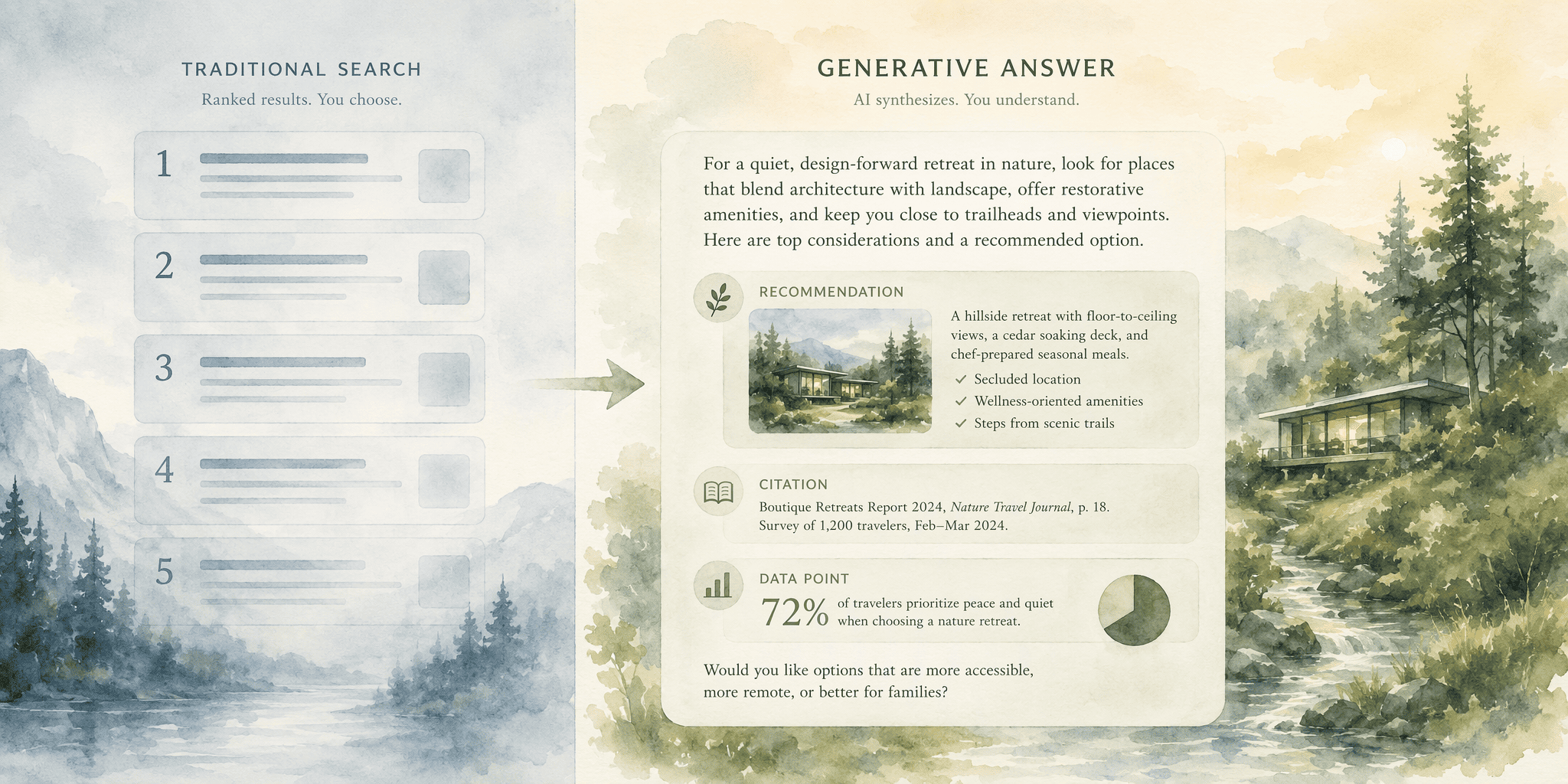
Traditional share of voice counts impressions, clicks, and position in a ranked list of blue links. AI share of voice tracks whether a generative model synthesizes your brand name into a natural-language answer as a recommendation, a citation, or a data point. The metric answers a single question: "When the market asks, does the AI name you?" RWS defines the framework as a replacement metric for search traffic that measures how often a brand gets mentioned or cited when AI platforms answer a category question, compared with competitors answering the same question.
You are now operating inside the model's compressed knowledge representation. That demands a new vocabulary. RWS's "Share of Model" concept breaks this into mention frequency, citation share, and platform breakdown. A US court ruling from the Court of International Trade in October 2026 noted that AI-generated summaries carry a distinct legitimacy from aggregated sources. Your measurement has to separate being cited as a source from being mentioned as an entity.
Do not retrofit your rank tracker. AI-generated answers have no traditional SERP positions, and optimization tools built for page-one analysis cannot detect when a model describes your brand's category without referencing you.
Step 2: Identify the AI Engines and Models That Matter for Your Category
Your measurement program collapses into wasted compute cycles if you query every available model instead of the ones your buyers actually use. Build this list by analyzing customer call recordings, sales intake forms, and search query data for explicit platform signals: “I asked ChatGPT” or “Gemini told me.” Cross-reference those with tooling that logs referral headers, since AI-generated traffic arrives as non-search direct or through imperfectly tagged UTM strings.
- Audit your referral traffic: Pull a raw report of all direct and unbranded referral traffic, filtering for strings containing “chatgpt.com,” “perplexity.ai,” or any link-shortened variant generated by AI tools.
- Segment by model accessibility: Separate free-chat, logged-in-chat, and API-endpoint outputs. Tools like LLM Pulse demonstrate this segmentation, with one practitioner setup tracking 50 prompts weekly across 5 AI models (ChatGPT, Perplexity, Gemini, Google AI Mode, and Google AI Overviews), producing 250 AI evaluations per week.
- Score query volume by platform: Weight each platform by how many of your identified buyer questions get answered there. A productivity SaaS buyer likely queries ChatGPT more frequently than Perplexity; an academic researcher runs the reverse pattern.
- Commit to a model list in writing: Circulate an internal document that locks the named models and versions to be measured for the next quarter. Model version drift is a measurement threat because different model snapshots generate different answers from identical prompts.
Step 3: Choose the Metrics That Quantify Brand Visibility in Generated Answers

A single visibility score is a distraction. You need four metrics that you can compute identically each period. Your final AI share of voice is a composite of these components.
- Mention Frequency: Count responses containing your brand name divided by total prompt runs. LLM Pulse defines Mention Rate as the percentage of responses that mention your brand. This tells you whether the model considers your entity relevant enough to surface in a given context at all.
- Citation Rate: Track the percentage of responses that cite your domain. LLM Pulse defines it the same way. A high mention rate paired with a low citation rate means the model names you but does not link to you as authoritative source material, a structurally weaker position.
- Competitor Share: Calculate your brand mentions divided by total mentions across your brand and selected competitors. This gives you a percentage share for each prompt category. Okara.ai adds a prominence scoring layer that weights mentions by position within the generated answer, recognizing that a brand named first in a recommendation list carries a different weight than one named in a caveat paragraph later.
If you track nothing else, record Mention Frequency, Citation Rate, and Competitor Share percentage on a fixed prompt set each quarter. Sentiment classification is valuable but introduces annotation noise unless you dedicate human reviewers. Begin with objective counting before layering on qualitative scoring.
Step 4: Execute a Quarterly Benchmark Against a Fixed Prompt Set
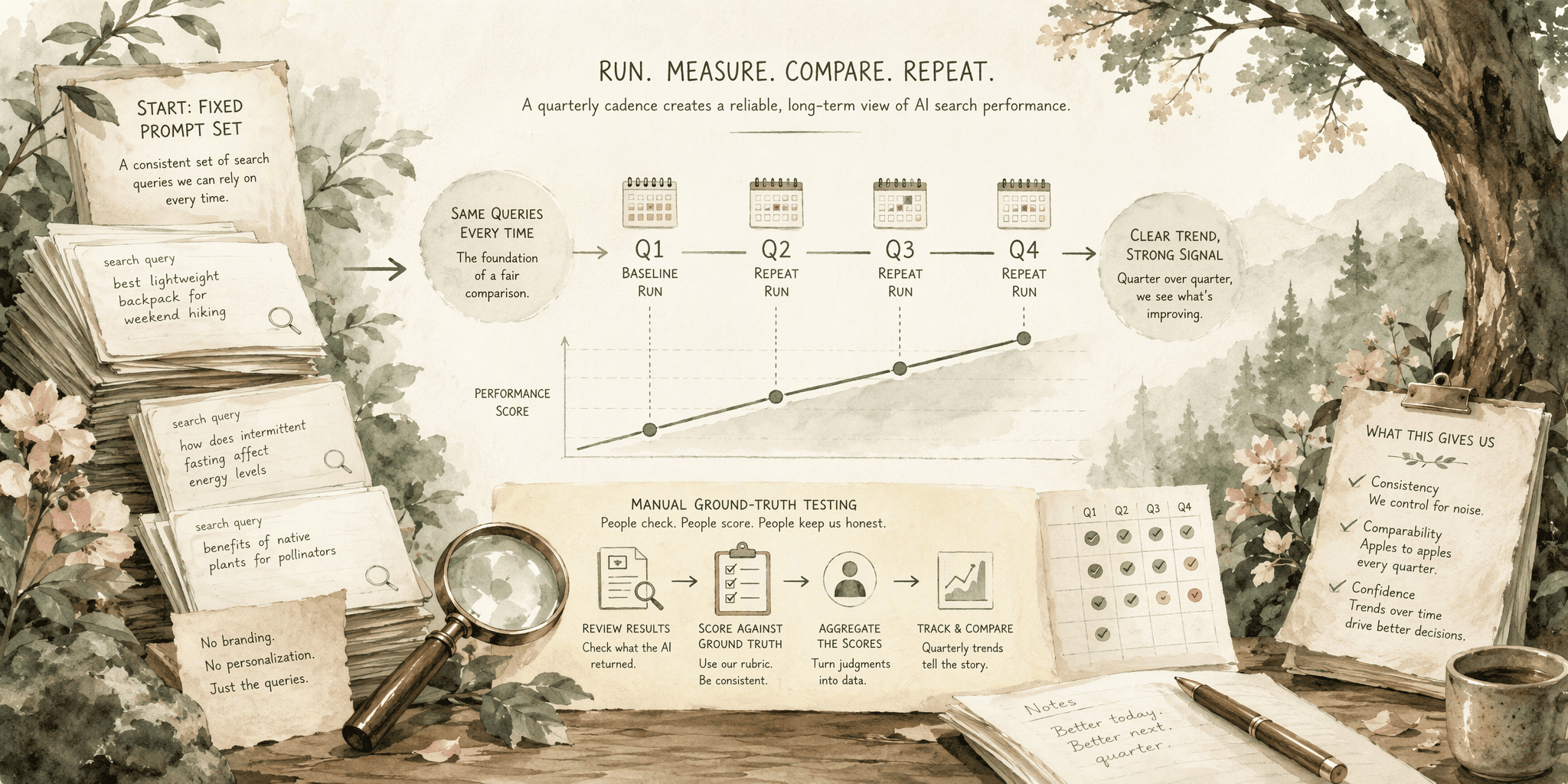
Before signing a contract for real-time monitoring, ground-truth your AI share of voice with a manual benchmark. The process mimics the controlled testing approach described in the practical community: repeated queries on a fixed schedule produce a trend line leadership can trust.
Start with a prompt set built from actual high-intent buyer questions rather than branded terms. Extract your top 20 to 50 non-branded queries from Google Search Console. Keep the ones containing "best," "for," "vs," and "recommend."
Lock them into a spreadsheet as the prompt inventory. For each prompt, run it against your target models in a fresh session, clearing context between queries to prevent model memory contamination. Record the first three brands mentioned in each response, plus any cited domains, into a structured log.
Repeat this on the same weekday each quarter. A benchmark repeats the same check on a regular cycle, so a CMO can see whether the position is improving, holding steady, or slipping. You will hit variance.
AI answers vary between sessions, prompts drift over time, and no single tool captures every platform with equal accuracy. Accept that your quarterly readout is a directional snapshot.
Structure your reporting to reflect that. A tool like Siftly can automate this workflow later, but starting with a manual benchmark establishes whether your base visibility is zero or measurable before you scale.
Step 5: Use Tools for Real-Time Monitoring and Consolidated Dashboards

Manual audits break once query volume crosses 50 prompts or when you need weekly trending instead of quarterly snapshots. At that point, a paid tool collapses the lifting into a structured dashboard that includes competitive benchmarking.
| Platform | Engine Coverage | Benchmarking Methodology | Optimization Features | Free Trial |
|---|---|---|---|---|
| Siftly | ChatGPT, Perplexity, Gemini, Google AI Overviews, Claude | Multi-engine competitive benchmarking with daily refreshes across tracked prompts | Generates AI-optimized content and actionable recommendations based on performance gaps | 14-day free trial with no credit card required; free AI Visibility Checker audit available |
| SlateHQ | Multi-model framework tracking citations and brand positioning | Positioning across model-generated answers with trend tracking | Content strategy and AI visibility improvement guidelines | Not specified in source data |
| LLM Pulse | ChatGPT, Perplexity, Gemini, AI Mode, AI Overviews | Weekly 250-evaluation benchmarks across fixed prompt sets; mention and citation rate scoring | Category-specific query optimization | Not specified in source data |
| GetVeritas.io | Multi-platform AI search monitoring | Composite share of voice metric with competitive indexing | Structured improvement recommendations based on visibility gaps | Not specified in source data |
| Higoodie | AI search engine coverage with brand mention tracking | Directed mention and citation aggregation | AI-tailored brand authority building | Not specified in source data |
Siftly's platform measures mention rates, citation quality, sentiment, and positioning across AI engines and refreshes competitive benchmarking data daily. When you graduate from quarterly manual checks, a tool that bakes competitive context into the interface keeps you from calling a visibility bump a win when your closest competitor climbed faster.
Step 6: Build a Leadership Report That Communicates Trends, Not False Precision
Executives will ask for one number they can march toward. Do not give it to them.
Probabilistic language models produce inherently noisy output. A single composite AI share of voice percentage reported to two decimal places signals confidence your methodology hasn't earned. The same query run minutes apart can return different brand mentions; Adobe's guidance on AI brand visibility measurement describes generative-channel metrics as inherently directional for exactly this reason.
Present your data as trended line charts over multiple quarters. Show a stacked bar chart where each bar represents a prompt category and the colored segments represent brand share distribution across competitors for that quarter. Next to the chart, place a simple table of directional arrows: your brand versus each tracked competitor across three consecutive quarters, with each cell showing only up, flat, or down.
This strips the decimal-point theater that would otherwise dominate the conversation and refocuses the room on trajectory. If a competitor pulls ahead in a specific product category, include a verbatim block pull of the AI's actual answer text side by side with your own mention context. Leadership cannot act on "37.2 percent brand share" but they can act on "We were named as the budget alternative while the competitor was named as the enterprise standard."
A tool like Siftly, which tracks competitive position and description context across engines, surfaces the exact language gap that drives strategy. Weekly reviews are for tactical identified trends; monthly reviews are for a full competitive review.
Step 7: Expand Your Program to Include Multilingual and Multi-Market Tracking
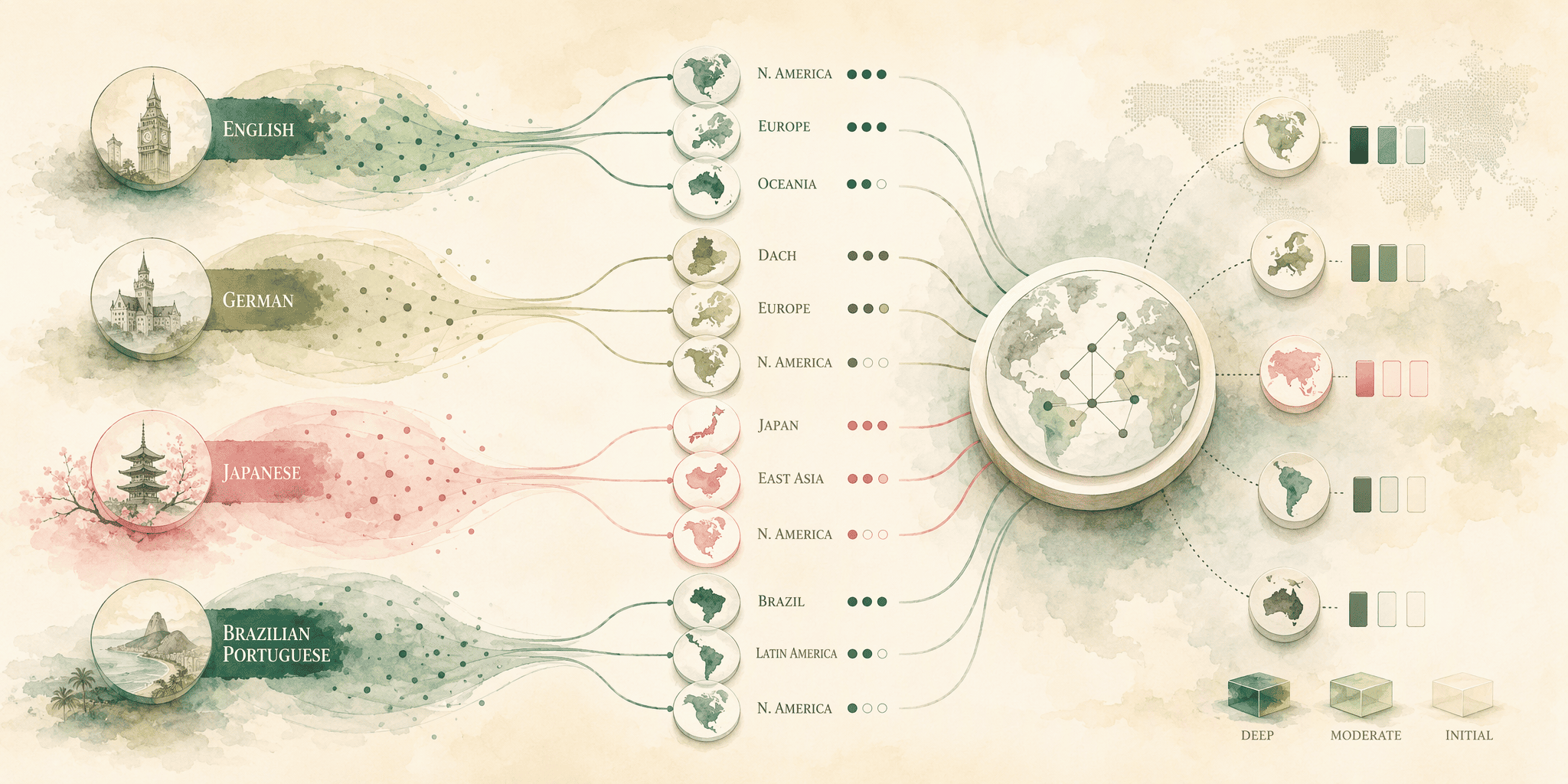
Your English-language share of voice score is a fiction if you do business in Germany, Japan, or Brazil. LLMs localize their source pools and training data weighting by language, meaning ChatGPT answering in English pulls from a fundamentally different corpus than the same model answering in Spanish. RWS’s 2024 findings confirmed completely different source pools by language. Multi-Market Expansion: Rollout Tiers
| Tier | Language/Market Coverage | Timing | Primary Consideration |
|---|---|---|---|
| Tier 1: Core English Markets | US, UK, Canada, Australia English prompts | Quarter 1 | Baseline share of voice in your revenue-dominant market |
| Tier 2: Local-Language Top Markets | Native-language prompts for your top three international markets by revenue | Quarter 2 to 3 | Drastic share-of-voice variance likely due to different local publisher ecosystems |
| Tier 3: Long-Tail Markets | Additional languages where competitors show early AI presence | Quarter 4 | Alert-only threshold; full benchmarking may be cost-prohibitive |
Localize each prompt set independently. A direct translation of “best CRM for mid-market” into German fails to capture the local phrasing a German buyer actually types. Commission a native-speaking market analyst to generate a separate prompt set for each locale using local keyword data. When evaluating tools for international expansion, prioritize platforms with explicit multi-language support. Okara.ai and platforms with global monitoring coverage offer visibility segmentation by language, which prevents a dominant English score from masking near-total invisibility in core operating markets. Siftly’s enterprise tier includes unlimited geographies, which supports phased rollout without per-market pricing penalties.
Conclusion
Your AI share of voice is raw operational data, not a branding trophy for a quarterly slide. Every time a model names a competitor but skips you, it flags a specific content gap or authority weakness you can close. The US Court of International Trade's October 2026 activity report recognized AI-generated summaries as legitimate aggregated sourcing, so the window to build uncontested brand presence inside those summaries is open but narrowing.
Run your first manual benchmark this month. Pick the 20 highest-intent buyer questions. Name your top three competitors. Count mentions across the two AI platforms your customers use. That count is your baseline, and from it, every optimization you make has a measurement system ready to validate it.
Frequently Asked Questions
What is share of voice in the context of AI-generated search results and how does it differ from traditional SEO share of voice?
AI share of voice measures how often a brand is mentioned or cited when generative AI platforms answer category-specific questions, compared with competitors. Traditional SEO share of voice counts impressions, clicks, and rank positions on a search results page. The AI metric tracks presence inside a synthesized natural-language answer where the model may name your brand without including a clickable link at all.
Which AI search engines and models should I measure to get a thorough view of my AI share of voice?
Focus on the platforms where your specific buyers ask category questions. Identify them by auditing referral traffic for AI-originating sessions and listening for brand mentions in sales conversations. The core set typically includes ChatGPT, Perplexity, Gemini, and Google AI Overviews, with Claude and Meta.ai added if your audience segments show platform adoption.
What specific metrics and data points are most important for calculating share of voice in AI-generated answers?
Track three primary metrics:
- Mention Frequency is the percentage of total prompt runs where your brand appears.
- Citation Rate is the percentage of responses linking to your domain as a source.
- Competitive Share of Voice is your mentions divided by total mentions across your brand and selected competitors. A composite prominence score can be layered on top to weight position within the answer.
What tools and platforms are available for measuring and monitoring brand visibility in AI search results?
Dedicated platforms include the following tools with overlapping capabilities:
- Siftly provides cross-engine monitoring across ChatGPT, Perplexity, Gemini, and AI Overviews with daily competitive benchmarking.
- SlateHQ, LLM Pulse, GetVeritas.io, and Higoodie offer overlapping capabilities in citation tracking, brand mention monitoring, and visibility scoring across AI models with varying reporting depths and international coverage.
How do I benchmark my AI share of voice against competitors, and what constitutes a good score?
Benchmark by running a fixed set of 20 to 50 buyer-intent questions across your chosen AI models each quarter and recording which brands are mentioned. A “good” score has no absolute threshold. You want to see your mention share percentage improving quarter-over-quarter relative to named competitors. The directional trend matters more than a static number.
What is a practical step-by-step process for setting up an ongoing AI share of voice measurement program?
Follow these steps to operationalize AI share of voice measurement:
- Define the metric stack first.
- Build a fixed prompt set from actual customer questions.
- Run a manual quarterly benchmark against 2 to 5 priority AI models to establish a trend line.
- Graduate to a monitoring tool once query volume exceeds 50 prompts.
- Build leadership reports showing directional arrows and distribution charts.
- Phase in multilingual tracking for international markets.
Sources
Keep exploring
More from the blog.

Oct 16, 2026
How to Track Competitor Visibility in ChatGPT Shopping Recommendations (2026 Guide)
Your competitor just became the first brand ChatGPT recommends when a shopper asks for the best running shoe under $120. You have no dashboard showing

Oct 15, 2026
Best Ahrefs Alternatives for Tracking AI Visibility in 2026
Your SEO dashboard says organic traffic is holding steady, but your brand mentions in ChatGPT are plummeting and you would never know it. Ahrefs Brand Radar

Oct 15, 2026
Siftly Alternatives for Tracking AI Visibility in 2026
Your brand gets praised all day in ChatGPT and Perplexity, until it doesn't. One model update, one new competitor content push