Oct 17, 2026
How to Measure AI Share of Voice in 2026: The 7-Step Execution Plan
Your brand might be mentioned in a ChatGPT answer right now, but you have no dashboard that shows it.

Introduction
Your brand might be mentioned in a ChatGPT answer right now, but you have no dashboard that shows it.
Research from March through May 2026 reveals a stark visibility gap: global household names such as Stripe and Nike appear in 73% of relevant AI answers on their first tracking run, while niche and small brands appear in just 11%. This divergence has a clear cause.
Traditional analytics fail to capture this channel because AI-referred visitors don't all carry clean referrer headers. You need a systematic program that combines manual baselines, automated monitoring, citation quality scoring, and business outcome tracking. This guide delivers the complete framework to build that measurement capability, starting today.
We will cover the exact metrics to track, how to configure tools like Siftly, Ahrefs, and Semrush, and how to connect AI visibility shifts to revenue through UTM-tagged referral links.
Key Takeaways
Visibility is shaped by your brand's overall authority footprint across the web, not by a single page's keyword rank.
- Citation quality is the important metric: Whether the AI frames your brand positively or negatively flips about 6.7 times more often than whether the brand is mentioned at all. Measure the authority of the pages the AI cites, not just the count of mentions.
- Multi-platform monitoring is mandatory: ChatGPT, Gemini, Perplexity, and Google AI Overviews each cite sources differently. A single score aggregated across all platforms hides weaknesses on individual engines.
- UTM-tagged referrals connect visibility to revenue: Without UTM parameters, AI-referred traffic blends into direct traffic in Google Analytics 4.
- Mention frequency: How often your brand appears, weighted at 25% of the composite score.
- Sentiment: Analyzes whether the AI frames your brand positively, negatively, or neutrally in its natural language summary, weighted at 25%.
- Citation quality: Scores the referring domain's rating using backlink profile metrics from tools like Ahrefs and Semrush, weighted at 35% of the composite score.
- Positioning: Penalizes brands buried deep in an answer while rewarding the first cited source, weighted at 15%.
Step 2: Establish a Baseline with Manual Checks Across Core AI Platforms

Automated tools can hallucinate or sample inconsistently, so start with a controlled manual sweep the same week you define your framework. Open an incognito browser window, disable location services, and run the same five high-intent commercial queries that matter to your business across ChatGPT, Gemini, Perplexity, and Google AI Overviews. If you sell CRM software, query "best CRM for mid-market SaaS companies" on each platform and record every brand mentioned, the order they appear, and the tone of the description.
Record source URLs the AI cites alongside your brand. Note whether your brand is present at all.
Document variability. Run each query three times within the same hour. If your brand appears in two of three ChatGPT responses but only one of three Gemini responses, that platform inconsistency is itself a baseline finding.
This manual spreadsheet becomes your empirical ground truth against which you validate automated tools. A tool like Siftly's free visibility checker queries AI models with industry-relevant buyer questions and can supplement your manual checks with structured data, but your own incognito queries capture the exact moments and wording that matter most to your specific use case. The combined dataset eliminates the illusion that any single tool perfectly captures AI variability.
Step 3: Select and Configure Automated Tools for Continuous Monitoring
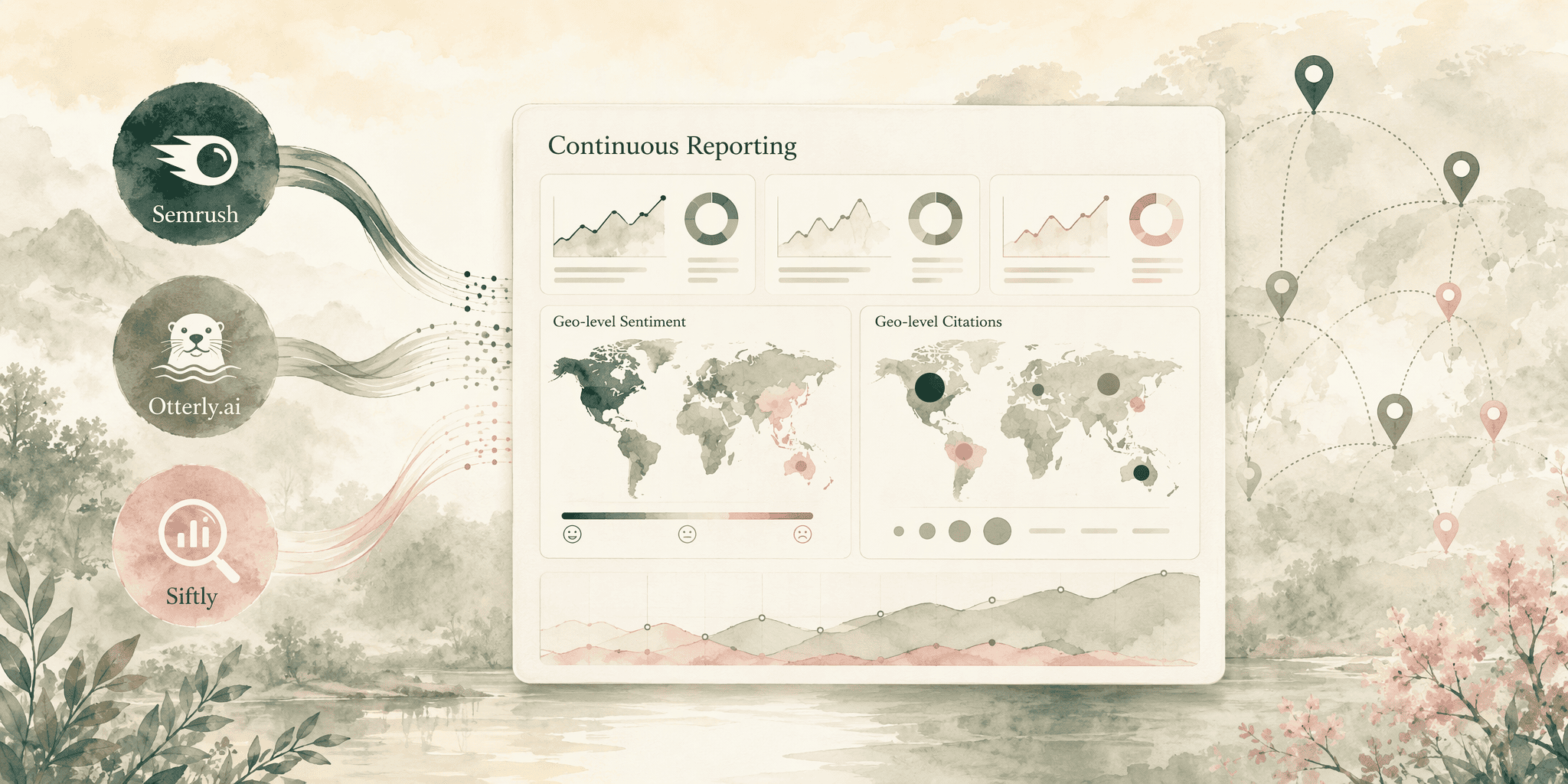
Manual checks capture a moment; automated tools build a trend. Semrush tracks brand perceptions across ChatGPT, Gemini, and Perplexity across 68,000 locations for brand sentiment tracking, making it feasible to monitor geographic variation. Otterly.ai, trusted by over 40,000 marketing professionals, queries multiple AI search engines and surfaces citation patterns. Siftly provides cross-platform monitoring that attributes referral traffic directly to LLM citations and measures mention rates, citation quality, sentiment, and positioning.
Define your keyword set by mapping the top 50 questions your ideal customers ask about your product category. Add your top five competitors as tracked entities. Configure each tool to scan for these keywords and competitors specifically.
The setup takes roughly two hours. Validate the first automated scan against your manual baseline spreadsheet.
If the tool reports a brand presence in ChatGPT that your incognito queries missed, adjust the prompt phrasing in the tool. Configuration is an active calibration exercise: it makes automation amplify your manual insights rather than replacing them with noise.
Step 4: Expand to Multi-Engine Competitor Benchmarking

An isolated brand score tells you almost nothing useful on its own. The number only becomes meaningful when you place it next to the competitors your buyers actually evaluate.
Run the same query across all major models and generate a comparative report that places your brand's mention frequency, sentiment, and citation quality alongside your top competitors on each AI engine separately. Some platforms like Meltwater and Brandwatch now offer AI benchmarking modules, and tools like Siftly provide multi-engine competitor benchmarking dashboards that show side-by-side comparison views.
Apply market share weighting to the final composite score. If Perplexity drives 5% of your target audience's AI queries but Google AI Overviews drives 45%, a dominant score on Perplexity should not inflate your weighted average. Assign each engine a weight proportional to its share of your audience's actual AI search usage, drawn from your own referral data or from platform-specific survey data publicly available from research firms.
A mention on a high-traffic engine matters more than one on a niche platform. Weight the engines by their actual query volume in your audience, and the composite number reflects something closer to real visibility. This step transforms a dry dashboard number into actionable competitive intelligence.
Step 5: Implement AI Citation Quality Scoring to Go Beyond Presence/Absence

A raw mention count treats a citation from an anonymous blog and a citation from a leading industry publication as equal. Citation quality scoring fixes this by evaluating the domain rating and backlink profile of each cited webpage. The data also reveals that when AI search engines cite any sources, about 78% of those citations go to corporate websites, and the ranked 'best-of' listicle is the most-cited content format at about 21% of all citations. A single authoritative listicle can surface your brand across dozens of AI answers simultaneously.
|---|---|---|---|
| Source Type | Anonymous blog or user forum with low domain authority | Corporate website, industry publication, or academic source with high domain rating | 40% |
| Direct vs. Implied Citation | AI name-drops your brand with no linked source | AI output includes a direct referral link to your page | 35% |
| Topical Authority of Cited Page | Page covers the topic generally or tangentially | Page is explicitly about the AI's topic and ranks for related search terms | 25% |
A brand mentioned twice with both citations earning a quality rating scores higher than a brand mentioned five times with low-quality citations. The output captures meaningful influence over the AI's recommendation.
Every piece of content your team publishes must carry UTM parameters embedded in the canonical URL. For example, tag your core product page with `utmsource=chatgpt&utmmedium=organicai&utmcampaign=ai_visibility`. Generative AI models that read your pages during training or retrieval will expose those tagged URLs when they cite your brand in an answer.
In Google Analytics 4, build a custom segment that isolates sessions where the source or medium matches your AI UTM tagging scheme. This segment captures AI-referred traffic that would otherwise blend into direct traffic or vanish entirely. The configuration takes about 30 minutes in GA4's exploration reports.
Look for correlation. Full attribution remains complex; no platform yet offers a fully validated citations-to-revenue attribution model.
The incremental data is still powerful enough to inform content investment decisions.
Step 7: Set Your Monitoring Cadence and Build an Actionable Report

- Set automated scans to run weekly: Configure your monitoring tool to query the defined keyword-competitor set every Monday morning, capturing trend data without manual effort.
- Use a spreadsheet or a BI tool layered over the data export from your monitoring platform.
- Immediate intervention, like publishing updated content or addressing the cited source's accuracy, preserves citation quality.
- Re-baseline manually each quarter: Run the Step 2 incognito protocol every 90 days to recalibrate automated tools against current AI model behavior, since model updates can shift citation patterns overnight.
A spike in your composite score looks good on a dashboard, but zoom in. Separate the quality grade from the raw frequency. A brand named favorably in two high-context citations matters more than one sprinkled neutrally across ten low-authority responses. The ratio tells you whether your visibility is durable or just widespread noise. Watch the gap between quantity and quality each month; when frequency climbs but sentiment or authority has dropped, your content is showing up in the wrong conversations.
Conclusion
AI share of voice is a permanent competitive intelligence function. By 2026, brands that master citation quality scoring, multi-engine benchmarking, and UTM-tagged referral tracking will dominate the generative answer engine era because their measurement program pinpoints exactly where to invest content effort for maximum AI visibility return.
Start with your manual baseline this week. Configure automated monitoring within a fortnight. Build the reporting cadence within a month.
Frequently Asked Questions
What is share of voice in the context of AI-generated search results, and how does it differ from traditional SEO share of voice?
AI share of voice measures how frequently and favorably a brand appears in the text of generative AI responses across platforms like ChatGPT and Gemini. It diverges from traditional SEO share of voice, which counts clicks on ranked blue links, because AI models synthesize answers from authoritative sources and may cite a brand without a corresponding high search ranking, making citation quality the central metric rather than keyword position.
Which metrics and dimensions should I track to measure AI share of voice?
Track four core dimensions of your brand's AI presence, weighting citation quality most heavily since it signals the AI's trust in the underlying source:
- Mention frequency: how often your brand is named.
- Sentiment: positive, negative, or neutral framing of the mention.
- Citation quality: the authority and backlink profile of the cited source page.
- Positioning: whether your brand appears first or is buried within the AI's response.
What tools or platforms are available to monitor brand visibility specifically in AI search engines?
Several platforms provide AI-specific monitoring as of 2026. Ahrefs offers a free AI Visibility Checker that queries ChatGPT, Gemini, Perplexity, Copilot, and Google AI Overviews. Semrush tracks brand sentiment across major AI platforms, Otterly.ai provides multi-engine citation analytics, and Siftly measures AI visibility, citation quality, and AI-referred traffic across ChatGPT, Perplexity, and Google AI Overviews.
How do I benchmark my brand's AI share of voice against competitors across multiple AI platforms simultaneously?
Configure your monitoring tool with your competitor set and keyword list, then generate comparison reports that show mention frequency, sentiment, and citation quality for each brand, broken out by engine. Weight each AI platform's score by its actual share of your audience's AI search usage so that a strong score on a low-traffic engine doesn't distort your competitive standing.
What is the step-by-step process for setting up an AI share of voice measurement program and tracking changes over time?
First, define a scoring framework weighting mention frequency, sentiment, citation quality, and positioning. Second, establish a manual baseline by running incognito queries on each AI platform. Third, configure automated tools to scan weekly across your defined keyword-competitor set.
Fourth, expand to multi-engine competitor benchmarking with market share weighting. Fifth, add a citation quality layer by scoring the domain authority of cited pages.
Sixth, connect the data to business outcomes through UTM-tagged referral links in GA4. Seventh, set a weekly automated scan cadence with a monthly trend report and alert thresholds.
Can I connect AI share of voice data to actual business outcomes like site traffic and conversions from AI-referred clicks?
Yes. Embed UTM parameters like `utm_source=chatgpt` into the canonical URLs of all published content that AI models may cite. In Google Analytics 4, build a custom segment filtering for these AI-specific source and medium values. Full attribution remains imprecise, but directional linkage is strong enough to justify content investment decisions.
Sources
- Free ChatGPT Shopping Visibility Checker | Siftly - siftly.ai
- Free AI Visibility Checker by Ahrefs: Track Your Brand in AI search - ahrefs.com
- AI brand sentiment & perception analysis | Semrush features - www.semrush.com
- Generative Engine Optimization at Scale: Measuring Brand Visibility Across AI Search Engines - arxiv.org
- AI Search Monitoring Tool: Track ChatGPT, Perplexity & Google AIO - otterly.ai
Keep exploring
More from the blog.

Oct 17, 2026
8 Best AI Brand Monitoring Tools for Startups on a Budget in 2026
The difference between a funded quarter and a missed target is increasingly a single sentence generated by ChatGPT or Perplexity.

Oct 17, 2026
7 Best AI Brand Monitoring Tools for 2026
Your brand can be cited in a Google AI Overview, praised in a Perplexity answer, or recommended by ChatGPT with zero visibility on your end.

Oct 16, 2026
How to Measure Share of Voice in AI Search: A CMO’s Benchmarking Playbook
Your brand's most critical marketing metric stopped working the moment Google launched AI Overviews.