Oct 27, 2026
How to Get Alerts When Your Brand Visibility in AI Search Suddenly Drops
Your brand spent years mastering search performance. You built topical authority, earned backlinks, and optimized for featured snippets.

Introduction
Your brand spent years mastering search performance. You built topical authority, earned backlinks, and optimized for featured snippets. The playbook was reliable until it wasn't.
The problem today is that AI-generated search answers like those in ChatGPT and Google AI Overviews operate on an entirely different logic than traditional search engines. A model update, a competitor's aggressive Generative Engine Optimization strategy, or even a shift in training data can wipe your brand from AI answers overnight. You don't get a gradual velocity curve to watch.
One day you are the recommended provider, the next you simply do not appear in the response. A survey-based brand health tracker cannot catch this because it lags by weeks, given that surveys take time to field, code, and ship.
This new fragility demands a completely new defense mechanism: continuous algorithmic sentiment monitoring with real-time alerting. This article dissects why AI visibility collapses come without warning, identifies the drivers behind sudden citation drops, and presents the exact technological approach and tools needed to detect them before your revenue is impacted.
Key Takeaways
AI visibility drops are binary events driven by model shifts, not organic ranking decay. Legacy analytics are blind to them, and manual checking cannot scale. Automated, multi-model monitoring is the only viable control.
- Causes of collapse: Sudden AI visibility drops stem from model fine-tuning, context-window competition, and content corpus changes, not slow ranking algorithm adjustments.
- Legacy tool failure: Traditional SEO rank trackers and web analytics fail entirely here because LLMs output conversational citations rather than lists of links, generating zero usable data for those platforms.
- Monitoring necessity: Manual prompt testing becomes operationally infeasible beyond 50 prompts per week across 5 competitors, necessitating synthetic query agents that run daily across multiple models.
- Alerting mechanics: Effective alerting systems use Named Entity Recognition and volatility baselining to flag genuine structural citation gaps while filtering out transient probabilistic noise.
- Impact justification: Without deterministic click-through data, proxy metrics like Share of Model and Conversational Mindshare become key financial narratives for defending monitoring investment.
Why AI Brand Visibility Collapses Without Warning
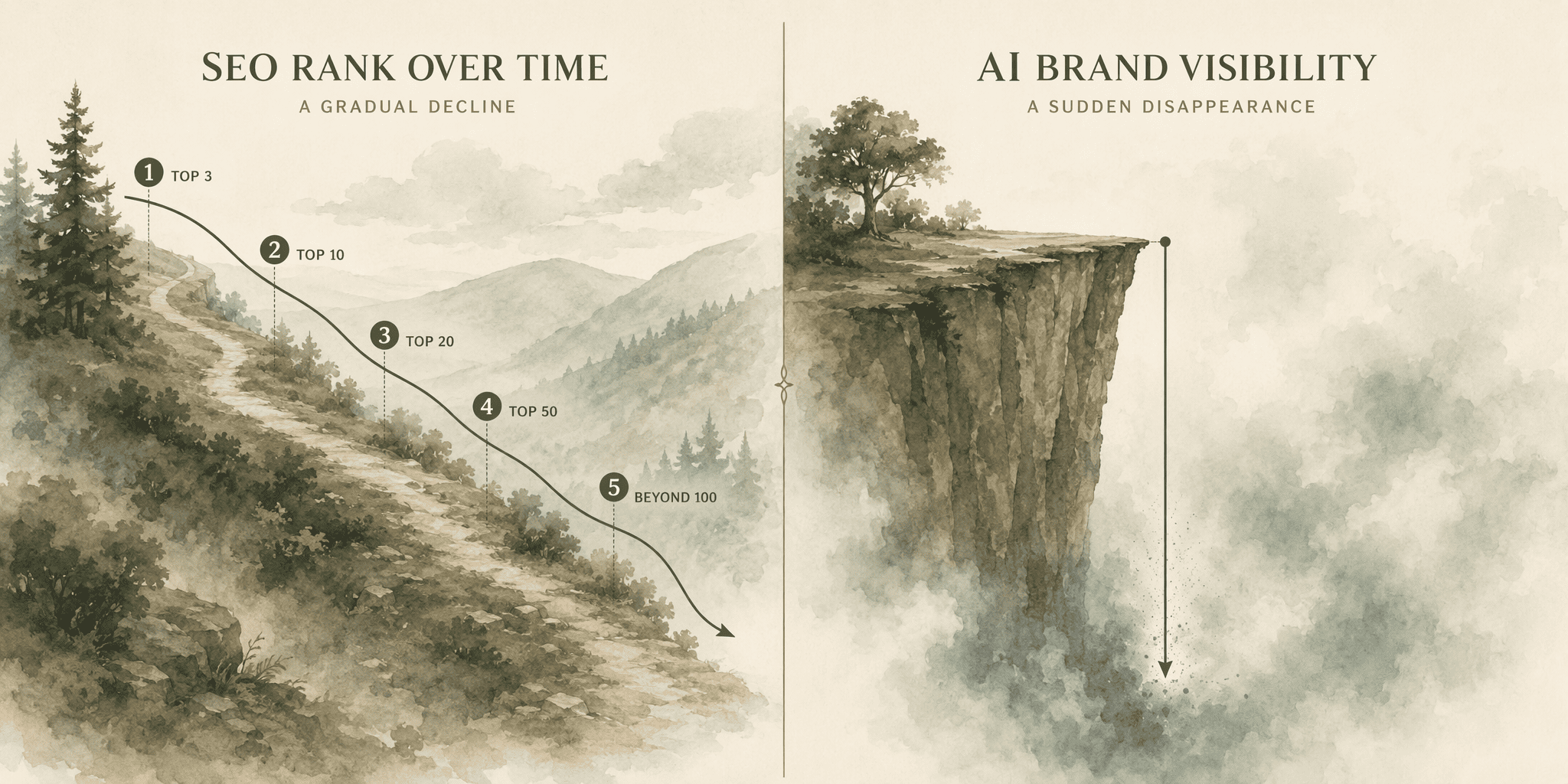
Traditional SEO operates on a gradient. A Google ranking decay for a primary keyword usually happens over days or weeks as backlinks age, competitors publish fresher pages, or algorithmic weights shift gradually. You can watch the ranking move from position 3 to 7 to 14, and you have data points every step of the way.
AI-generated search answers do not function on a gradient. A Large Language Model constructs a response probabilistically, selecting tokens based on learned patterns in its training data and any injected retrieval context. When you ask an AI engine a question about a product category where your brand previously appeared, the model is not consulting a static index with ranked URL positions. It is generating a text sequence where your brand entity either meets the model's current weight threshold for inclusion in that specific context window or it does not. A single change to the system prompt, a model fine-tuning round that shifts entity associations, or a competitor achieving denser semantic saturation around your key product descriptors can cause your brand to vanish from the answer entirely between one query and the next.
This produces a binary visibility event. Your brand is either visible in the generated answer as a recommended entity, or it is completely absent. There is no position 8 to track. This black-box omission leaves no trail in standard analytics because the interaction happens inside the AI interface, not on your website, making the omission invisible to conventional monitoring infrastructure.
The business consequence is that your reaction window shrinks from days to hours. A zero-click AI Overview that replaces your visibility can potentially cost sites up to 30% of their traffic without generating a single alert in your existing martech stack. Your team needs to know within minutes that the model stopped citing you.
The Drivers Behind a Sudden Drop in AI Mentions
Sudden drops in AI visibility fall into three primary categories: model-level technical changes, competitive content saturation, and reputational data contamination.
- Model fine-tuning and architecture updates: When an AI provider updates its underlying model or system prompt, the associative weights between entities shift. A reinforcement-learning round that prioritizes different citation patterns can deprioritize your brand category entirely.
- Retrieval-Augmented Generation (RAG) source shifts: In engines that use real-time retrieval, a change in which source indexes the model queries can replace your content in the injection layer regardless of your on-page authority.
- Competitive prompt saturation: Competitors executing GEO strategies may flood the retrieval corpus with semantically dense content that displaces your entity from the limited token budget available in the model's response context.
- Reputational triggers and corpus contamination: Press events, data breaches, or narrative shifts that make their way into training data or retrieval sources can alter how a model evaluates the safety or relevance of recommending your entity.
How Automated AI Monitoring Catches Drops That Manual Checks Miss
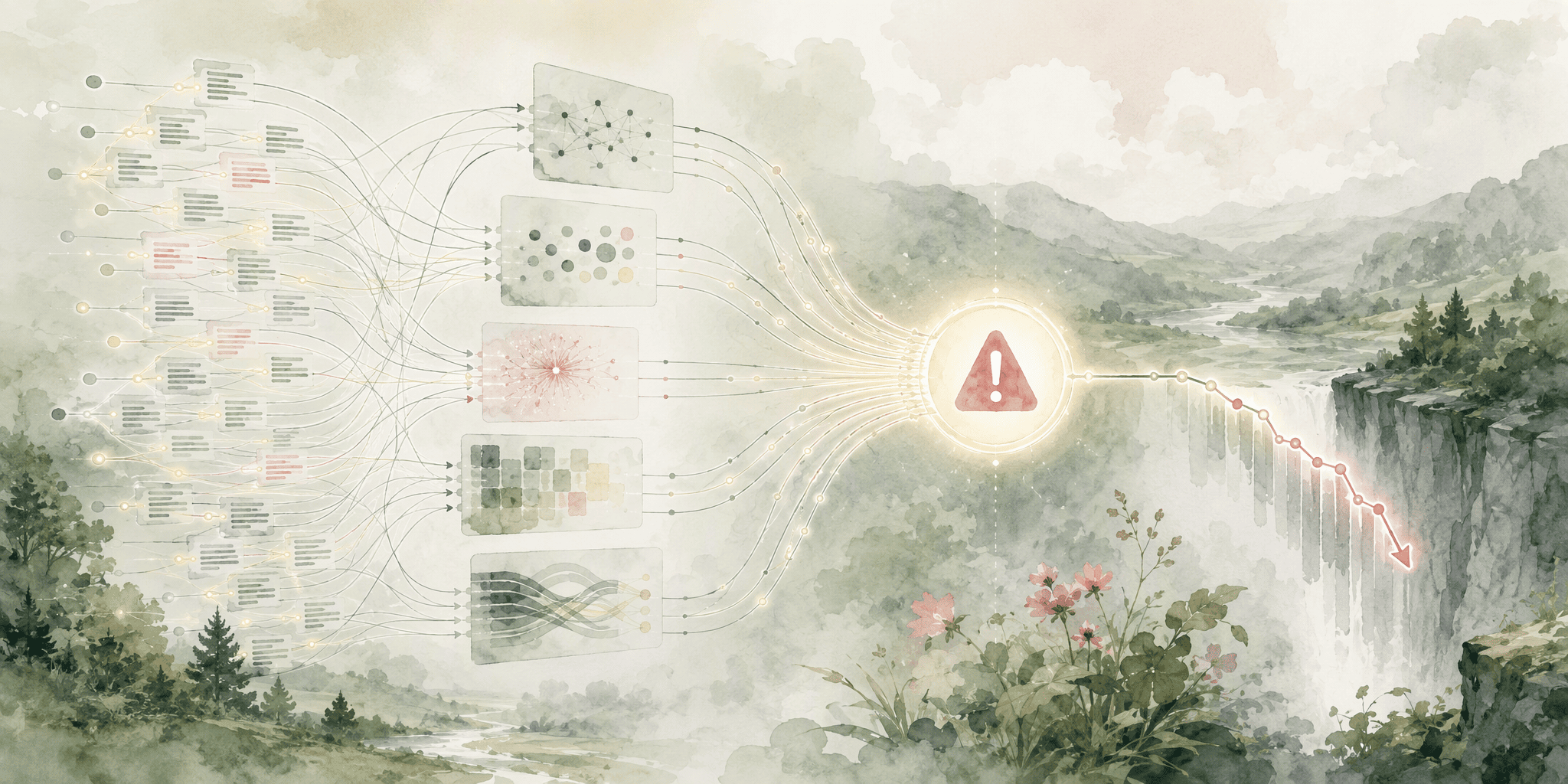
Manual brand tracking in AI search hits an operational wall fast. To get a statistically useful signal, you need to query multiple AI platforms across multiple prompt variations repeatedly. Manual tracking becomes infeasible above 50 prompts per week when monitoring 5 competitors. At even modest enterprise scale, the combinatorics of language, region, platform, and prompt phrasing produce thousands of distinct queries that no internal team can execute consistently.
Automated monitoring solves this through synthetic query agents that fire every tracked prompt daily across the major generative engines. Tools classify queries by intent and market, then parse the generated responses for brand entity mentions using NER pipelines that tag your brand, your products, and your competitors, even when referenced in natural language rather than hyperlinks. Critically, capturing AI responses from the browser-level front-end, rather than the API, ensures the output matches exactly what customers see. This method produces time-series citation data that a simple Google Sheets audit cannot replicate, surfacing volatility events within a detection window short enough for your team to investigate before a citation gap turns into market-share loss.
Why Traditional Analytics Fail to Spot AI Citation Shifts
Standard analytics and rank-tracking tools are structurally incapable of capturing AI citation shifts. They record clicks, impressions, and URL positions on search engine results pages. When a customer asks ChatGPT for a vendor recommendation and the model leaves your brand out, your Google Analytics instance records absolutely nothing. Traditional analytics dashboards simply do not record AI citations, and that creates a dangerous monitoring blind spot.
New monitoring platforms take a fundamentally different approach. Instead of tracking SERP positions, they scan generated text for entity mentions, citation frequency, and the surrounding sentiment context. When a model that cited a brand consistently suddenly stops, the system flags an anomaly. A non-click in traditional analytics is indistinguishable from background noise. This difference is the reason legacy tools cannot serve as a substitute for purpose-built AI visibility monitoring.
| Dimension | Traditional SEO/Web Analytics | AI Citation & Visibility Monitoring |
|---|---|---|
| What is measured | URL ranking position, click-through rate, page impressions | Brand entity mentions, citation frequency, sentiment context within generated text |
| Data generation event | User clicks a search result and loads a tracked page | LLM generates a text sequence containing or omitting a tracked entity |
| Detection of brand omission | Impossible; a non-click is indistinguishable from background noise | Active flagging; a model previously citing the brand and suddenly stopping triggers an anomaly alert |
| Core failure mode | Records zero usable data for AI-sourced brand presence or absence | Designed specifically to parse unstructured natural-language output for entity inclusion |
| Signal speed | Data can lag by hours or days | Engineered for near-real-time notification of statistically significant citation shifts |
How AI Citation Tracking Works as an Early Warning System

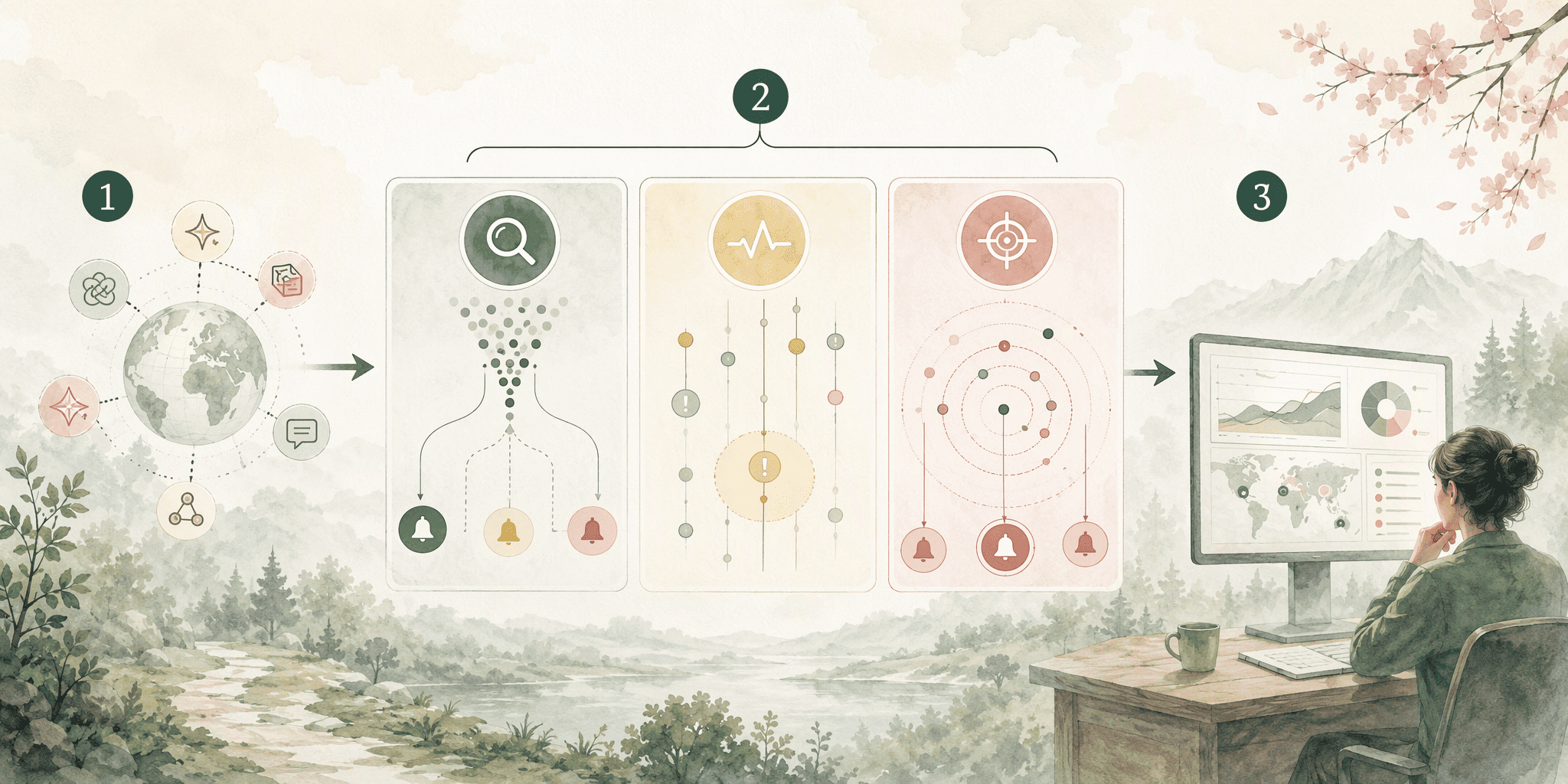
An AI citation tracking system functions as a continuous monitoring loop with three core steps:
- Execute daily prompts: The platform runs a pre-configured set of natural-language prompts against multiple generative engines every day, acting as a synthetic audience that mimics real consumer queries. Running every tracked prompt daily captures the true variation in AI responses across sampling events.
- Parse and annotate mentions: A parsing layer extracts brand entity mentions from the unstructured text output using Named Entity Recognition models that tag surface-level brand names, associated products, and executives. The system applies sentiment tagging and citation-context annotation to distinguish between a brand being positively recommended, negatively contrasted, or entirely omitted from a category answer. Multiple AI platforms, including ChatGPT, Perplexity, Claude, and Google AI Overviews, are queried through their front-end experiences to capture exactly what a normal user sees.
- Build a volatility baseline and fire alerts: Against this data stream, the system builds a volatility baseline. When citation frequency for a tracked entity drops below a configured threshold relative to its historical average across platforms, the engine fires an alert. This statistical approach filters transient noise from structural dislodgement, preventing alarm fatigue while ensuring genuine exclusion events reach the brand team in time to act.
Tools That Provide Real-Time Alerts for AI Search Visibility Drops
Dedicated AI visibility platforms have emerged to fill this monitoring gap, each with a different alert architecture:
- Brandpeek and Llmpulse trigger alerts based on citation frequency changes.
- Profound captures AI responses directly from the browser rather than the API, so what you see in its dashboard matches what your customers see when they query AI. Profound also includes a FactCheck layer that surfaces inaccurate AI claims about a brand and identifies their sources, letting your team correct the narrative driving the drop.
- Enterprises can also use social-listening vendors adding tooling to this space, but their alert logic was built for post-volume spikes. A dedicated platform like Siftly can automate daily queries across ChatGPT, Google AI Overviews, Gemini, Perplexity, and Claude, surfacing citation shifts days faster than manual Google Sheets audits.
Interpreting Drop Signals in the Context of Probabilistic AI Outputs
Not every visibility alert is a crisis. Large Language Models are probabilistic generators, not deterministic databases. The temperature parameter and sampling mechanisms inside these models deliberately inject variance into token selection to produce natural, non-repetitive text. A single query instance where your brand fails to appear in a ChatGPT answer can be a transient hallucination event driven by sampling randomness.
Tuning your alerting threshold correctly is the difference between operational paranoia and operational control. You need multi-sample confirmation across query runs to confirm reproducibility before triggering an escalation. If your brand disappears in 7 out of 10 prompt executions on the same platform within the same day, the probability that a structural retrieval or weight-change problem is at play is high. A one-off omission with p-value noise is not worth waking up the VP.
Repetition penalties and the model's own anti-hallucination guardrails further complicate the picture. A model may deliberately suppress a brand mention if its internal confidence scorer rates the citation as uncertain or if a recent fine-tuning pass instructs it to reduce named-entity density in its outputs.
Practical alerting strategy requires setting a composite threshold: cross-platform confirmation, repetition count, and persistence over consecutive monitoring cycles. All three must align before you declare a genuine drop event and mobilize a response team.
Immediate Response Playbook: First Steps After an AI Visibility Alert
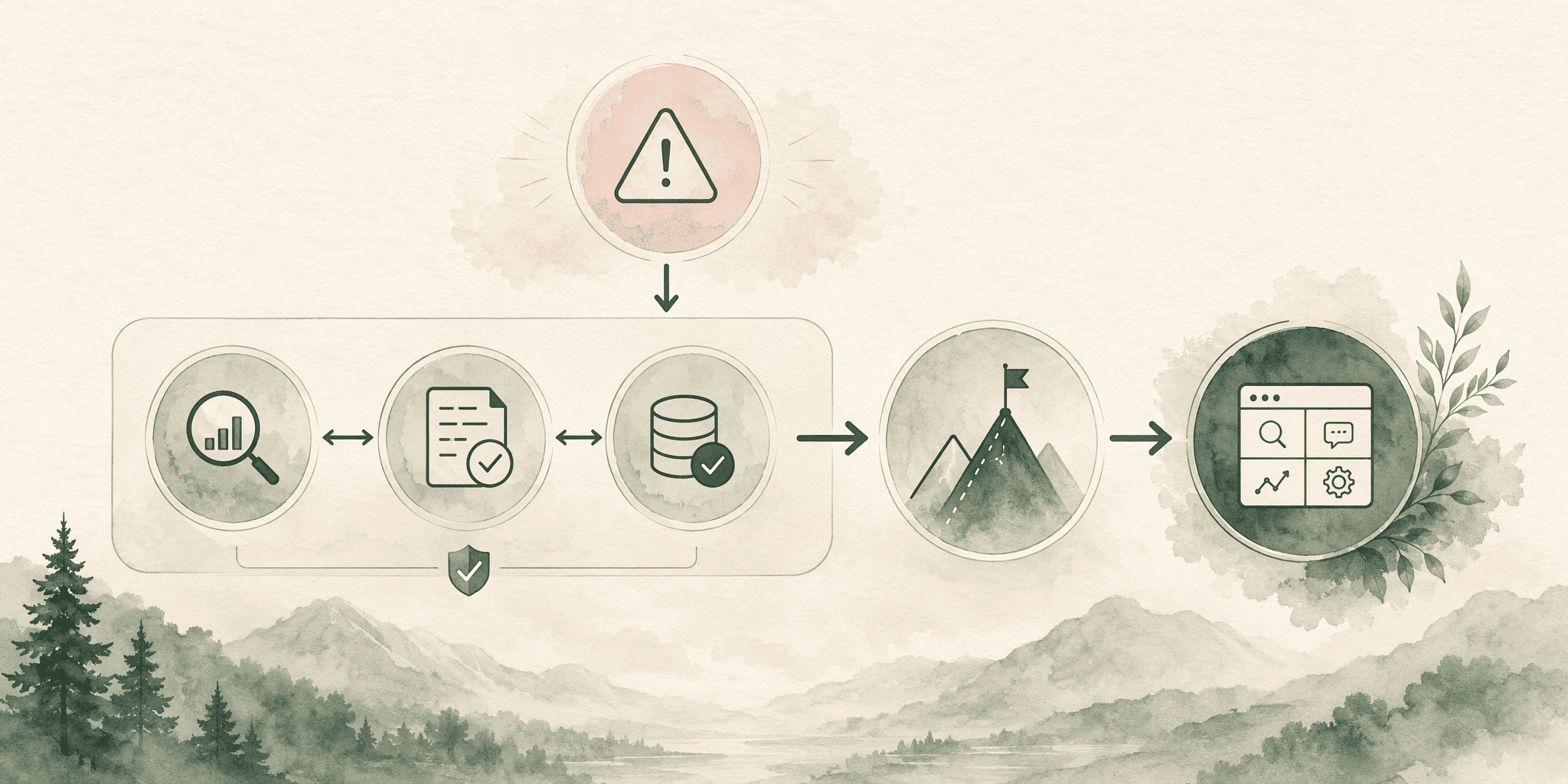
A confirmed drop alert demands a structured diagnostic and remediation sequence. Start with cross-validation, then move to competitive gap analysis. The table below organizes the first four response actions and the specific AI platforms to target for each diagnostic step.
| Response Action | Primary Diagnostic Platform | Key Artifact to Analyze |
|---|---|---|
| Cross-validate the drop across at least three AI engines using identical prompts | ChatGPT, Gemini, Perplexity | Identical prompt-response pairs confirming persistence or isolation of the omission |
| Identify the entity-dense competitor now occupying your citation slot | Google AI Overviews, ChatGPT | The business name, product descriptors, and supporting sources of the entity the model replaced you with |
| Audit your brand's semantic keyword burden in competitor citation sources | Claude, AI Mode | A side-by-side comparison of the semantic fields and content depth your competitor's cited pages contain that yours do not |
| Draft remediation content package targeting the identified coverage gaps | ChatGPT with browser tool, Perplexity | A content brief that addresses the specific entity associations your domain must strengthen to re-enter the model's context window |
Connecting AI Citation Drops to Business Impact When Deterministic ROI Isn't Available
Finance teams want a revenue-attribution number. Generative AI search cannot yet provide one with statistical precision. No platform today offers a fully validated citations-to-revenue attribution model, and upstream traffic data modeled from LLM citations should not be treated as deterministic traffic logs. The conversion chain from AI recommendation to sale breaks at multiple points that resist closed-loop measurement.
That does not make the monitoring investment indefensible. You replace the old attribution metric set with proxy metrics that your CFO can model against revenue. "Share of Model" quantifies your brand's citation ratio within category prompts across major engines compared to competitors. "Conversational Mindshare" tracks the sentiment-weighted frequency of your entity in AI-generated category discussions. Both metrics serve the same budget-justification function that share-of-voice did for paid and organic before multi-touch attribution matured.
You establish a defensible business case by linking citation presence to a leading-indicator funnel. The chain of inference runs: higher Share of Model drives higher brand recognition in AI-mediated discovery, which drives higher prompted search volume and direct traffic, which then converts at your site's established rate. The link from prompt to sale is probabilistic. The directional attribution is strong enough to support a six-figure monitoring budget.
For a concrete benchmark, factor a realistic improvement target into your investment model. A 10-point improvement in citation rate across tracked prompts is framed as a realistic 6-month goal for a brand executing a disciplined GEO program in parallel with continuous monitoring. If you cannot measure the baseline first, then ROI improvement and competitive share-of-voice gains cannot be measured. Establishing monitoring infrastructure is the necessary first action.
Conclusion
AI search engines do not index content, they extract it.
The marketing analytics stack built over the last decade was engineered for a world where brands fought for ranked positions on indexed results pages. That world is receding. The replacement is a probabilistic extraction layer where your brand is either inside the generated answer or it is invisible, and standard analytics cannot tell you which condition you are in today.
Proactive detection through automated multi-model monitoring shifts the posture from retroactive panic to operational control.
The brands that instrument for this now, establishing citation baselines and alerting thresholds before the competitive dynamics in their category heat up, will be the ones that maintain influence inside the AI-mediated buyer journey.
Frequently Asked Questions
What causes a sudden drop in brand visibility within AI-generated search results?
Sudden drops arise from three sources: model-level changes like fine-tuning that shifts entity association weights, retrieval-augmented generation source-index changes that replace your content in the injection layer, and competitive prompt saturation that displaces your entity from the model's limited context-window token budget.
How can I automatically monitor my brand's presence across multiple AI search engines like ChatGPT and Google AI Overviews?
You can deploy automated AI visibility platforms that run synthetic queries daily against multiple engines including ChatGPT, Gemini, Perplexity, and Google AI Overviews. These tools parse responses with Named Entity Recognition to track brand mentions at browser-level fidelity, capturing exactly what users see.
Which tools offer real-time alerts for changes in AI search visibility and brand mentions?
Dedicated platforms offer varying monitoring capabilities:
- Brandpeek and Llmpulse provide real-time citation change alerts.
- Profound captures browser-level responses across 9 AI platforms daily and includes a FactCheck feature.
- Siftly monitors across ChatGPT, Google AI Overviews, Gemini, Perplexity, and Claude with daily query execution.
How does AI citation tracking work and how does it signal a brand visibility drop?
Citation tracking executes daily prompted queries against multiple AI engines, parses the generated text with entity extraction models to identify brand mentions, and builds a volatility baseline. When your citation rate drops below a configured threshold relative to that historical baseline, the system fires an anomaly alert.
What should my team do immediately after an alert about a drop in AI search visibility?
Respond to a confirmed citation drop with a four-step workflow:
- Cross-validate the drop across at least three AI engines.
- Identify the competitor entity now occupying your citation slot.
- Audit their cited content for semantic coverage gaps.
- Draft a remediation content package targeting those gaps, and re-baseline after deployment.
Can I measure the business impact of a drop in AI search citations and share of voice?
No fully validated citations-to-revenue attribution model exists today. Replace traditional ROI with proxy metrics like Share of Model and Conversational Mindshare, then link citation presence directionally to prompted-search and direct-traffic leading indicators that convert at your site's established rate.
Sources
- 8 Brand Tracking Software Tools Compared (2026) - Analyze AI - www.tryanalyze.ai
- Answer Engine Insights: #1 AI Search Visibility Platform - www.tryprofound.com
- A Major AI Search Tool Just Shut Down. Is ‘GEO Strategy’ Officially Dead? | by Amit Mishra , Room Service Branding | Medium - realamitmishra.medium.com
Keep exploring
More from the blog.

Oct 27, 2026
9 Best AI Optimization Platforms for B2B SaaS Startups on Tight Budgets in 2026
81% of users now prefer AI over human assistance for information discovery. For B2B SaaS startups, this single statistic rewrites the rules.

Oct 27, 2026
5 AI Brand Monitoring Tools That Show You Exactly What AI Says About Your Brand vs. Competitors in 2026
Search is no longer a list of ten blue links and an ad. This shift creates a brutal visibility problem for brands:

Oct 27, 2026
7 Causes of Your 2026 Website Traffic Drop as AI Replaces Google Search
Your organic traffic is down, and it has nothing to do with a Google core update. Search engines drove just 12% of publisher pageviews in North America in Q3