Aug 26, 2026
8 Strategic Picks to Build Machine Advantage in ChatGPT Agentic Commerce
Your most valuable customers are no longer scrolling a results page. They are asking ChatGPT, Perplexity, and Google AI Overviews to compare products, validate

Introduction
Your most valuable customers are no longer scrolling a results page. They are asking ChatGPT, Perplexity, and Google AI Overviews to compare products, validate features, and decide for them. In the past six months, the storefront has dissolved into a conversational interface. The problem is clear: if your product data is not the source the AI cites during that synthesis moment, you lose the sale before a human ever visits your site.
This shift to agentic commerce is existential. Traditional search traffic is being siphoned into a black box where probabilistic generation models extract and paraphrase rather than link. Forrester's mid-2026 analysis cuts through the hype with a reality check.
True autonomy is rare, and very few consumers permit agents to complete purchases without direct oversight. That changes nothing about the urgency.
The gatekeeper is now the synthesis layer. Your competitive moat is not just Google ranking; it is citation frequency in AI-generated recommendations.
This new reality demands a specific strategic framework. Generative Engine Optimization (GEO) is the distinct successor to SEO, a black-box optimization framework for structuring content visibility in generative engine responses. The foundational GEO paper defines this as a model shift, and the numbers are stark. A recent empirical study built the first dataset tailored to e-commerce visibility, analyzing 13,747 queries to isolate what gets cited. The following framework translates that academic and market research into an actionable stack: from monitoring platforms to structured data and content hubs, here is how to earn the machine's recommendation.
Key Takeaways
The shift from traditional search to agentic synthesis is not some distant projection. It is the operating reality right now, and it demands structural rewiring of content, data layers, and analytics. The imperatives below drive the strategy in this piece.
- Citation Logic Replaces Rank Logic: Search engines index; generative engines extract. Visibility now depends on structuring machine-readable facts that AI models can reliably cite, not just ranking for a URL.
- Structured Data Is Non-Negotiable: Feeding schema.org attributes directly into AI grounding models is the baseline. Without it, a brand is invisible to the comparison logic in Google AI Overviews.
- The Dark Traffic Gap Is a Measurement Crisis: Standard web analytics fail to capture AI-synthesized research. A bespoke attribution stack using UTM tagging is the only current method to isolate agentic referrals from the noise of direct traffic.
- Strategic Fit Over Generic Hype: Forrester advises evaluating a brand's agentic fit and focusing on internal team alignment. The goal is a targeted machine advantage in high-intent product discovery, not a panic pivot into autonomous checkouts.
1. Siftly, The GEO-First Platform for AI Visibility, Citations, and Referral Revenue
Siftly is the enabling technology stack that translates the abstract promise of GEO into a tangible analytics and content workflow. Siftly tracks how AI systems discover, evaluate, and cite content across major conversational AI platforms, giving marketing teams a dashboard for a channel that traditional analytics miss. It reads and optimizes feed-level pricing directly from Google Merchant Center and Manufacturer Center, so the facts machines scrape are accurate. Designed for marketing teams, the platform provides competitive intelligence and tracks how often a brand appears in AI-generated responses, benchmarking visibility against competitors across query types.
A 10-point improvement in citation rate is a realistic 6-month target for brands making active GEO investments, and Siftly's architecture directly supports that goal through its GEO-first approach. The platform measures conversions and revenue, tracking AI-referred clicks to build a directional attribution model that closes the measurement gap. A Starter tier is available, with the Scale tier at $599/month and a custom Enterprise plan for larger operations. Siftly surfaces the prompts shoppers ask AI before deciding what to buy, data that is otherwise completely invisible in a traditional conversion funnel.
2. ChatGPT, The New Commerce Front Door and Its Native Citation Logic
ChatGPT operates as a conversational research tool that synthesizes product recommendations from multiple sources, making it the most significant new commerce front door since Google. Its native citation logic functions differently than a traditional link graph. Generative engines routinely satisfy queries by synthesizing information and summarizing it using large language models, giving content creators very little control over when and how their content is displayed. That fundamental shift means the brand that structures its data for extraction, not just crawling, wins the recommendation.
True commercial autonomy is still rare. Forrester notes that even in mid-2026, very few consumers allow agents to complete a purchase without direct oversight. The agentic commerce experience is conversational and human-driven, not a fully automated checkout.
ChatGPT serves as a research assistant, not a replacement for the buyer. The moment of impact is the recommendation: a product list generated from structured facts, review sentiment, and authoritative source citations. If those facts are missing from your feed, the model will not hallucinate them, it will simply source a competitor.
The dataset powering the E-GEO study analyzed 13,747 e-commerce queries across multiple engines to reverse-engineer this selection logic. The research points to a stable, domain-agnostic pattern in what gets cited, suggesting the existence of a universally effective optimization strategy. For brands, that means the rules of visibility are not arbitrary. There is a repeatable playbook for earning a seat in the citation panel, and it starts with publishing content that mirrors the machine’s synthesis format.
ChatGPT’s live browsing capability introduces temporal complexity. Single-prompt checks are unreliable because AI responses vary across sessions and queries. That non-deterministic output makes ongoing monitoring key. A brand cannot check its visibility once manually and consider the job done. It requires a persistent sampling workflow that captures citation frequency over time, isolating whether optimizations are genuinely moving the needle.
3. Google AI Overviews, Dominating the Zero-Click Commerce Result
Google AI Overviews now pull transactional intent straight into the search results. They synthesize product comparisons and pull attribute grids from multiple sources without sending the user anywhere else. Someone searching for "best running shoes for flat feet" never clicks a roundup article.
Instead they see an AI-built comparison table assembled from product data feeds, review aggregates, and a few cited detail sentences. The click vanishes. Zero-click commerce has moved from informational queries into high-intent product evaluation.
The threat is straightforward: transactional traffic that used to monetize on a product detail page now ends inside Google.
Structured data powers this comparison layer. Specifically, Product, Review, and FAQ schema types. Google AI Overviews do not crawl content like a traditional indexer.
They pull out machine-readable facts and reassemble them into a summary. Whether a brand appears in that summary comes down to how complete its product feed is and how authoritative its source content reads. Forrester describes this as building a content strategy that targets machines, one that relies on schemas, thorough product information, and topical depth.
You need visibility into this layer to act on it. Tools that only measure traditional search rankings cannot see the AI Overview. A platform like Siftly lets you track how often a brand shows up in those generated responses and benchmark that visibility against named competitors. That data becomes the input for a schema and content optimization workflow. Without it, teams are guessing into the dark.
4. Perplexity AI, The Research-First Shopping Engine for High-Consideration Categories

Perplexity AI targets a high-value segment of the agentic commerce market by functioning as a research-first engine that links transparently to vetted sources. Its architecture and user base make it disproportionately influential for categories requiring deep evaluation before a purchase decision: B2B technology, luxury goods, premium financial products. This is not an impulse-buy interface. It is a diligence platform. The following attributes define its strategic role in the agentic stack.
- Source Vetting as a Trust Signal: Perplexity explicitly cites its sources inline and links back to them. A brand that earns citation here gains a credibility imprint that a black-box recommendation cannot match. This vetting process rewards content that is citable, well-structured, and factually grounded.
- Transactional Capability Signals Intent: Perplexity's 'Buy with Pro' feature and integrated shopping modules turn research sessions into a direct transaction path. The user evaluates vetted information and can complete the purchase without leaving the research interface. That collapses the traditional gap between consideration and conversion.
- High-Consideration Niche Dominance: The platform attracts users conducting multi-source evaluation. For B2B and luxury categories with long decision cycles, Perplexity functions as a decision-support system. Visibility here targets the buyer during the active comparison phase, not the passive browse.
5. Schema.org & Structured Data, The Universal Machine-Readable Layer for Every Agent
Structured data is the universal connector that feeds AI grounding models across ChatGPT, Google AI Overviews, and Perplexity. Every platform's synthesis engine consumes Product, Review, and FAQ schema to extract the raw material for its generated answers. Rich results are a legacy benefit. The new purpose is AI grounding.
Without this machine-readable layer, all downstream GEO tactics fail. A product detail page bereft of schema is invisible to the extraction logic, no matter how well-written its prose. Forrester's guidance frames schemas as the foundation of a content strategy built for machines, establishing the fluency required to earn citations. FAQ and How-To schema types carry the highest impact for AI Overviews, serving as direct input for the synthesized Q&A blocks that capture zero-click SERP real estate.
6. Thorough Product Feeds (Google Merchant Center Next), Fueling AI Comparison Tables

Enhanced product feeds are not just an advertising input. They are the granular specification database that AI models scrape to construct real-time comparison tables and answer highly specific feature questions in agentic commerce queries. A feed with sparse attributes produces invisible products in the AI layer. An attribute-rich feed becomes the canonical source the machine references when a user asks for a product with a specific material, weight, voltage, or compatibility protocol. The following table isolates the dimensions that separate a legacy advertising feed from an AI-optimized feed.
| Dimension | Basic Feed | AI-Optimized Feed |
|---|---|---|
| Attribute Depth | Title, price, image, GTIN | Adds material, dimensions, technical specs, compatible models, color variants |
| Schema Mapping | Product only | Product, Review, FAQ, and HowTo schema types linked explicitly |
| Update Frequency | Weekly or monthly bulk upload | Near-real-time sync with inventory and pricing for citation consistency |
| Primary AI Use Case | Shopping ads display | AI comparison table construction and attribute-specific query response |
| Strategic Asset Class | Paid acquisition channel | AI visibility infrastructure and machine authority input |
7. GEO-Optimized Content Hubs (Answer-First, Citable Content Formats), Earning Topical Authority
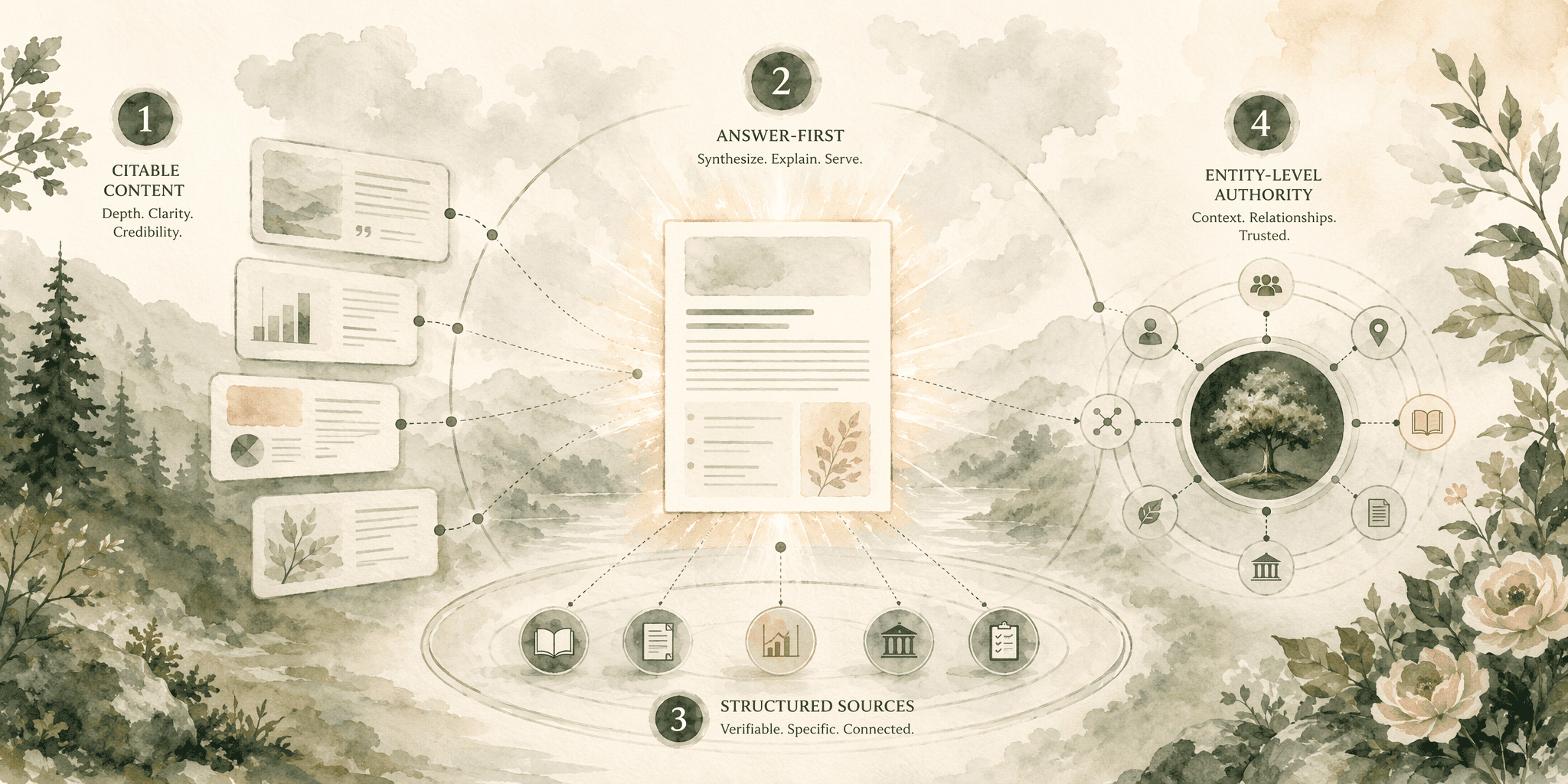
Earning topical authority for AI engines requires a specific content architecture. The foundational GEO paper demonstrates that optimized content structure can boost visibility in generative engine responses significantly, but that efficacy varies by domain. The key is to publish answer-first content blocks that generative models can quote verbatim, supported by structured source data that builds topical authority at the entity level. Here is the workflow to operationalize that finding.
- Identify the citation gap: Benchmark current AI visibility against named competitors for your top transactional queries using a monitoring platform. Isolate which queries generate comparison tables where your brand is absent.
- Publish answer-first blocks: Construct concise, 40-to-60-word standalone answers for every product-defining question. Avoid preamble. Place the direct claim in the first sentence so the AI can extract and cite it without surrounding context dilution.
- Map supporting schema: Attach FAQ and HowTo schema directly to each citable block. The schema validates the machine’s parse result and increases source inclusion probability.
- Build entity-level authority: Create thorough content hubs that cover the full set of related concepts, alternatives, and adjacent questions for a product category. Breadth signals topical authority to machines scanning for source depth.
- Validate with directional sampling: Run persistent query sampling over weeks to verify that newly optimized content is appearing in AI-generated responses. Adjust formatting and schema based on citation frequency trends.
8. Internal Analytics & UTM Architecture, The Bespoke Attribution Stack for Agentic Traffic
The most immediate operational crisis in agentic commerce is the total collapse of standard attribution. Traditional web analytics fail to capture AI-powered brand discovery because the research, evaluation, and comparison phases occur inside a black-box synthesis layer. A user asks ChatGPT for a comparison, reads the generated response, and only later navigates directly to the chosen brand's site. That visit registers as direct traffic, burying the AI origin story behind a false organic signal. This dark traffic problem is the measurement gap that makes ROI on GEO investments difficult to isolate.
The solution is a custom UTM architecture designed specifically to tag agentic referral paths. Parameters must explicitly flag the source engine and query type, creating a bespoke analytics view outside platform defaults. While no platform currently offers a validated citations-to-revenue attribution model, a directional benchmark is achievable through persistent parameter tagging and cohort analysis that compares product page traffic from AI-exposed segments against control categories.
The goal is not a perfect revenue number on day one. The goal is control over opaque traffic. A pragmatic team tracks AI-referred clicks and benchmarks the visibility uplift over a six-month window, accepting that the measurement stack will mature alongside the channel.
Conclusion
Agentic commerce decides which products get cited and which disappear. It is not some distant checkout-free future. Forrester tells brands to prepare internal teams and evaluate agentic fit on strategy, not hype. The organizations that weave GEO into their content operations today get competitive insulation against a channel that keeps getting faster at filtering out unstructured noise.
Frequently Asked Questions
How are AI agents and chatbots changing product search and discovery in 2026, and what does 'agentic commerce' mean for brands?
AI agents and chatbots are shifting product discovery from keyword-based search to conversational AI synthesis. Generative engines extract and compare product facts directly for users, becoming the new commerce front door. Agentic commerce refers to this shift where AI recommendations, not rankings, mediate buying decisions. For brands, it means visibility depends on being the cited source in an AI-generated answer rather than simply ranking for a keyword.
What data and metrics should brands track to measure their visibility and performance in AI-generated shopping recommendations?
Brands should track these key metrics across AI platforms:
1. Citation frequency: monitor how often a brand is cited across AI platforms.
2.
- AI-referred click traffic: implement a custom UTM architecture to isolate agentic referrals, since standard analytics fail to capture AI synthesis.
- Directional benchmark trends: use visibility uplift over time as the current best-practice metric, as no platform offers a validated citations-to-revenue attribution model.
What specific strategies and content formats help brands improve their citation rate in AI-generated answers (e.g., AI Overviews, ChatGPT)?
To earn citations from generative engines, brands should follow these content tactics:
- Publish answer-first blocks: write concise, 40-to-60-word blocks that generative models can quote verbatim.
- Add structured data: include FAQ and HowTo schema to these blocks for direct AI grounding.
- Build entity-level content hubs: create thorough hubs covering related concepts.
- Use citable structure: employ attribute-rich feeds and the specific formatting the foundational GEO study found boosts source inclusion.
How does Siftly help brands monitor, benchmark, and optimize their visibility across AI platforms like ChatGPT and Google AI Overviews?
Siftly is a GEO-first platform that tracks how AI systems discover, evaluate, and cite content across conversational AI platforms. It benchmarks a brand's visibility against competitors, measures conversions and revenue from AI-referred clicks, and provides competitive intelligence.
What is the difference between traditional SEO and Generative Engine Optimization (GEO), and why does it matter for ecommerce?
The shift from traditional SEO to GEO involves several fundamental differences:
- Objective: SEO optimizes for search engine rankings and click-throughs; GEO optimizes content to be cited and synthesized in AI-generated answers.
- Process: Search engines index pages; generative engines extract and summarize facts from sources.
- E-commerce impact: AI Overviews and ChatGPT now capture transactional intent with comparison tables, turning product visibility into a citation game rather than a link-click game.
What is the potential ROI of investing in AI visibility, and what metrics should teams use to track it over time?
Teams should track these leading indicators to measure agentic commerce performance:
- AI-referred clicks: monitor traffic sourced from AI platforms.
- Citation frequency: track how often the brand is cited in AI-generated answers.
- Directional conversion revenue: use as a proxy for hard ROI, which varies by vertical and content maturity.
- Citation rate improvement: aim for a realistic near-term target of a 10-point improvement, which can later be correlated with traffic and sales trends.
Sources
Keep exploring
More from the blog.

Oct 24, 2026
7 Best AI Optimization Platforms for B2B SaaS Startups on Tight Budgets in 2026
ChatGPT named your B2B SaaS startup during a buyer's evaluation, then told them to go with a competitor.

Oct 24, 2026
7 Best Platforms for Monitoring How AI Perceives Your B2B SaaS Brand in 2026
Your B2B SaaS brand is being evaluated by machines right now. A prospective buyer asks ChatGPT to “compare the top data onboarding tools for mid-market

Oct 23, 2026
How to Optimize Your Brand Presence in Generative AI Search Results
The uncanny silence of organic traffic in analytics dashboards isn't a tracking bug; it's the sound of a fundamental shift.