Aug 17, 2026
8 Best AI Search Visibility Optimization Tools for 2026
Your SEO rankings have never been shakier. A brand can dominate page one of Google and still be completely invisible when a prospect asks ChatGPT or Perplexity

Introduction
Your SEO rankings have never been shakier. A brand can dominate page one of Google and still be completely invisible when a prospect asks ChatGPT or Perplexity for a recommendation. Only 11% of cited domains overlap between ChatGPT and Perplexity, according to The Digital Bloom's 2025 AI Visibility Report. Worse, roughly 80% of LLM citations don't rank in Google's top 100 for the same query. The search game has split into two parallel universes, and traditional analytics were not built to detect the second one.
Marketing teams are waking up to a harsh truth: the organic traffic they have measured for decades is increasingly a sideshow. Google AI Overviews now trigger on nearly half of all tracked search queries, and zero-click searches keep climbing. Your content is being consumed, summarized, and cited by generative engines without anyone ever visiting your site. If you are not tracking how AI models discover, evaluate, and reference your brand, you are flying blind on a channel that now shapes purchase decisions before a single Google search gets typed.
The fix is Generative Engine Optimization (GEO), and it requires a new toolkit. The platforms below monitor brand visibility across ChatGPT, Perplexity, Google AI Overviews, Gemini, and more, surfacing exactly where you are cited, with what sentiment, and against which competitors. This guide ranks the eight best tools available in 2026, from budget-friendly monitors to managed enterprise platforms.
Key Takeaways
AI citation intelligence is no longer optional for brands that depend on organic search traffic. Before diving into the platform breakdown, here are the core criteria that separate genuine GEO platforms from basic monitors.
- Breadth of engine coverage matters more than depth on one: A tool that tracks only Google AI Overviews misses the fragmentation happening across ChatGPT, Perplexity, Claude, and Gemini. Multi-model monitoring is the baseline.
- Prompt-level data separates signal from noise: Knowing which specific queries trigger your citations, and with what frequency and sentiment, is the only path to prioritizing content updates that move the needle.
- You need to see which competitors are being cited more often, for which queries, and why.
- Pricing splits cleanly into two tiers: Monitoring dashboards start as low as $29/month, while managed platforms that include content creation and optimization begin at roughly $399/month and climb sharply into enterprise territory.
- Platforms that only monitor are half the picture: The real return comes from connecting citation gaps to content action. Some tools alert you; others go further and generate GEO-optimized content or deploy structured data changes directly.
1. Siftly: The Live-Browsing GEO Platform Built for Product and Ecommerce Teams

For DTC brands and Shopify merchants, the question that matters is straightforward: 'Does ChatGPT recommend my product when someone asks for the best running shoe under $120?' Siftly answers it by simulating live AI browsing sessions. It renders the results with a visual overlay that pinpoints where your products show up, what sentiment they get, and which competitors occupy the citation slots you want.
The platform connects keyword intent to specific product URLs and monitors visibility on major conversational AI platforms. Its competitive share-of-voice dashboard tells ecommerce managers, on one screen, whether they are gaining or losing ground on transactional queries. Siftly's Scale tier is $599/month and pulls pricing data from Google Merchant Center, connecting AI citations to revenue rather than vanity mentions.
2. Profound: Enterprise-Grade AI Visibility with Proprietary Prompt Volume Data
Profound addresses the biggest blind spot in GEO: knowing which prompts actually carry search demand. Its proprietary Prompt Volumes dataset estimates monthly query volumes for specific AI prompts, giving enterprise teams a way to prioritize high-traffic conversations over niche citations that look impressive in a dashboard but generate zero commercial impact. The company raised a $96M Series C in February 2026 at a $1B valuation, with Sequoia, Lightspeed, and Kleiner Perkins backing the bet that AI visibility data becomes as key as search console data.
- Citation tracking and sentiment scoring: Captures brand mentions across ChatGPT, Perplexity, Google AI Overviews, and Gemini, with sentiment classification that distinguishes between a glowing recommendation and a cautionary mention.
- Pricing and the usefulness threshold: The dashboard starts at $399/month for features that deliver real planning value. Lower tiers exist but provide monitoring data without the Prompt Volumes layer that makes the platform worth the investment.
- Enterprise fit: Best suited for brands with dedicated SEO or content strategy teams who will act on the citation gap analysis rather than simply observe it.
3. OtterlyAI: The Budget-Friendly Monitoring Suite for AI Overviews and LLMs
OtterlyAI has quietly become the go-to entry point for agencies and mid-market teams that need broad LLM coverage without enterprise price tags. At $29/month, it tracks brand visibility across six major search engines including Google AI Overviews, ChatGPT, and Perplexity, making it the most cost-efficient way to establish a baseline AI citation measurement programme. The platform has grown to serve more than 15,000 marketing professionals and was recognized as a Gartner Cool Vendor for AI in Marketing 2025.
Beyond simple mention counting, OtterlyAI provides prompt-level citation alerts, share-of-shelf reporting that shows which percentage of a given answer space your brand occupies, and sentiment detection that flags when your citations carry negative or neutral framing rather than endorsement. For agencies managing multiple client brands, the dashboard centralizes monitoring across portfolios, removing the need to run separate tools for each account. A 14-day free trial makes it easy to test the platform against real queries before committing.
The trade-off is depth. OtterlyAI excels at monitoring and alerting, but it stops short of the content optimization and managed GEO workflows that platforms like WP SEO AI or Kalendar AI offer. If your team already has a content engine and needs to feed it with AI citation intelligence, rather than outsource the entire GEO stack, this is the most practical starting point in 2026.
4. Semrush AI Visibility: Integrating Traditional SEO with AI Citation Tracking

For the thousands of marketing teams already inside Semrush every day, Semrush AI Visibility puts the AI-citation picture right where you're already working. The add on layers AI Overviews citation data, featured snippet tracking, and LLM mention monitoring into the existing keyword and backlink dashboards for an extra $99 a month.
The power is the fact that you never leave the workflow. When the platform spots a keyword where you rank well on Google but don't appear in AI Overviews citations, it flags that gap and shows you the pages that are earning the AI citation for that same query. You can audit what those pages do differently (longer entity coverage, cleaner structured data, more direct-answer formatting) and adjust your content without switching tools.
The integration is tight, but it requires Semrush. You need an active Semrush subscription to use the add on, and the AI visibility data is strongest for Google AI Overviews.
Coverage for ChatGPT and Perplexity is thinner than what you get from native GEO platforms like OtterlyAI or Profound. For teams already running SEO through Semrush, it's the lowest-friction path to GEO intelligence available.
5. WP SEO AI: CMS-Native GEO Workflow for Managed WordPress Sites

WP SEO AI is the only platform in this guide that handles the full GEO stack, content briefing, author entity optimization, structured data deployment, and ongoing citation monitoring, entirely within the WordPress dashboard. At €768/month, it is the most expensive option here, but it is also the only one where you are not just buying a dashboard. You are buying a managed service where their team researches prompts, writes GEO-optimized copy, deploys the technical markup, and tracks the results across LLMs.
| Capability | WP SEO AI | Monitoring-Only Tools |
|---|---|---|
| AI citation monitoring | Included, multi-LLM | Included, varies by platform |
| GEO content briefing and writing | Included, done by their team | Not included; you write the content |
| Structured data and author entity markup | Included, deployed in WordPress | Not included; requires separate dev work |
| Competitive share-of-voice tracking | Included | Included on most platforms |
| Monthly starting price | €768 | $29 to $399 |
The managed model suits brands that lack an in-house GEO specialist or need hands-off execution. The trade-off is cost and platform lock-in: the workflow assumes WordPress as your CMS.
6. Perplexity for Publishers: Direct LLM Citation Analytics from the Search Engine Itself
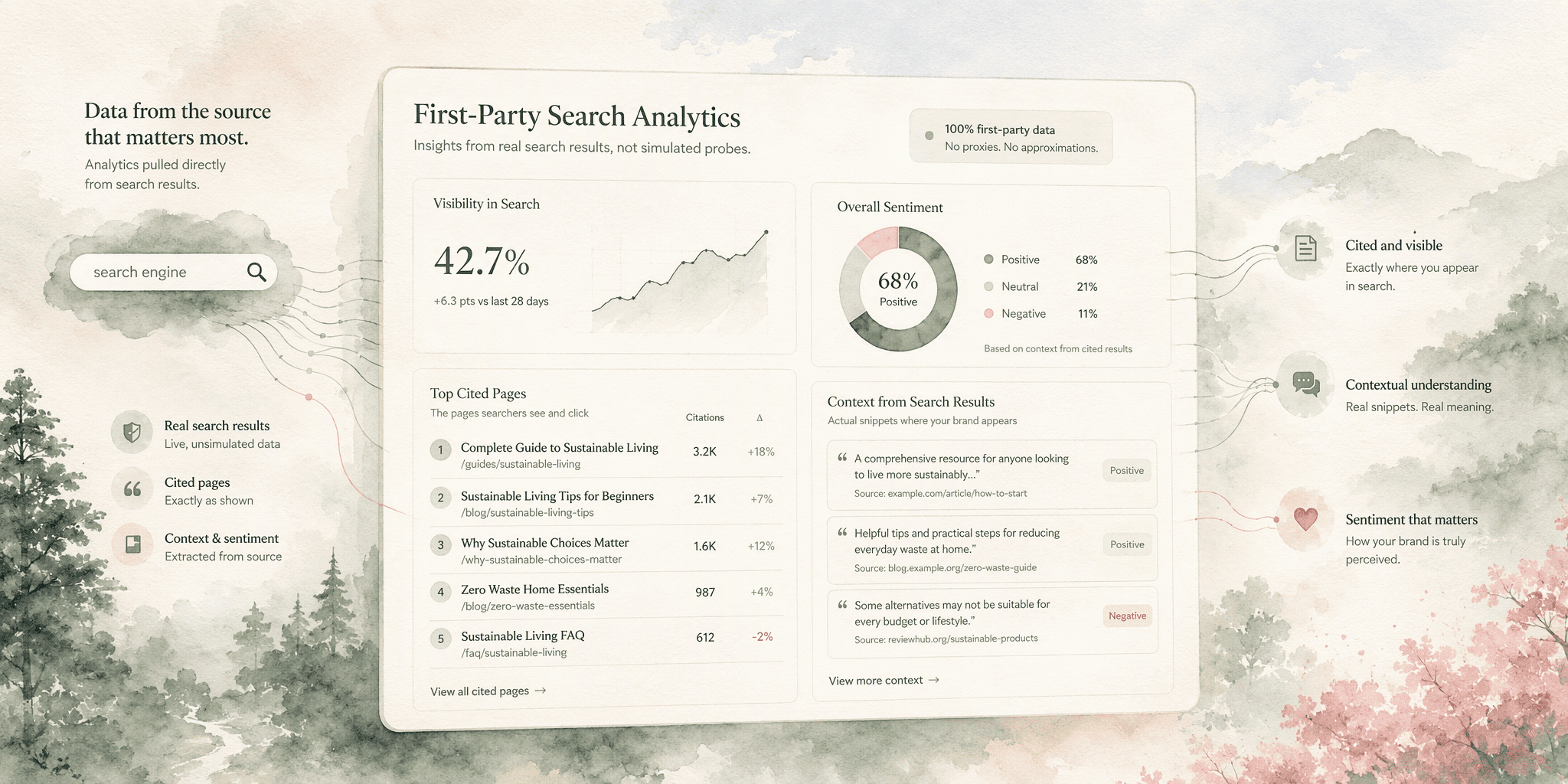
Most AI visibility tools estimate your citation performance by repeatedly querying LLMs and logging the responses. Perplexity for Publishers skips the estimation entirely. It's a first-party tool, so the data comes straight from Perplexity's own analytics, not from simulated probe queries. You see exactly which pages are cited, in which contexts, and with what sentiment. For publishers diagnosing citation gaps inside the Perplexity ecosystem, this is the cleanest signal you can get.
The catch is scope. The tool only covers Perplexity. It won't tell you anything about ChatGPT, Google AI Overviews, or Gemini.
Running it as your only GEO monitoring source would leave big blind spots. Pair it with a broader multi-engine platform like OtterlyAI or Profound, though, and that first-party data turns into a calibration point. You can check whether the third-party estimates you rely on for other engines hold up against the ground truth where you can actually verify it.
7. Kalendar AI: End-to-End GEO with Automated Content and Sentiment Scoring
Kalendar AI is built for lean teams that need one vendor to handle GEO content creation and AI visibility monitoring. The platform writes copy tuned to how generative engines pull and cite information. An alert system kicks off re-optimization when a brand's LLM sentiment or citation rate slides, so the loop from detection to fix closes without a person reviewing every change.
- Writing and tracking in one place: Kalendar AI combines GEO-optimized content generation with dashboards that monitor how often major AI engines cite your brand and the tone those citations carry.
- Alerts that trigger do-overs: The platform flags content when sentiment shifts or citation volume drops past a set threshold. From there it can start updates without someone manually inspecting the scores.
- Sentiment that goes past good, bad, neutral: Kalendar AI distinguishes a passing name-check from a product recommendation, and from a citation that includes a warning or a competitive comparison.
- Who fits: Small to mid-size marketing teams that would rather not pay separate vendors for content creation and citation monitoring but still need to run GEO at scale.
8. Dashword: Content Optimization Suite with a Focus on AI-Ready Scoring

Dashword started as a content optimization tool for traditional search. Its newer scoring model targets AI readiness, measuring readability, entity coverage, and structural clarity against what language models tend to cite. The content brief builder now pulls in AI search intent signals alongside standard keyword targets. The idea is to help writers build pages that work for Google's ranking algorithms and for the extraction patterns of ChatGPT and Google AI Overviews.
The competitive scoring feature checks your pages against the ones currently earning the most LLM citations inside a topic cluster. You see the entity coverage gaps between your content and the pages AI models keep referencing. That replaces a good deal of guesswork about what makes a page worth citing. Dashword is a bridge, not a ground-up GEO platform. For content teams already running their optimization workflow inside Dashword, it offers a way to add LLM readiness without switching tools.
Conclusion
The fragmentation between traditional search and AI search is no longer a prediction; it is a data point. Only 11% of cited domains overlap between ChatGPT and Perplexity, and brands that treat GEO as an afterthought are ceding discovery moments they cannot even see. The right tool depends entirely on where your team sits on the spectrum from do-it-yourself monitoring to fully managed optimization.
OtterlyAI gives you the broadest coverage for the lowest cost. Profound adds prompt-demand data that justifies GEO investment to a CFO. WP SEO AI removes the execution burden entirely for WordPress teams.
And if product visibility inside AI answers is your specific battleground, Siftly is built for that exact use case. Start tracking your AI citations before your competitors do.
Frequently Asked Questions
What is the current state of AI search in 2026 and why do brands need visibility optimization tools?
AI search has split decisively from traditional search. Only 11% of cited domains overlap between ChatGPT and Perplexity, and roughly 80% of LLM citations do not rank in Google's top 100. Google AI Overviews now trigger on nearly half of tracked queries. Brands that only measure Google rankings are blind to the channel where AI-generated answers increasingly shape purchase decisions.
How do AI search visibility optimization tools work and what features should marketing teams prioritize?
These tools repeatedly query generative engines like ChatGPT, Perplexity, and Google AI Overviews with target prompts, logging which brands are cited, with what sentiment, and in which position. Teams should prioritize multi-engine coverage, prompt-level citation data, competitive benchmarking, sentiment analysis, and actionable content recommendations over basic mention counting.
What does the GEO ROI chain look like and how do inputs, leading metrics, traffic, and revenue connect?
Currently, no platform offers a validated citations-to-revenue attribution model, so brands should measure visibility uplift and AI-referred clicks as proxies.
How does Siftly compare to other AI search visibility platforms in terms of pricing, features, and methodology?
Siftly is purpose-built for ecommerce and DTC brands, with live-browsing simulation that visually highlights product citations and a competitive share-of-voice dashboard. Its Scale tier is $599/month. Unlike general-purpose monitors such as OtterlyAI, Siftly maps keyword intent to product URLs and pulls Merchant Center pricing data to connect citations to revenue signals.
What measurable results can brands expect from a GEO-first approach and what is a realistic timeline for improving AI citation rates?
A 10-point improvement in AI citation rate is a realistic 6-month target for brands making active GEO investments, per Siftly's published guidance. Results depend heavily on industry vertical and content maturity. Hard ROI data varies significantly and is not publicly available on a per-platform basis, but leading indicators include citation frequency and share-of-voice gains.
How can marketing teams get started with AI search visibility optimization using free or low-cost tools?
Start with a 14-day free trial from a monitoring platform like OtterlyAI, which offers multi-engine tracking without requiring a credit card. Run a batch of 50 to 150 prompts segmented by AI model to establish a baseline. Siftly also offers free tools that provide a directional snapshot of your current AI visibility before committing to a paid plan.
Sources
- Top 25 AI SEO Tools in 2026 AI Search Visibility Blog | Insights and Data | OtterlyAI - otterly.ai
- What are the best AI search visibility tools? - wpseoai.com
- Best AI Visibility Tools for SaaS Companies in 2026 - LLM Pulse - llmpulse.ai
- The 10 Best AI Visibility Tools for 2026 - Evertune - www.evertune.ai
Keep exploring
More from the blog.

Oct 16, 2026
How to Measure Share of Voice in AI Search: A CMO’s Benchmarking Playbook
Your brand's most critical marketing metric stopped working the moment Google launched AI Overviews.

Oct 16, 2026
How to Track Competitor Visibility in ChatGPT Shopping Recommendations (2026 Guide)
Your competitor just became the first brand ChatGPT recommends when a shopper asks for the best running shoe under $120. You have no dashboard showing

Oct 15, 2026
Best Ahrefs Alternatives for Tracking AI Visibility in 2026
Your SEO dashboard says organic traffic is holding steady, but your brand mentions in ChatGPT are plummeting and you would never know it. Ahrefs Brand Radar