Aug 19, 2026
8 Best AI Optimization Platforms for B2B SaaS Startups
81% of users now prefer AI over human assistance for information discovery. For B2B SaaS startups, this single statistic rewrites the rules.

Introduction
81% of users now prefer AI over human assistance for information discovery. For B2B SaaS startups, this single statistic rewrites the rules. Your buyers are asking ChatGPT, Perplexity, and Google AI Mode for vendor recommendations before they ever visit a pricing page. Being invisible in those answers means losing deals before a conversation even starts.
Yet the economics look brutal. Most blog content sees only a 3 to 6 percent citation rate in AI-generated answers. Product pages, however, are cited at a staggering 46 to 70 percent rate. The gap reveals a painful truth: generic content investments are burning cash in an AI-first world, while high-intent commercial formats are getting surfaced over and over again.
The good news is that solving this doesn't require an enterprise budget. A 2026 Princeton/arXiv study found that structural optimization alone improves citation rates by 17.3 percent and subjective quality scores by 18.5 percent. These are low-cost, in-house changes any founder can direct today.
This guide ranks the best AI optimization platforms purpose-built to help lean B2B SaaS teams increase AI visibility this year. We evaluated tools based on affordability, startup-specific workflows, and their ability to turn passive AI monitoring into high-intent product page citations.
Key Takeaways
Every platform and tactic in this guide points toward one workflow: run free structural GEO changes first, add monitoring from a single affordable tool, and turn the data into comparison pages that AI engines pull when buyers ask which product to pick.
- Start with free structural GEO: The architecture of your content yields a 17.3 percent citation lift independent of any paid tool.
- Semrush AI Visibility is the safest first investment at $99 per month per domain, giving you the industry's largest prompt database.
- Otterly AI and HubSpot AEO lower the barrier: Freelancers and current HubSpot users can start tracking AI mentions without adding a standalone subscription.
- Monitor what gets cited: Product pages and comparison content see citation rates of 46 to 70 percent, while most blogs sit around 3 to 6 percent.
- Build a conversion flywheel: Find an un-owned high-intent query, publish a lean comparison or spec page, and measure AI-driven demo requests within weeks.
- Consolidate spend where possible: If you already license Ahrefs or a similar mature SEO suite, check its AI tracking features before adding a new point solution.
1. Siftly: Real-Time Purchase-Intent Conversation Optimization

Siftly focuses on the queries that matter most to a B2B startup: the purchase-intent conversations where a buyer asks an AI for a direct comparison. It monitors AI engines continuously to flag when your brand is cited, recommended, or skipped.
| Capability | How Siftly Applies It to B2B Startups |
|---|---|
| Real-time monitoring | Siftly monitors references across thousands of queries in real time, showing you exactly when and where your brand appears in AI answers. |
| Purchase-intent focus | The platform is built to optimize for conversations that drive purchases, not just track brand mentions. A lean team can see which product queries trigger a competitor's citation instead of theirs. |
| Citation-level visibility | You can track every time your brand is mentioned, cited, or recommended across ChatGPT, Perplexity, and Google AI Overviews. |
| Optimization workflow | Siftly generates SEO and GEO-optimized content backed by your own data, with automatic citation integration and internal linking built into the output. |
Siftly is backed by Y Combinator. It exists because a startup eventually outgrows a basic brand-monitoring tool and needs to do something with the signal: intercept the commercial AI queries that drive evaluations and purchases. This is not an SEO platform with an AI-monitoring tab added afterward. It is a Generative Engine Optimization platform, period. When a founder asks "what is the AI recommending right now for the best tool in my category," Siftly answers that question directly. That specificity is the whole point.
2. Semrush AI Visibility: The Established 289M+ Prompt Database
Semrush brings the deepest competitive intelligence to AI search through a prompt database that includes over 289 million prompts. For a startup that needs immediate, broad AI competitive intelligence, this is the safest first investment in the category.
Its AI Visibility toolkit sits alongside its traditional SEO database of 28 billion-plus keywords and 43 trillion backlinks, meaning a lean marketing team can analyze what gets cited in ChatGPT alongside what ranks on Google in a single subscription.
The workflow is practical. A SaaS marketer enters their target keywords and immediately sees which competitor product pages appear in AI-generated answers for those queries, then identifies prompt gaps where no brand occupies the answer slot yet.
The trade-off is that it is a broad suite, not a purpose-built GEO platform, which means some workflows require navigating feature sets that were designed for traditional SEO first.
3. Otterly AI: Budget-Friendly Citation Monitoring for Freelancers

A solo marketing founder doesn't need a 289-million-prompt database. They just need to know if ChatGPT is citing their brand, and if those mentions lean positive, negative, or neutral. Otterly AI is built for exactly that question, with a price that makes the "maybe later" excuse hard to justify.
It checks for brand mentions across ChatGPT, Perplexity, and Gemini. It counts how often you get cited and tells you when sentiment shifts, all without the setup hassle that enterprise GEO tools drag along. When your whole marketing operation runs on one person's laptop, replacing "are we visible in AI search?" with a real answer for under $99 a month changes when you start.
Where the price delivers, the feature set stops short. Otterly will flag that a competitor is being cited more often. It will not identify which prompt gaps create that gap or write content to close it. Monitoring, not optimization.
For a B2B SaaS product that hasn't launched or is still scratching toward first revenue, that's the right rung. Otterly puts AI brand monitoring within reach at a price no other standalone platform here matches. It proves the first step, simple visibility tracking, doesn't need an enterprise budget. It just needs a founder who knows they want monitoring before they're ready to pay for the optimization layer beyond it.
4. HubSpot AEO: The Convenient Add-On for Existing Ecosystems
Answer Engine Optimization structures content so AI models cite it when they generate answers. That is a different job from traditional SEO, which chases link-based ranking signals. HubSpot's AEO add-on puts this capability inside the platform marketing teams already use every day.
If your company runs CRM, email, and CMS on HubSpot, this add-on gets you AI visibility tracking with almost no new vendor onboarding. It monitors citations from ChatGPT, Gemini, and Perplexity and drops the results into the reporting dashboards your team already reviews.
The trade-off is real. The data lives inside HubSpot. A team that migrates off the platform later loses that AI citation history. That lock-in matters less if HubSpot is your long-term operating system and you want AI visibility tracking now, without signing up for another subscription.
For a B2B SaaS startup with 10 to 50 employees and an existing HubSpot instance, this add-on is the lowest-friction way to start monitoring AI mentions. The tool your team actually uses beats the theoretically better tool they ignore. This one removes adoption risk by sitting exactly where your workflows already run.
5. Ahrefs: Expanding Core SEO Power into AI Answer Tracking

A lean team licensing a mature SEO suite already pays for keyword data, backlink analysis, and rank tracking. Adding a separate AI visibility tool on top of that creates both budget bloat and the cognitive switching cost of toggling between platforms. Ahrefs addresses this by extending its existing SEO infrastructure into AI answer tracking territory.
- Consolidation advantage: Unifying AI citation data with backlink and keyword data in one subscription reduces tool-switching time and keeps the monthly tooling budget predictable.
- Familiar workflow retention: A B2B SaaS marketer who already uses Ahrefs for competitor keyword analysis can add AI citation tracking without learning a new interface or building new reporting rituals from scratch.
- Data correlation potential: Seeing which traditional backlinks also appear as AI answer citations lets a small team model the overlap and allocate content resources toward the formats and pages that perform in both SEO and GEO environments.
- Feature maturity trade-off: The AI tracking features of an established SEO suite may not match the depth of a dedicated platform like Siftly or ProRank. The question is whether "good enough within one tool" beats "excellent across two tools" for a small team.
- Spend efficiency test: A team should verify the exact AI visibility features their current Ahrefs plan includes before evaluating point solutions. Some capabilities may already be bundled, making the incremental cost of "adding" AI tracking effectively zero.
6. Clearscope: Content Optimization to Dominate AI Citations
Monitoring tells you who is getting cited. Clearscope changes whether your page is the one the AI picks. It grades your existing content against what the top-performing pages for a given topic cover, then recommends specific additions and structural changes that increase a page's topical authority.
The connection to the structural GEO research is direct. The Princeton study found that content architecture alone delivers a 17.3 percent citation lift. Clearscope gives you a practical score for the things that drive that lift: your headings, lists, entity coverage, and readability. Those are the same macro, meso, and micro-structure signals LLMs weigh when they choose a citation source.
A small team can use Clearscope inside an existing content workflow without adding a separate monitoring habit. The loop is simple. A writer drafts a product comparison page.
They run it through Clearscope. They apply the structural fixes. What goes live is a page built to be the single source an AI answer cites for that comparison query.
For a B2B SaaS startup with a small content team, pairing a grader with an AI monitoring tool creates a tight feedback loop. The monitoring tool finds the high-intent queries you do not own yet. Clearscope makes sure the response page is structured the way LLMs reward. And the monitoring tool confirms the citation appeared. That pairing costs less than a second content hire and can drive an outsized share of AI-sourced demo requests.
7. ProRank AI: Dedicated GEO for the Agile B2B Builder
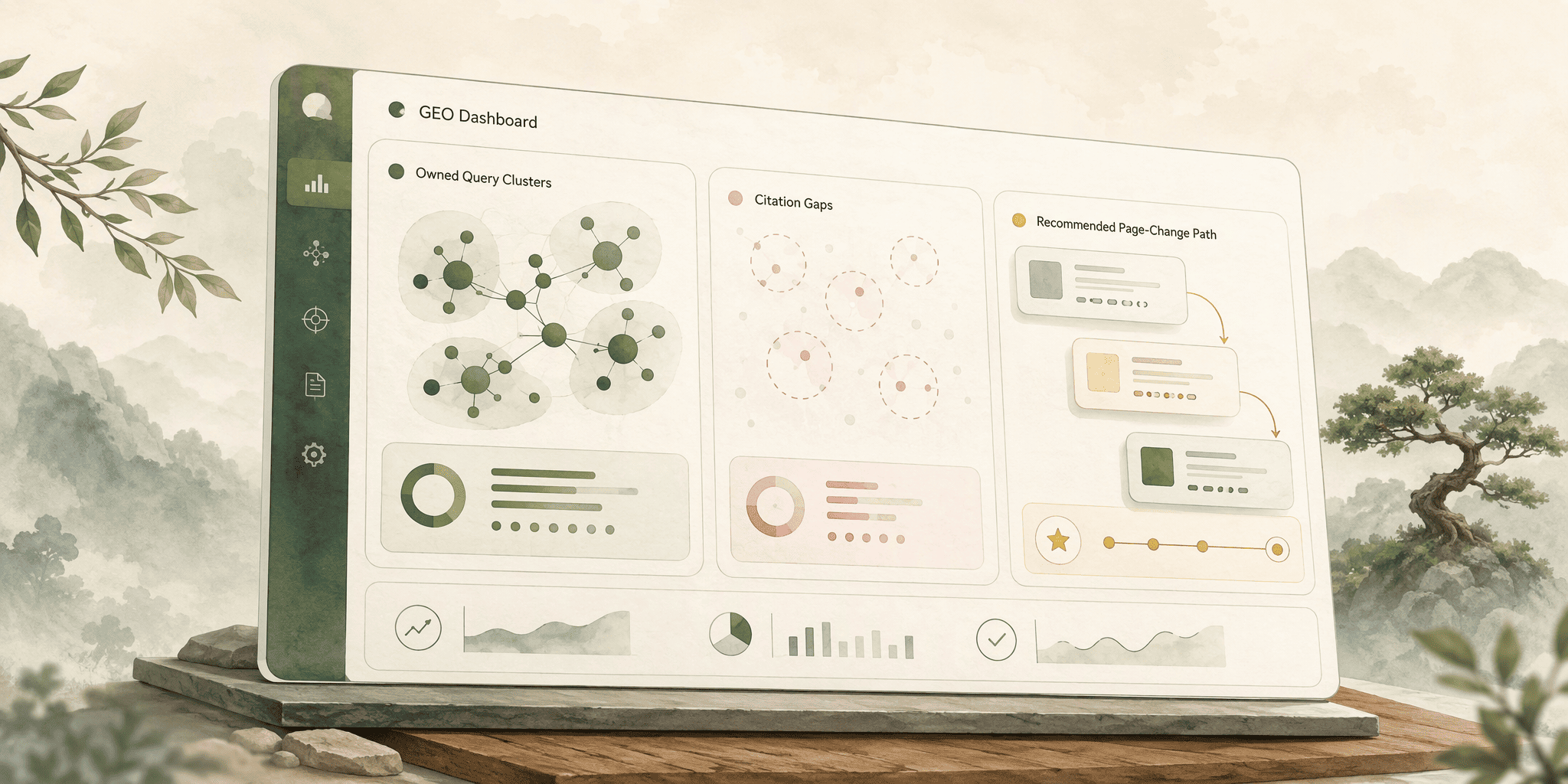
ProRank AI does not try to be an everything platform. It is a dedicated Generative Engine Optimization tool, built for B2B teams from the ground up, not a bolt-on to an older SEO suite. For a startup that chooses speed over breadth, that tight scope is the whole reason to buy it.
A small team sees which "best X for Y" queries a competitor already owns in ChatGPT, which ones nobody has claimed, and what structural or topical change is most likely to shift the citation to their own product page.
A lean B2B builder running two-week sprints can pick up a ProRank recommendation on Monday, ship an optimized comparison or product-spec page by Friday, and measure the resulting AI citation shift before the next sprint planning session. That speed to signal is what a broad SEO suite with an AI tracking tab often cannot match. The same dashboard depth that makes a suite powerful can bury a startup in data before it surfaces one clear action. For teams that want exactly one recommendation per week and a measurable result, a dedicated GEO platform fits.
8. Structural GEO: The 17.3% Citation Lift from Content Architecture
The most actionable finding in generative engine optimization this year is that how you structure a page, separate from what topic it covers or how long it is, directly changes how often AI engines cite it. Researchers at Princeton mapped that relationship across six mainstream generative engines and published the playbook on arXiv.
- Build a clear document hierarchy: Use descriptive H1, H2, and H3 tags that map to a logical macro-structure. An LLM scans headings to understand whether a page covers a query comprehensively, and a flat or disorganized heading structure signals low authority.
- Chunk information into scannable meso-structures: Break blocks of information into lists, comparison tables, and FAQ sections. The Princeton study frames this as information chunking, and AI engines prefer to cite sources where the answer is already extracted into digestible fragments rather than buried in dense paragraphs.
- Apply micro-structural signals of authority: Use bolded key terms, pull-out quotes, and labeled statistics. These micro-emphasis patterns signal to the LLM that a specific claim or definition is a verified, quotable piece of information, not a loosely held opinion.
- Implement schema markup correctly: JSON-LD structured data gives an AI engine a machine-readable map of what each element on your page represents, whether a product review, a pricing table, or an FAQ. Missing or incorrect schema forces the engine to guess, and guessing produces mis-citations or non-citations.
- Measure subjective quality as a leading indicator: The study found that structural optimization improves subjective quality scores by 18.5 percent. This matters because AI engines cite sources they perceive as high quality; structural changes make a page read as higher quality to a model before a human editor ever evaluates it directly.
How a Lean SaaS Team Turns AI Visibility Insights into Conversions

The dashboard showing a 4 percent competitor citation rate is useless unless it triggers content that earns a demo request. The insight-to-conversion workflow requires three steps that a founder and one content marketer can run in a single sprint.
- Identify the high-intent, un-owned query: Use Semrush AI Visibility or Siftly to surface a prompt where a competitor's product page is cited for a commercial query like "best contract management tool for remote teams." Note which specific page of theirs the AI is citing, then open their page next to a blank document.
- Build a lean comparison or product-spec page against that query: This is not an 800-word blog post. It is a structured, schema-tagged page that states, directly and with numbered specs and comparison tables, why your product solves that specific use case and how it differs from the cited competitor. A small team can design, write, and publish this page in under five days when they treat it as a conversion asset rather than a content marketing project.
- Measure citation and conversion within weeks: Most AI visibility platforms update within days, meaning a startup can see whether their new page displaced the competitor's citation within two weeks of publication. Pair that timing with a demo-request CTA embedded on the page, and the conversion loop closes. The tactic extends beyond web pages. Reddit discussions are cited 40.1 percent of the time by Gemini and Perplexity, so a founder or marketer who answers Reddit threads with a helpful, structurally optimized response pointing back to that product-spec page is seeding the very discussion threads that AI engines surface as citations.
Conclusion
If 81 percent of your buyers start their research inside an AI, and your product pages get cited 46 to 70 percent of the time when they're structured correctly, skipping AI visibility is not a future regret. It is a pipeline decision you are making this quarter.
You don't need a perfect stack to begin. Deploy the free structural GEO checklist now. Pick one monitoring tool that fits where you already work: Semrush if your team lives inside a competitive research workflow, HubSpot AEO if your CRM and content already run on HubSpot, Otterly if you're a solo operator or small studio that needs a clean, affordable read on where you show up. Graduate to a dedicated platform like Siftly or ProRank when revenue justifies a workflow built around conversion, not just citation tracking.
The startups closing AI-sourced deals right now are not waiting. They are writing pages that answer real buyer questions, formatting those pages so LLMs lift them cleanly into answers, and measuring what happens after the citation: demo requests, pipeline, revenue.
Frequently Asked Questions
What is AI optimization (GEO) and why does it matter for B2B SaaS startups?
Generative Engine Optimization is the practice of structuring content and brand signals so AI engines like ChatGPT, Perplexity, and Google AI Overviews cite your pages in generated answers. For B2B SaaS startups, it matters because 81 percent of users now prefer AI for discovery, and product pages see citation rates of 46 to 70 percent, directly influencing purchase decisions.
Which AI optimization platforms are affordable for early-stage B2B SaaS companies?
Semrush AI Visibility starts at $99 per month per domain. HubSpot AEO is a low-cost add-on for existing HubSpot users, and Otterly AI targets freelancers and tiny teams with a low entry point. Siftly and ProRank AI are dedicated GEO platforms available as startups scale.
How do AI search monitoring tools track brand visibility and competitor citations?
These tools query AI engines with keyword and prompt databases, then record which brands appear in the generated responses, how often, and with what sentiment. Semrush, for example, uses a database of over 289 million prompts to benchmark competitor citation frequency and identify prompt gaps where no brand is cited.
What core features should a startup look for in a generative engine optimization tool?
Prioritize the following three capabilities when evaluating GEO tools:
- Competitor citation tracking: Shows where rivals get cited instead of you.
- Prompt gap analysis: Surfaces queries without your brand.
- Sentiment monitoring: Flags how AI describes your company. Tools like Siftly also add conversion-query optimization built directly into the feature set.
What data privacy and security concerns arise when connecting third-party accounts to GEO tools?
Any tool connecting to CRM, analytics, or ad platforms introduces API-level risk. Startups should verify SOC 2 compliance, data retention policies, and whether the tool only reads data or can write to accounts. Siftly, for instance, states that AI search competitor monitoring is read-only and does not require pipeline write access.
How can a small SaaS team act on AI visibility insights to drive conversions?
A practical three-step cycle to turn GEO insights into conversions:
- Identify an un-owned high-intent query where a competitor is currently cited.
- Build a lean product comparison or spec page optimized for that query within a week.
- Measure AI citation and demo requests within two weeks. Reddit-thread answers also matter since Reddit is cited 40.1 percent of the time by Gemini and Perplexity.
Sources
- The 8 Best AI Visibility Tools to Win in AI Search (2026) - www.semrush.com
- [2603.29979] Structural Feature Engineering for Generative Engine Optimization: How Content Structure Shapes Citation Behavior - arxiv.org
- AI Search Visibility: Complete Guide for B2B SaaS - www.therankmasters.com
- AI Search Citation Benchmarks: What Gets Cited [2026 Data] | Averi | Averi Resources - resources.averi.ai
- Siftly: Introduction - docs.siftly.ai
Keep exploring
More from the blog.

Oct 17, 2026
How to Measure AI Share of Voice in 2026: The 7-Step Execution Plan
Your brand might be mentioned in a ChatGPT answer right now, but you have no dashboard that shows it.

Oct 17, 2026
8 Best AI Brand Monitoring Tools for Startups on a Budget in 2026
The difference between a funded quarter and a missed target is increasingly a single sentence generated by ChatGPT or Perplexity.

Oct 17, 2026
7 Best AI Brand Monitoring Tools for 2026
Your brand can be cited in a Google AI Overview, praised in a Perplexity answer, or recommended by ChatGPT with zero visibility on your end.