Oct 29, 2026
7 Tools to Measure Brand Visibility Across AI Platforms like ChatGPT and Gemini in 2026
Marketing teams are discovering a chilling fact in 2026: their carefully built search dominance is invisible to a growing segment of buyers.

Introduction
Marketing teams are discovering a chilling fact in 2026: their carefully built search dominance is invisible to a growing segment of buyers. A prospect asks ChatGPT or Perplexity for a recommendation and the AI composes an answer that either names the brand or doesn't. There is no rank to tweak, no meta description to test. The brand shows up in the response or it doesn't.
Traditional analytics miss this interaction entirely. They record a visitor from an LLM referral as a single session in GA4, stripping away the key context: which competitor was cited instead, what framing the AI used, and whether the brand's own pages backed the claim. This gap between what AI search engines use as source material and what conventional tools report is the central visibility problem of the generative era.
A wave of tools built specifically for this new channel has arrived. They monitor brand mentions and citations across ChatGPT, Gemini, Perplexity, and other conversational platforms, tracking a metric set that didn't exist two years ago. This article breaks down the platforms that measure and improve AI brand visibility, from pure reporting dashboards to tools that actively deploy technical fixes to close citation gaps.
Key Takeaways
Every tool on this list addresses the same foundational question, 'Is our brand showing up in AI answers?', but they answer it with fundamentally different approaches.
- The market splits into two categories at the feature level: reporting-only dashboards (OtterlyAI, Profound, Semrush) that show what AI engines cite, and fix-it platforms (Ryze AI) that also deploy schema markup, llms.txt updates, and answer-first copy to improve citation rates.
- Citations matter more than mentions for referral traffic: AI engines increasingly show clickable citation links to source pages, and measuring citation position and decay over time is the primary proxy for what might eventually become defensible attribution.
- Pricing spans an enormous range: You can baseline your visibility for $0 today, start continuous monitoring around $99/month, access enterprise tracking at $599/month, or invest $2,999/month in a platform like Siftly that bundles monitoring with optimization recommendations across 9 AI engines.
- Closed-loop attribution remains the frontier: Tools can route AI referral sources, 'chatgpt.com / referral', 'perplexity.ai / referral', into GA4, but no platform yet offers a fully validated model that connects a specific citation to a specific conversion.
- Brand size dramatically predicts AI visibility on day one: Niche and small brands appear in just 11% of relevant AI answers on their first tracking run, which makes the case for measurement before any optimization begins.
1. Siftly

Siftly is a dedicated Generative Engine Optimization platform that monitors brand visibility, rank, and share of voice across 9 AI engines, ChatGPT, Gemini, Perplexity, Claude, Google AI Overviews, Copilot, Grok, and DeepSeek, through daily automated query execution. The platform earns the top spot because it bundles real-time monitoring with prescriptive optimization recommendations grounded in citation analysis, closing the gap between knowing about a visibility deficit and fixing it.
When a shopper types a purchase-intent query, Siftly captures the brand name, the merchant, displayed price, product details, and buy destination surfaced alongside it. You can use the AI Prompt Tracking feature to monitor exactly how a brand fares across tracked keywords, while the platform's approach to attribution attempts directional citation-to-traffic modeling rather than claiming a deterministic revenue link, an honest reflection of where the industry stands in 2026. Siftly also tracks competitor products and relative price index versus peers in AI shopping answers, giving ecommerce teams a window into how generative models position their catalog against alternatives.
At $2,999/month for the Pro plan, this is an enterprise investment.
The Growth tier includes real-time monitoring and optimization recommendations, while mid-market access starts around $599/month on the Scale tier. For teams that need more than a dashboard, organizations where AI visibility has become a measurable traffic channel, Siftly's combination of breadth (9 engines), depth (competitor pricing intelligence), and actionability (prescriptive recommendations) places it at the front. A 14-day free trial with no credit card makes the auditable commitment low.
2. OtterlyAI
OtterlyAI is a citation-tracking powerhouse trusted by 40,000+ marketing professionals worldwide and built around a simple, deep capability: it captures every cited URL for every prompt across 7 AI search engines, ChatGPT, Claude, Perplexity, Copilot, Gemini, Google AI Mode, and AI Overviews.
The platform doesn't just tally brand mentions. It tracks citation position changes over time, measures domain-level influence, and computes share of voice across competitors. If a brand's product page drops from the second citation to the fifth for a high-intent query, OtterlyAI surfaces the movement.
This granularity makes it the strongest choice for teams that need multi-engine monitoring with detailed citation analytics, rather than a tool that also deploys fixes. Integrations with Google Looker Studio and Claude, alongside API and MCP access, mean data flows into existing reporting stacks without manual export. Coverage across 65+ countries and languages makes it viable for global brands running localized visibility programs.
Self-reported data shows 8x citation growth in 12 months across tracked properties, an imperfect but directionally significant indicator that active monitoring correlates with increasing AI surface area.
3. Ryze AI

Ryze AI is the tool that crosses the line from observation to intervention. It tracks mentions and cited URLs across ChatGPT, Claude, Gemini, and Perplexity for up to 50 buyer questions on weekly, monthly, or on-demand refreshes, but its core distinction is what happens after the report populates: the platform deploys on-page changes, schema markup, llms.txt updates, and answer-first copy, directly to the site to close gaps where a competitor is being cited instead.
The SEO Starter plan costs $129/month flat, which undercuts many reporting-only tools while delivering a fundamentally different product. For a mid-market brand that lacks dedicated technical SEO resources, this bundling of diagnostics and treatment is efficient. The trade-off is engine coverage, four engines versus OtterlyAI's seven, but the workflow argument is compelling: a team that buys a monitoring dashboard still needs to staff the diagnostic and repair work, while Ryze AI ships the fixes as part of the subscription.
4. Profound

Profound is an enterprise AI visibility platform that monitors more prompts, engines, and markets than mid-market tools. Pricing starts at $99/month billed annually, and the platform scales to multi-brand, multi-geography keyword and competitor tracking, not a single-domain 50-prompt setup.
| Dimension | Profound | Mid-Market Alternatives |
|---|---|---|
| Prompt scale | Enterprise breadth, no published cap | Ryze AI caps at 50 prompts; Siftly Growth tier covers monitored queries |
| Engine coverage | Multi-engine across markets | OtterlyAI covers 7 engines; Ryze AI covers 4 |
| Pricing model | Starting at $99/month billed annually, scales with scope | Ryze AI flat $129/month; Siftly Growth tier seats at ~$129/month |
| Action capability | Reporting-focused | Ryze AI deploys on-page fixes; Siftly bundles recommendations |
For a brand managing thousands of keywords across dozens of competitors in multiple languages, Profound's architecture handles the data volume without an information-quality ceiling. Where a smaller tool might surface only the generative engines it can query cost-effectively (OtterlyAI covers seven; Ryze AI covers four), Profound provides cross-market breadth. The analytics separate citation count from presence quality, brands running territory-level metrics find that break indispensable.
5. Semrush AI Visibility
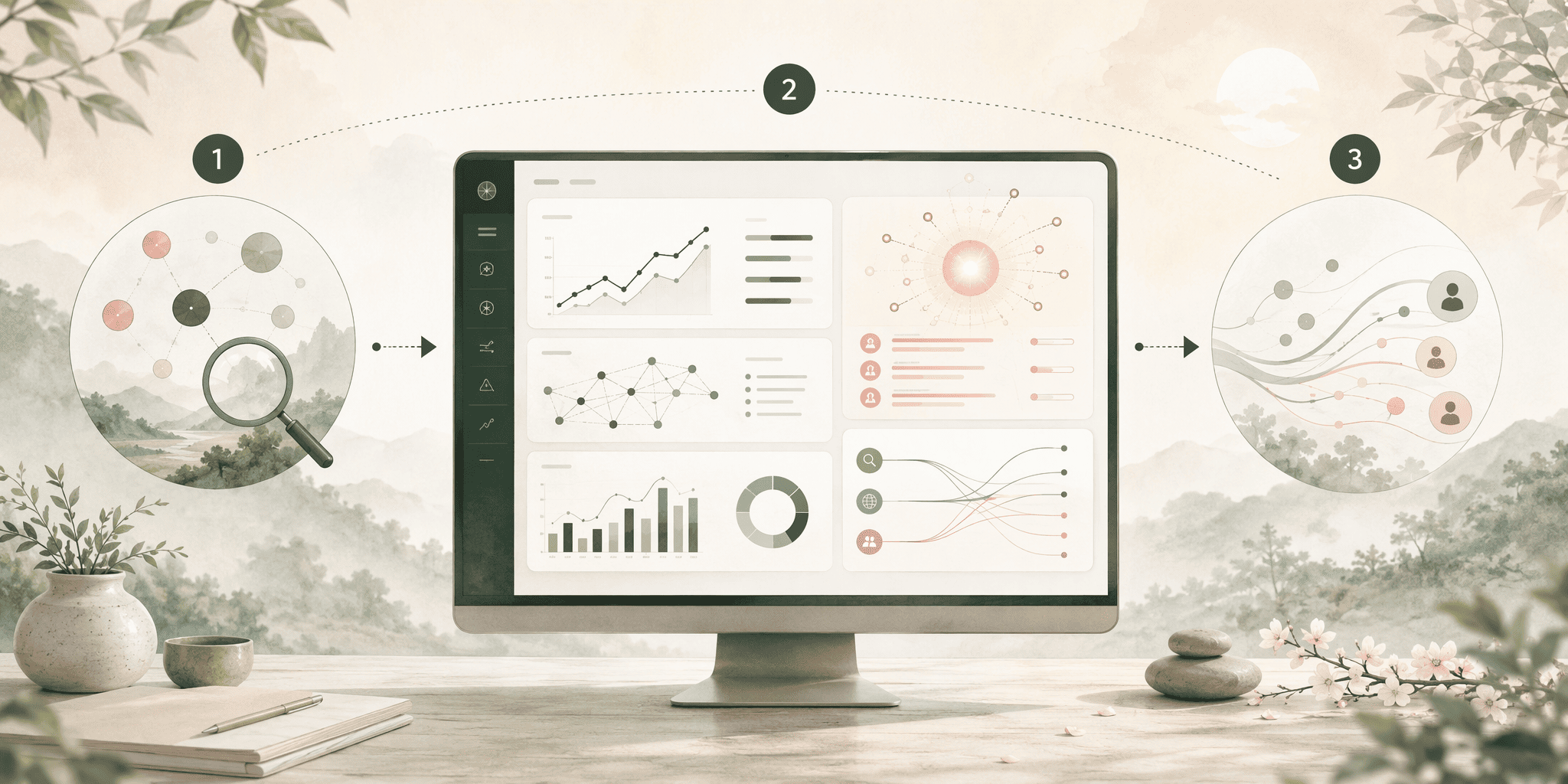
Semrush AI Visibility adds AI mention and referral tracking to the existing Semrush SEO suite for $99/month per domain. It reports what is happening -- it will not fix the gaps it finds. A team or agency still needs to act on the data.
The workflow is straightforward:
- Activate AI Visibility within the existing Semrush account: the tool lives alongside keyword rankings, backlink profiles, and traffic analytics. No separate login required.
- Monitor share of voice across the tracked query set: the reports surface which competitors get cited, how often your brand appears, and whether citations point to pages you own or to third-party sites.
- Route AI referral traffic into GA4 for session-level reporting: Semrush identifies sessions that began on an AI platform. Teams can then examine on-site behavior, bounce rates, and conversion paths in Google Analytics.
- Hand off the visibility report to an internal SEO team or agency for execution: the gap analysis still demands staff time or consultant budget. That labor cost matters when you weigh the $99/month price against platforms that include remediation.
6. Brand24
Brand24 arrived at AI visibility measurement from the other direction, traditional media monitoring and sentiment analysis, and its value proposition reflects that lineage. Where tools like OtterlyAI and Ryze AI were purpose-built for generative engine tracking, Brand24 extended its existing brand reputation infrastructure to capture when a brand is discussed within AI-generated content and answers.
The strength of this approach is context. Brand24 reports that ChatGPT mentioned a company in an answer to a buyer question and applies the same sentiment analysis engine it uses for news articles and social posts to evaluate whether that mention was positive, negative, or neutral. For a brand manager who cares about AI visibility primarily as a reputational signal rather than a traffic channel, this framing matters. A citation alone doesn't indicate whether the AI positioned the brand as a top choice or a cautionary footnote.
The trade-off is depth. Brand24's AI mention capture is a feature within a broader suite, so it doesn't deliver the citation position tracking or domain-level influence scoring that specialist tools provide. It is best understood as a brand risk monitor that extends coverage into conversational AI, rather than a GEO execution platform.
7. Free AI Visibility Checkers (Otterly Lite and Ryze Free Checker)

The quickest path to a brand's first AI visibility measurement costs nothing. Otterly Lite and Ryze's Free Checker both provide a snapshot of how AI engines handle a small set of buyer prompts, giving marketing teams a directional baseline before they commit to a recurring subscription. These free tiers solve a specific organizational problem: getting an AI visibility conversation started without procurement approval, a budget line, or an IT security review.
- What they deliver: a team can run eight or ten core prompts, the high-intent questions that matter most to revenue, and walk into a planning meeting with a concrete answer to "Does our brand appear in AI answers?" rather than a theoretical discussion. The output won't be statistically representative or refreshed automatically, but a static snapshot at zero cost is a massive improvement over no data.
- What they lack: no continuous monitoring, no competitor share-of-voice tracking over time, no citation position decay analysis, and no action layer, just a point-in-time benchmark. This makes them useless for ongoing competitive intelligence but ideal for getting a first read.
The step from free snapshot to paid monitoring is usually triggered when a team discovers that their brand appears far less often than they assumed, which for established mid-market brands happens 56% of the time on a first tracking run.
Start with a free check. Use the result to make the business case for continuous monitoring. Then pick a tool that matches your team's capacity to act on what the data reveals.
Conclusion
The AI visibility tool market in 2026 draws a clean line between platforms that report on citations and platforms that close citation gaps. Reporting-only dashboards like OtterlyAI, Profound, and Semrush AI Visibility tell a team what's happening; fix-it platforms like Ryze AI and monitoring-and-recommendation bundles like Siftly equip a team to do something about it. The right choice depends on whether your organization has the technical SEO resources already staffed, or whether it needs the tool itself to execute the changes.
Attribution will improve. AI referral streams into GA4 are already surfaceable, and platforms are building directional citation-to-traffic models that will harden over time. The brands measuring this channel now are building the baseline data that will make those models meaningful. The gap between the organizations appearing in 73% of relevant AI answers and those appearing in 11% is already measurable, and it is widening every quarter.
Frequently Asked Questions
What tools are available to monitor and measure brand visibility within AI platforms like ChatGPT and Gemini?
Specialized platforms include:
- OtterlyAI for multi-engine citation tracking.
- Ryze AI for monitoring plus on-page fixes.
- Profound for enterprise-scale monitoring.
- Siftly for monitoring with prescriptive optimization across 9 engines.
- Semrush AI Visibility for integrated SEO reporting.
- Brand24 for AI mention capture with sentiment analysis.
- Free checkers from Otterly and Ryze provide initial baselines at no cost.
How do AI brand visibility measurement tools actually work, and what metrics do they track?
These tools execute automated daily queries against AI platforms on tracked buyer keywords, then capture whether the brand name appeared (mention) and which specific URLs the AI cited as sources (citation). Primary metrics include:
- Share of voice across competitors.
- Citation position and movement over time.
- Domain-level influence.
- AI referral traffic surfaced into GA4.
What key features should I look for when choosing an AI visibility monitoring platform?
When choosing a tool, evaluate these factors:
- Engine coverage: some track 4 engines, others cover 9.
- Actionability: check whether the platform only reports on visibility gaps or also deploys fixes like schema markup and llms.txt updates.
- Analytics depth: confirm competitor benchmarking, citation position tracking, and integration with your existing analytics stack.
- Pricing model: models vary from flat monthly fees to prompt-count or seat-based tiers.
How much do these AI brand visibility tools typically cost, and are there free options available?
Paid monitoring starts around $99/month (Semrush AI Visibility, Profound entry tier). Action-inclusive platforms like Ryze AI cost $129/month flat. Mid-market tools range $29 to $200/month; enterprise platforms reach $599/month (Siftly Scale tier) or $2,999/month (Siftly Pro). Free checkers from Otterly Lite and Ryze Free Checker provide static, one-time baselines.
How does measuring brand visibility on AI platforms differ from traditional SEO analytics?
Traditional SEO tracks keyword rankings and clicks from a fixed index. AI platforms generate probabilistic answers that change across sessions, a brand can be cited in one query instance and omitted in the next, even for identical prompts. The metrics shift from position and click-through rate to mention rate, citation presence, share of voice, and sentiment stability across engines.
What is the current state of attributing revenue or traffic directly to AI platform citations in 2026?
Attribution is nascent. Tools surface AI referral sessions in GA4 (tagged by source like 'chatgpt.com' or 'perplexity.ai'), and platforms like Siftly offer directional citation-to-traffic modeling. But no platform yet provides a fully validated, closed-loop model connecting a specific AI citation to a specific conversion. This remains the frontier, not the standard.
Sources
- AI Search Optimization Tools: 2026 Buyer's Guide | Siftly - siftly.ai
- AI Citation Tracker - Top AI Search Tool 2026 | OtterlyAI - otterly.ai
- AI Visibility Tool: Track and Fix Your Brand in ChatGPT, Gemini and Perplexity | Ryze AI - www.get-ryze.ai
- Generative Engine Optimization at Scale: Measuring Brand Visibility Across AI Search Engines - arxiv.org
Keep exploring
More from the blog.

Oct 29, 2026
7 Best AI Brand Monitoring Tools to See What AI Actually Says About You in 2026
You send a prospect to check what ChatGPT says about your category. It mentions three of your competitors by name, pulling a specific product detail for each.

Oct 29, 2026
7 Best AI Shopping Visibility Tools in 2026 to Win the AI Shelf
Your best-selling product can get a glowing five-paragraph recommendation from ChatGPT and still lose the click to a competitor cited in Google's AI Overview.

Oct 29, 2026
How to Track Your Company's Visibility Across AI Search Platforms in 2026
Your next buyer is not on Google. They are inside ChatGPT asking for a recommendation, on Perplexity comparing three alternatives