Sep 4, 2026
7 Solutions to Understand AI-Driven B2B Customer Discovery
The following seven tools, platforms, and approaches give B2B organizations visibility into how AI engines discover, cite, and describe their brands today:

Introduction
The following seven tools, platforms, and approaches give B2B organizations visibility into how AI engines discover, cite, and describe their brands today:
- BrightEdge: Quantifies the scale of the blind spot, 44% of ChatGPT prompts contain zero brand mentions, helping B2B brands understand how often they are missing from AI-driven discovery.
- Entity recognition analytics: Identifies how conversational platforms like Claude and Perplexity connect entities (e.g., "Salesforce" and "CRM") and detect patterns such as negative sentiment about a vendor across multiple articles.
- Brand mention monitoring tools: Tracks how consistently your brand name appears across the web, which is critical for AI to recognize and trust it; hyperlinks are optional when context, repetition, and topic alignment are strong enough.
- AI search engine citation analysis: Monitors how AI search engines (e.g., ChatGPT, Perplexity) cite your brand in their generated answers, revealing whether your brand is included in constructed consideration sets.
- Conversational AI sentiment trackers: Analyzes the sentiment associated with your brand across AI conversations, surfacing negative or positive patterns that might influence buyer shortlists.
- Entity relationship mapping platforms: Visualizes how your brand connects to related concepts (e.g., "Snowflake" as a data platform in B2B queries) within AI training data and retrieval mechanisms.
- Discovery gap analysis tools: Compares your brand's visibility in traditional search (Google) versus AI-driven discovery, exposing when buyers find competitors via ChatGPT instead of your top keyword rankings.
Key Takeaways
AI-driven discovery has already outpaced the measurement frameworks most B2B organizations rely on. The following findings form the strategic foundation for building a monitoring stack.
- Revenue attribution is the new north star: Monitoring tools that count impressions inside AI chat windows are directionally useful, but the ones that tie AI citations to pipeline and closed revenue answer the CFO's question. Siftly and Adobe Brand Visibility approach this from different angles, but both connect visibility to business outcomes.
- Entity-based metrics replace keyword tracking: AI engines extract meaning from entity recognition, topic alignment, and sentiment, not from keyword density. Your monitoring must track how your brand is described and whether it is cited at all, making Brand Claims and Share of Voice dashboards key infrastructure.
- AI visibility is a separate data stream that must connect to web analytics: The 8 in 10 online purchases involve multiple touchpoints, and AI chat is increasingly the first one. Google Search Console and GA4 provide the bridge between AI-driven discovery spikes and downstream on-site conversions.
- Competitive benchmarking is the hard gap most brands miss: Most B2B brands appear in only about 3% of AI-generated answers, according to Walker Sands' B2B AI Search Visibility Benchmark of 828 enterprise companies. Knowing your own mention rate is useless without knowing whether your competitor claims 6% or 0.3%.
- The integration window is closing: Only 56% of B2B organizations are investing in tactics designed to help their content surface in AI-generated answers and recommendations. The gap between those who build monitoring now and those who wait will compound as LLM-based B2B searches increase by nearly 1100% within the next two years.
1. Siftly, Monitor AI Conversations That Directly Drive Revenue

Siftly earns the top position because it answers the one question boards actually ask about AI visibility: is this generating pipeline? Instead of counting impressions inside chat interfaces, Siftly tracks how AI engines talk about a brand across ChatGPT, Perplexity, and Google AI Overviews and connects those conversations to revenue outcomes.
The data foundation matters here. Siftly monitors references across thousands of queries in real time, tracking the context, sentiment, and topics that surround each citation. A brand mentioned naturally within a useful explanation carries more weight than a random link dropped into a paragraph, because context matters more than placement in AI search. Siftly's monitoring layer captures that context and flags shifts before they harden into permanent brand perception problems inside the models themselves.
Who it fits best: B2B marketing leaders who need to defend or grow a specific revenue line tied to AI-driven discovery. The tool provides a free audit with no sign-up required, letting you surface real results before committing budget.
One standout detail is the Experimentation module. Users create a handful of prompts that reflect actual customer questions, run control-versus-optimized content comparisons, and filter results by AI model, geographic location, and specific topics. That closed-loop cycle makes AI visibility an operational function rather than a quarterly report.
2. Adobe Brand Visibility, Measure AI Share of Voice with Enterprise-Grade Analytics
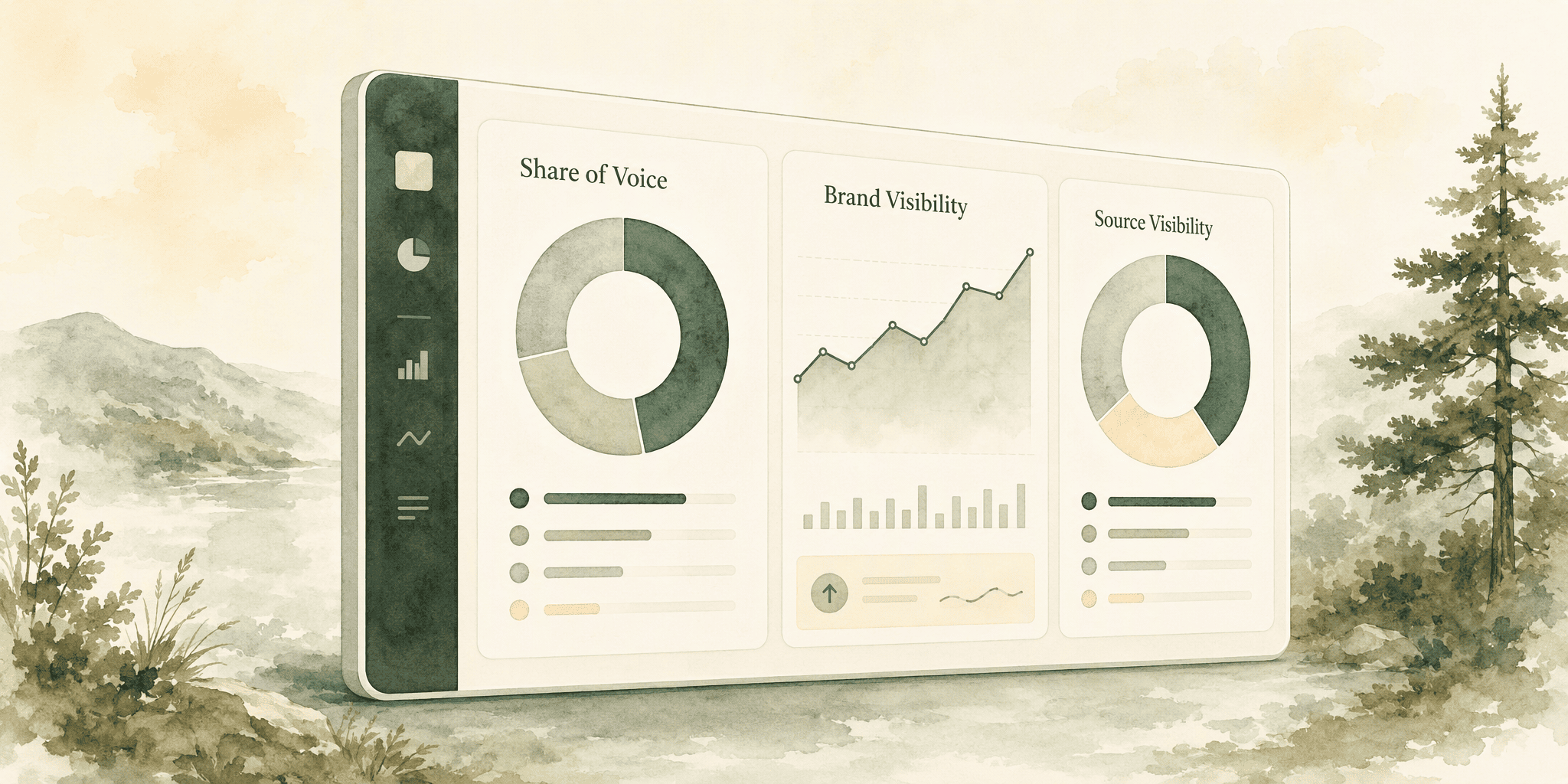
Adobe Brand Visibility moved to General Availability on August 4, 2026, bringing together AI visibility measurement, optimization, and impact measurement into a unified enterprise workflow. For large B2B organizations already running Adobe stacks, this integration makes a standalone point solution unnecessary.
Paid plans expose the dashboard suite that serious AI monitoring requires: Share of Voice, Brand Visibility, and Source Visibility metrics delivered across LLMs including Claude, Grok, and DeepSeek out of the box. The Brand Claims feature surfaces what AI systems are actually saying about a brand. The Impact Measurement Engine tracks changes in citation rate after deploying Recover Content Visibility optimizations, comparing performance before and after without manual before-and-after stitching.
The platform moves past simple mention counting to parse the context of each citation. It analyzes whether an AI citation appears as a formal source reference or a passing mention. A raw count inflates volume with low-value name drops, so the tool isolates citations that carry real weight.
Organizational access controls map to enterprise structures, granting different teams visibility into metrics that match their scope. Global marketing can track region-specific AI performance across markets, while content teams monitor the performance of individual product lines or campaigns. This multi-tiered governance eliminates the friction of sharing logins or exporting reports manually.
Paid Adobe Brand Visibility plans start at $9,900 per year for the Share of Voice + Brand Visibility tier, while the Enterprise plan at $24,000 per year unlocks Citations, Citation Audits, and the full Impact Measurement feature set. The Impact Measurement Engine is the feature that directly ties optimization work to a business outcome. After a team applies AI-optimized content fixes, the engine isolates the before-and-after citation change.
It surfaces a direct delta in how often models reference the brand post-optimization rather than leaving teams to stitch together proxy metrics like organic traffic or impressions and guess at attribution. For the B2B enterprise buyer who already lives in Marketo, AEM, and Analytics, Adobe Brand Visibility plugs AI monitoring into the stack where the rest of the measurement already lives. It is the clear integration-first choice for the Adobe enterprise shop.
3. BrightEdge Generative AI Insights, Bridge AI Discoverability and Traditional SEO

BrightEdge occupies the bridge position for organizations that cannot abandon their SEO investment but recognize that generative AI citations are becoming the new top-of-funnel. Its Generative AI Insights module tracks brand mention frequency and context in AI results while linking those patterns to organic search performance.
- Dual visibility measurement: BrightEdge monitors both how a brand appears in AI-generated answers and how those appearances correlate with traditional search movements. Practitioners get a unified view of discoverability across both surfaces.
- Benchmark context, not just count: The platform distinguishes between a brand listed as a primary recommendation and one mentioned in passing. AI engines don't need a hyperlink to connect a brand name to the entity behind it. What matters is whether the brand is cited as a source or authority, and how prominently.
- Strategy unification: For teams where the SEO director also owns AI visibility, BrightEdge prevents the data silo that forms when AI monitoring lives in a separate tool. A decline in AI citation rate can be diagnosed alongside organic ranking shifts in the same interface.
4. Profound, Uncover the Real Questions Your Buyers Ask AI Engines
Profound flips the monitoring lens from "how often am I cited?" to "what are my buyers actually asking?" Its methodology tracks the granular, long-tail queries that users submit to generative engines, surfacing the specific pain points, feature comparisons, and buying signals that conventional keyword tools miss entirely.
The value for B2B content strategy is direct. A keyword volume report tells you 500 people search "data warehouse migration" monthly. Profound shows you that buyers are asking ChatGPT, "what are the three biggest hidden costs in a Snowflake-to-Databricks migration with fewer than 200 employees."
That level of specificity reshapes how you build thought leadership, case studies, and technical content. More than 80% of B2B organizations plan to create content that directly answers customer questions, but most are still guessing what those questions are. Profound removes the guesswork.
This tool fits organizations where content marketing is the primary lever for AI visibility. If your GTM motion depends on creating the reference material that AI engines cite, Profound tells you exactly which topics to cover and which gaps your competitors are exploiting.
5. Brandwatch, Apply Social Listening Tactics to AI Sentiment Analysis
Brandwatch adapted its social listening engine to analyze AI-generated mentions across LLMs. For teams already fluent in sentiment tracking, it's the fastest ramp.
| Capability | What Brandwatch Brings | Gap to Watch |
|---|---|---|
| Sentiment Analysis | Mature NLP models trained on social data, now adapted to AI-generated text | AI-generated text carries different structural patterns than social posts; contextual sentiment (a neutral mention inside a positive answer) can be mis-scored |
| Competitive Intelligence | Benchmarks competitive share and trended sentiment across AI platforms alongside social channels | Does not yet connect AI citations to owned content pages the way Adobe and BrightEdge do |
| Trend Detection | Identifies emergent topic clusters inside AI conversations before they appear in traditional keyword tools | Trend signals from social listening and AI chat are converging, but Brandwatch treats them as separate streams |
| Strategic Framework Familiarity | Teams already running Brandwatch for social can add AI monitoring without learning a new platform | The risk is applying social-first KPIs to an AI visibility problem that demands different outcome metrics |
6. Semrush Enterprise AIO, Benchmark Your AI Citations Against Key Competitors

Knowing your own AI citation rate is a vanity metric if you never compare it to your actual competitors. Semrush Enterprise AIO provides the competitive benchmarking layer by quantifying which brands are cited, how frequently, and in what context inside AI Overviews and generative engine results.
This turns AI monitoring from a curiosity into a defensible business case. Adobe Brand Visibility integrates Semrush Enterprise AIO data to let brands benchmark against up to 4 competitors, surfacing where a brand is winning or missing from AI-generated responses. The relative performance metric is what matters. If your brand appears in 4% of relevant AI Overviews, that number alone says nothing. If your three nearest competitors appear in 1.2%, 6.8%, and 9.1% respectively, the conversation inside your organization changes entirely.
Walker Sands' benchmark data backs this up. The median enterprise B2B brand is cited in just 3% of relevant AI Overviews, yet cybersecurity brands earn the highest median citation rate in the study at 4.2%. A half-percentage-point gap between you and your nearest competitor may represent thousands of shortlist inclusions per quarter.
Semrush Enterprise AIO works best paired with a content optimization engine. The benchmarker tells you where you stand relative to competitors; you then use a tool like Siftly's GEO Content module to close the gap by generating structured, cited, and formatted content that AI models are more likely to surface.
7. Google Search Console & GA4, Connect AI Discovery Patterns to Downstream Conversions

Every tool mentioned above reports on what happens inside the AI black box. Google Search Console and GA4 are what translate those signals into the business's universal reporting language: traffic, engagement, and revenue. This is not a separate monitoring tool. It is the integration layer that makes the others accountable.
The practical method is straightforward in concept and painful in execution. When an AI platform drives a surge of brand searches, Search Console captures the spike in branded query impressions and clicks. When that traffic lands, GA4 tracks the session through to a demo request, a pricing page view, or a gated asset download. B2B buyers engage in around 14 meaningful touchpoints before a decision is made, and AI chat is increasingly becoming the first of those touchpoints. Connecting that first interaction to the downstream conversion event is the attribution problem that closes the loop.
Advertisers who invest in first-party data integration already see the pattern. Marketers who perceive using first-party customer data as enabling AI report seeing a 30% lift in performance compared to those who don't. The same principle applies to connecting AI discovery data to owned analytics.
Adobe Brand Visibility explicitly builds this bridge by documenting GA4 impact measurement coupling. Siftly takes the route of tracking revenue it drives across ChatGPT, Gemini, Perplexity, and AI Overviews. Both paths acknowledge the same reality: an AI citation that never generates a site visit and never contributes to a pipeline stage is a monitoring artifact, not a business outcome.
Conclusion
The seven solutions above form a progression that mirrors your organization's AI monitoring maturity. You start with listening tools like Siftly and Profound that tell you what AI engines say about your brand and what your buyers ask. You layer in measurement platforms like Adobe Brand Visibility and Semrush Enterprise AIO to quantify share of voice and competitive position.
You close the loop with Google Search Console and GA4 to link AI activity to revenue. AI-driven customer discovery is no longer a future trend to prepare for. AI Overviews appear in 50% of search results where enterprise B2B brands rank, and the monitoring gap between early and late adopters is already visible in the data.
Frequently Asked Questions
What is AI-driven customer discovery and how does it differ from traditional search behavior?
AI-driven customer discovery is the process by which buyers use conversational AI platforms like ChatGPT or Perplexity to research solutions by asking natural-language questions, receiving synthesized answers instead of a list of links. Unlike traditional search behavior, which depends on keyword matching and domain authority, AI discovery relies on entity recognition, context, and topic alignment to assemble recommendations.
How can B2B brands monitor their visibility and sentiment across AI platforms like ChatGPT, Gemini, and Perplexity?
B2B brands can monitor AI visibility by using dedicated platforms like Siftly and Adobe Brand Visibility, which track citation frequency, sentiment, and share of voice across major LLMs. These tools surface what AI systems say about a brand, benchmark against competitors, and provide dashboards that quantify presence in ChatGPT, Perplexity, Gemini, and Google AI Overviews.
What tools and platforms are available to track competitor AI citations and share of voice in 2026?
Leading platforms in 2026 include Siftly for revenue-linked AI conversation monitoring, Adobe Brand Visibility for enterprise-grade share of voice dashboards, Semrush Enterprise AIO for competitive citation benchmarking against up to four rivals, and BrightEdge for bridging generative AI insights with traditional SEO performance metrics.
How do B2B companies optimize their content for generative engine optimization (GEO) to influence AI-generated answers?
B2B companies optimize for GEO by creating structured, clearly-answered content that aligns with actual customer questions surfaced by tools like Profound. Effective optimization includes ensuring brand names, product names, and core topics appear consistently across the web, building unlinked brand mentions in credible sources, and using experimentation modules that test citation rates before and after content changes.
What metrics and attribution models measure the business impact of AI-driven customer discovery?
Key metrics include AI share of voice, citation frequency, per-aspect sentiment, and competitive benchmarking data. Attribution is typically accomplished by connecting AI traffic spikes captured in Google Search Console to downstream conversion events in GA4, with platforms like Adobe Brand Visibility and Siftly providing impact measurement that links AI citations to pipeline and revenue generation.
What data privacy and integration considerations matter when adopting AI brand monitoring solutions in the US market?
Key considerations include:
- Restricted data access: Verify that the monitoring platform reads only publicly available AI outputs without requiring CRM write access.
- OAuth and API security: Understand how OAuth integrations and API keys are managed and encrypted.
- CDN onboarding requirements: Review required configurations, such as supported AWS regions.
- Compliance and privacy: Confirm alignment with WAF configurations and data privacy practices outlined in each provider's policy.
Sources
- ROI and AI-powered measurement strategies - Think with Google - business.google.com
- The State of B2B Customer Experience in an AI-Driven World - business.adobe.com
- Transform information gain into influence with Adobe Brand Visibility - abv.adobe.com
- Brand Mentions vs. Citations: What Drives AI Search ... - wellows.com
- B2B brands rank in Google but appear in just 3% of AI ... Search Engine Land https://searchengineland.com › SEO - searchengineland.com
Keep exploring
More from the blog.

Oct 15, 2026
Best Ahrefs Alternatives for Tracking AI Visibility in 2026
Your SEO dashboard says organic traffic is holding steady, but your brand mentions in ChatGPT are plummeting and you would never know it. Ahrefs Brand Radar

Oct 15, 2026
Siftly Alternatives for Tracking AI Visibility in 2026
Your brand gets praised all day in ChatGPT and Perplexity, until it doesn't. One model update, one new competitor content push

Oct 14, 2026
9 Best Marketing Software Platforms for Lean Support Teams in 2026
Your lean marketing team is running campaigns, analyzing data, and responding to a flood of customer questions across email, chat, and social media