Oct 20, 2026
7 Best Solutions to Optimize Content for ChatGPT Product Recommendations in 2026
Traffic from traditional search collapsed by 27% year-over-year in April 2026, while AI platform referrals surged 527%. Product discovery is no longer a game

Introduction
Traffic from traditional search collapsed by 27% year-over-year in April 2026, while AI platform referrals surged 527%. Product discovery is no longer a game of blue links and keyword rankings. It is now a contest of citations inside generative answers. ChatGPT, Perplexity, and Google AI Overviews are rewriting how buyers evaluate products, and the brands that fail to adapt are invisible to a rapidly growing audience.
Generative Engine Optimization (GEO) is the deliberate practice of structuring content and authority signals so that LLMs retrieve, cite, and recommend your brand. Traditional SEO establishes the foundation of discoverability and trust, but GEO layers on the technical and semantic precision that AI answer engines demand. A Semrush study confirms that 81% of top-ranking content is still human-written, proving that E-E-A-T signals are not legacy metrics. They are the trust layer that AI models rely on to filter noise.
Winning requires a framework that covers strategic content structure, brand authority reinforcement, structured data that disambiguates products, and an omnichannel presence that feeds citation models outside your domain. The tools in this article address each pillar. They move teams from monitoring vague AI share of voice to engineering it.
Key Takeaways
The shift from search rankings to AI citations demands a new operational stack. These are the structural changes that determine whether a product gets recommended in 2026:
- E-E-A-T signals remain the backbone of AI trust. LLMs weight content from identifiable experts and authoritative domains; 81% of top-performing content in AI-referenceable positions is human-written.
- Structured product feeds are a direct retrieval lever. LLM-optimized feeds that disambiguate attributes, pricing, and availability align with how ChatGPT's retrieval window extracts and cites product data.
- Citation tracking replaces classic rank checking. Cross-model monitoring across ChatGPT, Perplexity, Google AI Overviews, and Gemini measures AI share of voice, the new KPI that matters most.
- Omnichannel presence builds the citation surface area. Unlinked brand mentions, reviews, and social chatter contribute to the broader authority signal that AI models weight in recommendation algorithms.
- Unified SEO-GEO workflows eliminate fragmentation. Managing traditional search optimization and AI visibility in separate silos introduces blind spots; a single platform bridges the gap.
At a Glance
Here is how the options compare across the dimensions that matter most.
| Solution | Category | Key Capability | Ideal For |
|---|---|---|---|
| Siftly Free AI Visibility Audit | Citation Tracking | Tracks 100 responses/month across 10 prompts; logs citation rate, source URLs, position, and competitor presence across ChatGPT, Perplexity, Copilot, AI Mode | Teams needing a zero-cost baseline of their AI citation footprint |
| Structured Product Feeds | Content Structuring | Disambiguates attributes, pricing, and availability; aligns with ChatGPT's retrieval window for direct product citations | Brands with large catalogs or frequent pricing changes |
| E-E-A-T Content Framework | Authority Building | Human-written content by identifiable experts; reinforces trust signals that LLMs use to filter noise | Brands seeking long-term AI recommendation authority |
| Omnichannel Presence Builder | Authority Building | Tracks unlinked brand mentions, reviews, and social chatter to expand citation surface area | Brands wanting to boost authority through external signals |
| Schema Markup & Structured Data | Technical Discovery | Disambiguates product details via structured data; enables direct extraction by AI retrieval models | Brands with complex product lines or variants |
| Cross-Model Monitoring Platform | Citation Tracking | Tracks AI share of voice across ChatGPT, Perplexity, Google AI Overviews, and Gemini; replaces classic rank checking | Teams measuring ROI of GEO investments |
| SEO-GEO Unified Workflow Tool | Operational Efficiency | Merges traditional SEO and GEO management in one platform to eliminate blind spots and fragmentation | Marketing teams managing both search and AI visibility |
1. Siftly’s Free AI Visibility Audit: Map Your Baseline in Minutes
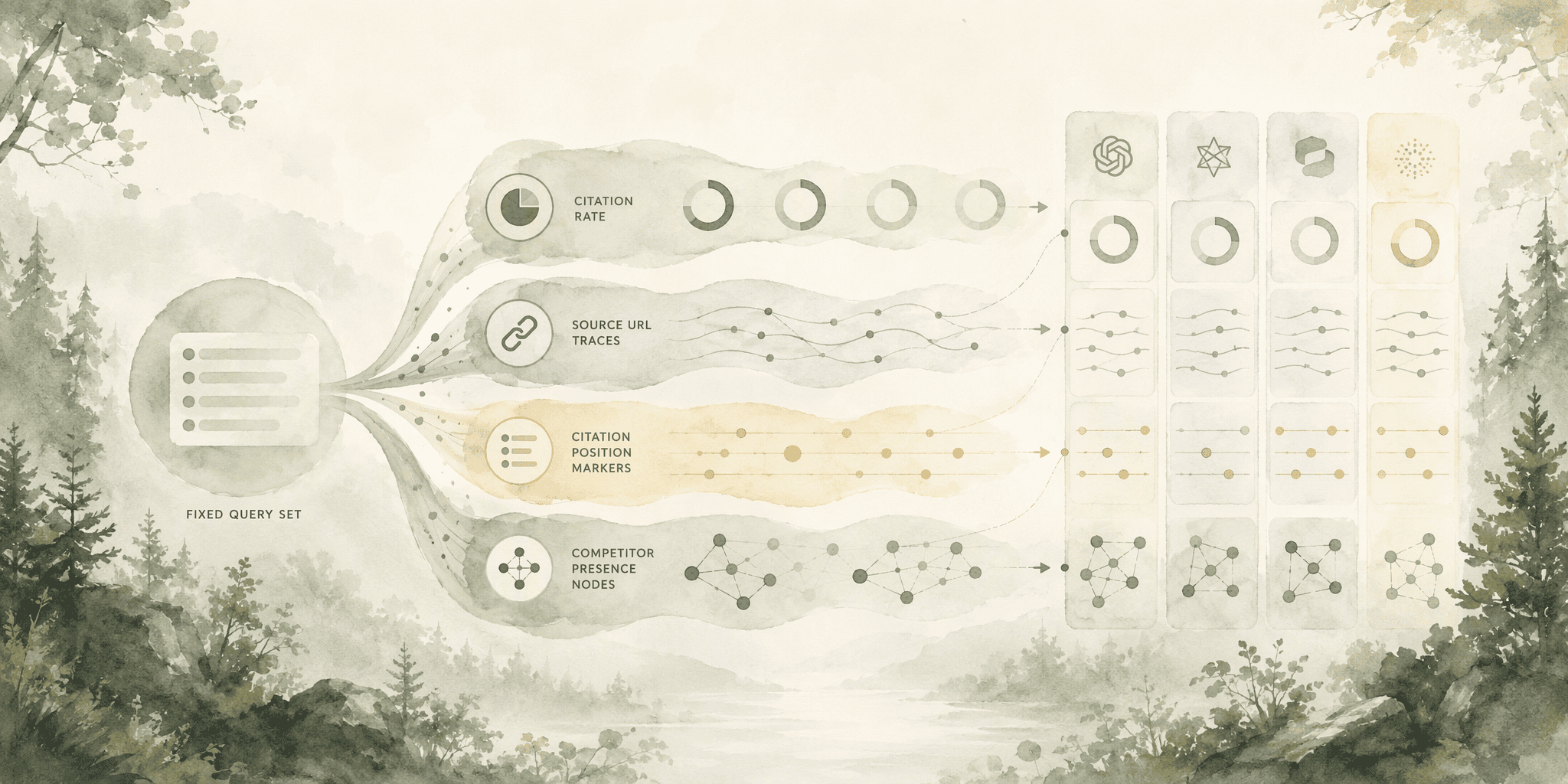
Siftly’s free tier tracks 100 responses per month across 10 unique prompts with a weekly refresh cadence, delivering a fast, zero-cost baseline of your ChatGPT and Google AI Overviews citation footprint.
Built as a GEO-native platform rather than a bolt-on to a legacy rank tracker, Siftly runs a fixed query set on a schedule and logs citation rate, cited source URLs, citation position, and competitor presence across ChatGPT, Perplexity, Copilot, AI Mode, and other AI surfaces. The platform also provides an AI visibility checker and a llms.txt generator as part of onboarding, directly addressing the technical retrieval gaps that prevent content from being extracted. A free audit with 30-day historical data requires no credit card and no signup.
For teams still treating AI visibility as a future problem, a single-prompt manual check is unreliable because generative responses vary with each request. A platform like Siftly introduces directional sampling and competitive benchmarking, giving product marketers a structured measurement layer that validates whether GEO investments are working.
2. Pencil: Structured Product Feeds Built for ChatGPT’s Retrieval Window
Most product feeds send a title, a price, and a few bullets. That works for a shopper scrolling a grid. It fails when an LLM needs to pull one SKU from forty near-matches and explain why it chose it. Pencil solves that specific problem: it restructures commerce data so models can disambiguate, price-check, and cite without hallucinating.
Standard feeds treat a red size-medium hoodie and a blue size-large hoodie as nearly identical rows. The LLM sees ambiguity and either drops both or guesses. Pencil anchors every variant signal (color, size, material, condition) in its own field. The model no longer needs to tease apart a crammed title string; it reads discrete attributes and matches the one that fits the query.
Pricing staleness creates a second risk. A product feed that refreshes every six hours might serve yesterday's sale price while a competitor's listing ticks up in real time. Pencil aligns refresh cadence with how often ChatGPT and Perplexity pull commerce data, so the number the model cites is the one a shopper will see at checkout.
Wording matters too. Most product copy is written for search-result snippets, not for the
3. Semrush: Monitor Classic E-E-A-T Signals That Still Feed the LLMs

The assumption that traditional SEO metrics stop mattering in an AI-first search landscape collapses under the weight of one data point: 81% of content that ranks well enough to be cited is human-written. LLMs do not index pages the way Googlebot does, but they do inherit the authority signals that traditional search surfaces. Semrush remains the most complete platform for tracking those signals systematically.
Backlink profiles, topical authority clusters, and content quality scores are the trust proxies that generative engines consume secondhand. A domain sleeping on thin content and weak backlinks does not become citation-worthy the moment a GEO plugin fires up. Semrush’s position tracking, site audit, and content analyzer validate whether the page-level E-E-A-T demanded by AI is actually in place. The platform added an AI Visibility module at an extra $99 per month. It rides on top of Semrush’s SEO architecture rather than being GEO-native, so some conversational nuance gets aggregated out of the dashboards.
The practical use case comes first: confirm your pages already meet the authority and quality thresholds that generative models use as a relevance filter. Semrush benchmarks those thresholds against competitors.
Start there.
4. Profound: Multi-LLM Citation Tracking That Goes Beyond Google

Single-engine monitoring is insufficient. AI search products use different combinations of search indexes, live web retrieval, and model knowledge, so strong visibility in one source does not guarantee visibility in another. Profound tracks brand citations across ChatGPT, Gemini, Claude, and Perplexity from a single dashboard, solving the fragmentation problem that makes AI share of voice difficult to measure.
Google Search Console reports on Google AI Overviews and provides no signal on ChatGPT, Perplexity, or Gemini citations. Profound fills that gap by running query fan-out analysis to capture the core topic queries and the sub-questions that generative engines produce for each prompt. A visibility audit that stops at primary keywords misses the derivative queries where brands actually get recommended. Profound's custom dashboard approach allows teams to track citation frequency by engine and against named competitors, creating the directional measurement layer that most SEO tools never attempted.
The measurement model here is as important as the tool. Profound moves the conversation from "did our URL rank?" to "was our brand cited in the answer, in what position, and against which competitors?"
That shift defines the GEO measurement framework.
5. seoClarity: Unify SEO and GEO Workflows in a Single Platform

Fragmentation burns AI optimization budget faster than any other mistake. Most enterprise teams research keywords in one platform and monitor GEO performance in another, so the connection between organic authority and AI citation probability stays invisible. seoClarity puts keyword research, content optimization, and AI visibility metrics into one operational layer.
The platform bridges the SEO-GEO gap that many organizations are failing to close. Content teams see how a page scores on traditional ranking factors and track citation frequency in AI Overviews or ChatGPT responses from the same dashboard. That dual view exposes the relationship between structured content, topical authority, and generative engine citation. With it, you make optimization decisions that strengthen both channels at once.
6. InLinks: Entity-First Schema Markup That Disambiguates Your Products
LLMs do not process semantic ambiguity with the same tolerance that human readers do. When ChatGPT encounters two products with similar descriptions but no structured disambiguation, the probability that it cites the wrong variant or omits a relevant result increases. InLinks generates Product, Organization, and FAQ schema by mapping each product to a unique Schema.org entity node that AI models can reference without confusion.
Adding FAQ and How-To schema helps models parse and cite content. That lever requires the schema to be in place before ingestion rather than relying on on-demand crawling. InLinks automates this at scale by mapping product catalogs to Schema.org entity standards with minimal manual configuration.
The result is a structured data layer that feeds AI disambiguation directly, complementing the technical structure pillar of the GEO framework. A properly schemad product page does not guarantee citation, but a product page without schema is a candidate for omission when a generative engine assembles a comparison answer from multiple competing sources.
7. Brand24: Capture the Omnichannel Mentions That Build AI Trust

AI trust is not built on your domain alone. Unlinked brand mentions seem to carry more weight in AI systems, so reviews, social chatter, and off-site citations all feed the authority layer that generative engines scrape when forming product recommendations. Brand24 monitors that wider citation surface area:
- Review monitoring across platforms. Brand24 captures product reviews on third-party sites, forums, and social channels, giving you visibility into the off-site content that AI models may ingest.
- Social listening for brand authority signals. Mentions on Reddit, X, LinkedIn, and niche communities feed the probabilistic models that determine which brands are credible enough to recommend.
- Crisis and sentiment alerting. A sudden spike in negative mentions can erode the trust signal that LLMs reference; Brand24's alerting catches sentiment shifts before they calcify into citation penalties.
- Integration with GEO monitoring workflows. Feed Brand24's mention data alongside a platform like Profound or Siftly to correlate off-site buzz with changes in AI citation frequency.
Conclusion
Winning product recommendations inside ChatGPT requires a seven-part tool stack that maps to a clear framework: audit your AI visibility baseline, structure product feeds for LLM retrieval, validate E-E-A-T signals, track citations across models, unify SEO and GEO workflows, implement entity-first schema, and monitor the omnichannel mentions that build trust. No single tool covers all seven, and no one-time fix sustains visibility as generative engines evolve their retrieval methods and model weights.
The brands that make GEO an ongoing operational practice will be the ones that get cited. Your competitors' volume in this space matters, but so does your own omnichannel footprint. When mentions across reviews, forums, and social platforms align with the structured product data you feed into the models, citation rates improve. Focus on the signals that actually move the needle: consistent entity markup and clean, crawlable product feeds.
Visibility in generative search is a continuous process, not a project with an end date.
Frequently Asked Questions
What specific content formats and technical elements make a brand more likely to be recommended by ChatGPT?
Question-style H2/H3 headings with crisp direct answers, tables, lists, and FAQ blocks improve citation probability. Pages with explicit FAQ markup get cited more frequently than flowing prose. Product schema, entity-first disambiguation, and a llms.txt file that guides LLM crawlers to high-priority URLs create the technical retrieval conditions generative engines need.
Which tools track brand visibility and competitive share of voice inside ChatGPT and Perplexity?
Siftly, Profound, and Otterly AI are purpose-built for cross-model AI citation tracking. Siftly monitors ChatGPT, Perplexity, Google AI Overviews, and Gemini with competitive benchmarking by query type. Profound covers ChatGPT, Gemini, Claude, and Perplexity in a custom dashboard. Google Search Console only reports on Google AI Overviews, leaving non-Google sources untracked.
How does Generative Engine Optimization differ from traditional SEO for product recommendations?
GEO builds on SEO rather than replacing it. SEO makes content discoverable and authoritative through backlinks and keyword rankings. GEO extends that by optimizing for retrieval, citation, and recommendation inside generative AI answers. The goal shifts from earning a click on a blue link to being the cited source when an LLM assembles a product comparison or recommendation.
What metrics should my business track to measure AI recommendation optimization success?
Track four core GEO KPIs:
- AI share of voice (citation frequency versus competitors)
- Citation position within answers
- Cited source URLs
- Query fan-out coverage
No platform offers a defensible citations-to-revenue calculation model; attribution remains directional. Directional citation-to-traffic modeling and per-engine KPI tracking provide the best available performance signal while perfect attribution is still developing.
What practical steps can a content team take today to improve its probability of being cited by ChatGPT for product queries?
Add FAQ and How-To schema to product pages immediately. Structure content with question-style headings and answer-first paragraphs under each. Confirm pages show named authors with clear bios and credentials. Implement a llms.txt file pointing LLM crawlers to high-priority product URLs. Run a free AI visibility audit to baseline current citation rates before optimizing further.
Sources
- 8 Strategic Picks to Build Machine Advantage in ChatGPT Agentic Commerce - siftly.ai
- GEO is the New SEO: AI Search Engine Optimization Playbook for 2026 - LLM Pulse - llmpulse.ai
- Generative Engine Optimization: A Practical Guide - Semrush - www.semrush.com
- What Is Generative Engine Optimization (GEO) [Tips & Workflows To Do It] - Moz - moz.com
- How to Integrate GEO with SEO: A Step-by-Step Strategy (2026) - www.trygeometrics.com
Keep exploring
More from the blog.

Oct 20, 2026
7 Most Affordable Competitive Intelligence Platforms for Startups Under 50 Employees in 2026
Your two top competitors just hired a veteran sales leader away from a public company, launched a new pricing page that undercuts your latest proposal

Oct 20, 2026
How to Get Real-Time Alerts When Competitors Change Their Messaging
Your top competitor just repositioned their entire product line around a new AI feature. Your sales team will find out in three weeks when a prospect parrots

Oct 20, 2026
Track Competitor Pricing Without Ever Visiting Their Sites: A 7-Step Guide
You know the burnout. Opening twenty browser tabs every morning, copying prices into a spreadsheet that is already out of date by the time you finish