Oct 29, 2026
7 Best AI Shopping Visibility Tools in 2026 to Win the AI Shelf
Your best-selling product can get a glowing five-paragraph recommendation from ChatGPT and still lose the click to a competitor cited in Google's AI Overview.

Introduction
Your best-selling product can get a glowing five-paragraph recommendation from ChatGPT and still lose the click to a competitor cited in Google's AI Overview. The reason is structural. ChatGPT and Google AI Overview disagree on brand recommendations for 61.9% of queries, according to a 2025 BrightEdge study. Generative Engine Optimization (GEO) is the practice of structuring product data, feeds, and metadata so that AI chatbots, from ChatGPT to Google AI Overview, surface your brand when shoppers ask what to buy. It demands a tool stack designed for a fundamentally different type of search, one where extraction replaces indexing.
The mechanics are split. For ChatGPT, a structured merchant feed acts as the primary authority on your brand and products. Google's AI Overview pulls from site content, citations, and structured data. The BrightEdge study quantifies the gap: Google AI Overview mentions 6.02 brands per query versus just 2.37 for ChatGPT, creating distinct competitive landscapes on each surface. Each engine requires a different optimization playbook.
This reality reshapes the tool market. You need solutions that monitor your brand presence, optimize product data for machine readability, and benchmark competitors inside generative answers. The seven tools below cover that spectrum, from free foundation layer to enterprise-grade competitive intelligence.
Key Takeaways
AI shopping visibility spans distinct platforms, each rewarding different signals. Your tool strategy needs to match:
- Platform-specific strategy is mandatory: ChatGPT mentions 3.2x more brands than it cites, while Google AI Overview cites 2.4x more sources than it mentions. A tool setup built only for one surface leaves the other exposed.
- Audit first, then optimize: Without a baseline visibility scan, competitive share-of-voice gains cannot be measured. The starting point is structured data hygiene, particularly Schema.org Product markup, before testing what each engine surfaces.
- High-disagreement categories hold the largest opportunity: Healthcare (68.5% disagreement rate) and B2B Tech (61.7%) offer the widest competitive window for brands that align product data to both trust-based and citation-based signals.
- Monitoring-only tools leave a gap: Platforms that track visibility but offer no prescriptive optimization guidance require separate consulting or an in-house workflow to translate data into action.
1. Siftly: All-in-One AI Shopping Visibility Platform for Monitoring, Optimization, and Competitive Intelligence

Siftly is the only platform that bundles real-time brand monitoring across nine AI engines with prescriptive optimization recommendations and competitive intelligence in a single integrated suite. It tracks visibility, rank, and share of voice across ChatGPT, Perplexity, and Google AI Overviews through daily automated query execution, then layer in competitor product and price position data surfaced alongside the brand.
Where a monitoring-only tool shows you a gap, Siftly's Growth tier provides prescriptive optimization recommendations grounded in citation analysis, tackling product metadata, attributes, schema, Shopify feeds, and Google Merchant Center data. It attributes referral traffic directionally to LLM citations, translating presence into an operational signal rather than a passive metric. The pricing structure reflects this scope: seat-based pricing typically starts at $129 per month, the Scale tier runs $599 per month, and the Pro plan costs $2,999 per month with enterprise pricing custom. For brands that need a unified view rather than stitching together three separate tools, Siftly's 14-day free trial with no credit card required provides a starting point.
2. BrightEdge AI Catalyst: Enterprise-Scale Brand Mention Tracking Across ChatGPT and Google AI Overview
BrightEdge AI Catalyst tracks brand mentions and citations across ChatGPT, Google AI Overview, and Google AI Mode at enterprise scale. It separates being cited as a source from being mentioned in passing. BrightEdge's own research published in 2025 quantifies the structural difference between those two visibility types per platform.
The platform works on a dataset large enough to make that distinction meaningful. BrightEdge published the finding that ChatGPT and Google AI disagree on brand recommendations 61.9% of the time. Catalyst contextualizes a brand's performance against that market-wide pattern. For a product team, the dashboard answers a specific question: the rate at which ChatGPT surfaces your brand, measured against the 6.02 brands per query the engine tends to display on average.
The enterprise fit is straightforward. Large catalogs spread across multiple geographies need monitoring that keeps pace with model behavior shifts without manual sampling. BrightEdge provides that coverage. Pricing is custom and positioned for organizations optimizing AI visibility at program scale, not for single-brand operators.
Real-time monitoring turns a BrightEdge stat into an operational dashboard. When 43.4% of queries get zero brand mentions from ChatGPT, the actionable question becomes whether your category gap is wider or narrower than the norm, and which product page changes start closing it.
3. SEO.AI Product Feed Optimizer: Automated Product Data Enrichment for AI Search Patterns
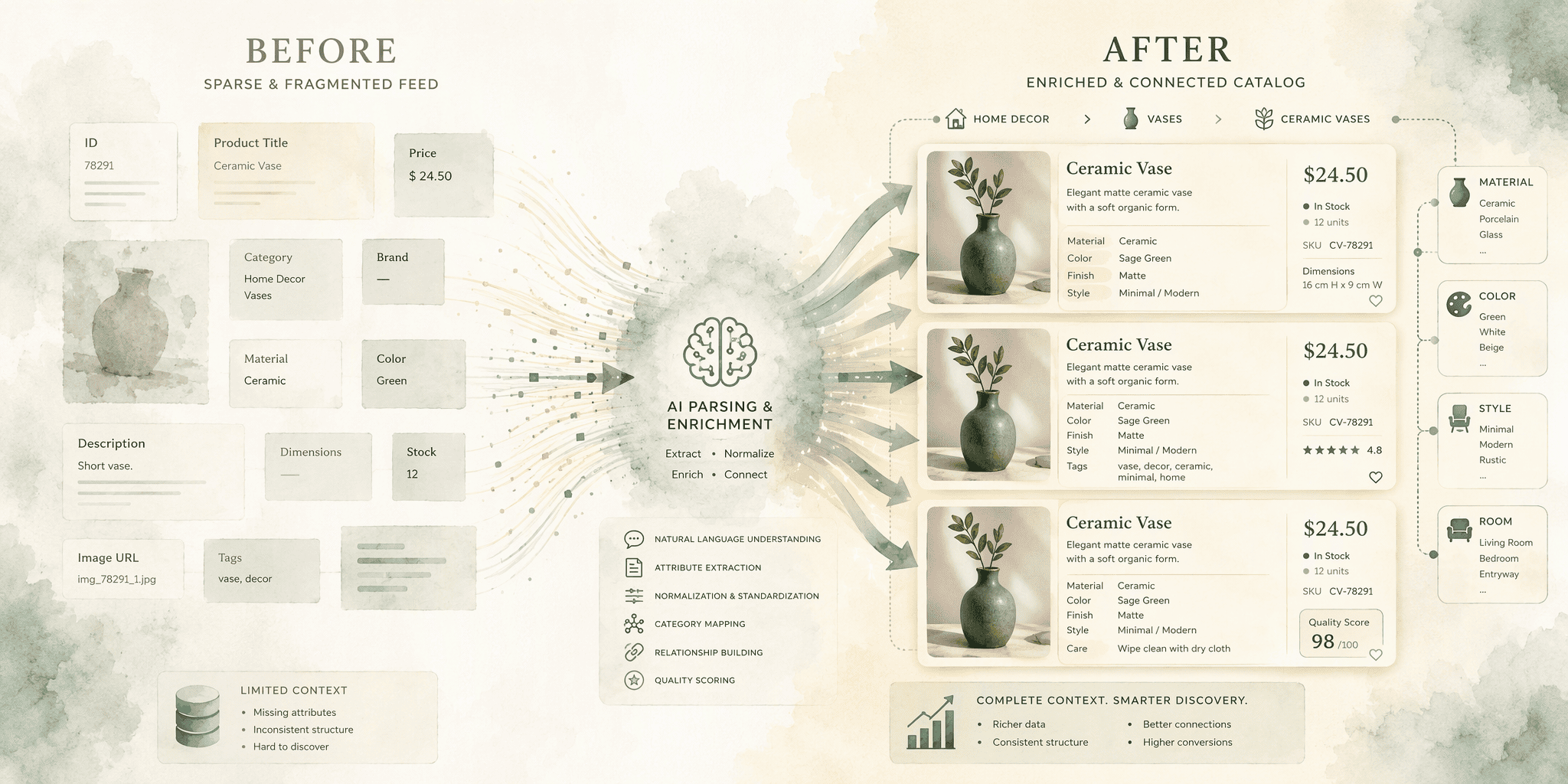
SEO.AI's Product Feed Optimizer automates enrichment of product titles, categories, and descriptions so they align with how generative engines parse and retrieve catalog data. For small and mid-market brands, it is the fastest way to start AI visibility work.
| Dimension | SEO.AI Product Feed Optimizer | Typical Manual Feed Workflow |
|---|---|---|
| Price point | $49 per month for Basic plan | Labor cost variable, no tooling fee |
| Time to Google Merchant Center integration | Approximately 24 hours | Days to weeks depending on catalog size |
| AI-specific enrichment scope | Titles, categories, descriptions, and structured attributes optimized for AI query patterns | Limited to manual field editing, typically keyword-driven rather than AI-structured |
| Feedback loop | Automated analysis of how enriched fields perform against AI search queries | No closed-loop measurement without additional tooling |
| Scalability ceiling | Best suited for catalogs under roughly 5,000 SKUs on Basic plan; higher tiers increase ceiling | Labor scales poorly above 500 SKUs without dedicated feed management staff |
4. Profound: Nine-Engine Brand Presence Monitoring with Patent-Pending Citation-to-Traffic Modeling

Profound monitors brand presence across nine AI engines and translates that visibility into estimated business impact through its patent-pending citation-to-traffic modeling. It covers analysis, content workflows, and a dedicated Shopping area.
The modeling is what sets it apart. Tracking which AI engines mention your brand is a starting point. Modeling what those mentions deliver in actual clicks turns the data into a decision-making input for budget allocation. No platform today provides a fully validated citations-to-revenue attribution model, but Profound's proprietary approach moves closer to operational relevance than simple mention counts.
Breadth matters only if it aligns with where citations actually exist. DeepSeek answers carry brand mentions and no source list at all according to LLM Pulse analysis. A nine-engine count requires distinguishing which platforms produce citable output and which hand out mere name-checks.
5. Schema App: Structured Data Management to Combat 62% Brand Recommendation Disagreement
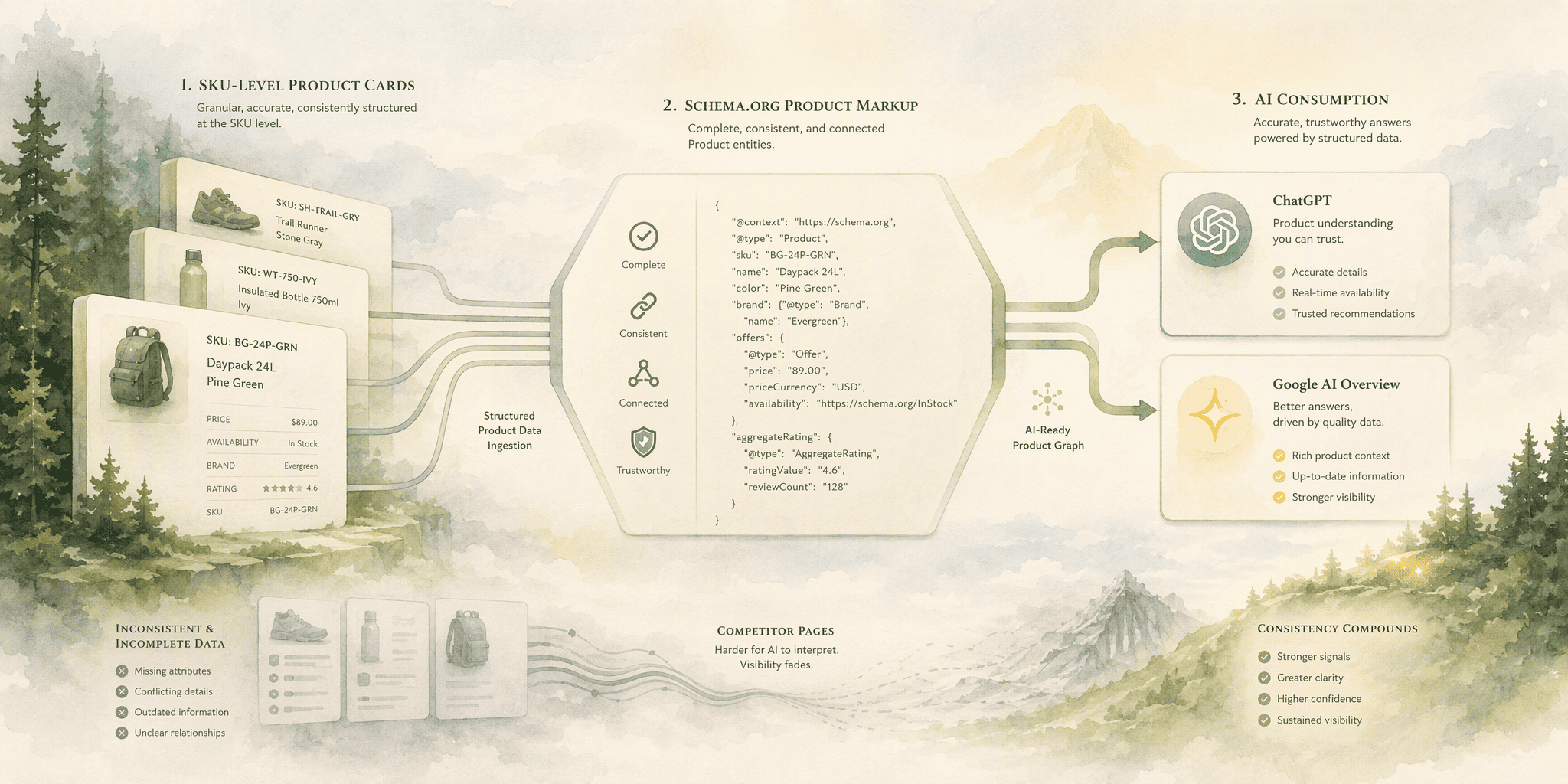
Schema App manages structured data at scale, addressing the foundational technical layer that directly reduces a brand's exposure to the 61.9% recommendation disagreement gap. When ChatGPT's merchant feed and Google's AI Overview pull from inconsistent or incomplete product data, they default to alternative sources, including competitor pages. Complete Schema.org Product markup across every SKU reduces the surface for that discrepancy.
That disagreement number is a measurable symptom of probabilistic generation models interpreting conflicting signals. Strong structured data is the single most controllable signal a brand can supply.
Implementation at scale means every product detail page carries consistent JSON-LD that maps to the Schema.org Product specification, including variant-level attributes like color, size, and availability. Schema App automates the creation and maintenance of that markup across large catalogs, preventing the drift that creates gaps AI engines exploit. When a query triggers disagreement, the brand with complete, machine-readable product data stands a better chance of surfacing consistently across platforms.
6. DataHawk: AI-Driven Product Detail Page Optimization and Competitive Ranking Intelligence
DataHawk applies AI-driven product detail page optimization and competitive ranking intelligence to the specific challenge of ecommerce GEO. It benchmarks which brands AI engines surface for identical queries, producing a competitive map that a pure monitoring tool cannot generate. When a shopper asks ChatGPT to compare two product categories, DataHawk shows whether your PDP content aligns with what the engine rewards, and which competitor pages are structurally outperforming yours in the generative answer set.
This is where product-level optimization meets marketplace dynamics. An AI visibility tool for e-commerce needs to distinguish a retailer mention from a product recommendation and a specific variant. DataHawk isolates that signal across the product detail layer. For operator teams managing hundreds of SKUs across Amazon, Shopify, or direct-to-consumer storefronts, that granularity turns abstract visibility into a per-SKU action list.
7. Google Manufacturer Center: Foundation-Level Product Attribute Submission for AI Shopping Visibility

Google Manufacturer Center is the free prerequisite every brand should configure before layering any paid tool on top. It submits authoritative product attributes, descriptions, and rich content directly into Google's ecosystem, giving the AI Overview and Google Shopping surfaces a single source of truth about your products. When Google's AI pulls product details for a search result, it can default to whatever third-party data it scraped last, or it can work from the structured feed you control.
Complete the following sequence as your first operational GEO step.
- Register and verify your brand: Submit your brand for approval in Manufacturer Center. Google verifies you as the legitimate owner, which elevates the authority weight of the product data you subsequently submit.
- Upload complete product attribute feeds: Populate every field Google accepts, including product type, description, GTIN, and variant-level attributes like size, color, and material. The richer the feed, the fewer gaps Google's AI has to fill with third-party data.
- Link to Google Merchant Center for retail distribution: Connect your Manufacturer Center account to Merchant Center to push approved product data to retailers and marketplaces, creating a consistent product story across the Google surfaces that feed AI Overviews.
- Refresh feeds on a cadence matching your catalog change frequency: The ChatGPT Product Feed Specification allows merchants to refresh structured product data as often as every 15 minutes via TSV, CSV, XML, or JSON files. Set your Manufacturer Center refresh cycle to match how frequently product details, pricing, or availability change.
Conclusion
The AI shopping visibility tool landscape in 2026 spans a clear spectrum: Google Manufacturer Center provides the free data foundation, Schema App hardens the structured data layer, SEO.AI automates feed enrichment for smaller catalogs, and BrightEdge AI Catalyst delivers enterprise-scale monitoring. Siftly fills the integrated middle, bundling monitoring and optimization across nine engines. High-disagreement categories like Healthcare and B2B Tech remain the most actionable competitive opportunity. An audit-first, platform-aware approach is the only methodology that accounts for the 61.9% of queries where ChatGPT and Google pick different winners.
Frequently Asked Questions
What is Generative Engine Optimization (GEO) and how does it work?
Generative Engine Optimization (GEO) is the practice of structuring product data, metadata, and feeds so AI chatbots like ChatGPT and Google AI Overview surface a brand in shopping recommendations. It works by optimizing product catalogs to match the signals probabilistic models use when deciding which brands to cite or recommend, rather than traditional keyword-based ranking factors.
How can brands monitor their visibility in AI chatbot shopping suggestions across multiple platforms?
Brands can monitor visibility using platforms that execute daily automated queries across multiple AI engines:
- BrightEdge AI Catalyst tracks enterprise-scale visibility across ChatGPT, Google AI Overviews, and Google AI Mode.
- Siftly monitors nine engines, providing share-of-voice and ranking analysis tied to specific product queries.
- Other platforms like DataHawk and Profound offer complementary monitoring capabilities.
What specific product data and metadata should brands optimize to appear in AI shopping results?
Key structured data elements for AI visibility include:
- Complete Schema.org Product markup across all SKUs.
- Enriched product feed fields such as product type and description.
- Variant-level attributes including size, color, and GTIN.
- An accurate ChatGPT merchant feed that serves as the primary authority on your brand.
What are the costs and features of platforms designed to improve AI shopping visibility?
Costs range from free tools like Google Manufacturer Center to SEO.AI at $49 per month for automated feed enrichment, Siftly's seat-based pricing starting at $129 per month, and custom enterprise pricing for BrightEdge AI Catalyst and Profound. Features span monitoring, feed optimization, and competitive benchmarking.
How do tools measure and track competitor performance within AI-generated shopping recommendations?
Monitoring tools execute identical shopping queries against AI engines and record which brands, products, and prices surface in generative answers:
- DataHawk benchmarks product-level ranking across engines.
- Profound models citation-driven traffic from visibility data.
- Siftly tracks competitor products and price positions alongside the monitored brand across multiple engines.
What are the first steps a brand should take in 2026 to increase its presence in AI chatbot product suggestions?
To get started with generative engine optimization:
- Perform a structured data audit using Google Manufacturer Center to submit complete product attributes.
- Run a baseline visibility scan across ChatGPT, Google AI Overview, and Google AI Mode.
- Prioritize optimization in high-disagreement categories like Healthcare (68.5%), where complete, consistent data creates the largest competitive advantage.
Sources
- Pricing — Siftly - siftly.ai
- Product Feed Optimization by AI - seo.ai
- AI Visibility Tools Compared | Semly EN - docs.semly.ai
- Best AI Citation Tracking Tools in 2026 - LLM Pulse - llmpulse.ai
- Optimizing for ChatGPT Shopping: How product feeds power GEO - searchengineland.com
- ChatGPT vs Google AI: 62% Brand Recommendation Disagreement | BrightEdge - www.brightedge.com
Keep exploring
More from the blog.

Oct 29, 2026
7 Best AI Brand Monitoring Tools to See What AI Actually Says About You in 2026
You send a prospect to check what ChatGPT says about your category. It mentions three of your competitors by name, pulling a specific product detail for each.

Oct 29, 2026
7 Tools to Measure Brand Visibility Across AI Platforms like ChatGPT and Gemini in 2026
Marketing teams are discovering a chilling fact in 2026: their carefully built search dominance is invisible to a growing segment of buyers.

Oct 29, 2026
How to Track Your Company's Visibility Across AI Search Platforms in 2026
Your next buyer is not on Google. They are inside ChatGPT asking for a recommendation, on Perplexity comparing three alternatives