Oct 17, 2026
7 Best AI Brand Monitoring Tools for 2026
Your brand can be cited in a Google AI Overview, praised in a Perplexity answer, or recommended by ChatGPT with zero visibility on your end.

Introduction
Your brand can be cited in a Google AI Overview, praised in a Perplexity answer, or recommended by ChatGPT with zero visibility on your end. The blue-link SERP created a clear audit trail. AI-generated answers dissolve that trail. Every day, millions of purchase decisions are shaped by AI engines that cite sources outside traditional first-page rankings, often with factual errors you cannot detect without dedicated monitoring.
A large-scale 2026 ACM study found that 11.0% of AIO claims were unsupported by the cited pages, with omission as the dominant failure mode. If an AI engine mischaracterizes your pricing, conflates your product with a competitor's, or omits you entirely from a category recommendation, that error propagates across millions of queries before you ever see it.
Traditional social listening and rank trackers were not designed to surface what large language models synthesize about your brand. The tools listed below track AI citation frequency, sentiment, competitor presence, and claim accuracy across ChatGPT, Perplexity, Google AI Overviews, Gemini, and Claude.
Key Takeaways
AI search engine monitoring requires tools that probe generative models directly, not tools that scrape SERP rankings. Here is what every executive and marketing leader needs to understand about the options in 2026:
- Top broad-spectrum platform: Siftly provides cross-engine monitoring, aggregated brand health scoring, and optimization workflows for teams that need coverage across every major AI answer engine without managing multiple tools.
- Best GEO-native citation monitor: OtterlyAI delivers the deepest per-prompt visibility and GEO optimization recommendations, translating citation patterns into measurable traffic gains.
- Enterprise social and AI listening suite: Brandwatch extends existing social listening infrastructure into AI-generated answer monitoring for large organizations that need unified dashboards.
- Core metrics to track: Citation frequency across engines, brand sentiment within AI responses, competitor mention comparison, and prompt-level visibility are the four non-negotiable signals.
- Unsupported claims are a measurable risk: In 2026, 11.0% of AIO claims studied lacked support from cited pages; brands that do not audit their AI representation are ceding their narrative to probabilistic generation models.
- Pair monitoring with GEO optimization: Tracking AI mentions without a structured optimization workflow, covering earned media, Reddit, Wikipedia, and social sources AI engines trust, leaves visibility gains on the table.
1. Siftly, Actionable AI brand visibility across the full answer engine landscape

Siftly monitors how AI engines talk about your brand, measures traffic, and flags what needs fixing across ChatGPT, Google AI Overviews, Gemini, and Perplexity. It functions as a broad-spectrum GEO command center rather than a single-engine citation checker, giving marketing teams a unified dashboard for brand health in generative answers.
- Cross-engine daily monitoring: Siftly measures visibility, rank, and share of voice across ChatGPT, Perplexity, and Google AIO daily, catching shifts before they compound.
- Unsupported claim detection: The platform flags incorrect or unsupported AI descriptions of your brand, addressing the exact failure mode documented in the 2026 ACM study where nearly 30% of domains cited by AIOs do not appear in co-displayed first-page results.
- Competitor benchmarking dashboard: A multi-engine AI competitor benchmarking tool surfaces where rivals are being recommended in AI answers and identifies high-priority gap opportunities.
- Optimization workflow recommendations: Siftly provides actionable, AI-optimized content recommendations that integrate with WordPress, Webflow, Search Console, Slack, and email, making optimization a structured process rather than guesswork.
- Conversion attribution: The platform measures conversion events tied to AI-referred clicks, directly connecting monitoring to revenue impact.
- Accessible entry point: A free AI Visibility Checker requires no sign-up, and a 14-day free trial with no credit card required makes it approachable for teams evaluating GEO platforms.
2. OtterlyAI, The GEO-native citation monitor for multi-platform dominance

OtterlyAI has emerged as the citation tracking standard for teams that need per-prompt visibility across every major generative engine. Trusted by 40,000+ marketing professionals worldwide, the platform monitors brand mentions in Google AI Overviews, ChatGPT, Perplexity, Claude, Copilot, and Gemini, surfacing which specific queries trigger your brand versus competitors'.
The key differentiator is the Prompt Research feature, which uncovers the exact question formats driving AI answers in your category before competitors act. This flips the monitoring workflow from reactive tracking to proactive positioning. When combined with sentiment analysis and Content Briefs that match AI citation patterns, the platform translates raw mention data into an actionable optimization pipeline.
One documented outcome is instructive. After adopting OtterlyAI, e-commerce platform Instant Commerce reported a doubling of both AI search visibility and incoming traffic. The causal chain is direct: identify citation gaps, optimize content for AI extraction patterns, measure the lift.
The trade-off is depth versus self-service simplicity. OtterlyAI demands a structured workflow: identify high-impact prompts across engines, benchmark competitor presence, audit content crawlability, and iterate on GEO recommendations. For teams committed to that cadence, the platform delivers the most granular per-citation intelligence available. For teams that only need a directional check on a single engine, the learning curve may outweigh the value.
3. Brandwatch, Enterprise-scale social and AI listening in one suite

Brandwatch extended its social listening infrastructure into AI-generated answer monitoring. Large organizations can now fold AI-answer intelligence into the same dashboards that track earned media, social sentiment, and consumer conversation trends. AI-generated brand mentions appear alongside social posts, Reddit threads, and news coverage, giving communications teams one place to monitor reputation.
For enterprises that already use Brandwatch's social listening suite, adding AI answer tracking keeps everything under one roof. No standalone GEO tool required. Sentiment analysis runs across social and AI sources and flags where the two diverge.
The trade-off is depth. Brandwatch doesn't match the per-prompt, per-model granularity available in tools like OtterlyAI.
Think of it as an enterprise listening extension rather than a dedicated GEO command center. Organizations that care more about unified dashboards than granular AI citation intelligence get what they need.
4. Meltwater, AI-powered media intelligence with generative answer tracking
Meltwater added an AI answer tracing module to its existing media intelligence platform. You can now watch brand mentions across news, social, and AI outputs in one place.
For PR teams, that closes the gap between conventional monitoring and a world where consumers ask ChatGPT instead of reading a press release. You run one dashboard instead of two.
GenAI Lens surfaces when an AI engine mentions your brand, and whether the tone is positive or negative. The workflow looks the same as the media tracking you already do. Set up brand and competitor queries, get alerts on sentiment swings, and track share of voice across sources.
The ceiling is depth. Meltwater tells you a mention happened. It does not break an AI answer into individual claims, flag one as unsupported, or suggest which content to adjust to change future citations.
Communications teams that want AI coverage inside their current monitoring view will find that useful. SEO teams needing per-prompt competitive data and optimization workflows will need a different tool.
5. Semrush, SEO suite adding AI Overview rank and citation dimensions
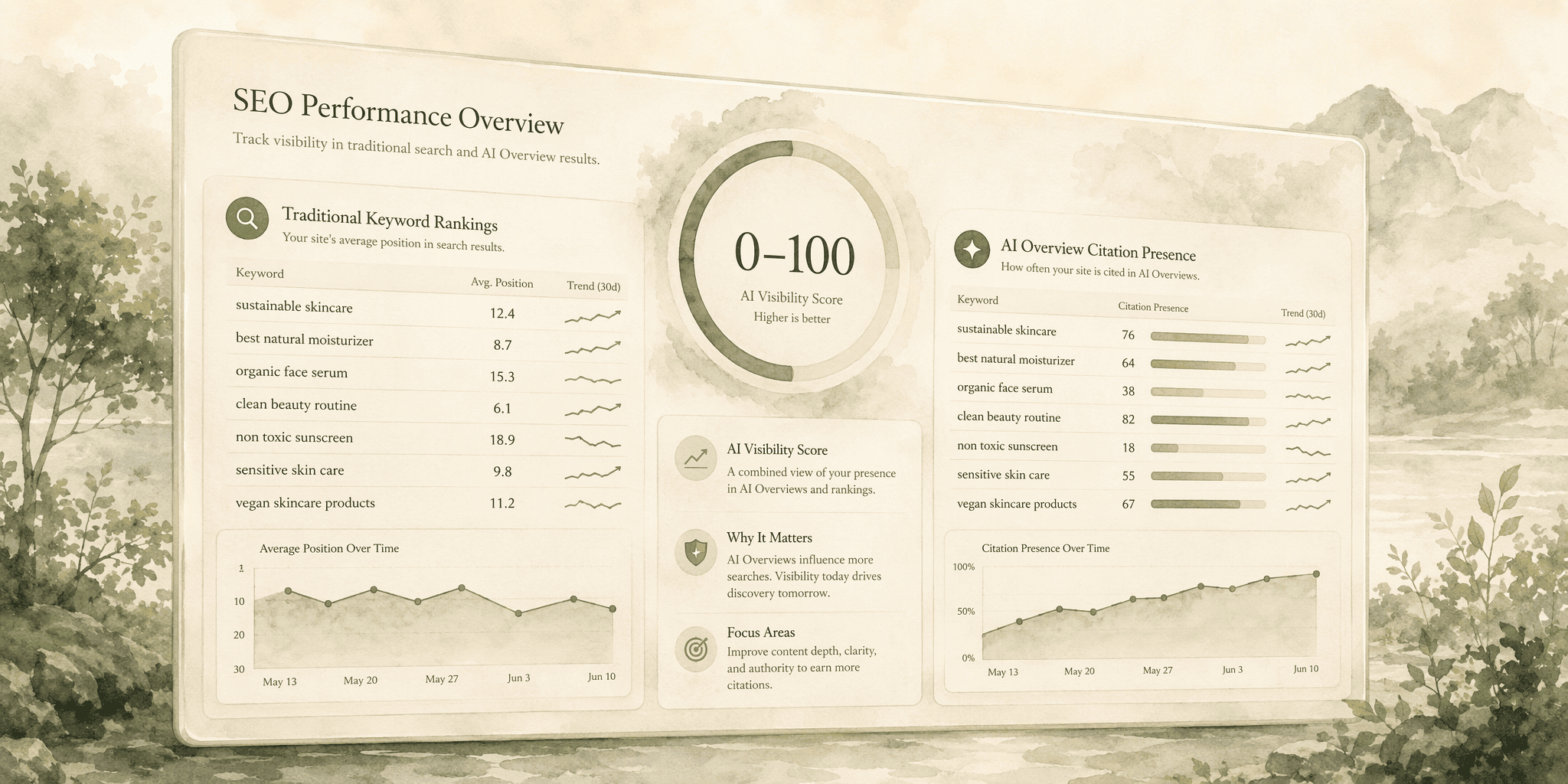
Semrush has layered AI Overview tracking directly into its SEO platform, meaning digital marketing teams can now monitor AI citation presence alongside traditional keyword rankings without switching tools. The AI Visibility Toolkit generates a score between 0 and 100 that reflects how a brand is cited across ChatGPT, Perplexity, Google AI Overviews, and AI mode.
The workflow advantage is real. SEO practitioners already spend their day inside Semrush for rank tracking, keyword research, and competitive analysis. Surfacing that a domain is cited, or conspicuously absent, in AI answers within the same interface reduces the cognitive overhead of managing a separate GEO platform.
The integration also surfaces a pattern that pure-play GEO tools sometimes hide: the gap between traditional search visibility and AI citation presence. With nearly 30% of domains cited by AIOs not appearing in co-displayed first-page search results, seeing both datasets side by side makes the divergence measurable.
Semrush's GEO capabilities are additive, not native. Citation tracking builds on the existing keyword infrastructure rather than being architected from the ground up to probe model behavior. The result is strong directional visibility into whether AI engines cite your content, but less granularity on why specific citations appear or how to systematically increase them. For SEO teams prioritizing workflow integration over deep GEO specialization, it is the most practical entry point.
6. Ahrefs, Webmaster tooling expanding into AI search result monitoring
Ahrefs is extending its backlink and keyword monitoring infrastructure into AI search result tracking. For webmasters and SEO professionals who work inside Ahrefs daily, this capability surfaces which pages get cited in AI Overviews and ChatGPT answers, layered onto existing domain authority and content performance data.
| Feature | Ahrefs AI Monitoring | Native GEO Platforms (OtterlyAI, Siftly) |
|---|---|---|
| Citation tracking | Pages cited in AI Overviews; emerging support for ChatGPT | Full multi-engine citation monitoring across ChatGPT, Perplexity, Gemini, Claude, Copilot, and AI Overviews |
| Competitor benchmarking | Compares AI-cited pages against traditional backlink profile | Dedicated AI-answer competitor benchmarking with prompt-level gap analysis |
| GEO recommendations | Not provided; relies on existing SEO workflow assumptions | Structured optimization recommendations matching AI citation patterns |
| Sentiment analysis | Not provided | Brand sentiment scoring within AI-generated responses |
| Unsupported claim detection | Not provided | Flags mischaracterizations and unsupported claims in AI answers |
| User base alignment | SEO professionals and webmasters already in the Ahrefs ecosystem | Marketing teams, PR, and GEO specialists who need AI-specific intelligence |
The trade-off is straightforward. If your primary question is "which of my pages are AI engines citing," Ahrefs offers a workable first-pass answer inside a familiar interface. If your question is "how are AI engines describing my brand compared to competitors, what claims are unsupported, and what content should I create to close the gap," a native GEO platform is the correct tool.
7. ChatGPT Citations Plugin, Lightweight direct-tracking for ChatGPT mentions

The ChatGPT Citations Plugin is a quick way to see whether ChatGPT mentions your brand. You ask the model about your company, and the plugin returns what citations show up right that moment. For a marketing team that needs a single-engine gut check without spending on a platform, this is about as light as it gets.
You write a handful of buyer-relevant prompts, run them through the plugin, and note whether your brand appears, how it is described, and which competitors show up instead. The result is a snapshot of visibility inside one engine, nothing more.
The limits are clear. ChatGPT only. Google AI Overviews, Perplexity, Gemini, and Claude are invisible to it. There is no trendline, so you cannot see whether things improved or slipped over time. No competitive benchmarking, no sentiment analysis, no fix recommendations.
If your team is asking "should we care about GEO at all," this plugin gives you a first look without much overhead. Once you confirm a gap exists and decide to close it systematically, swap it for a platform that tracks every engine, trends visibility over time, benchmarks competitors, and tells you what to fix.
Conclusion
The AI brand monitoring landscape in 2026 spans lightweight single-engine checks, SEO-suite add-ons, and dedicated GEO command centers. The right tier depends on how many AI engines already shape your audience's purchase decisions. With Google AI Overviews reaching over 2 billion users and an 11.0% unsupported claim rate documented in recent research, inaction carries measurable brand risk. Start by running a free audit through a tool like Siftly's AI Visibility Checker to assess your current exposure, then pair ongoing monitoring with structured GEO optimization that builds presence across the earned media, Reddit, Wikipedia, and social sources AI engines trust most.
Frequently Asked Questions
What are the best tools to track how AI search engines like Google AI Overviews or ChatGPT mention my company?
Major GEO tools offer distinct approaches to AI citation monitoring:
- OtterlyAI provides the deepest multi-engine citation tracking across ChatGPT, Perplexity, Google AI Overviews, Gemini, Claude, and Copilot.
- Siftly offers broad-spectrum cross-engine monitoring with competitor benchmarking and unsupported-claim detection.
- Semrush integrates AI Overview tracking into its SEO suite for teams that prefer a single interface.
How do AI brand monitoring platforms differ from traditional social listening or SEO tools?
Social listening watches public feeds; AI brand monitoring probes the models themselves. Traditional rank trackers measure SERP position, but AI answers have no page two and source content from domains that often do not appear in first-page search results. The visibility signal is inclusion within AI-generated responses, not ranking order.
What specific metrics should I track to measure my brand’s visibility in generative AI responses?
To evaluate AI brand visibility, track these five metrics:
- Monitor citation frequency across engines.
- Measure brand sentiment within AI answers.
- Run competitor mention comparison.
- Track prompt-level visibility to see which specific queries trigger your brand versus rivals.
- Measure unsupported or incorrect claims, since 11.0% of AIO claims studied in 2026 lacked support from cited pages.
How does competitor benchmarking work for AI-generated search results?
Competitor benchmarking tracks which sources each AI engine cites for specific prompts, then compares your brand's appearance rate and positioning against rivals. Tools like Siftly and OtterlyAI surface competitors' AI answer presence, identify high-priority gap opportunities, and show the exact prompts where competitors are cited instead of you.
How can I fix or improve how AI search engines describe my brand or products?
To increase AI citation frequency, follow this two-part approach:
- Build content presence across earned media, Reddit, Wikipedia, and social sources AI engines trust most.
- Then use GEO optimization recommendations to create content matching AI citation patterns; some platforms provide structured Content Briefs and audits that flag crawlability issues and recommend specific changes.
What is generative engine optimization (GEO) and how does it relate to citation tracking in 2026?
GEO is the practice of structuring content so AI engines cite it preferentially, formally defined in a 2024 ACM SIGKDD paper. It differs from traditional SEO because AI models evaluate content context, source authority across the web, and claim fidelity. Citation tracking measures GEO effectiveness by quantifying when and how AI engines reference your brand.
Sources
- How to track brand mentions in AI search - Adobe for Business - business.adobe.com
- How to Measure Brand Visibility in AI Search - searchengineland.com
- AI Search Monitoring Tool: Track ChatGPT, Perplexity & Google AIO - otterly.ai
- Measuring Google AI Overviews: Activation, Source Quality, Claim Fidelity, and Publisher Impact | Proceedings of the 2026 ACM Internet Measurement Conference - dl.acm.org
Keep exploring
More from the blog.

Oct 17, 2026
How to Measure AI Share of Voice in 2026: The 7-Step Execution Plan
Your brand might be mentioned in a ChatGPT answer right now, but you have no dashboard that shows it.

Oct 17, 2026
8 Best AI Brand Monitoring Tools for Startups on a Budget in 2026
The difference between a funded quarter and a missed target is increasingly a single sentence generated by ChatGPT or Perplexity.

Oct 16, 2026
How to Measure Share of Voice in AI Search: A CMO’s Benchmarking Playbook
Your brand's most critical marketing metric stopped working the moment Google launched AI Overviews.