Aug 16, 2026
5 Ways to Track Which Content Gets Cited Most by ChatGPT
A product manager reviews her quarterly brand report and sees that organic search traffic is flat, direct traffic is stable

Introduction
A product manager reviews her quarterly brand report and sees that organic search traffic is flat, direct traffic is stable, but the referral segment from 'chat.openai.com' and 'perplexity.ai' has materialized out of nowhere. The discovery channel that drove a double-digit share of new pipeline this quarter left no keyword trail, no backlink record, and no page-level conversion path she can trace in her analytics stack. AI search engines don't index content, they extract it, and that extraction happens inside a black box that traditional web analytics were never designed to observe.
This is the measurement gap that generative engine optimization has forced onto every brand team. When a prospective buyer asks ChatGPT for a vendor comparison and receives a synthesized answer citing three of your competitors, the event is invisible to Google Search Console and GA4. The underlying mechanism is fundamentally different from link-based search: LLMs process raw text semantics, not hyperlink graphs. One study analyzing 602 prompts found that ChatGPT cites a mean of 6.88 sources per prompt while Perplexity cites 16.35, and the page that ends up in the final answer carries influence weightings that have nothing to do with PageRank.
The visibility problem is compounded by where brand mentions originate. 85% of brand mentions in AI search come from third-party sources rather than the brand's own domain, and brand mentions correlate 3x more strongly with AI visibility than backlinks do. This means the content that determines whether your brand gets cited often lives on forums, publisher sites, and expert blogs far outside your CMS. Without a dedicated tracking discipline, you are flying blind on the channel that enterprise digital leaders are betting on: 94% planned to increase AEO investment in 2026.
Tracking AI citations requires a layered approach that combines purpose-built monitoring tools, structured manual auditing, and offsite mention attribution. This article examines five concrete methods, from all-in-one command centers to lightweight DIY stacks, that give you line of sight into where your brand is winning and losing inside generative answers.
Key Takeaways
The most actionable findings from the current research and tool landscape, distilled for teams that need to make funding decisions this quarter:
- Citation breadth vs. depth diverge sharply across platforms: ChatGPT averages 6.88 citations per prompt with high per-page influence, while Perplexity averages 16.35 citations with lower individual influence. Raw citation counts alone do not measure true answer-level contribution.
- Offsite mentions dominate AI visibility: 85% of brand mentions surfaced in AI answers originate on third-party domains, and brand mentions correlate approximately 3x more strongly with AI visibility than traditional backlinks do.
- The tool landscape spans free sampling to enterprise-scale experimentation: Starter tiers typically cost $100 to 300 per month, mid-market platforms run $500 to 600 per month, and enterprise tiers with API access and historical trending can exceed $2,000 per month. Pricing changes frequently, so current figures should be checked on each vendor's live pricing page.
- Manual auditing remains non-negotiable: AI responses are non-deterministic, varying by session, platform, and prompt phrasing. No tool replaces structured manual spot-checking across prompt variants as a ground-truth validation layer.
- Metrics that connect citations to pipeline exist but lack a validated attribution model: Mention velocity, topic cluster density, and resurfacing frequency are the most commonly tracked leading indicators. Brands earning both citations and mentions are 40% more likely to reappear across AI answers than citation-only brands, though no platform currently offers a validated citations-to-revenue attribution model.
1. Siftly, The All-In-One AI Citation Tracking Command Center

Most teams tracking AI citations operate from a patchwork of spreadsheets, each one covering a different engine. That setup breaks the moment you need the full picture. Siftly pulls ChatGPT, Perplexity, and Google AI Overviews data into a single interface so you stop stitching reports together and start seeing the patterns that matter.
No single engine gives you enough signal. ChatGPT, Perplexity, and Google AI Overviews each scrape different source pools and assign influence on different terms. Watching only one leaves gaps you cannot see until a competitor shows up where you should have been.
| Dimension | Siftly Capability | Why It Matters |
|---|---|---|
| Platform coverage | ChatGPT, Perplexity, Google AI Overviews | Covers the bare-minimum multi-engine surface required for credible AI visibility tracking |
| Monitoring cadence | Continuous tracking with mention velocity, topic cluster density, and resurfacing frequency metrics | Captures the temporal patterns that single-snapshot checks miss; brands earning both citations and mentions are 40% more likely to reappear across AI answers |
| Pricing tiers | Starter at $79/month; Scale at $599/month; Enterprise custom | Allows teams to start with foundational monitoring and scale to advanced features as organizational maturity grows; annual pricing is billed upfront |
| Integration depth | CMS-native integration; read-only access to Google Analytics, Search Console, and Manufacturer Center | Connects citation data to existing analytics infrastructure without modifying any live systems |
The platform takes a GEO-first approach: it surfaces the prompts shoppers type into AI before they decide what to buy, then tracks AI-referred clicks as a directional measure of commercial impact. Siftly says a 10-point improvement in citation rate is a realistic 6-month target for brands putting real resources into GEO, but the organization cautions that hard ROI numbers shift a lot by vertical and by how mature your content is.
2. OtterlyAI, Specialized Multi-Platform AI Monitoring for Brand Consistency
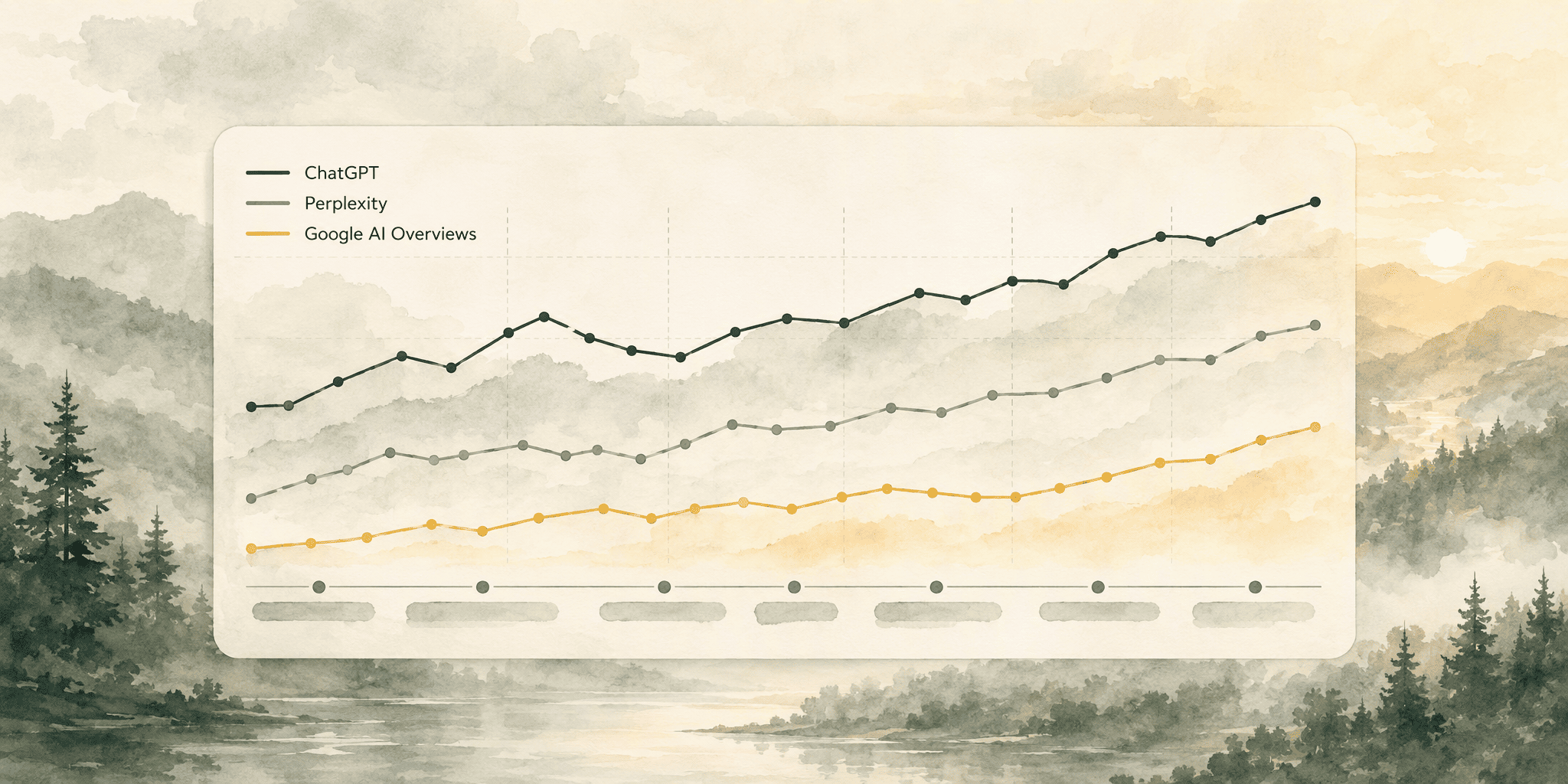
OtterlyAI tracks brand visibility across ChatGPT, Perplexity, and Google AI Overviews with an emphasis on longitudinal data rather than single-snapshot checks. That time-series orientation separates signal from noise in a non-deterministic environment where any one prompt result can mislead.
Single-prompt checks are unreliable because AI responses vary across sessions. OtterlyAI addresses this by measuring citation rate and resurfacing frequency over extended monitoring windows. Competitive benchmarking layers show how your brand's visibility trajectory compares to competitors across the same query set, which transforms raw citation counts into a relative market position metric. The methodology draws on the principle that traditional web analytics fail to capture AI-powered brand discovery because LLMs process raw text semantics, not hyperlink graphs, and monitoring must account for that fundamental difference by tracking where consensus signals aggregate across third-party sources.
Pricing spans starter tiers around $100 per month to enterprise tiers exceeding $2,000 per month, with the feature gradient running from basic multi-platform monitoring up to historical trending and API access. Real-time alerting systems cost more than scheduled sampling workflows. Teams evaluating OtterlyAI should map their required monitoring cadence to the pricing tier that matches it.
3. AirOps, AI Visibility Workflows with Enterprise-Scale Experimentation
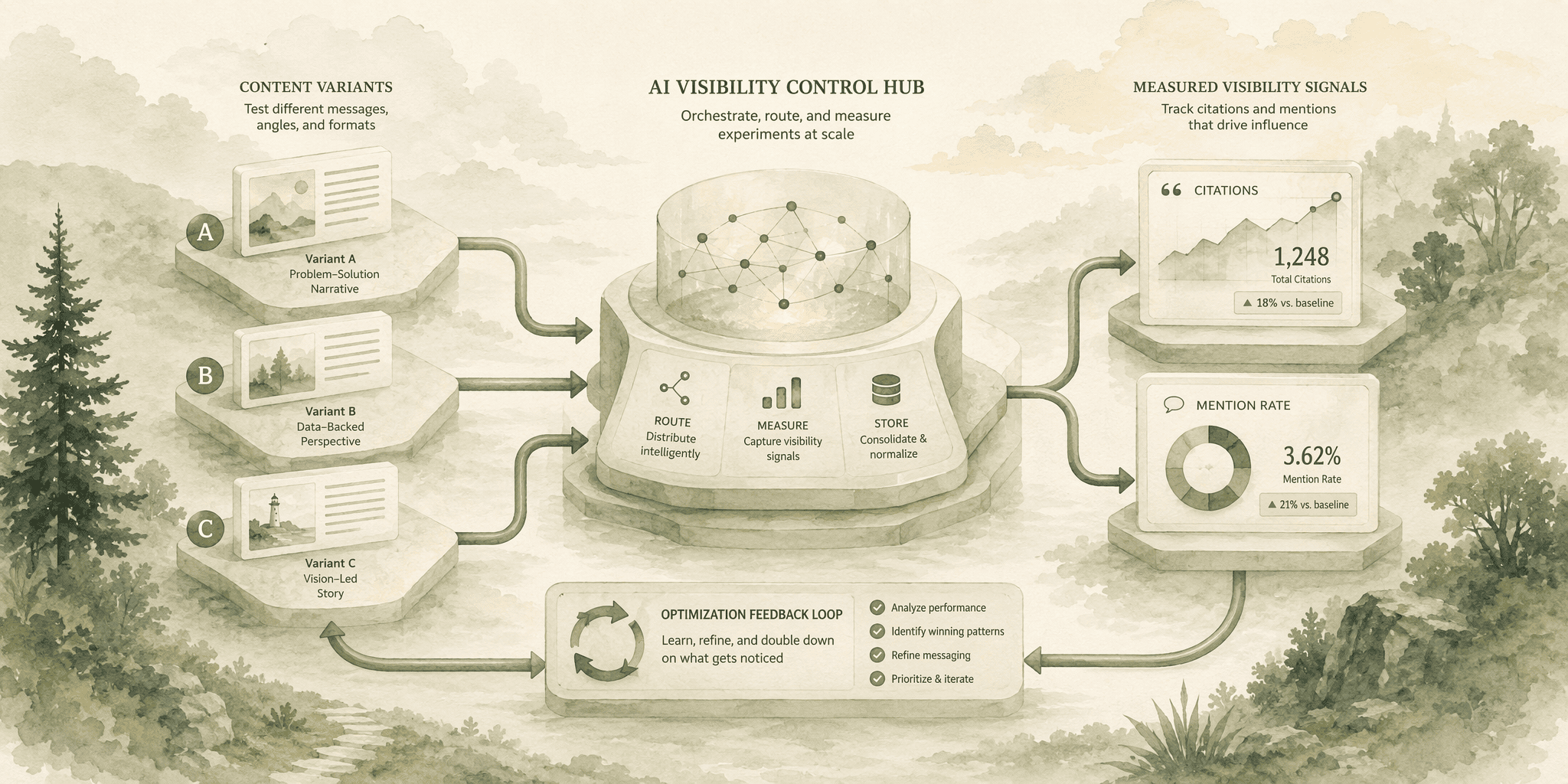
AirOps layers structured experimentation and workflow automation on top of AI citation data, moving beyond passive monitoring toward active optimization. The platform measures mention rate and citation rate across ChatGPT, Perplexity, and Google AI Overviews. What sets it apart is the testing framework. Enterprise teams can run controlled experiments on content variants to identify what shifts generative engine citations.
The platform provides API access for teams that need to pipe citation data into internal dashboards and data warehouses, alongside historical trending that reveals whether visibility gains are compounding over time or spiking and decaying. This capability addresses the core question that snapshot-based tools cannot answer: is your GEO investment producing durable visibility, or are you chasing one-off citation events? The workflow automation layer connects citation monitoring directly to content operations, closing the loop between measurement and action in a way that read-only monitoring tools cannot replicate.
Enterprise pricing ranges from $500 to over $2,000 per month depending on experimentation volume and API depth. Hard ROI data is not publicly available, and performance varies significantly by industry vertical and content maturity, so teams should run a bounded pilot before committing to an annual contract.
4. Manual Prompt Auditing, The Essential Non-Deterministic Reality Check
No dashboard replaces the blunt instrument of sitting down and querying the AI yourself. LLM responses are non-deterministic by design, varying across sessions, platforms, and even small changes in prompt phrasing. The divergence scales are substantial: in a controlled 602-prompt study, ChatGPT cited a mean of 6.88 sources per prompt while Perplexity cited 16.35, yet ChatGPT exhibited substantially higher average citation influence at 0.2713 versus Perplexity's 0.0646 among fetched pages. A tool reporting simple citation counts without influence weighting would mischaracterize where the real visibility lives.
Structured manual auditing means building a prompt library of approximately 20 to 50 queries that represent your brand's highest-stakes commercial topics and running them systematically across ChatGPT, Perplexity, and Google AI Overviews on a bi-weekly cadence. Track which URLs are cited, which competitor domains appear, and whether your brand surfaces in the synthesized answer (not just the citation list). Vary prompt phrasings intentionally: an informational framing like 'explain the trade-offs between X and Y' often surfaces different sources than a commercial framing like 'what is the best X for a mid-market team.' The finding that high-influence pages are longer, more modular, and more likely to contain extractable evidence such as definitions and numerical facts gives you a rubric for evaluating why certain competitor pages consistently appear while yours do not.
Manual auditing costs labor rather than SaaS spend, which makes it accessible to resource-constrained teams that cannot yet justify a dedicated monitoring platform. Its chief limitation is scalability: a bi-weekly audit of 50 prompts across three platforms produces 150 data points, which is directionally useful but cannot match the statistical confidence of tools tracking thousands of prompts continuously. The right operating model is to use manual auditing as a ground-truth validation layer that pressure-tests the numbers coming out of your paid monitoring tool.
5. DIY Attribution Stack, Tracking the Offsite Mention Flywheel

For teams that need to start tracking AI citations before securing budget for a dedicated platform, a composable attribution stack built from low-cost monitoring channels can deliver directional visibility. The architecture targets the reality that 85% of brand mentions in AI search originate on third-party domains, not your own website.
- Forum monitoring for consensus signals: Set up keyword alerts on Reddit, Quora, and niche community platforms where your category gets discussed. When a thread comparing vendors gains traction, it often feeds directly into the next round of AI training data and retrieval-augmented generation lookups.
- Publication and expert content tracking: Monitor the major publisher sites in your vertical for new articles citing your brand or category. These pieces function as high-authority source nodes that generative engines draw from repeatedly, compounding citation frequency over time.
- Free-tier tool sampling for ground truth: Use free plans from platforms like Siftly, whose free tools offer limited daily checks without requiring a credit card. Pair these spot-checks with manual audits to cross-validate what your alert-based monitoring picks up.
- Correlation mapping against organic traffic shifts: When a third-party mention surfaces and is subsequently cited in AI answers, watch for correlated movement in branded search volume and direct traffic. This triangulation provides a proxy signal for AI citation impact even without a direct attribution pipeline.
Conclusion
Tracking AI citations is a three-layer discipline: a monitoring tool to capture breadth, a manual auditing routine to validate depth, and an offsite mention monitoring system to map the third-party sources that drive visibility.
The implementation sequence follows organizational maturity. Phase one, foundation, deploys a DIY attribution stack and bi-weekly manual prompt auditing to establish a citation baseline at near-zero cash cost. Phase two, scaling, layers in a purpose-built monitoring platform at the starter to mid-market tier once the baseline data justifies the spend. Phase three, optimization, adds enterprise-scale experimentation and API-driven data pipelines when the volume of AI-referred traffic warrants dedicated workflow investment.
The brands that win inside generative answers will be the ones that treat citation tracking not as a one-time audit but as an ongoing operational cadence.
Frequently Asked Questions
What tools and platforms can track how often a brand or URL gets cited in ChatGPT, Perplexity, and Google AI Overviews?
Purpose-built platforms including Siftly, OtterlyAI, and AirOps track brand citation frequency and mention rate across ChatGPT, Perplexity, and Google AI Overviews. Siftly consolidates multi-platform monitoring into one dashboard; OtterlyAI emphasizes longitudinal citation-rate tracking; AirOps layers experimentation workflows on top of enterprise-scale visibility measurement.
How does AI citation tracking work, and what signals do tools use to measure visibility in generative engines?
AI citation tracking tools issue queries to generative engines and parse the responses for brand mentions, URL citations, and answer-level contributions. Unlike traditional SEO tools that rely on hyperlink graphs, these platforms monitor raw text semantics, measuring citation frequency, resurfacing rate, and the source domains that generative engines draw from when synthesizing answers.
How reliable are AI citation measurements given that AI responses are non-deterministic and vary by session?
Single-prompt snapshots are unreliable because LLM responses vary across sessions, platforms, and prompt phrasing. Reliable measurement requires repeated sampling over time, which is why platforms emphasizing longitudinal data rather than one-off checks are more representative, and why manual prompt auditing remains a necessary ground-truth validation layer alongside any paid tool.
What metrics matter when measuring ROI from generative AI visibility, and how do they connect from citation to revenue?
Mention velocity, topic cluster density, and resurfacing frequency are the leading metrics platforms track. Brands earning both citations and mentions are 40% more likely to reappear across AI answers, but no platform currently offers a validated citations-to-revenue attribution model. AI-referred click tracking provides a directional proxy for commercial impact.
How much does an AI citation tracking tool cost, and what features differentiate free, starter, and enterprise tiers?
Free plans typically offer limited daily checks. Pricing for AI citation tracking tools generally breaks down into these tiers:
- Starter tiers: cost approximately $100 to 300 per month with multi-platform monitoring.
- Enterprise tiers: range from $500 to over $2,000 per month and include historical trending, competitive benchmarking, API access, and experimentation frameworks.
- Pricing changes frequently and should be verified on each vendor's current site.
Why can't I just use Google Search Console or GA4 to track citations from ChatGPT, AI Overviews, or Perplexity?
Google Search Console and GA4 were built to track hyperlink-based search and page-level referral traffic. LLMs process raw text semantics, not hyperlink graphs, meaning AI-cited pages do not generate a traditional referral event that those tools can capture. 85% of brand mentions in AI search also originate on third-party domains outside your analytics perimeter.
Sources
- From Citation Selection to Citation Absorption: A Measurement Framework for Generative Engine Optimization Across AI Search Platforms - arxiv.org
- GEO: Generative Engine Optimization | Proceedings of the 30th ACM SIGKDD Conference on Knowledge Discovery and Data Mining - dl.acm.org
- AEO Tools Guide 2026: 9 Best Answer Engine ... - www.tryprofound.com
- How Offsite Brand Mentions Compound to Drive AI Citations Over Time - www.airops.com
Keep exploring
More from the blog.

Oct 15, 2026
Best Ahrefs Alternatives for Tracking AI Visibility in 2026
Your SEO dashboard says organic traffic is holding steady, but your brand mentions in ChatGPT are plummeting and you would never know it. Ahrefs Brand Radar

Oct 15, 2026
Siftly Alternatives for Tracking AI Visibility in 2026
Your brand gets praised all day in ChatGPT and Perplexity, until it doesn't. One model update, one new competitor content push

Oct 14, 2026
9 Best Marketing Software Platforms for Lean Support Teams in 2026
Your lean marketing team is running campaigns, analyzing data, and responding to a flood of customer questions across email, chat, and social media