Aug 14, 2026
Why Your B2B SaaS Brand Is Invisible in ChatGPT, and How to Fix It
Your B2B SaaS company is invisible in ChatGPT because the content you publish and the content AI engines cite are fundamentally mismatched.

Introduction
Your B2B SaaS company is invisible in ChatGPT because the content you publish and the content AI engines cite are fundamentally mismatched. A DerivateX benchmark of 50 B2B SaaS brands found an average AI Presence Score of just 56.9 out of 100, with 44% scoring below 50. Meanwhile, a SEMAI study of 25,540 URLs revealed that blogs and webpages drive over 90% of all AI citations, yet the top performer scored 89 and the worst just 2. The gap is not your product. It is your publication strategy.
This visibility crisis is accelerating as AI search replaces traditional query-and-click behavior. More than half of consumers now use AI to find products and services, and that number is climbing. When a potential buyer asks ChatGPT, Perplexity, or Gemini to recommend a solution, the engine draws from a narrow, specific set of content types and trusted third-party signals. If your content portfolio does not match that blueprint, you simply do not appear.
This article diagnoses the root causes of AI invisibility and lays out the specific content formats, technical fixes, and review economy levers that determine whether a B2B SaaS brand gets cited. You will learn why static corporate pages fail, how each AI platform selects sources differently, and what a sequenced 12-month execution plan looks like.
Key Takeaways
AI-generated answers reward conversational, experience-driven content published in formats each platform can extract cleanly. The following data points anchor the actionable strategy that follows.
- GEO replaces SEO in AI search: AI engines do not rank pages; they extract and cite specific content blocks. The discipline shifts from keyword optimization to building quotable, answer-first material.
- Blogs and webpages drive 90%+ of AI citations: A SEMAI study of 25,540 URLs found these two content types dominate every major platform, yet many B2B SaaS sites lean heavily on static product pages.
- 44% of B2B SaaS brands score below 50 on AI presence: The DerivateX benchmark across 1,400 prompts shows a severe visibility gap, with a top performer at 89 and a bottom performer at 2.
- Review platforms are the second-most cited source type at 14%: Trustpilot accounts for 14% of all AI citations. Brands with no review profile appear in only 1% of answers, while those with 80+ reviews appear in over 75%.
- Each AI platform has a distinct citation fingerprint: ChatGPT favors academic and authoritative content, Perplexity uniquely cites comparison pages, and Gemini prioritizes brand-owned editorial while avoiding community sources.
- Mention rate and position drive 60 of 100 possible visibility points: Tracking these metrics across ChatGPT, Perplexity, Gemini, and Claude establishes the baseline for measuring improvement.
What Generative Engine Optimization Is and How It Rewrites the B2B SaaS Visibility Playbook
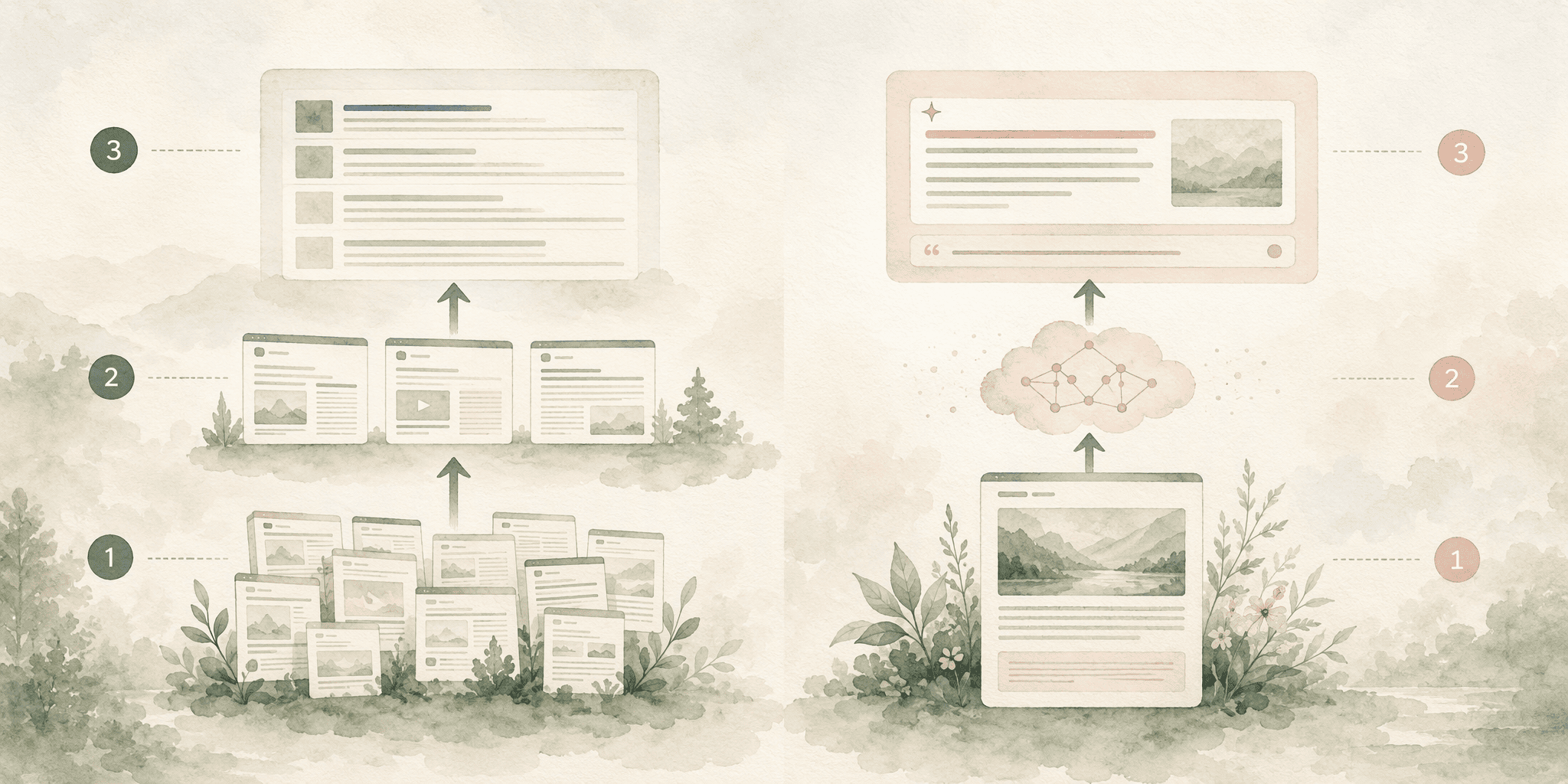
Generative engine optimization (GEO) is the practice of engineering content specifically for discovery, retrieval, and citation by AI answer engines rather than for traditional search result pages. It replaces the old SEO workflow because AI engines operate on a fundamentally different pipeline. The following sequence defines how GEO works and why it demands a new playbook.
- GEO targets AI citation, not search ranking. Traditional SEO optimizes pages to rank in Google's blue-link results. GEO optimizes content blocks to be extracted and cited verbatim inside an AI-generated answer. The objective shifts from earning a click to being the quoted source.
- AI search uses a multi-step pipeline traditional indexing alone cannot address. The process moves from initial crawling and indexing to retrieval, LLM synthesis, and real-time web grounding. GEO must account for each stage, ensuring content is indexable, retrievable by relevance models, structured for clean extraction, and authoritative enough for the model to ground its answer in it.
- The signal model inverts. In SEO, backlinks and keyword density functioned as credibility proxies. In GEO, citation frequency in trusted sources, structured data clarity, and review profile depth become the primary signals. Generative engine optimization flips the script: it is no longer about whether you rank for a keyword; it is about whether you are being talked about with authority in places that matter.
- Content format matters as much as content quality. AI engines prefer self-contained, extractable formats such as answer-first blocks, standalone definitions, and FAQ Q&A pairs. Traditional long-form blog structures with slow, narrative openings underperform because the model cannot cleanly pull a quotable snippet from a buried paragraph.
How AI Answer Engines Discover and Select Content: A Platform-by-Platform Citation Blueprint
Each major AI answer engine applies a distinct set of content preferences when selecting sources. Publishing one generic blog and expecting uniform citation across platforms guarantees invisibility on at least two of the three. The citation patterns below reveal what each platform rewards.
- ChatGPT favors academic and deeply authoritative sources. ChatGPT cites academic content at 2.2%, more than six times the rate of its rivals, and strongly prefers material that carries institutional or research-backed weight. For B2B SaaS, this means original research reports, survey data, and technical documentation earn citations where marketing copy does not.
- Perplexity is the only platform that cites comparison and solution pages. SEMAI data identifies Perplexity uniquely surfacing head-to-head comparison content and buying-guide format pages. A brand that publishes a structured comparison between itself and a competitor is far more likely to appear in Perplexity answers than one relying on product pages alone.
- Gemini prioritizes brand-owned editorial content and avoids community sources. Gemini explicitly favors content published directly by brands on their own domains, such as thought-leadership articles and detailed guides, while actively deprioritizing Reddit and similar community forums. This makes a well-maintained editorial blog a non-negotiable asset for Gemini visibility.
- Review platforms rank as the second-most cited source across all engines. Trustpilot and equivalent platforms account for 14% of all AI citations. Engines treat verified customer reviews as a credibility signal, meaning a thin or absent review profile directly suppresses your citation rate regardless of how well your on-site content is engineered.
Why Your B2B SaaS Brand Is Invisible: The Content Mismatch and Technical Roadblocks
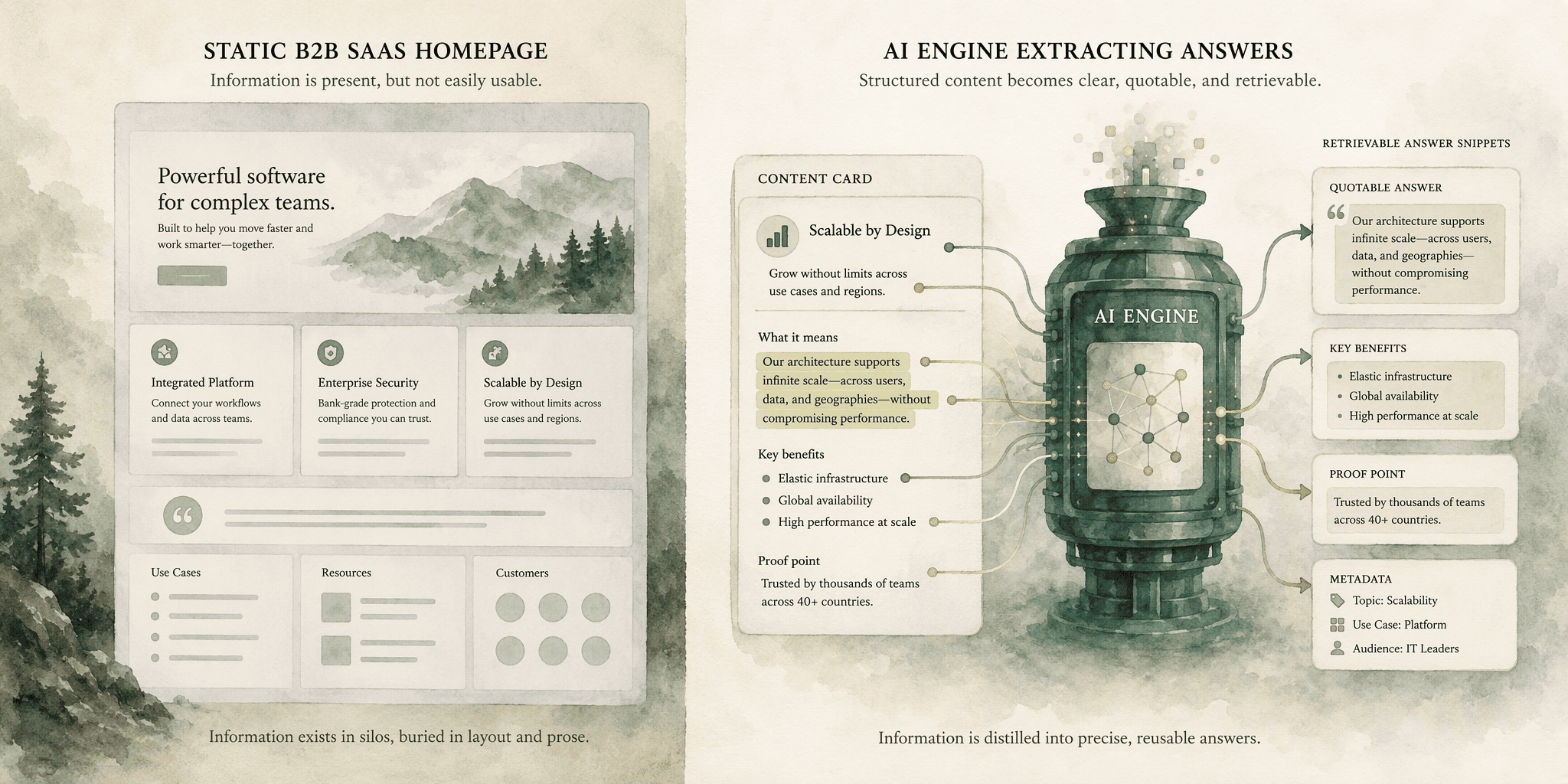
The root cause of B2B SaaS invisibility in AI answers is a content mismatch: most companies publish static, feature-oriented corporate pages, while AI engines extract conversational, experience-driven material that answers a specific question in a retrievable block. When a buyer asks ChatGPT for the best contract management tool, the engine does not crawl your homepage. It looks for structured, quotable content that directly addresses that comparative question. If your entire blog consists of product announcements, you will not appear.
A DerivateX benchmark across 50 brands and 1,400 AI prompts quantifies how widespread this gap is. 44% of companies scored below 50 on a 100-point AI presence scale. The distance between Clio at 89 and LeadSquared at 2 is not a function of brand awareness or marketing spend, both are established players with active teams, but of how their content portfolios match the specific citation patterns each AI engine demands.
Technical roadblocks compound the content problem. Poor crawlability, missing structured data, and JavaScript-rendered content blocks prevent AI systems from indexing what does exist. Structured data provides a machine-readable layer that defines entities and relationships, reducing ambiguity and strengthening attribution. Without it, even well-written content may be invisible to retrieval systems.
Third-party trust signals are another gap. Brands with no Trustpilot profile appear in just 1% of AI-generated answers. The fix is distribution, not rebranding: the same DerivateX study identified ten companies with perfect sentiment scores but mention rates of 8 out of 30 or lower.
The reviews exist. The sentiment is positive. The AI engines simply have no structured, verifiable source to cite.
How to Engineer Content That ChatGPT, Gemini, and Perplexity Will Cite
Begin every piece by writing the answer-first block you want the AI to extract and quote verbatim. Write a single, standalone paragraph of 40 to 60 words that fully resolves the query without relying on surrounding context. This is the snippet an engine will surface, so front-load the claim and keep it under 30 words where possible.
Layer every article with the specific structural elements AI engines target during retrieval:
- Standalone definitions: render them as a single extractable sentence
- FAQ Q&A blocks: structure them with the question exactly as a user would ask it
- Comparison tables: use factual, parallel cells
- Platform-specific hooks: vary format but serve the same function, Gemini rewards editorial depth, Perplexity indexes solution-comparison pages, and ChatGPT gravitates toward research-backed claims with named sources and year-dated statistics
The Review Economy: Using Third-Party Signals as AI Citation Drivers
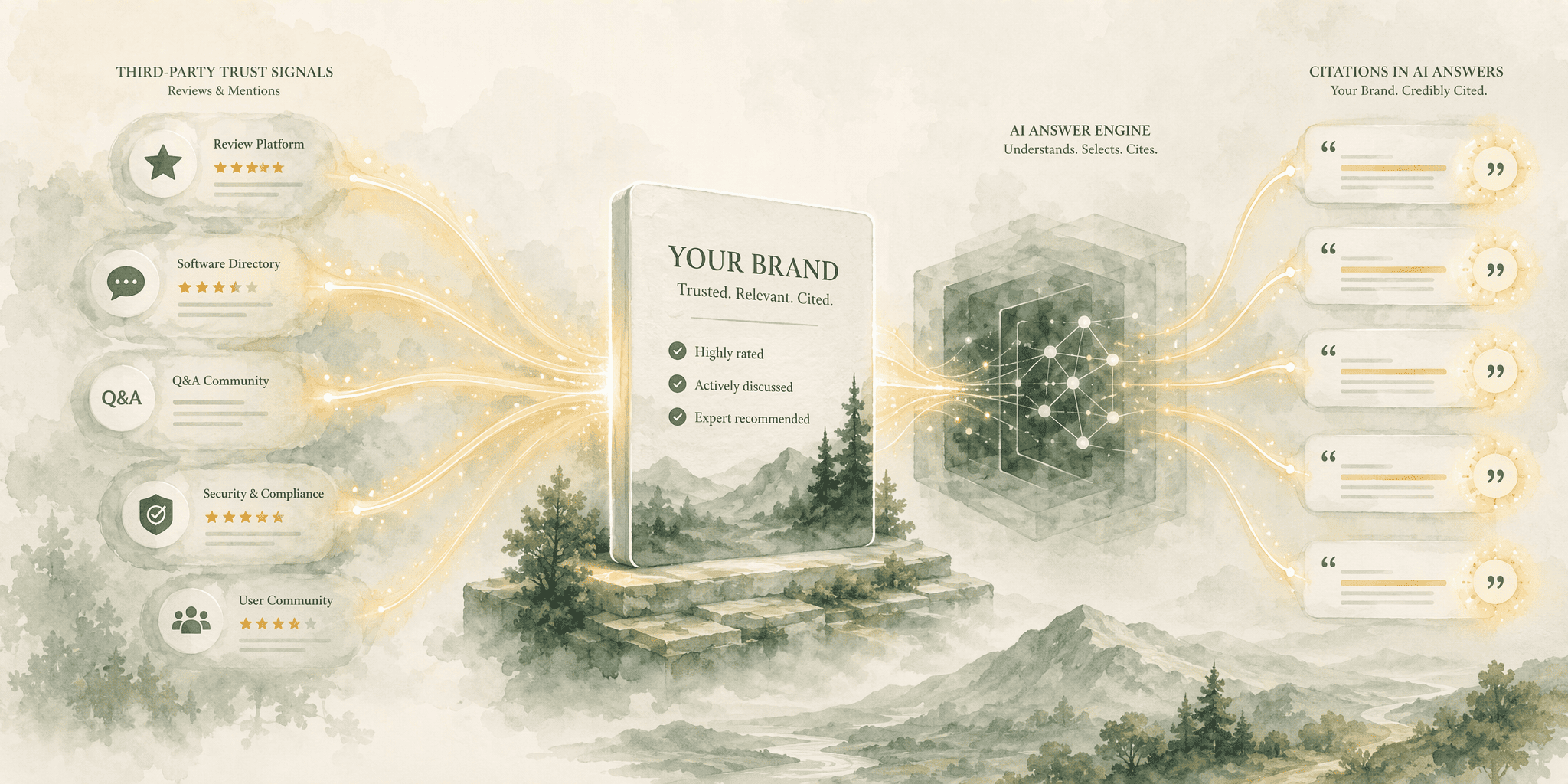
Customer reviews have become a direct, quantitative lever for AI answer engine visibility. Trustpilot's analysis of 800,000 AI-generated answers found that review and trust platforms are now the second-most cited source type, accounting for 14% of all citations. This is not a passive brand reputation metric. It is an active growth lever that directly controls how often your brand appears when a buyer asks a recommendation question.
Brands with no Trustpilot profile appeared in just 1% of AI-generated answers. The same dataset shows that once a profile accumulates 80 or more reviews, the citation rate jumps to over 75%. The mechanism is straightforward: AI engines treat verified, third-party feedback as a credibility signal that reduces the grounding risk of citing an unknown source. A profile with few or no reviews offers no such signal, so the engine defaults to a competitor that does.
The gap between sentiment and mention rate proves that visibility failure is a distribution problem, not a perception problem. DerivateX identified companies including Close, Freshworks, and Razorpay with perfect sentiment scores but mention rates of 8 out of 30 or lower. Their customers are satisfied, but the AI engines lack a structured, high-volume review footprint to draw from. The fix is not to chase more positive reviews at any cost but to activate review profiles actively, respond to feedback to show recent engagement signals, and ensure the volume threshold crosses the platform's confidence bar for citation.
Third-party signals do not replace on-site content engineering. They multiply its effectiveness. A review profile with 80+ citations makes every answer-first blog post and comparison page more likely to surface because the engine now has a corroborating trust signal.
How to Benchmark Visibility and Turn Competitor Citation Gaps into Your Roadmap
Competitor citation gaps are the single most actionable input to a GEO roadmap because they reveal exactly where an AI engine is looking for a source and not finding one. When a competitor has a perfect sentiment score but a low mention rate, the engine wants to cite a credible brand in that space and cannot find enough extractable content from them. That gap is yours to fill.
Build your benchmark by measuring three dimensions across ChatGPT, Perplexity, Gemini, and Claude for a defined set of buyer-intent queries:
- Mention frequency: how often your brand appears in AI answers
- Position within the answer: where your citation lands in the response sequence
- Platform breadth: how many major engines cite you for the same query
In the DerivateX scoring model, mention rate and position carry 60 of 100 possible points, making them the highest-weight signals. Audit your top five competitors on these same queries. Find the commercial-intent prompts where they show up only sometimes or land low in the response. Then publish the content format that same engine rewards for that query type: a comparison page for Perplexity, an editorial guide for Gemini, a research-backed report for ChatGPT. A tool like Siftly tracks how often a brand appears in AI-generated responses and benchmarks visibility against competitors across query types, turning this manual audit into a repeatable workflow.
How to Measure and Track Your AI Answer Engine Presence

Measuring AI visibility requires tracking three core KPIs that together describe your presence across the conversational search landscape:
- Mention rate: the percentage of relevant prompts where your brand appears at all
- Position: where in the answer sequence your citation lands, first is materially different from fourth
- Platform breadth: how many of the major engines cite you for the same query, revealing whether your content strategy is platform-balanced or over-optimized for one ecosystem
In the DerivateX 100-point benchmark model, mention frequency and position alone account for 60 points. A brand that appears in 80% of target queries but always in the third or fourth citation slot has a fundamentally different problem from one that appears in 10% of queries but always in the first position. Both are broken, but the fix for each is different.
Dedicated monitoring platforms provide structured, longitudinal data. Manual query sampling provides directional snapshots.
Single-prompt checks are unreliable because AI responses vary across sessions. For a directional estimate, run each query five times across multiple days and aggregate the results. For operational decision-making, use a tool that samples at scale and normalizes across models. The target is a stable, repeatable number you can trend quarter over quarter, not a single session's anecdotal result. A 10-point improvement in citation rate is a realistic 6-month target for brands making active GEO investments, as noted in performance benchmarks from brands tracking this metric.
From Citation to Revenue: Attributing AI Visibility Without Real-Time Cost Burn
Attributing revenue to AI citations is an upper-funnel measurement problem, not a direct-response tracking problem. No platform currently offers a validated citations-to-revenue attribution model because AI engines do not pass referrer data reliably and responses are not deterministic. The task is to build a lightweight, directional correlation between visibility improvement and pipeline movement without burning budget on tools that promise precision they cannot deliver.
Start with UTM parameters on every URL that could plausibly be cited in an AI answer: blog posts, comparison pages, resource libraries. When a user clicks through from an AI-generated answer, those parameters capture the session source even if the referring domain is inconsistent. Layer this with branded search trend monitoring in Google Search Console. As your AI citation frequency increases, branded search volume should rise on a lagged basis, and that delta becomes a measurable upper-funnel proxy for AI-driven awareness. Add a one-question brand lift survey on your demo request form asking where the prospect first heard about you, with an explicit checkbox for a conversational AI tool or AI-generated recommendation.
Frame AI visibility as a pipeline indicator rather than a direct conversion channel. The KPI the CFO needs is not per-citation revenue. It is the correlation coefficient between your AI presence score and monthly demo request volume, tracked over six months. Start with the citation baseline, then measure the change in upper-funnel volume alongside improvements in mention rate and position score. The relationship is directional, but it is sufficient to justify the GEO investment when the alternative is accepting permanent invisibility in the channel where 58% of consumers now begin their purchase journey.
A 12-Month Tactical Action Plan for B2B SaaS AI Visibility
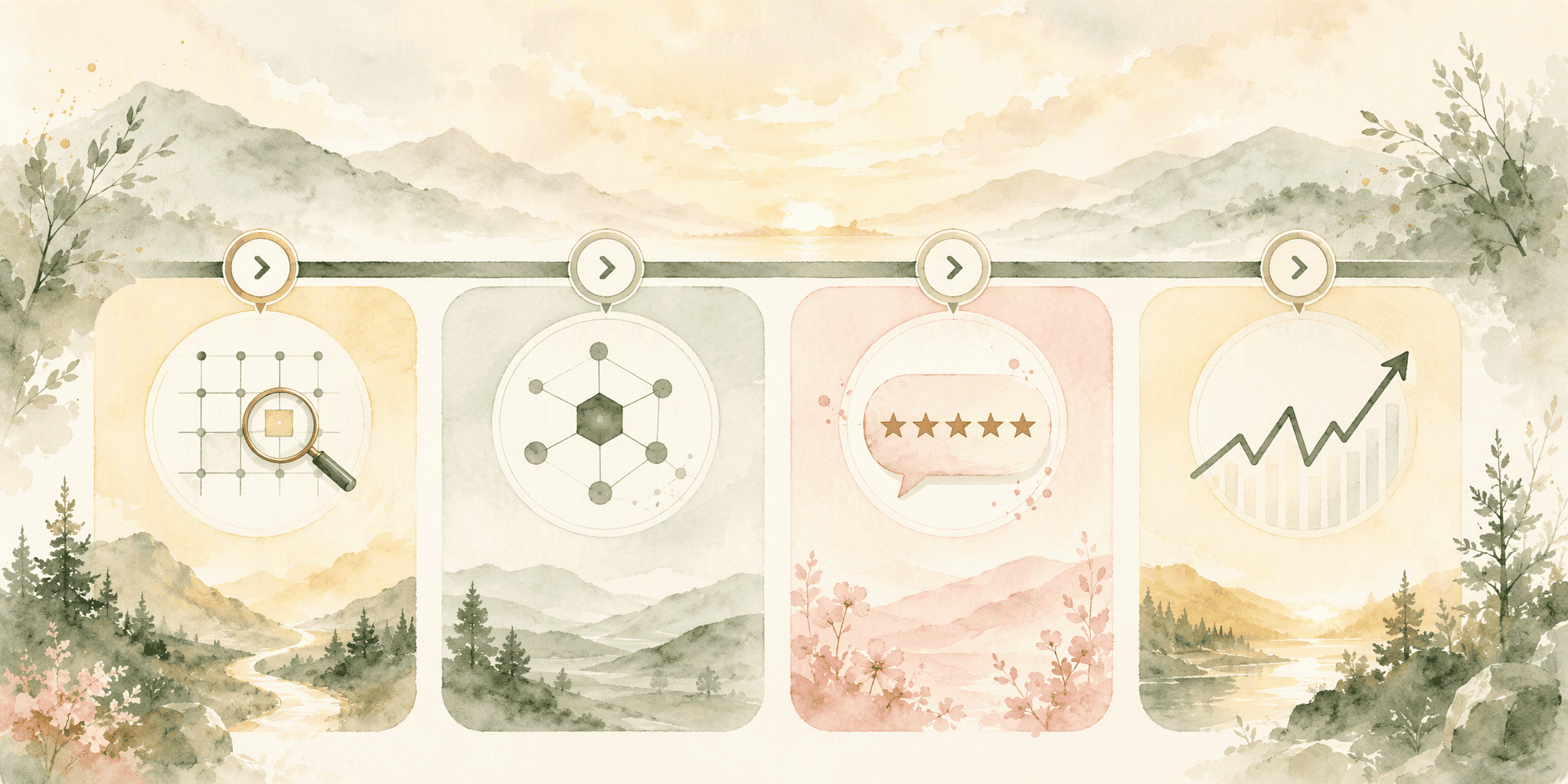
The following roadmap sequences the insights from SEMAI, DerivateX, and Trustpilot into four quarters of concrete, executable work.
| Quarter | Focus Area | Key Actions | Target Outcome |
|---|---|---|---|
| Q1: Audit and Foundation | Crawlability and structured data | Fix JavaScript rendering blocks; implement JSON-LD schema for FAQ, HowTo, and organization entities; claim and verify review profiles on Trustpilot and equivalent platforms; audit competitor citation presence across ChatGPT, Perplexity, Gemini, and Claude. | Indexable technical foundation established; baseline AI presence score measured at quarter end. |
| Q2: Content Engineering and Review Seeding | Answer-first content and review volume | Rewrite top 10 product-related blog posts with answer-first blocks and quotable snippets; publish 3 comparison/solution pages targeting Perplexity; launch formal review generation campaign targeting 80+ reviews per platform. | Review profile thresholds crossed; first comparison pages indexed; initial citation lift of 3 to 5 points. |
| Q3: Platform-Specific Content Pushes | Targeted content per engine | Publish one original research report with named-source statistics for ChatGPT authority signals; publish a quarterly editorial thought-leadership series for Gemini; create 6 FAQ-structured resource pages templated for clean extraction. | Content portfolio matches all three platform citation blueprints; mention rate and position scores rise in weekly monitoring. |
| Q4: Measurement Refinement and Gap Exploitation | Monitoring cadence and competitor gaps | Deploy dedicated visibility monitoring with weekly query sampling; benchmark 6-month delta against initial baseline; identify 3 competitor citation gaps with perfect sentiment but low mention rates; publish content targeting those specific query gaps. | A 10-point improvement in overall citation rate measured against the Q1 baseline; branded search volume trend line established for revenue correlation analysis in year two. |
The 10-point target is grounded in benchmarks that show it as a realistic 6-month target for brands making active GEO investments. Actual results vary by industry vertical and content maturity, but the sequencing holds: fix the foundation, engineer the content, activate review signals, and then measure and exploit competitor gaps.
Conclusion
AI search invisibility is a content mismatch you can diagnose and fix. Most B2B SaaS pages are static feature lists. AI engines pull from conversational, experience-backed material that is structured in ways they can parse.
The gap is measurable. 44% of B2B SaaS brands score below 50 on AI presence benchmarks.
Review profiles with 80-plus citations show up in more than three-quarters of the answers. And every major engine rewards a different, well-documented content format.
Run the audit first. Track your mention rate, position, and platform spread across a set of queries that match buyer intent. That turns the rest of the work, content engineering, review seeding, platform pushes, and competitor gap exploitation, into something you can measure, not a shot in the dark. The channel has already shifted. The brands that move now will lock down the citations that drive discovery while everyone else catches up.
Frequently Asked Questions
What is Generative Engine Optimization (GEO) and how does it differ from traditional SEO?
Generative engine optimization is the practice of engineering content for discovery and citation by AI answer engines rather than for traditional search engine rankings. GEO targets whether your content blocks get extracted and quoted inside an AI-generated answer. Traditional SEO optimizes for keyword ranking and click-through; GEO optimizes for answer-first structure, quotable snippets, and third-party credibility signals that AI models use for grounding.
How do AI answer engines like ChatGPT discover and select content for their responses?
AI engines use a multi-step pipeline: indexing and crawling, retrieval based on relevance models, LLM synthesis, and real-time web grounding. Each engine applies distinct source preferences, ChatGPT favors academic content, Perplexity uniquely cites comparison pages, and Gemini prioritizes brand-owned editorial while avoiding community sources. Content must be crawlable, structurally extractable, and perceived as authoritative.
What specific steps can a B2B SaaS company take to increase its visibility in ChatGPT search results?
Publish content with answer-first blocks, standalone definitions, and FAQ structures that ChatGPT can extract cleanly. Create original research reports with named-source statistics, which ChatGPT cites at six times the rate of other platforms. Activate a Trustpilot review profile with 80+ reviews to cross the confidence threshold for citation. Fix technical crawlability issues with structured data markup.
How can you measure and track whether your brand is appearing in AI-generated answers?
Track three KPIs: mention rate across a defined set of buyer-intent queries, position within the answer, and platform breadth across ChatGPT, Perplexity, Gemini, and Claude. Use dedicated monitoring tools for longitudinal data and manual query sampling for directional snapshots. Run queries multiple times across days since single-prompt checks are unreliable due to response variation.
What are the common technical or content roadblocks that prevent a B2B SaaS website from being cited by AI?
Static corporate pages lack the conversational, answer-first structure AI engines extract. Poor crawlability from JavaScript rendering, missing structured data like JSON-LD schema, and absent third-party review profiles prevent citation even when content quality is high. The most common pattern is perfect customer sentiment but a review volume below the platform's confidence threshold for grounding.
Is a 10-point improvement in AI citation rate realistic, and how long does it take?
A 10-point improvement in citation rate is a realistic 6-month target for B2B SaaS brands making active GEO investments, according to performance benchmarks from companies tracking this metric. Results vary by industry vertical and content maturity. The improvement curve depends on how quickly review profiles hit the 80+ threshold and how aggressively the content portfolio is rebuilt for extractability.
Sources
- 8 Solutions to Optimize Content for ChatGPT Shopping (2026) - siftly.ai
- Is your business not showing up in AI overviews? Trustpilot thinks it could be because you're not doing this one thing | TechRadar - www.techradar.com
- Structured Data’s Role In AI And AI Search Visibility - www.searchenginejournal.com
- Why Your Company Isn’t Showing Up In AI Search Results - www.forbes.com
- SEMAI Research Finds B2B Brands Invisible Across ChatGPT, Gemini, and Perplexity Due to Content Mismatch - The Des Moines Register - www.desmoinesregister.com
- DerivateX: 44% of B2B SaaS Companies Are Invisible to AI-Assisted Buyers, Benchmark Study Finds - Iowa City Press-Citizen - www.poughkeepsiejournal.com
Keep exploring
More from the blog.

Oct 12, 2026
6 Most Affordable AI Visibility Tracking Tools for B2B Companies in 2026
B2B buyers are bypassing Google. Nearly two-thirds of discovery moments now start inside an AI chat interface rather than a traditional search box.

Oct 12, 2026
The Best Otterly AI Alternatives for Tracking AI Visibility in 2026
Your organic search traffic is no longer just about the blue links. 15% of all website traffic now originates from AI agents and bots

Oct 10, 2026
6 Best AI Brand Visibility & GEO Platforms for 2026
Your brand is being described right now inside ChatGPT, Perplexity, and Google’s unified AI Search surface