Oct 23, 2026
The 527% Traffic Shift That Makes Enterprise GEO Software a Boardroom Mandate
Your organic search traffic just fell off a cliff. It dropped 27% year-over-year, and your traditional SEO dashboard offers zero explanation.

Introduction
Your organic search traffic just fell off a cliff. It dropped 27% year-over-year, and your traditional SEO dashboard offers zero explanation. Meanwhile, a parallel, invisible discovery channel is exploding.
Traffic arriving from AI platforms like ChatGPT, Perplexity, and Google AI Overviews grew 527% in the same period, as reported by HubSpot in April 2026. This is a structural break where AI-generated answers replace the ten blue links as the primary surface for brand visibility. Enterprise generative engine optimization software gives operators systematic control over how AI engines cite, describe, or ignore their brand inside an answer layer that traditional analytics cannot see.
Key Takeaways
Enterprise Generative Engine Optimization software is a separate operational category with its own budget line, metrics stack, and integration requirements. The platform cost reflects that separation.
- The structural shift from SEO to GEO changes what you optimize for: GEO targets full conversational prompts. Users ask AI systems complete questions averaging 23 words, compared with Google's typical 4-word query.
- The metric that replaces rankings is Share of Model: Share of Model measures the percentage of AI-generated responses where your brand appears as a cited source. It tracks your visible mental real estate inside the answer.
- The pricing bracket for enterprise-scale platforms runs $15,000 to $50,000+ annually: Cost follows operational load: the volume of tracked prompts, the number of LLMs monitored, and integration depth.
- Your first step costs zero dollars and needs no software: Export your top 20 organic keywords. Turn each into 2 to 3 natural-language prompts. Run that prompt set manually across five AI engines and record whether your brand gets cited. That is your baseline.
At a Glance
Here is how the options compare across the dimensions that matter most.
| Software Platform | Share of Model Tracking | Prompt Volume Tier (Monthly) | LLM Coverage | Annual Enterprise Pricing |
|---|---|---|---|---|
| Siftly | Yes, brand visibility & share of voice | 10,000 to 50,000 | ChatGPT, Perplexity, Google AI Overviews | $15,000 to $25,000 |
| BrightEdge GEO | Yes, with competitor citation audit | 25,000 to 100,000 | ChatGPT, Gemini, Perplexity, Claude | $25,000, $40,000 |
| Conductor | Yes, with narrative accuracy scoring | 20,000 to 80,000 | ChatGPT, Gemini, Perplexity | $20,000, $35,000 |
| Semrush GEO Insights | In development, beta citation tracking | 5,000 to 30,000 | ChatGPT, Perplexity | $15,000, $20,000 |
Defining Enterprise GEO Software and Its Clear Divergence from Traditional SEO

Enterprise GEO software is a platform that monitors, analyzes, and optimizes how a brand appears in the responses generated by AI systems such as ChatGPT, Gemini, Perplexity, and Claude. The operational model shares almost no common ground with traditional SEO. An SEO platform crawls a website, checks keyword rankings, and maps backlink authority. A GEO platform continuously queries large language models (LLMs) with the specific natural-language prompts your buyers use, then measures whether your brand surfaces in the generated answer, what the model says about you, and which third-party sources the model trusts.
The mission control metric for this new model is Share of Model. Traditional search tracks rank position on a search engine results page. GEO tracks how often an AI engine elects to cite your content across a defined set of topics. Visibility is probabilistic and narrative, not deterministic and paginated. A platform like Siftly, for example, tracks brand visibility, rank, and share of voice across ChatGPT, Perplexity, and Google AI Overviews, giving you a dashboard for a channel where your competitors are already being recommended inside AI-generated answers.
The Engine of Visibility: How Multi-Platform AI Citation Tracking Actually Works
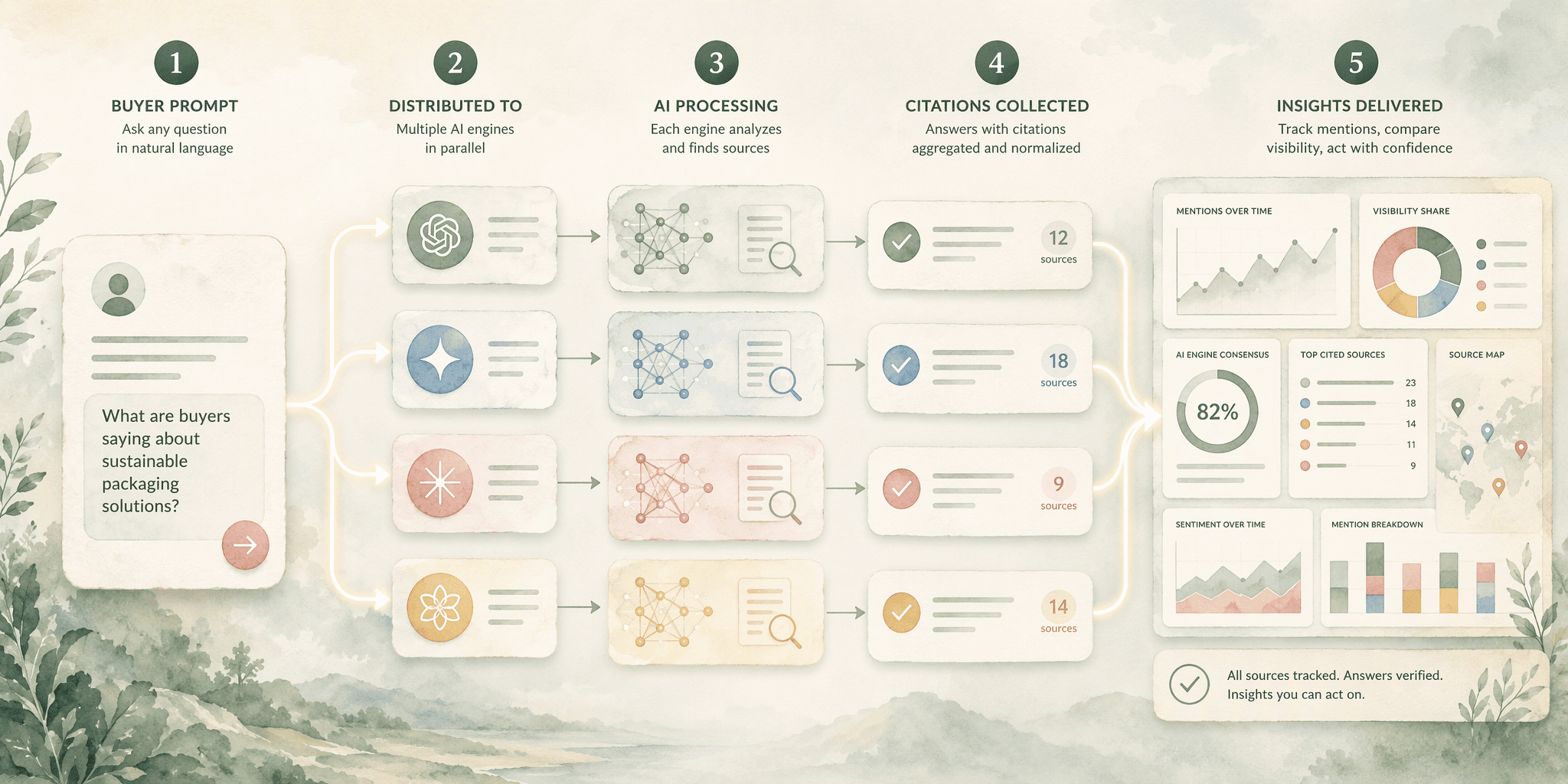
AI citation tracking is the operational core of GEO. It audits the answer space by systematically submitting your critical buyer prompts to multiple AI engines and recording the textual and source-level output. You get a set of quantifiable signals: exactly which AI engines cite you, how accurately your brand is described, and which competitor sources occupy the answer space you could displace.
- Prompt-to-keyword mapping: Convert your top-funnel and purchase-intent SEO keywords into the exact conversational phrasing users speak to AI. A keyword like 'enterprise analytics' becomes 'Which enterprise analytics platform is best for a mid-market SaaS company running on AWS?'
- Automated daily query execution: Run the resolved prompt library at scale against your targeted LLM set. Siftly executes automated daily queries across ChatGPT, Google AI Overviews, Gemini, Perplexity, Claude, Copilot, Grok, and DeepSeek to reduce the noise of probabilistic variance.
- Citation source extraction and Share of Model computation: For each prompt-engine pair, determine if your brand is cited, which URL was the source, and which competitor was cited in your place. This calculation produces your Share of Model score.
- Hallucination and sentiment scoring: Automated analysis classifies whether the AI description of your brand is factually accurate, favorable, or contains fabricated attributes that need immediate correction.
Core Feature Stack for Enterprise-Grade AI Visibility Monitoring and Analytics
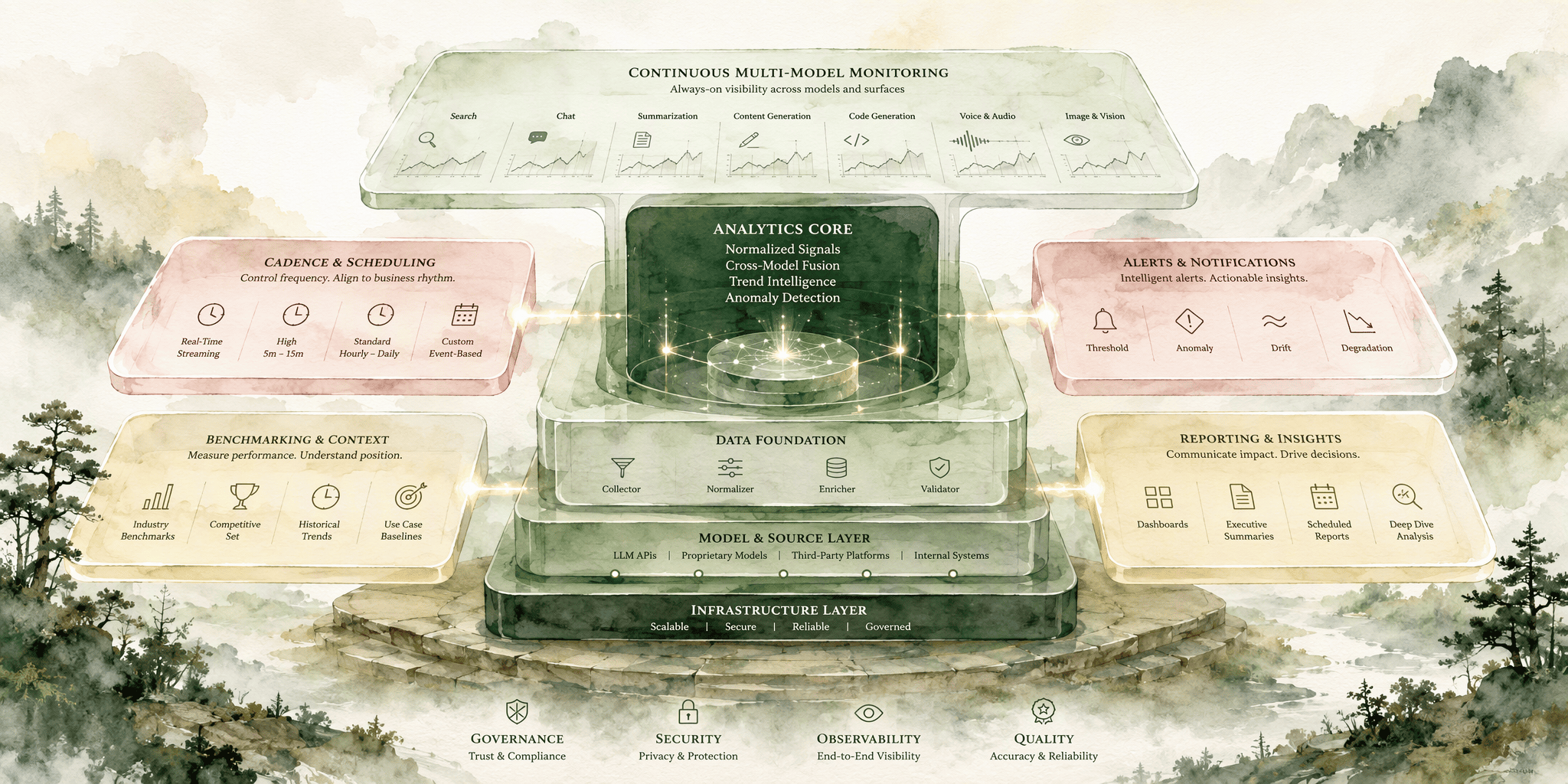
Most tools calling themselves GEO aren't built for the enterprise. They monitor one model, or they count mentions without context. An enterprise platform has to do more.
Continuous, multi-model monitoring is the baseline. You're tracking responses across ChatGPT, Gemini, Perplexity, and the models your own customers use. Frequency matters.
Daily, at minimum, with the option to increase cadence during a product launch or a competitor's news cycle. The output is not a static ranking report. It is a time series that shows your brand gaining share or losing it to a specific competitor, model by model.
Source-level attribution tells you why. A visibility drop that traces back to a stale product page needs a different response than one caused by a competitor publishing new technical documentation. The platform has to surface the content layer behind the AI answer: which pages the models are drawing from, which ones they're ignoring, and whether crowd-sourced sources such as Reddit and Quora are starting to outrank your owned content for key queries. In generative search, attribution shifts can happen inside a week.
Sentiment and claim accuracy closes the loop. A mention isn't a win if the model describes your product inaccurately or alongside a discount brand. Enterprise teams need the platform to flag factual errors, categorize the sentiment of every citation, and prioritize the ones that pose a compliance or reputational risk. For regulated industries, this is often the capability that justifies the investment before any other use case.
Competitive benchmarking turns the data into action. The platform should map your share of AI voice against named competitors for the same query set, surface threats you didn't already know about (an unfamiliar brand suddenly appearing in your category's answers), and let you segment performance by topic cluster, geography, or audience persona. The comparison data has to be query-level, not just aggregate, so your team can replicate any result and validate it.
Integration readiness determines whether the insights stay locked in a dashboard. The platform needs an API that pushes alerts and structured reports into your existing stack (Looker, Tableau, Slack, your SEO platform) without manual export steps. Single sign-on, role-based access, and audit logging are table stakes for any security review.
What Enterprise GEO Software Costs and the Levers That Drive Pricing
Enterprise-grade generative engine optimization platforms typically fall into a credible price band of $15,000 to $50,000+ annually for a scaled deployment across multiple brands, markets, and extensive prompt libraries. You buy a data and monitoring infrastructure investment that scales directly with the operational complexity of your AI visibility surface.
Three primary levers drive that variance. The first is prompt volume. Tracking the AI citation behavior for 100 core buyer questions is a fundamentally different workload from tracking 10,000, and every incremental prompt multiplies across your set of monitored LLMs.
The second lever is the number of AI engines under watch. Monitoring ChatGPT and Google AI Overviews gives a solid foundation, but adding Gemini, Perplexity, Claude, Copilot, Grok, and DeepSeek to the queue multiplies the daily query load and the data processing pipeline. The third lever is integration depth.
Connecting AI citation data to your SEO dashboard for a unified view is relatively lightweight. Building a custom API bridge that maps specific AI citations through your CRM to pipeline and attributable revenue demands heavier engineering, pushing implementation toward the upper end of the pricing bracket. Siftly's Pro plan, for context, costs $2,999 per month and includes real-time monitoring across multiple engines with prescriptive optimization recommendations, while Enterprise pricing is custom-quoted based on catalog size, geographies, and team requirements.
The cost question, ultimately, is a question of displacement. If your top five competitor brands are systematically cited in the AI answers your buyers read before talking to your sales team, the price of visibility is the cost of not being there.
Measuring Real Business Impact: From AI Citations to Attributable Revenue

No platform today offers a validated, closed-loop citations-to-revenue attribution model. AI-generated answers are probabilistic. A user who reads your brand cited in a Perplexity response may visit your site directly, and that session looks like direct traffic in your analytics. Traditional attribution breaks at the AI layer.
What works right now is a correlational measurement framework built on two parallel signals. First, track AI-referred traffic sessions. When an LLM cites your content with a link, the click arrives with a referrer that you can isolate, trend, and compare against your baseline period. Second, track your Share of Model movement on your core purchase-intent prompt set.
A sustained increase in AI citation rate is a leading indicator that should correlate with branded search lift and direct traffic improvement over a multi-month window. Siftly provides directional citation-to-traffic modeling that helps bridge this visibility-engagement gap. The model is a signal, not a deterministic ledger entry.
The final step toward revenue attribution requires custom engineering. Funnel AI-sourced traffic into a dedicated landing path with persistent UTM logic. Map that cohort's behavior through your CRM to pipeline stages.
You can then construct a defensible correlation between AI citations and attributable pipeline. A realistic initial target is a 10-point improvement in citation rate over six months, measured against a documented baseline. Presenting that citation improvement alongside the downstream conversion behavior of the AI-referred cohort transforms GEO from an abstract brand metric into a boardroom conversation about revenue coverage where your buyers now start their research.
A Complete Guide to Getting Started and Benchmarking Your Baseline AI Performance

This initial audit requires no platform and no budget. You fix your baseline before you ever log into a GEO tool, and a single marketing operator can execute the whole exercise in under a week. The output is a snapshot of your current AI visibility that anchors every subsequent investment decision.
Start by exporting the top 20 keywords from your SEO platform, the exact queries that drive revenue or pipeline today, not vanity terms. For each keyword, write 2 to 3 natural-language prompts using the full, conversational structure your buyers actually use. A keyword like 'sales forecasting tool' becomes 'What is the most accurate sales forecasting tool for a B2B SaaS company with under 200 reps?'
and 'Compare the top three sales forecasting platforms on pipeline accuracy.' This prompt library is your test specification. Now manually submit every prompt to at least five AI engines.
Enter each prompt into ChatGPT, Google AI Overviews (via search queries that trigger the AI snapshot), Perplexity, Gemini, and Claude. For every single prompt-engine combination, record a binary answer: was your brand cited or not. Also note which competitor was cited in your place, and whether your description was accurate.
Your Share of Model baseline is the number of prompts where your brand appeared divided by the total prompts submitted, expressed as a percentage. Document this figure alongside a competitor Share of Model for the same prompt set. This is the benchmark against which every future improvement is measured. Without it, no ROI improvement can be claimed.
The final step is to prioritize the structural fixes that cost nothing but time. Pages that already rank well in organic search but are absent from AI answers often lack the formatting that LLMs prefer. Convert high-authority content to include explicit FAQ schema, use bulleted summary blocks, and structure answers as direct, quotable statements under clear H2 or H3 headings. Pages with explicit FAQ blocks get cited more frequently than pages with the same information in flowing prose, and pages containing quotes and statistics achieve 30% to 40% higher visibility in AI responses. These formatting decisions, made before you ever spend a dollar on a GEO platform, directly increase your baseline.
Conclusion
Organic search traffic is falling at the same moment AI-referred visits have surged 527% in the past year. That combination is forcing a structural channel shift, and American enterprises are being cited inside AI-generated answers right now, whether they can measure it or not.
Enterprise GEO software gives you the infrastructure to observe, manage, and improve your brand's presence in those answers. Your competitors are already showing up in the responses your buyers read before visiting any website.
Your next step is concrete: run the 20-keyword baseline audit outlined above this week. Quantify your current Share of Model. That number is your starting point.
Frequently Asked Questions
What is enterprise-grade generative engine optimization (GEO) software and how does it differ from traditional SEO tools?
Enterprise GEO software is a platform that monitors and optimizes how a brand appears in AI-generated answers from systems like ChatGPT, Gemini, and Perplexity. It differs fundamentally from SEO by tracking natural-language prompts rather than keywords, measuring Share of Model instead of search rankings, and prioritizing citation source quality over backlink authority.
What core features should an enterprise GEO platform include for AI visibility monitoring and analytics?
An enterprise platform must include prompt-to-keyword mapping, automated daily monitoring across five or more LLMs, third-party citation source intelligence that identifies where models pull brand information, hallucination and sentiment detection, and API-based integration with existing analytics dashboards to connect AI visibility data to business decisions.
How does AI citation tracking work across multiple platforms like ChatGPT, Gemini, and Perplexity, and what metrics matter?
Citation tracking works by systematically submitting a defined prompt library to each AI engine, then recording whether the brand was cited, which URL sourced the citation, and what the model said. The core metrics are Share of Model (percentage of prompts where the brand appears), prompt coverage, citation count, and hallucination flags.
What does enterprise GEO software typically cost, and what factors drive the pricing for large-scale implementations?
Enterprise implementations typically range from $15,000 to $50,000+ annually, driven by three cost factors:
- Volume of tracked prompts: This multiplies across LLMs, directly scaling cost.
- Number of AI engines monitored: Each additional engine adds to the total expense.
- Depth of CRM and analytics integration: Required to connect AI citations to downstream revenue reporting, which increases cost proportionally.
How can a brand measure the business impact of AI-generated citations and visibility on traffic or revenue?
Measure impact by tracking AI-referred traffic sessions alongside Share of Model movement on purchase-intent prompts. For revenue correlation, funnel AI-referred visitors through dedicated landing paths with persistent UTM logic, then map that cohort's CRM behavior to pipeline stages. No platform currently offers a fully closed-loop citations-to-revenue attribution model.
What is the step-by-step process for getting started with a GEO platform and benchmarking current AI search performance?
Begin by exporting your top 20 revenue-driving SEO keywords. Convert each into 2 to 3 natural-language prompts. Manually audit all prompts across five AI engines, recording whether your brand is cited and which competitor appears in your place. Document your starting Share of Model percentage, then prioritize high-authority pages for FAQ schema and direct-answer formatting.
Sources
- Generative Engine Optimization (GEO): 2026 Guide | Siftly - siftly.ai
- Generative Engine Optimization: A Practical Guide - Semrush - www.semrush.com
- How to Integrate GEO with SEO: A Step-by-Step Strategy (2026) - www.trygeometrics.com
Keep exploring
More from the blog.

Oct 23, 2026
How to Optimize Your Brand Presence in Generative AI Search Results
The uncanny silence of organic traffic in analytics dashboards isn't a tracking bug; it's the sound of a fundamental shift.

Oct 23, 2026
How to Get Real-Time Alerts When Competitors Change Their Messaging
A quiet update to a competitor's homepage can rewire how AI search engines frame your entire category in under 48 hours.

Oct 22, 2026
7 Best AI Brand Monitoring Tools for Startups in 2026
Your startup spent months tightening its messaging and building an organic presence. But when a buyer asks ChatGPT who the top options are in your category