Aug 20, 2026
How to Monitor and Counter Competitor Mentions in Generative
AI search engines don't index content, they extract it. This operational reality means your competitor monitoring must shift from tracking keyword positions

Introduction
AI search engines don't index content, they extract it. This operational reality means your competitor monitoring must shift from tracking keyword positions on a page to tracking which brands earn citations in generated answers on platforms like ChatGPT, Perplexity, and Google AI Overviews. For an SEO manager, a top-three organic ranking no longer guarantees visibility when 58.5% of U.S. Google searches result in zero clicks and ChatGPT commands over 900 million weekly active users. The brands your prospects see are the ones AI models cite as authoritative sources.
This article presents a direct, operational workflow for detection, measurement, gap analysis, and content optimization. You will learn how to map your AI citation landscape, deploy multi-engine monitoring tools including HubSpot's 2026 AEO tool designed for this exact task and measure what matters: citation frequency, answer share, and entity coverage. The end goal is to close what HubSpot calls "AI visibility gaps" by building the structured, citable content that generative engines reward, so your brand becomes the one an AI cites as the authoritative answer.
Key Takeaways
AI-generated answers reward cited sources, not organic rank positions, redefining competitor monitoring as a discipline of tracking brand citations across ChatGPT, Perplexity, and Google AI Overviews.
- AI answers cite, not rank: Unlike traditional SERPs, generative engines extract and cite sources, making citation frequency the new primary competitive metric.
- New KPIs are required: Citation frequency, answer share (the percentage of tracked queries citing a brand), and entity coverage (the breadth of topics cited) form the core AI visibility KPIs.
- HubSpot tool benchmarks competitors: HubSpot's 2026 AEO tool specifically tracks where brands appear across AI answers and benchmarks competitors on answer share and entity coverage, providing a direct score.
- Multi-engine monitoring is mandatory: Each platform, ChatGPT, Perplexity, and Google AI Overviews, has unique answer profiles, making a single-engine monitoring approach a competitive blind spot.
- The workflow ends with content: Monitoring data must feed into a strategic content process, building authoritative, structured QA content that closes identified visibility gaps before competitors consolidate their citation advantage.
Step 1: Map Your AI Citation Landscape, Queries, Entities, and Competitors to Watch

Without a defined landscape, monitoring generates noise. Start by constructing a query set that mirrors how buyers actually ask questions. This means mapping informational and transactional prompts, the exact phrasing users type into ChatGPT or Perplexity.
You can use a tool like Siftly to build prompts that reflect real customer questions, creating the foundation for tracking. Layer onto this a map of your core brand and product entities, structuring them as discrete concepts the AI needs to understand. Ahrefs’ Site Explorer now allows you to filter organic keywords by entity, brand, product, or person, which reveals precisely which topics already drive visibility and where your entity footprint begins.
Next, select a competitor shortlist. This is not your traditional organic search competitor set from Ahrefs or Semrush. Analyze which brands AI models already cite for your mapped queries. This requires querying the engines directly and recording the cited sources for each prompt, using platforms capable of monitoring references across thousands of queries in real time to identify the recurring citation leaders.
Document this in a living matrix: one dimension lists the defined queries, the other lists the identified competitors and their citation frequency. This landscape map becomes the targeting logic for all subsequent monitoring, transforming a broad market scan into a directed competitive intelligence operation.
Step 2: Deploy Multi-Engine Monitoring Tools for Real-Time Citation Tracking

Operationalizing monitoring means moving beyond manual spot checks to continuous, query-level tracking. The core requirement is a platform that covers ChatGPT, Perplexity, and Google AI Overviews simultaneously, because a brand can be a dominant citation source in one engine but entirely absent in another. A dedicated Generative Engine Optimization tool like HubSpot’s AEO grader provides a direct route, offering multi-engine coverage and tracking brand visibility with a competitive share-of-voice metric.
For SEO managers needing a dedicated interface, Siftly offers a platform purpose-built for this workflow. It monitors how AI engines talk about a brand, tracks visibility against competitors across ChatGPT, Perplexity, and Google AI Overviews, and provides real-time competitive intelligence without pinging models with the same queries week after week. The platform delivers actionable recommendations grounded in detection, not generic rank reports.
Set up your dashboards with the query map from Step 1 as the input. A strong setup will also track citation nuances, such as whether a mention includes a functional link or is a bare brand reference, across all engines. Free tiers, such as HubSpot’s offering that lets you track 25 prompts in ChatGPT, Perplexity, and Gemini for free with no credit card required, provide an immediate start point for testing the multi-engine monitoring dynamic before committing to a broader enterprise deployment.
Step 3: Measure What Matters, Citation Frequency, Answer Share, and Entity Coverage

Raw citation volume is a starting signal, but strategic decisions require a three-metric framework. Establish a measurement system that tracks these core KPIs to convert monitoring data into a comparable competitive index.
- Citation Frequency: The raw count of times a brand is cited across your mapped query set on each engine. This provides the baseline volume signal. A tool like Otterly detects when AI platforms cite your content with links, making the counting process auditable and specific to a page level.
- Answer Share: Calculate the percentage of tracked queries in which a brand appears. HubSpot's AEO tool defines this as its competitor visibility metric, calculated as a brand's visibility divided by the total number of answers analyzed. This shifts the view from absolute volume to relative market mindshare.
- Entity Coverage: Measure the breadth of topics for which a brand is cited against your entity map from Step 1. High citation frequency but low entity coverage signals niche dominance with brittle dependency on a narrow topic cluster.
Set targets against the competitors you benchmarked. A brand with high answer share but low entity coverage controls a deep trench; a competitor with rising answer share and expanding entity coverage represents a broader, and more dangerous, strategic threat to your generative visibility.
Step 4: Benchmark Competitor Citations Across ChatGPT, Perplexity, and Google AI Overviews
Build a cross-engine benchmark report to make your competitive intelligence actionable. Pull citation data for each competitor from your monitoring tool and line it up side by side. Every AI engine picks sources differently.
Perplexity's real-time retrieval favors current, well-structured web pages. ChatGPT leans harder on the training data it absorbed before its knowledge cutoff. Google AI Overviews applies its own ranking logic that blends live crawl results with semantic understanding.
Your benchmark has to account for these engine-by-engine differences when you calculate a competitor's share of voice. HubSpot's AEO tool handles this directly, providing competitor share of voice and citation analysis across its tracked platforms.
A single topline share-of-voice number hides the story. Break the data out by engine in your visualization.
Calculate AI search share of voice using the competitor's mentions divided by all tracked brand mentions, same prompts, same engines, same measurement window. Trend that relative number over time and you'll see who is gaining generative mindshare and who is getting cited out of the conversation. Ahrefs adds another angle: its AI citations chart compares mentions and citations across platforms and tracks impressions and AI Share of Voice, with up to five months of historical data for ChatGPT and Perplexity.
Make a cross-engine comparison table the centerpiece. Put competitors in the rows and engines in the columns. Citation frequency and answer share fill the cells. The table surfaces asymmetries immediately, a competitor strong on Perplexity but invisible on ChatGPT points straight to platform-specific content gaps.
Step 5: Analyse the Citation Gap, Why Competitors Get Cited and You Don’t
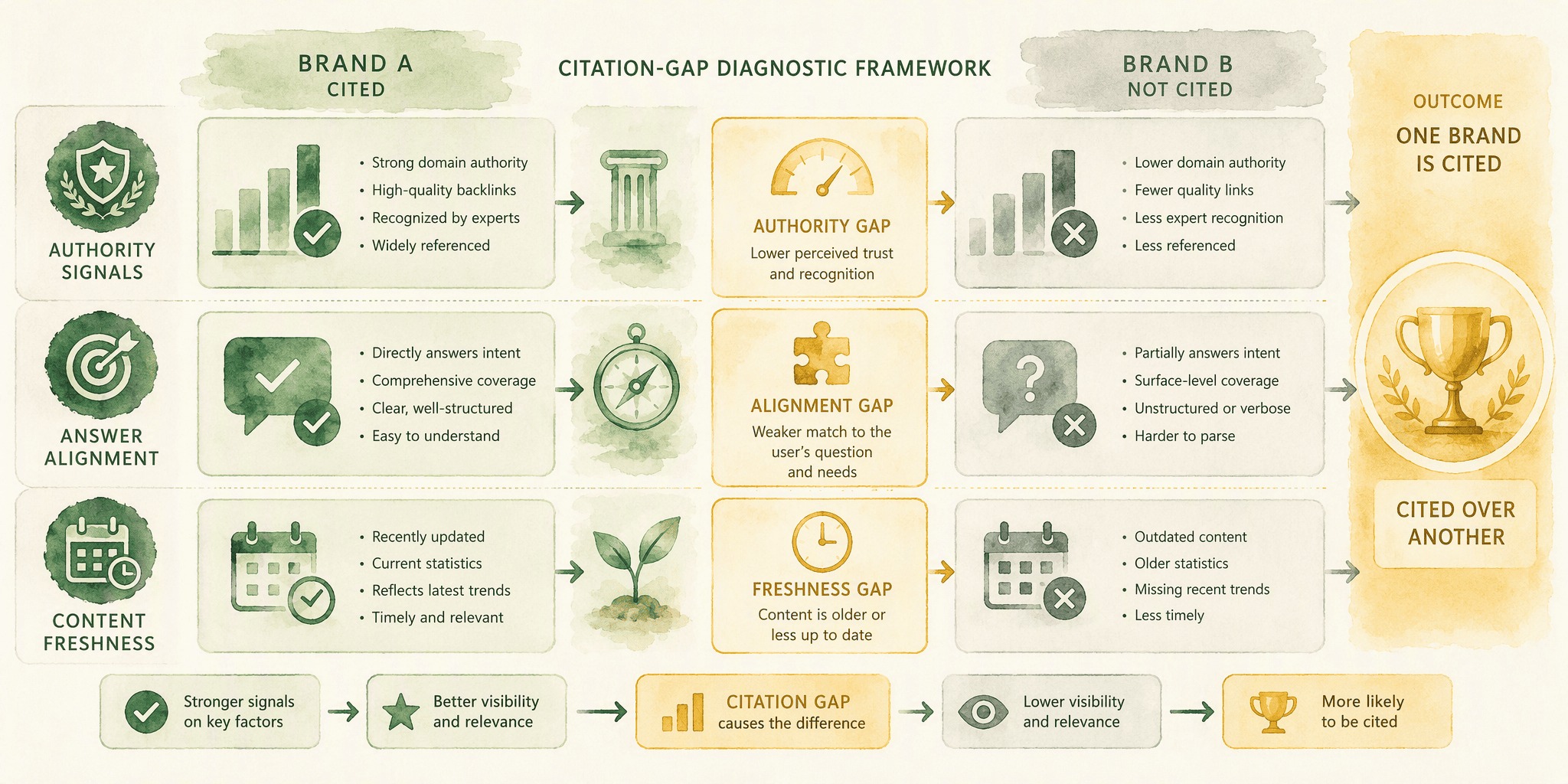
With benchmark data in hand, isolate the specific drivers of the citation gap through a structured competitive content audit. The analysis must move beyond wondering why a competitor is cited and attribute it to concrete, fixable factors. This diagnosis centers on three comparison points: authority signals, answer alignment, and content freshness. The following table provides a direct analytical framework to guide that attribution.
| Gap Category | Your Brand Profile | Competitor Profile | Diagnostic Question |
|---|---|---|---|
| Authority Signals | Audit your schema markup, structured data implementation, and cited backlink authority. | Evaluate the competitor's structured data richness and the specific sources AI engines cite when referencing them. | Does the competitor's content architecture provide clearer machine-readable trust signals than your own? |
| Answer Alignment | Compare your content's directness with the AI's chosen phrasing and query interpretation. Extract the exact text blocks the AI cited. | Analyze the competitor's cited content type. Is it a definition, a comparison list, or a technical specification structured exactly as the AI prefers to output? | Does the competitor's content format match the AI's generated answer template with higher fidelity? |
| Freshness & Citation Stickiness | Check the publication date and last-modification date of your own cited pages versus uncited ones. | Record the date of the competitor's cited resource. Note how frequently they update the content that earns citations. | Is the competitor's cited resource demonstrably more current within a model's training or retrieval window? |
An authority-signal gap often traces back to trust factors that AI models weigh heavily in legal and high-stakes commercial contexts. An answer-alignment gap is a content structuring problem, and it is much faster to fix. Identifying which column drives the gap tells you whether you need a branding and trust-building campaign or an immediate content restructuring sprint.
Step 6: Turn Competitor Insights into Authoritative, Citable Content
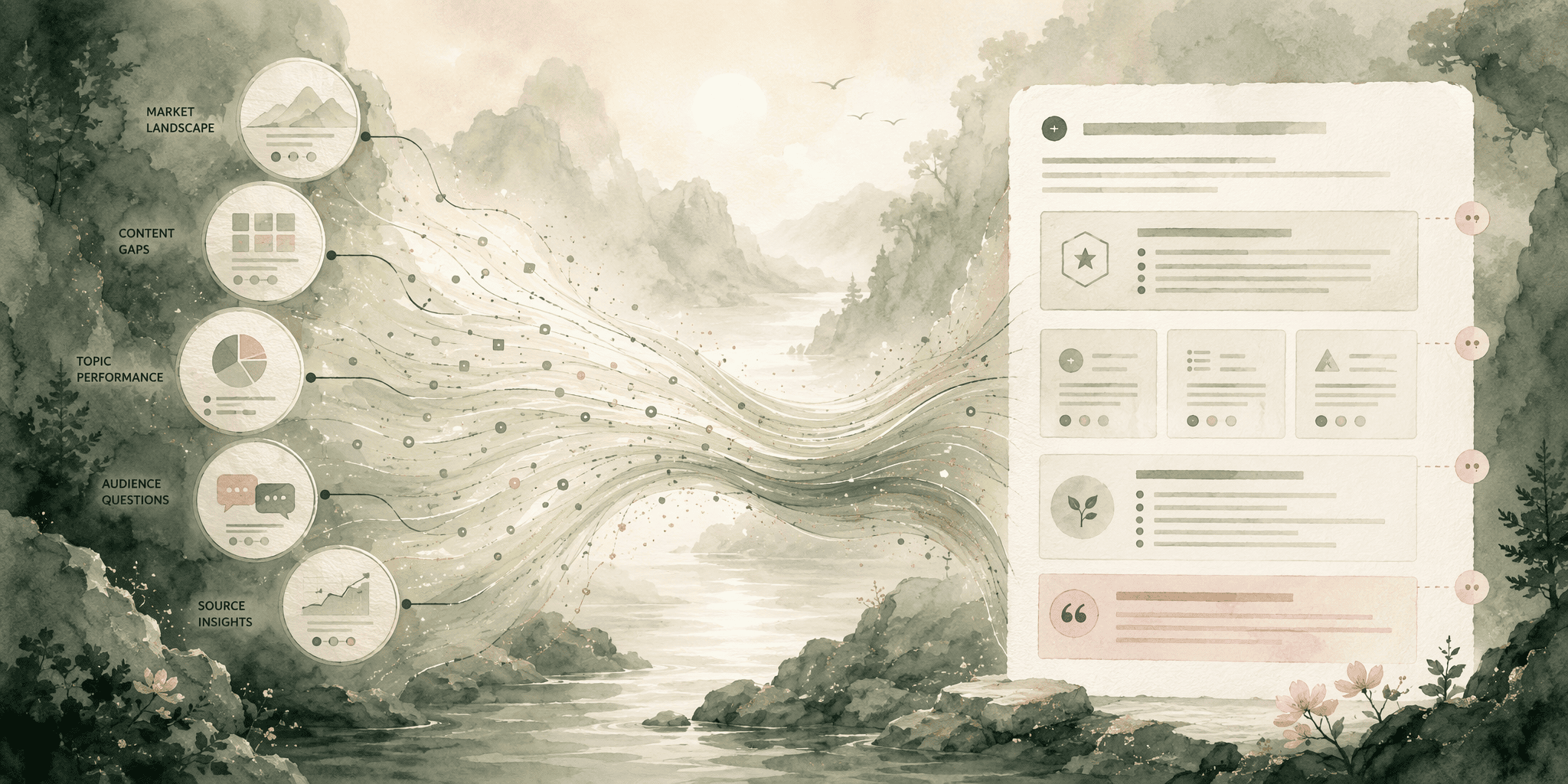
The output of your gap analysis must now become the input for a targeted content strategy. This is where monitoring data stops being an observational report and becomes an operational lever. Identify the exact queries where your answer share is low but competitor citation frequency is high, and prioritize these for content development. The aim is to build structured, entity-rich QA content that directly answers the question the engine is asking, in the format it most often cites. HubSpot’s broader data provides a directional incentive: the company reports growing leads from AI by 1,850% using its AEO software, underscoring the output potential of closing these gaps.
The tactical implementation requires implementing schema markup that AI engines parse. Move beyond standard organizational markup to detailed Article, FAQ, and HowTo schema that explicitly declares the entities and steps your content covers.
Crucially, enforce E-E-A-T signals. This means publishing content with clear author bios linked to demonstrable expertise, referencing original research, and compiling data that can serve as a citable source in its own right.
A platform such as Siftly provides a content generation workflow that produces structured, cited, and formatted content specifically for this generative channel. The core principle remains: create the single best, most clearly structured, and most current answer to each high-value query where a competitor currently holds an AI citation advantage. This transforms your brand from an un-cited domain into the machine-readable authority the engine already prefers to cite.
Conclusion
The shift from link-based authority to mention-based authority for AI overviews is here, and the monitoring tools to act on it are operational. This workflow moves from query mapping through multi-engine detection, KPI measurement, competitive benchmarking, and on to a targeted content response. It turns the abstract threat of AI invisibility into a programmable SEO function.
Citation patterns in LLMs tend to stick. Once a model links a brand to authority on a topic, that advantage persists and becomes hard for others to overturn, as noted in Siftly's competitor tracking research. Your proactive strategy is to make your brand the entity that earns that sticky citation position now, guarding your place before the AI's default answer permanently locks onto someone else.
Frequently Asked Questions
What methods can SEO managers use to detect when competitors are mentioned in AI-generated search results from tools like ChatGPT or Google AI Overviews?
SEO managers detect competitor mentions by using dedicated Generative Engine Optimization tools that monitor query-based citations. Platforms like HubSpot’s AEO tool or Siftly automate this over thousands of queries across ChatGPT, Perplexity, and Google AI Overviews, identifying which specific brands and pages AI models cite in real time.
How do generative engine results differ from traditional search engine results in the context of competitor monitoring?
Traditional search results rank links on a page, where monitoring tracks keyword positions. Generative engines extract and cite sources within a direct answer, meaning monitoring shifts entirely to tracking which brands earn these citations, a binary metric of cited or not cited, independent of a brand’s organic rank position.
What tools are available in 2026 specifically designed for tracking competitor mentions in generative AI engines?
HubSpot’s 2026 AEO tool is prominent, tracking brands across ChatGPT, Gemini, and Perplexity, with pricing starting at $50 per month. Other dedicated tools include Siftly, which monitors ChatGPT, Perplexity, and Google AI Overviews for competitor visibility, and Ahrefs, which provides AI citation charts and historical visibility data.
Why is monitoring competitor citations in AI-generated answers important for brand visibility and market share?
With over 58% of Google searches ending without a click and massive user migration to answer engines, the AI-cited source is the new first-page result. Monitoring competitor citations is therefore critical to protecting brand visibility and preventing market share loss to rivals who become the default AI recommendation.
What metrics should an SEO manager track when measuring competitor impact within generative engine results?
The core metrics are:
- Citation frequency: a raw count of citations.
- Answer share: the percentage of tracked queries citing the brand relative to competitors.
- Entity coverage: the breadth of topics cited.
How can SEO managers act on competitor mention data to improve their own brand's presence in AI-generated answers?
The data must feed a gap analysis that attributes a competitor’s citation success to authority signals, answer alignment, or content freshness. The actionable step is then building authoritative, entity-rich, and structurally aligned QA content that precisely matches the query format the AI model prefers to cite.
Sources
- How to Monitor Competitor Mentions in AI Search - siftly.ai
- AEO Competitor Analysis: Track AI Answer Engine Rivals - blog.hubspot.com
- Generative Engine Optimization Tool | HubSpot - www.hubspot.com
- AI Share of Voice Tools: Formula and Checklist | Foglift - foglift.io
- Connect Ahrefs to ChatGPT, AI citations charts, and more (October 2025) - ahrefs.com
- The 9 Best Generative Engine Optimization (GEO) Tools of 2026 - www.semrush.com
Keep exploring
More from the blog.

Oct 20, 2026
7 Most Affordable Competitive Intelligence Platforms for Startups Under 50 Employees in 2026
Your two top competitors just hired a veteran sales leader away from a public company, launched a new pricing page that undercuts your latest proposal

Oct 20, 2026
How to Get Real-Time Alerts When Competitors Change Their Messaging
Your top competitor just repositioned their entire product line around a new AI feature. Your sales team will find out in three weeks when a prospect parrots

Oct 20, 2026
Track Competitor Pricing Without Ever Visiting Their Sites: A 7-Step Guide
You know the burnout. Opening twenty browser tabs every morning, copying prices into a spreadsheet that is already out of date by the time you finish