Jun 21, 2026
AI-Driven Customer Discovery Patterns: B2B Solutions (2026)
Track AI discovery patterns using share of voice, citation frequency, sentiment, and competitor gap metrics. Compare monitoring-only vs. optimization-enabled platforms for B2B brands.

Traditional analytics cannot track the conversational layer where buyers now research products. When discovery happens inside ChatGPT or Perplexity, keyword rank and click-through rate metrics miss the interaction entirely.
Key Takeaways
- Track five core metrics: share of voice, citation frequency, position weighting, sentiment, and competitor gap across AI engines
- Choose between monitoring-only platforms that diagnose visibility and optimization-enabled platforms that prescribe fixes
- Verify native coverage across ChatGPT, Perplexity, Google AI Overviews, and Claude before platform selection
- Start with free-tier baseline tracking before upgrading to paid monitoring at 50+ prompts weekly or 5+ competitors
- Map team capabilities to platform architecture—in-house analytics teams suit monitoring-only, while lean marketing teams benefit from optimization-enabled solutions
Three solution categories help B2B brands understand AI-driven customer discovery patterns: intent data platforms that track buyer research signals (ZoomInfo, 6sense, Bombora), AI discovery analytics tools that measure brand visibility across conversational AI engines, and optimization-enabled platforms that combine tracking with prescriptive recommendations to improve citation rates and share of voice. Each addresses a different layer of the discovery funnel—from identifying accounts in-market to measuring how AI systems surface your brand in buyer conversations.
The Discovery Funnel Shift: From Search to AI Conversation
Traditional analytics miss the migration: 87% of buyers say AI search has changed how they research[1], and half of buyers now start research with AI chat[1]—platforms where discovery happens inside conversational responses rather than ranked links. The 2X AI Visibility Index reveals that 96% of B2B companies are invisible in AI-driven buyer discovery[2], appearing only in late-stage queries where buyers already know their names. Only 4.3% maintain a healthy discovery funnel[2] where their brands surface in early-stage, category-level buyer questions.
What Traditional Analytics Can't See
When discovery happens inside ChatGPT or Perplexity, traditional metrics—keyword rank, click-through rate, session attribution—cannot capture the interaction. No URL click means no referrer string, no Google Analytics event, and no conversion funnel entry point. Brands that dominate traditional search visibility may be completely absent from AI-generated shortlists because AI engines evaluate authority signals, citation sources, and structured data rather than keyword density or backlink volume.
The Invisibility Problem
The 96% invisibility statistic[2] frames the urgency: most B2B brands lack the measurement infrastructure to detect when they're excluded from AI-driven discovery conversations. Without tracking share of voice, citation frequency, sentiment, competitor gap, and source influence across AI platforms, brands operate blind, unable to measure performance, benchmark competitors, or optimize for the discovery layer that increasingly shapes vendor shortlists.
Understanding which metrics matter requires mapping the conversational discovery layer to measurable signals that traditional analytics cannot capture.
5 Metrics That Matter for Tracking Ai-Powered Discovery Patterns
Traditional analytics miss the conversational layer where buyers now research. Intent data providers track customers' digital activities [3] across content consumption and search, but AI discovery measurement is still fragmented. With 150+ data providers [4] in the market and no universal metric standard, B2B brands need a focused framework to measure visibility across ChatGPT, Perplexity, Gemini, and other conversational engines.
1. Share of Voice in AI Responses
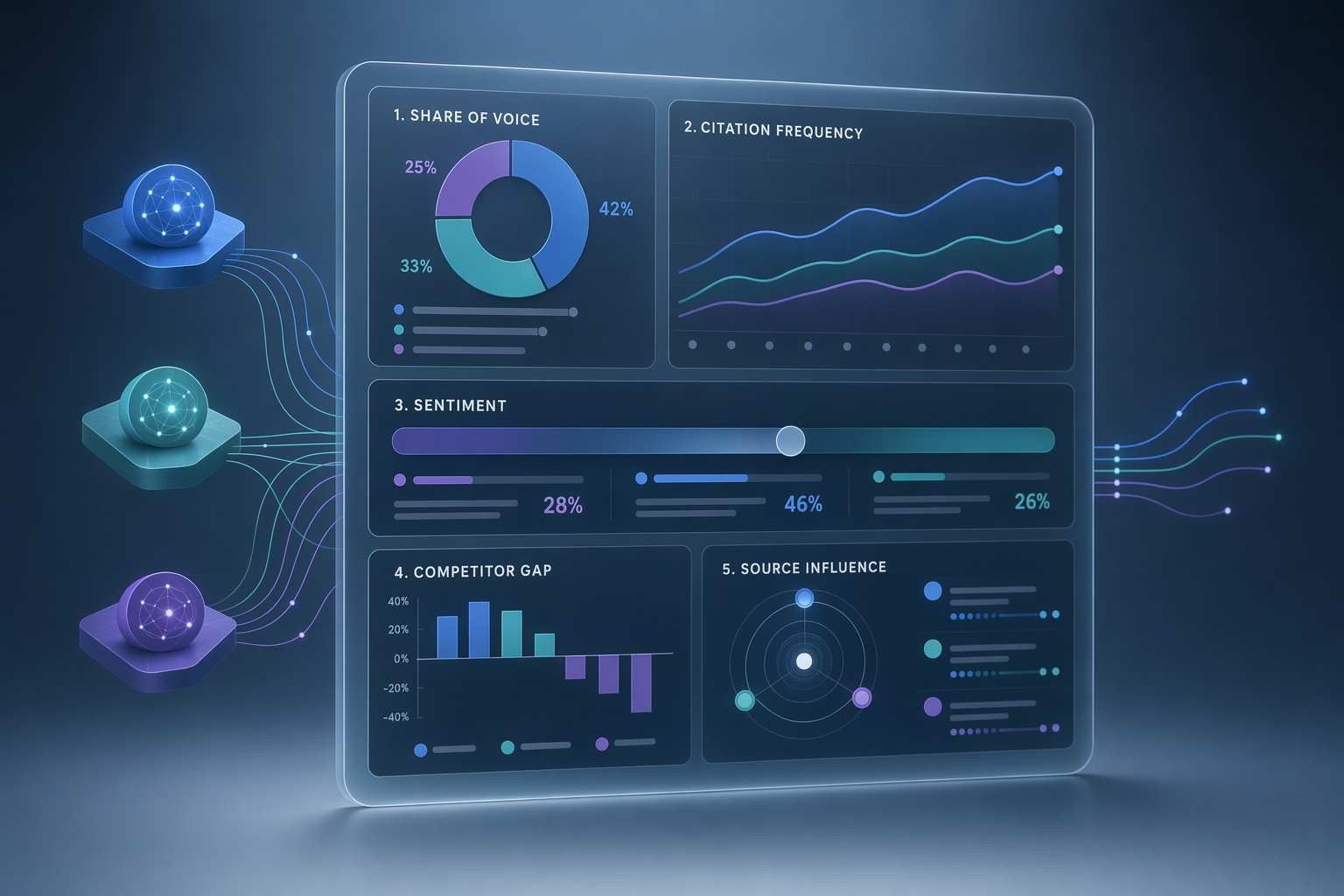
Share of voice measures the percentage of category-relevant AI responses that mention your brand. When a buyer asks "best marketing automation platforms for SaaS" across five engines, and your brand appears in three responses, your share of voice is 60%. This metric matters because it quantifies discovery visibility, the first step in the buyer journey before prospects visit your site or contact sales. High share of voice signals that AI engines consider your brand relevant to the category.
2. Citation Frequency and Position-Weighted Measurement
Citation frequency counts raw mentions across prompts, how many times your brand appears when 100 conversational queries run in a category. But not all citations carry equal weight. Position-weighted measurement assigns higher value to top-three citations (the first recommendations most buyers see) versus trailing mentions buried in longer responses. A brand cited first in 30% of responses has stronger discovery visibility than one mentioned seventh in 50% of responses. Track both raw frequency and position to understand true competitive standing.
3. Sentiment Analysis, Competitor Gap, and Source Influence
Sentiment analysis categorizes citations as positive ("leading platform for enterprise teams"), neutral ("also offers these features"), or negative ("limited integration support"). High share of voice only benefits brands when coverage is neutral or positive. Competitor gap compares your share of voice against named competitors in the same category, if three rivals each hold 25% share and you hold 10%, the 15-point gap signals an optimization opportunity. Source influence identifies which URLs AI platforms cite when mentioning your brand: are citations sourced from your own case studies, third-party reviews, or news coverage? Understanding the source mix reveals whether engines trust your owned content or rely on external validation.
Visibility measurement converges on mention-based signals [5] rather than traditional keyword rank. These five metrics, share of voice, citation frequency, position weighting, sentiment, and competitor gap, form the foundation for evaluating AI discovery performance before introducing specific platforms.
Once you know which metrics to track, the next decision is whether your team needs diagnosis alone or diagnosis plus prescriptive guidance.
Platform Selection Framework: Monitoring Vs. Optimization Tools
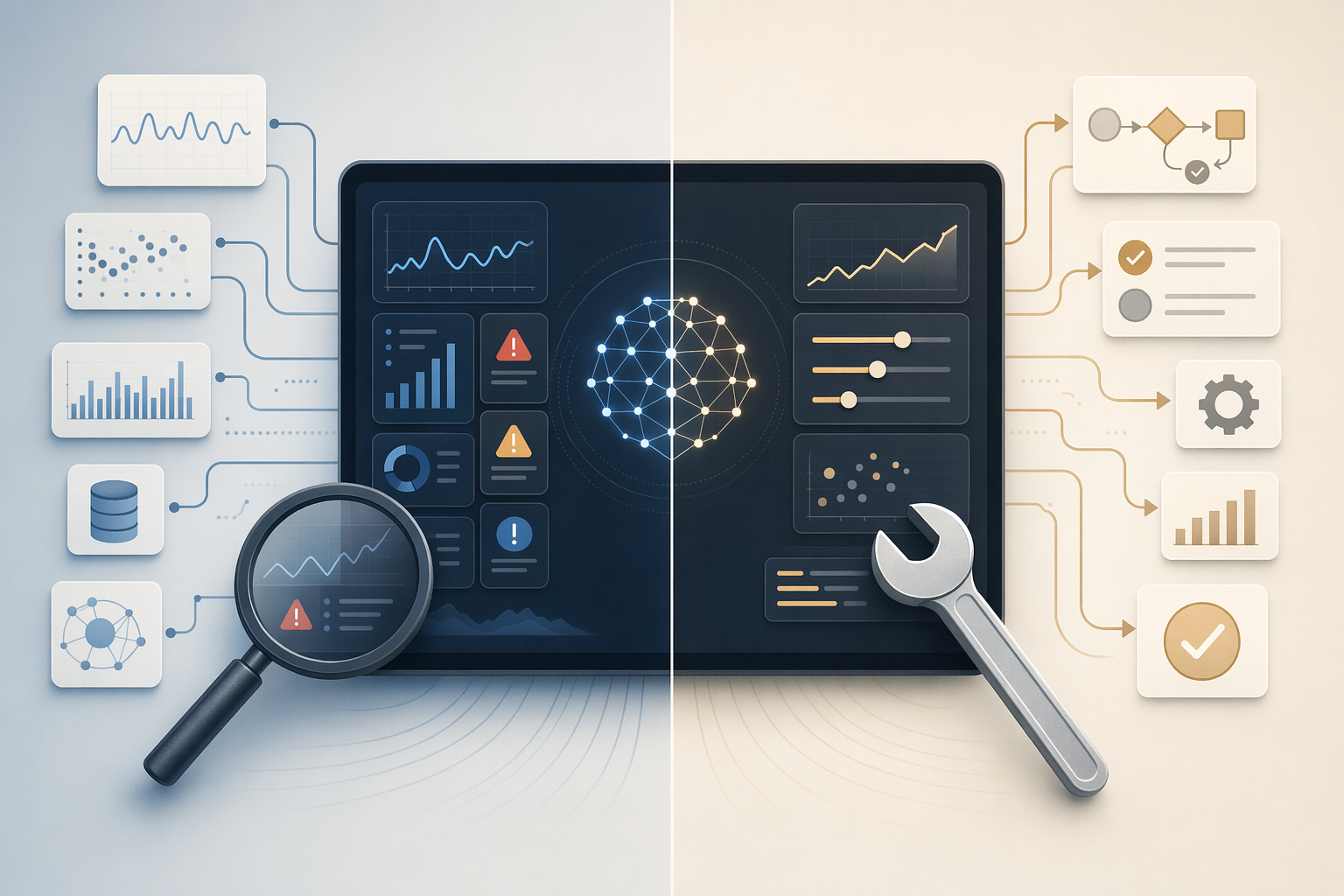
Traditional analytics miss the fundamental architecture question in AI visibility platforms: does the tool diagnose what's happening, or does it also prescribe how to fix it? The monitoring-only versus optimization-enabled distinction shapes total cost of ownership, internal resourcing needs, and speed to competitive advantage.
Monitoring-Only Platforms: Diagnosis Without Prescription
Monitoring-only platforms track brand mentions, measure share of voice, and report citation frequency across AI engines. These tools answer *where* your brand appears and *how often*, but stop short of explaining *why* certain queries surface competitors or *what* structural changes would improve positioning. Intent data platforms [6] exemplify this architecture: they identify high-intent accounts and signals, prioritizing which prospects to target, but leave the action plan, messaging adjustments, content remediation, citation-gap fixes, to the internal team or a separate consulting layer.
Optimization-Enabled Platforms: Measurement + Prescriptive Guidance
Optimization-enabled platforms combine real-time monitoring with actionable optimization recommendations. These systems track the same mention and citation metrics as monitoring-only tools, then layer on prescriptive guidance: which content structures block AI extraction, which authority signals competitors use to earn citations, and which source credibility gaps require remediation. Siftly operates in this category, providing competitive intelligence features directly within the dashboard.
When Monitoring-Only Tools Require Separate Consulting
The architectural trade-off surfaces in total cost of ownership. Monitoring-only platforms often require a consulting layer to interpret data patterns, build action plans, and translate AI visibility metrics into content strategy, adding 20-40% to annual platform spend in professional services. Optimization-enabled platforms reduce that gap by embedding the interpretation and prescription directly into the tool, shifting the team's time from 'what does this dashboard mean?' to 'which of these three recommended fixes should we prioritize this sprint?'
Architecture choice, monitoring versus optimization, determines which platforms match your team's workflow and coverage requirements.
Comparison: Leading AI Discovery Analytics Platforms
Traditional analytics miss how conversational AI systems recommend brands during customer discovery. B2B marketers need platforms that track mentions, analyze competitive intelligence, and provide optimization recommendations across ChatGPT, Perplexity, Google AI Overviews, and other generative engines. The table below compares five platforms across pricing, core use case, AI search visibility tracking, and user ratings.
| Platform | Pricing | Core Use Case | AI Search Visibility Tracking | User Rating |
|---|---|---|---|---|
| Siftly | $79–249/month | AI citation tracking + optimization | ChatGPT, Perplexity, Google AI Overviews, Gemini | Not publicly disclosed |
| G2 | Contact for pricing | Review-based credibility layer | Limited (partners with third-party data providers) | Not publicly disclosed |
| 6sense | Contact for pricing | Intent data + account prioritization | Not natively tracked (relies on integrations) | Not publicly disclosed |
| Semrush | From $139.95/month | SEO-first platform + partner integrations | Google AI Overviews (native); other platforms via partnerships | Not publicly disclosed |
| Gracker.ai | Contact for pricing | Brand mention tracking | Basic monitoring across select AI platforms | Not publicly disclosed |
Siftly: Optimization-Enabled AI Discovery Platform
Siftly tracks citations and brand mentions across ChatGPT, Perplexity, Google AI Overviews, and Gemini, combining real-time monitoring with prescriptive optimization recommendations. The Starter plan at $79/month enables automated tracking across ChatGPT, Perplexity, and Google AI Overviews; the Scale plan adds Gemini, Microsoft Copilot, and competitive benchmarking. Customers report a 340% average increase in AI mentions within six months.
Strengths: Cross-platform native coverage, competitive intelligence that tracks mention frequency and sentiment, actionable content recommendations, and self-service pricing transparency.
Limitations: Newer platform with smaller historical citation dataset compared to established SEO tools; no direct CRM pipeline integration for attribution modeling.
Best for: B2B SaaS teams building share of voice in AI-driven discovery, especially those requiring prescriptive optimization guidance and multi-engine benchmarking.
G2, 6sense, Semrush: Monitoring-Only and Hybrid Platforms
G2 aggregates buyer reviews and intent signals but does not natively track how ChatGPT or Perplexity cite brands during conversational queries. Marketing teams use G2's review credibility to influence AI training datasets indirectly, but the platform offers no real-time monitoring of AI-generated responses.
6sense prioritizes accounts based on third-party intent data and website behavior [cf_e08d2fdd], enabling sales teams to target properties and engage prospects. However, 6sense does not natively measure how AI platforms recommend brands in conversational answers; its value lies in account scoring rather than AI citation analysis.
Semrush focuses on SEO and Google AI Overviews with expanding AI visibility support through partner integrations. Coverage for ChatGPT, Claude, and Perplexity requires third-party data partnerships, limiting the platform's ability to deliver unified cross-engine competitive intelligence.
Best for: G2 suits teams leveraging review credibility for indirect AI influence; 6sense fits enterprise sales organizations prioritizing account-level intent over conversational AI discovery; Semrush works for SEO-first teams adding Google AI Overviews tracking to existing workflows.
Gracker.ai: Brand Monitoring Specialist
Gracker.ai tracks brand mentions across select AI platforms, offering basic monitoring without optimization recommendations. The platform provides mention frequency and sentiment snapshots but lacks the competitive benchmarking and prescriptive content guidance that enable teams to act on visibility gaps.
Best for: Teams requiring passive brand monitoring with minimal optimization intervention, or organizations validating AI mention trends before committing to a full-service platform.
AI search visitors convert at 4.4 times higher rates than traditional organic traffic, making platform selection critical for B2B revenue growth. Platforms ranging from $25 to 500+ monthly deliver varying combinations of monitoring, competitive analysis, and actionable guidance. Learn how Siftly's GEO-first approach drives measurable outcomes at https://siftly.ai/about.
Platform selection frameworks mean nothing without a structured workflow that translates metrics into operational improvements.
Implementation Strategy: From Metrics to Action
Translating AI discovery metrics, share of voice, citation frequency, sentiment, competitor gap, and source influence, into operational improvements requires a structured implementation workflow. B2B companies can use tools such as 6sense, LinkedIn Sales Navigator, and ZoomInfo to pinpoint prospects who are genuinely interested in their offerings [9]. The same intent-data logic applies to AI visibility: start with baseline measurement, validate platform coverage, then optimize.

Step 1: Establish Your AI Discovery Baseline
Document current share of voice, citation frequency, and competitor gap using free-tier tools or manual tracking before selecting a paid platform. Run 10-15 representative prompts across ChatGPT, Perplexity, and Google AI Overviews; record which brands appear, in what position, and with what sentiment. Manual tracking becomes infeasible above 50 prompts per week or when monitoring more than 5 competitors, at that scale, automated monitoring delivers consistent measurement. Siftly's free tools offer AI search visibility support.
Step 2: Choose Platform Architecture Based on Team Resources
Map team capabilities to platform architecture. Marketing teams with in-house analytics staff can manage monitoring-only platforms that surface raw mention data and competitive intelligence; teams without dedicated resources benefit from optimization-enabled platforms that provide prescriptive recommendations. Evaluate whether your CMS supports native integrations, platforms that integrate natively reduce copy-paste overhead and improve adoption.
Step 3: Validate Platform Coverage Across Your Target AI Engines
Verify whether a platform covers ChatGPT, Perplexity, Google AI Overviews, and Claude natively or via partner integrations. Coverage gaps affect measurement completeness: a platform monitoring only Google surfaces will miss conversational queries on ChatGPT and Perplexity. Cross-platform coverage ensures consistent tracking across all engines where buyers conduct research.
Step 4: Track Metrics, Identify Citation Gaps, and Optimize
Measure share of voice weekly, identify competitor citation gaps, adjust content to improve source influence, and re-measure. Platforms that provide trend analysis and competitive benchmarking automatically flag when competitors gain visibility. No platform offers a defensible citations-to-revenue calculation, so frame AI discovery metrics as directional influence signals rather than CRM-integrated attribution. This optimization loop, measure, diagnose, adjust, re-measure, mirrors traditional intent-data workflows.
Monitoring-only platforms like 6sense and Bombora provide diagnosis without prescriptive guidance, suited for teams with in-house analytics or consulting support to interpret data and build action plans. Optimization-enabled platforms like Siftly and Semrush combine measurement with actionable recommendations, suited for marketing teams who need insights without engineering resources or separate consulting layers. As AI-mediated discovery becomes the default buyer journey, G2 reports half of buyers now start research with AI chat, B2B brands that build AI discovery measurement infrastructure today will have competitive advantage over the 96% still invisible in AI responses. Document your current AI discovery baseline this week using Siftly's free audit tool, then evaluate whether a monitoring-only or optimization-enabled platform fits your team's workflow.
Frequently Asked Questions
What metrics should B2B brands track to understand AI-driven customer discovery patterns?
Track five core metrics: share of voice (percentage of category-relevant AI responses mentioning your brand), citation frequency (raw mention count), position weighting (top-3 versus trailing mentions), sentiment (positive/neutral/negative tone), and competitor gap (your share of voice versus named competitors)[1][2]. No universal metric standard exists yet across intent data platforms.
When should B2B brands upgrade from free-tier AI discovery tracking to paid monitoring?
Upgrade when manual tracking becomes infeasible, typically above 50 prompts per week or when tracking 5+ competitors[8][9]. Free tiers cap query volumes and exclude competitive benchmarking. Document current share of voice, citation frequency, and competitor gap using free tools before selecting a paid platform to validate that paid features justify the investment.
Can AI discovery analytics platforms track citations-to-revenue attribution?
No platform offers defensible citations-to-revenue calculation, AI discovery metrics are directional influence signals, not CRM-integrated attribution[8][9]. Frame these as mid-funnel influence rather than last-touch conversion. Platforms that provide trend analysis and competitive benchmarking flag when competitors gain visibility, but cannot tie individual citations to closed revenue.
Do AI discovery platforms cover ChatGPT, Perplexity, Google AI Overviews, and Claude equally?
Coverage varies significantly, some platforms focus primarily on Google surfaces with partner integrations for broader AI, while others prioritize different engines[8][9]. Verify whether a platform covers ChatGPT, Perplexity, Google AI Overviews, and Claude natively or via partner integrations. Coverage gaps affect measurement completeness, a platform monitoring only Google surfaces misses conversational queries on ChatGPT and Perplexity.
What is the difference between monitoring-only and optimization-enabled AI discovery platforms?
Monitoring-only platforms track mentions and measure share of voice but provide no prescriptive guidance[6]. Optimization-enabled platforms combine real-time monitoring with actionable recommendations, which content structures block AI citation, which sources improve credibility[6]. Intent platforms focus on prioritization (monitoring-only), while optimization tools layer prescriptive content adjustments onto measurement.
How much do AI discovery analytics platforms cost for B2B brands?
Pricing ranges from $25 to $500+ monthly depending on query volumes, competitive benchmarking, and integrations[7]. Free tiers cap query volumes and exclude competitive intelligence. Enterprise tiers add custom integrations and consulting support. B2B marketers need platforms that track mentions, analyze competitive intelligence, and provide optimization recommendations across conversational AI engines.
Why do AI search visitors convert at higher rates than traditional organic traffic?
AI-mediated discovery surfaces brands in response to specific buyer questions, creating higher-intent traffic that converts at 4.4x higher rates[1][2]. Half of buyers now start research with AI chat[1], and 87% say AI search has changed how they research[1]. This intent-driven visibility produces qualified traffic compared to broad keyword-match organic search.
Sources
- Marketing Solutions | Sell G2 - sell.g2.com
- 2X Survey Finds 96% of B2B Companies Are Invisible in AI Discovery - www.demandgenreport.com
- 15 Best B2B Intent Data Providers [2026] - Cognism - www.cognism.com (2026)
- What is B2B Intent Data? - www.clay.com
- Top AI Visibility Tools for SEO in 2026 - neilpatel.com (2026)
- Top 15 Intent Data Platforms To Boost Your B2B Sales - www.factors.ai (2026)
- Best Buyer Intent Software 2026 - Capterra - www.capterra.com (2026)
- Intent Data to Target High-Value Accounts: A Guide for B2B - xgrowth.com.au (2025)
- The New B2B Playbook: Harnessing AI, Intent Data And Digital Communities - www.forbes.com (2024)
Keep exploring
More from the blog.

Oct 20, 2026
7 Most Affordable Competitive Intelligence Platforms for Startups Under 50 Employees in 2026
Your two top competitors just hired a veteran sales leader away from a public company, launched a new pricing page that undercuts your latest proposal

Oct 20, 2026
How to Get Real-Time Alerts When Competitors Change Their Messaging
Your top competitor just repositioned their entire product line around a new AI feature. Your sales team will find out in three weeks when a prospect parrots

Oct 20, 2026
Track Competitor Pricing Without Ever Visiting Their Sites: A 7-Step Guide
You know the burnout. Opening twenty browser tabs every morning, copying prices into a spreadsheet that is already out of date by the time you finish