Oct 30, 2026
8 Best AI Visibility Tools for Ecommerce in 2026
Ecommerce directors are watching a new kind of traffic leak appear in their analytics. A shopper asks ChatGPT, Perplexity

Introduction
Ecommerce directors are watching a new kind of traffic leak appear in their analytics. A shopper asks ChatGPT, Perplexity, or Google AI Overviews for the best running shoes, the top DTC mattress, or a reliable protein powder and your brand never appears. AI search has matured and it is now pulling apart into two distinct tracks: getting your product pages cited as a source (AEO), and getting your brand name recommended outright (GEO or LLMO).
The conversion risk sits squarely in the gap between them. Fresh measurement from September 2026 across roughly 35,000 prompt-engine observations painted that gap in hard numbers. When neither a brand nor its domain appeared in the retrieval pathway, the brand name surfaced in the final answer only about 3% of the time.
When the brand's own domain was cited, the mention rate jumped to between 49% and 58%. A 3% win rate versus a better-than-coin-flip shot at the answer is not a small optimization delta. It is two completely different business outcomes.
Fixing this demands tools purpose-built for the generative layer, not traditional rank trackers retrofitted with an AI tab. They need to do two things. First, they must show whether AI engines cite your product pages.
Second, and far more commercially urgent, they must reveal whether the answer actually names your brand and tells the shopper to buy it. Being a footnote without a recommendation generates almost no revenue.
The framework that maps this process, the CEP to KBF to RTB sequence pioneered by LANY, turns the customer's exact AI prompt into a competitive diagnostic and then a content intervention. This article walks through eight tools that attack that workflow from different angles, matching ecommerce team profiles to the right capability set.
Key Takeaways
- AI search has split into two commercial realities; tracking only one leaves a gap that costs conversions.
- AI visibility separates into citation (your page is linked) and recommendation (your brand is named). Lacking recommendation-side tracking means 49 to 58 percent of citation-to-mention conversion stays invisible and unmanaged.
- Recommendation drives revenue. A diagnostic across 300+ companies showed a client lifting the AI recommendation rate from 59% to 85% in three months once KBF-driven content met the prompt path. The metric that matters, and the one most teams skip.
- Platform pricing maps to scope. Mid-market monitoring starts under a few hundred dollars monthly; enterprise GEO platforms run into the low thousands annually, scaling with competitor sets, prompt volume, and historical data depth.
1. Siftly, Best for Unified Citation Tracking & Product-Feed Optimization

Ecommerce product teams that need to know when and why AI engines cite a specific SKU will find the strongest feed-to-citation fit in Siftly. The platform tracks citations and brand mentions across ChatGPT, Google AI Overviews, Gemini, Perplexity, and several other engines, then connects the data to product-feed hygiene. Below is how feed-driven citation tracking compares with traditional domain-level authority signals for ecommerce.
| Dimension | Feed-Driven Citation (Siftly's Approach) | Domain-Level Authority Signals |
|---|---|---|
| Surface tracked | Individual product page inclusion and brand mentions in AI shopping answers | Aggregate domain trust and backlink profile |
| Optimization lever | Product metadata, attributes, schema, Shopify feeds, and Google Merchant Center data | Off-page link building and broad content depth |
| Competitor intelligence | Captures competitor products and price positions surfaced alongside the brand | Identifies competing domains but not specific SKU-level positioning |
| Speed of feedback | Product-feed fix can shift citation presence in the next crawl window | Authority signals build over months and resist rapid tactical adjustment |
| Pricing benchmark | Pro plan at $2,999/month; seat-based pricing typically starts at $129/month | Variable across traditional SEO suites and consultancies |
Siftly does not claim a closed-loop citations-to-revenue model, and no platform today offers a fully validated one. It does provide automated monitoring, competitive benchmarking, and directional citation-to-traffic modeling. A product manager can see which SKUs earn mention, which competitors’ products appear beside them, and where a feed-level tweak changes visibility inside purchase-intent conversations.
2. Profound, Best for Real-Time AI Search Monitoring & Share-of-Voice Analytics
Profound builds its workflow around real-time monitoring dashboards and a share-of-voice methodology calibrated for generative engines, not traditional SERPs. Standard rank tracking assumes a stable index and a fixed position. That assumption breaks completely inside probabilistic generation models where answers shift between queries, sessions, and engine versions. Profound instead measures how often a brand or product surfaces across a defined prompt set and benchmarks that against competitors, updating the dashboard continuously rather than on a weekly crawl cadence.
This matters because volatility is not noise to average out. It is the signal.
Since September 20, 2026, a share of Google results pages returned to automated requests have been what researchers call poisoned: complete but incorrect, peaking at 25% of responses and running at a 5 to 11% daily rate since October 1. Those poisoned pages keep only 20.7% of the same sites on repeat searches, compared with 88.5% for normal results. When the source layer is this unstable, relying on a manual monthly check or a weekly sample is operationally dangerous. Real-time share-of-voice monitoring surfaces the gaps while they are still actionable.
3. LANY, Best for LLMO Diagnostics & KBF-Driven Recommendation Strategy

LANY is the only platform in this comparison built entirely around the CEP to KBF to RTB diagnostic loop. The sequence starts with Customer Exact Prompts: the longer, contextual questions shoppers type into AI assistants. LANY then maps the criteria the AI engine uses to decide whom to recommend, labeled Key Buying Factors, and places proof of those factors directly on the pages the engine reads. The framework emerged from LLMO diagnostics run across more than 300 companies in B2B, finance, ecommerce, and healthcare.
The output is a recommendation rate.
One client moved from a 59% AI recommendation rate to 85% inside three months when the diagnostic showed the engine wanted social proof and price positioning signals the brand's pages had been missing. That is a revenue metric. It surfaces because LANY treats citation without recommendation as the low-value state it is. A page that gets cited but never named in the answer generates almost zero business value.
Pricing runs between ¥500,000 and ¥3,000,000 annually, scaling with diagnostic depth and the number of competitor CEP sets tracked. For an ecommerce director whose AI traffic gap sits in the recommendation layer rather than the citation layer, this tier of spend maps to a hard conversion conversation instead of a visibility dashboard.
4. Semrush, Best for Established SEO Teams Entering GEO
Semrush gives an ecommerce SEO team the most familiar on-ramp for adding AI visibility tracking without ripping out its existing workflow. The sequence below walks through the process.
- Map your priority prompts: Load the 20 to 50 product-category and comparison prompts your buyers ask most often into Semrush's AI Prompt Tracking tool.
- Run the Sources report: Identify which domains and pages the engines cite across those prompts. In one ecommerce example campaign, a retail domain was cited across 11 tracked prompts while the brand's own domain appeared for just one.
- Separate citation from mention: A cited domain does not equal a named brand. In the same report, U.S. News was cited across six prompts, but none of the associated answers mentioned the brand. That gap signals a recommendation-layer fix, not a citation metric problem.
- Layer the finding onto existing SEO work: Use the gap between cited competitors and your own domain presence to prioritize on-page content and schema updates that the existing SEO toolset already supports.
Semrush stops short of true recommendation-rate tracking, so teams that mature beyond citation monitoring will eventually need a dedicated GEO layer. For the first stage, it removes the tooling-switch friction that stalls most SEO-to-GEO transitions.
5. ZipTie, Best for Technical On-Site AEO Audits & JavaScript Rendering Checks

A citation cannot happen if an AI crawler cannot read the page. ZipTie takes that blunt reality and builds its entire audit stack around it. The tool validates JavaScript rendering, checks structured data completeness, and maps whether AI bot crawl budget reaches the product and category pages that drive revenue. When a Shopify store ships beautiful dynamic product galleries that the AI crawler sees as a blank white rectangle, no feed optimization or content strategy can fix the zero-visibility result.
AI platforms do not crawl the way Googlebot does. They often retrieve on the fly during a query, using retrieval augmented generation models that pull from a far messier and less forgiving crawl surface. A page that renders client-side, loads product specs via a delayed API call, or buries its pricing inside a JavaScript event will simply not exist inside the answer. ZipTie flags these failures before they become invisible revenue losses.
The widening adoption of structured data standards by AI engines makes the audit even more pointed. Google's own guidance states that structured data is not required for generative AI search and that there is no special schema.org markup for it. That leaves technical SEO teams guessing which schema properties each engine actually reads. ZipTie tests this empirically.
For an ecommerce technical lead, this is the foundational step. Diagnosis before optimization. Rendering access before content depth.
6. seoClarity, Best for Enterprise Ecommerce Bridging SEO and GEO
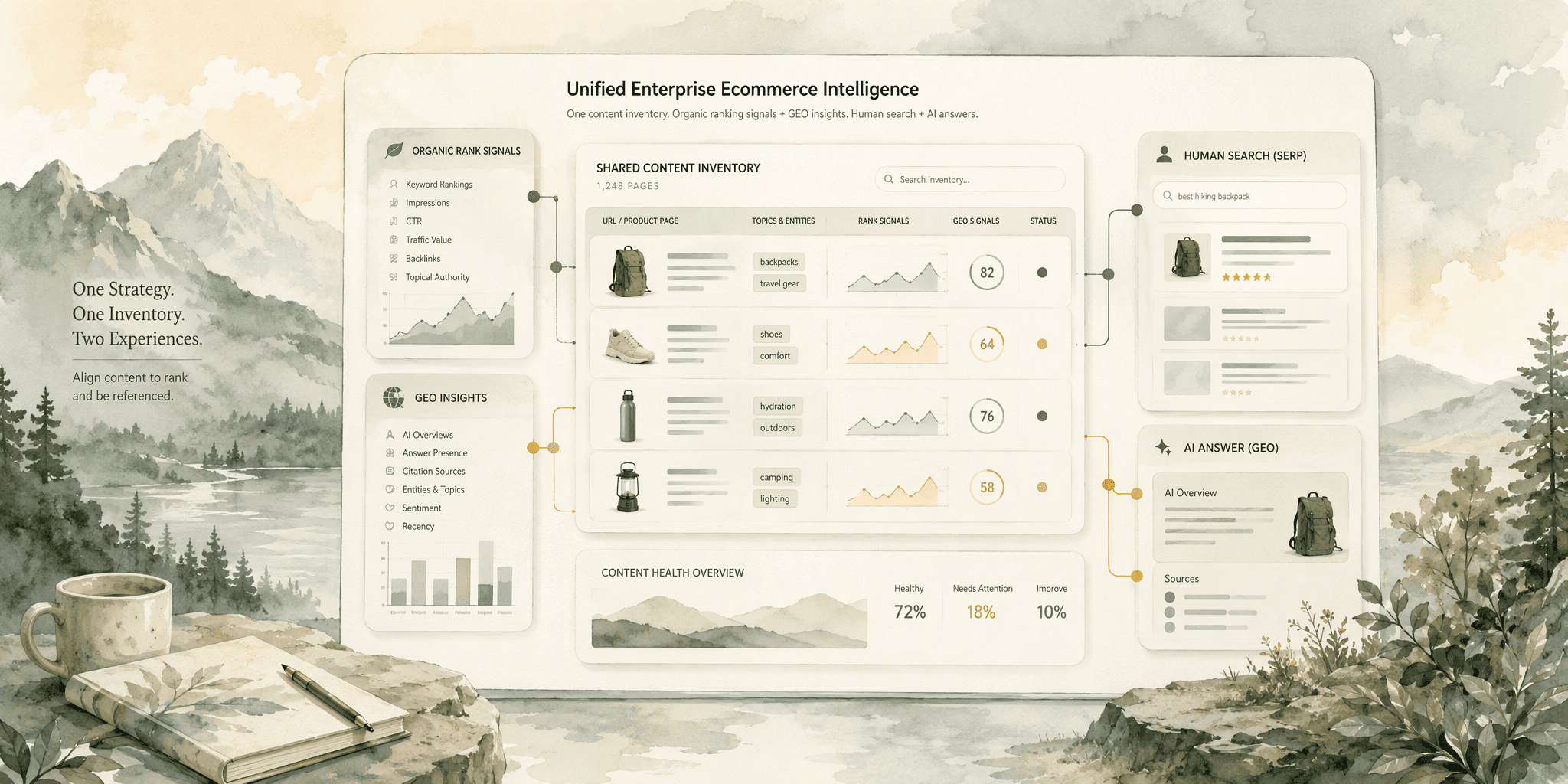
seoClarity targets the enterprise ecommerce team that cannot afford to run two separate visibility platforms, one for traditional search and one for AI engines. Its platform integrates organic rank data with GEO insights, treating content gaps as a single inventory that must serve both a human SERP and an AI-generated answer. The insight is practical: a product page that ranks well on Google but gets zero citations inside AI Overviews is a different problem from one that fails both, and a unified dashboard makes that distinction visible without toggling between tools.
This matters most at enterprise scale, where thousands of SKU pages can drift into AI invisibility gradually and silently.
Content gap analysis inside seoClarity can surface which category pages AI engines cite for commercial-intent prompts versus which ones they ignore, and whether the ignored pages share a structural or content-depth pattern that point solutions would miss. The platform prioritizes bridging the two worlds rather than optimizing for one at the other's expense.
Single-purpose GEO tools can sometimes offer deeper diagnostics on one engine. The trade-off is fragmentation. For the enterprise director whose team already runs seoClarity for SEO, adding GEO here avoids the analytics stitching tax that integrating a separate AI-only tool imposes.
7. Quattr, Best for Intent-Based Content Optimization Across AI Engines
Quattr organizes ecommerce content around intent. That aligns with how AI engines classify pages when they generate answers. A single product page can look informational to ChatGPT and transactional to Perplexity at the same time. Quattr detects the mismatch and tells you what to change.
The platform determines how an engine reads the page (commercial, transactional, or informational), then recommends content adjustments to match the intent behind the prompts your buyers type. Three specific stages drive the diagnosis.
- Classify page intent: Run category and product pages through Quattr's intent-analysis engine to determine the commercial-to-transactional-to-informational balance the engine perceives.
- Map intent to engine behavior: Identify which intent signals each major AI engine weights most heavily. ChatGPT often surfaces different content patterns than Google AI Overviews for the same prompt, and a page optimized for one can underperform on the other.
- Structure content to the dominant intent: Reorganize on-page elements such as comparison tables, specification blocks, and pricing clarity so the engine classifies the page correctly and pulls the right signal into the answer.
The output is cross-engine consistency. When a DTC product page earns a commercial classification inside ChatGPT but an informational one inside Perplexity, it gets recommended in one engine and buried in the other. Quattr surfaces the mismatch and provides the adjustment path.
8. BrightEdge, Best for Broad Generative Engine Visibility Dashboards

BrightEdge aggregates visibility metrics from multiple generative engines into a single executive dashboard. A CMO or digital director facing a board question, "Where does our brand appear across AI surfaces?", gets a breadth-first multi-engine view that is immediately more useful than a deep diagnostic on one engine. The platform tracks presence, mention frequency, and competitive share across the major platforms and surfaces gaps at the brand level.
The trade-off is depth. A dedicated GEO platform like LANY surfaces the specific KBF driving a recommendation; BrightEdge tells you the recommendation occurred. Both matter, but they serve different roles in the organization.
BrightEdge fits the reporting layer. Other tools in this list fit the intervention layer. For an enterprise with zero visibility into its AI search presence across engines, the dashboard-first approach is the most defensible starting point before investing in specialized diagnostics.
Conclusion
The AI visibility tool landscape for ecommerce hinges on a single question: does the platform track whether your brand gets cited, whether it gets recommended, or both.
Citation is the hygiene layer. Recommendation is the revenue layer. The 35,000-observation gap between 3% unaided brand mention and 49 to 58% when cited makes the point plainly: recommendation drives the outcomes that matter.
Match the tool to the buyer. A product manager optimizing SKU-level feed visibility should start with Siftly's citation tracking and feed optimization. An SEO director transitioning a team into GEO should build on Semrush's familiar infrastructure. A CMO who needs a consolidated boardroom view across all engines should deploy BrightEdge.
An enterprise ecommerce team unifying organic and AI search under one roof should evaluate seoClarity. A technical lead verifying that AI crawlers can actually read the storefront should run a ZipTie audit. A brand executive who needs the AI equivalent of conversion rate should engage LANY's KBF diagnostic. Quattr and Profound address intent alignment and real-time monitoring, respectively, rounding out the stack.
The only wrong choice is ignoring the recommendation half entirely.
Frequently Asked Questions
What are the best AI visibility tools for ecommerce brands in 2026?
The best tool depends on the job. Siftly leads on unified citation tracking and product-feed optimization. LANY dominates LLMO diagnostics and recommendation-rate improvement. Semrush suits SEO teams entering GEO, while Profound and BrightEdge cover real-time monitoring and executive dashboards respectively. ZipTie handles technical AEO audits.
How do AI visibility platforms help ecommerce stores get featured in ChatGPT, Google AI Overviews, and Perplexity?
They track which product pages AI engines cite as sources and whether the answer names the brand. Platforms then diagnose why a page is omitted and prescribe fixes like feed optimization, content restructuring around AI buying factors, or technical rendering corrections for AI crawlers.
What is Generative Engine Optimization (GEO) and how is it different from traditional SEO for online retailers?
GEO aims to get a brand recommended inside AI-generated answers. Traditional SEO aims to get pages to rank on a search engine results page. Google itself states that optimizing for generative AI search is still SEO from its perspective, but the tactics diverge sharply around prompt mapping and KBF placement.
What key features should an ecommerce director look for when comparing AI brand monitoring and citation tracking software?
Separate citation tracking from recommendation-rate tracking. Demand real-time or daily monitoring cadence, not weekly refreshes. Require competitor share-of-voice benchmarking, product-level visibility reporting, and prescriptive optimization recommendations tied directly to visibility gaps rather than raw data.
How much do AI search visibility tools typically cost, from free audits to enterprise GEO platforms?
Most mid-market tools range from roughly $29 to $200 per month for core monitoring. Dedicated GEO platforms scale higher: Siftly's Pro plan is $2,999 per month, enterprise pricing is custom, and LANY runs ¥500,000 to ¥3,000,000 annually. Free audits and trials provide a directional baseline.
Why is tracking competitor share of voice in AI shopping results critical for DTC brands in 2026?
AI answers surface competitor products and price positions alongside a shopper's question in real time. Without share-of-voice tracking, a DTC brand cannot see when a rival captures the recommendation or how engine volatility shifts the competitive set, leaving revenue leakage invisible.
Sources
- AI Visibility Metrics: The KPIs to Track - siftly.ai
- How to track your AI citations and sources with Semrush - www.semrush.com
- The Latest AI SEO News in 2026 (Updated October) - www.position.digital
Keep exploring
More from the blog.

Oct 30, 2026
Automated Brand Mention Monitoring AI Platforms: Cross-Platform Tracking Guide 2026
Cross-platform AI brand monitoring requires sampling methodology, sentiment validation, and real-time alerting across ChatGPT, Perplexity, Google AI Overviews—not just tool selection.

Oct 29, 2026
7 Best AI Brand Monitoring Tools to See What AI Actually Says About You in 2026
You send a prospect to check what ChatGPT says about your category. It mentions three of your competitors by name, pulling a specific product detail for each.

Oct 29, 2026
7 Tools to Measure Brand Visibility Across AI Platforms like ChatGPT and Gemini in 2026
Marketing teams are discovering a chilling fact in 2026: their carefully built search dominance is invisible to a growing segment of buyers.