Oct 20, 2026
7 Most Affordable Competitive Intelligence Platforms for Startups Under 50 Employees in 2026
Your two top competitors just hired a veteran sales leader away from a public company, launched a new pricing page that undercuts your latest proposal

Introduction
Your two top competitors just hired a veteran sales leader away from a public company, launched a new pricing page that undercuts your latest proposal, and started getting cited in ChatGPT answers for the exact buying questions your SDR team relies on. You found out from a forwarded tweet two weeks late. For a startup with under 50 people, competitive intelligence (CI) feels like a luxury reserved for organizations with dedicated enablement heads and six-figure tool budgets.
The standard enterprise CI stacks, Klue and Crayon, start at roughly $20,000 to $40,000 per year and assume at least a part-time operator to curate battlecards and train reps. That math fails for a team where the head of sales also runs revops and the CMO writes blog posts. Yet competitive pressure doesn't scale down with headcount. In fact, 68% of B2B deals now involve at least one direct competitor, which means every rep is fighting a positioning battle for which they are likely unprepared.
The good news is that affordable CI platforms now exist that trade full-feature breadth for immediate signal value. Kompyte gives you dedicated competitor tracking and battlecards for $300 per year. LinkedIn Sales Navigator unlocks personnel and account-level signals for under $1,000 annually. Semrush delivers digital footprint analysis for $139.95 per month. These tools won't replace a full-time CI function, but they will surface the moves that matter before you read about them on social media.
Key Takeaways
The enterprise CI stack carries a $20,000-plus annual price tag and operational demands that small teams cannot sustain. Startups under 50 employees need tools that deliver specific, high-signal intelligence without requiring a dedicated operator. Below are the core findings for time-pressed founders and revenue leaders.
- The budget dedicated CI winner: Kompyte starts at $300 per year and covers automated competitor tracking with unlimited battlecards. No other platform delivers full battlecard functionality at a startup-viable price.
- The highest-ROI entry point: LinkedIn Sales Navigator costs $79.99 per month and surfaces the personnel moves, account changes, and hiring signals that traditional CI platforms miss entirely.
- The digital footprint key: Semrush, at $139.95 per month, provides competitive gap analysis across SEO, PPC, and content, indispensable for startups competing on organic and paid channels.
- Enterprise tools are right for established teams: Klue and Crayon run $20,000 to $40,000 per year and require a part-time CI operator. That overhead doesn't fit a startup that lacks dedicated competitive enablement headcount yet.
1. Siftly, AI citation monitoring and visibility intelligence for the AI-search era

A competitor's newest blog post just appeared as a source in a ChatGPT answer for a high-intent buying query your team considered safe territory. Traditional CI platforms were built for SERPs, press mentions, and review sites, not for the generative answer engines where prospects now ask direct vendor questions. Siftly monitors brand and competitor citations across ChatGPT, Google AI Overviews, Gemini, Perplexity, Claude, and four other AI engines through daily automated query execution.
No battlecard answers the question Siftly was built for: when a prospect asks an AI engine who the best vendor is, does your brand get cited, or does your competitor? The platform distills that answer into an AI visibility score built from mention rate, ranking, and citation presence. It also produces prescriptive optimization recommendations grounded in citation analysis. The Growth tier includes real-time monitoring, and a 14-day free trial requires no credit card.
2. Kompyte, The standout budget dedicated CI platform for automated tracking
Dedicated CI platforms carry an enterprise price tag, but Kompyte is the exception. It automates competitor monitoring and battlecard creation at a price a 10-person startup can actually approve. The gap between Kompyte and Crayon or Klue comes down to cost, feature set, and who runs the tool day-to-day.
| Dimension | Kompyte | Crayon / Klue |
|---|---|---|
| Annual starting price | $300 | $20,000 to $40,000 |
| Battlecard generation | Unlimited, automated | Advanced, AI-driven dynamic cards |
| Setup requirements | No setup fees, self-service | Requires dedicated CI/revops operator |
| Integration breadth | Core CRM and web monitoring | Deep enterprise ecosystem (Slack, Salesforce, intel aggregators) |
| Best for | Startups needing immediate, low-touch CI | Organizations with competitive enablement headcount |
Kompyte starts at roughly $300 a year. Crayon and Klue begin around $20,000 and climb to $40,000. That difference reflects the operational weight each platform assumes. Kompyte is self-service: you set it up, you run it. Crayon and Klue assume someone on staff owns competitive intelligence as a function.
Battlecards tell the story. Kompyte generates unlimited automated battlecards. Crayon and Klue produce dynamic, AI-driven cards that pull real-time signals from the CRM, Slack, and news aggregators. The output on the enterprise side is richer, but it presumes the organization has a person stitching those signals into sales plays. At a smaller company, a battlecard that updates itself without a human in the loop matters more than one with deeper enrichment that nobody has time to configure.
Integration scope follows the same logic. Kompyte covers the core CRM and web monitoring. Crayon and Klue wire into a broad enterprise stack and surface intelligence where competitive teams already work. If your team lives in a handful of tools, the narrow footprint is a feature, not a gap.
3. LinkedIn Sales Navigator, The highest-ROI entry point for sales and personnel signals

Most startups treat Sales Navigator as a prospecting tool and overlook its CI power. For $79.99 per month, it surfaces competitive signal that no battlecard platform captures: the human moves behind account dynamics.
- Account change alerts: Track when competitor champions leave target accounts, exposing relationship gaps and opening re-engagement windows within 24 hours.
- Hiring pattern intelligence: Monitor competitor headcount growth by department to infer strategic bets. A sudden hiring surge in enterprise sales signals a segment push months before it hits the market.
- Job posting analysis: Follow competitor LinkedIn job descriptions to extract required technical stacks, territory assignments, and compensation ranges. Public hiring data becomes product and pricing intelligence.
- Deal-level signal at under $1,000 per year: No other platform reveals the real-time personnel churn that drives deal outcomes at this price point, making Sales Navigator the highest-ROI CI entry point for sales-led startups.
4. Semrush, Digital footprint analysis for SEO, PPC, and content competitive gaps

Semrush lacks battlecards. It will not alert you when a competitor changes its executive team. But for startups whose competitive battleground is organic search and paid digital channels, it is arguably the most important tool in the stack.
At $139.95 per month for the Pro plan, Semrush maps your entire digital competitive landscape. The domain versus domain analytics reveal exactly which keywords competitors rank for that you don't, which paid terms they bid on above you, and which content clusters drive their search authority. This is competitive intelligence, just not in the format the enterprise CI category trained us to expect.
The competitive gap module shows you the intersection of your keyword universe and your competitors', flagging high-volume terms where you have no presence. For content teams, this replaces months of editorial guesswork with a prioritized, data-grounded content roadmap. Meanwhile, the PPC analysis exposes competitor ad copy, landing page structures, and budget patterns, signals you'd otherwise have to infer from manual searches.
The trade-off is real. Semrush delivers zero sales battlecards, no win/loss analysis, and no automated news alerts about competitor funding rounds. It is a digital channel intelligence tool. Pair it with Kompyte or Sales Navigator, and you cover both digital and organizational signal. Rely on it alone, and you'll miss every personnel move and account shift that shapes deal outcomes.
5. Klue, AI-native win/loss analysis and dynamic battlecard generation for scaling teams

Klue sits at the ambitious end of AI-native competitive intelligence, built for a startup's future state more than its current one. The platform ingests competitive signals automatically, generates dynamic battlecards that update as competitor positioning shifts, and builds win/loss analysis pipelines that surface the pricing objections and feature gaps actually killing deals.
Klue's AI engine distills unstructured competitive data, call recordings, Slack threads, CRM notes, into structured intelligence without the manual curation most battlecard platforms demand.
The capability is real. The math is where it gets aspirational. Enterprise pricing starts in the $20,000 to $40,000 annual range.
The platform assumes someone on your team will spend meaningful hours configuring, curating, and training the system. Until your startup crosses roughly 50 people with a dedicated revenue operations or competitive enablement function, that price and people commitment overruns the likely ROI. For a 15-person team still figuring out which deals they lose and why, Klue is the tool you grow into.
6. Crayon, Enterprise-grade CI hub with deep integrations and dedicated operator requirements
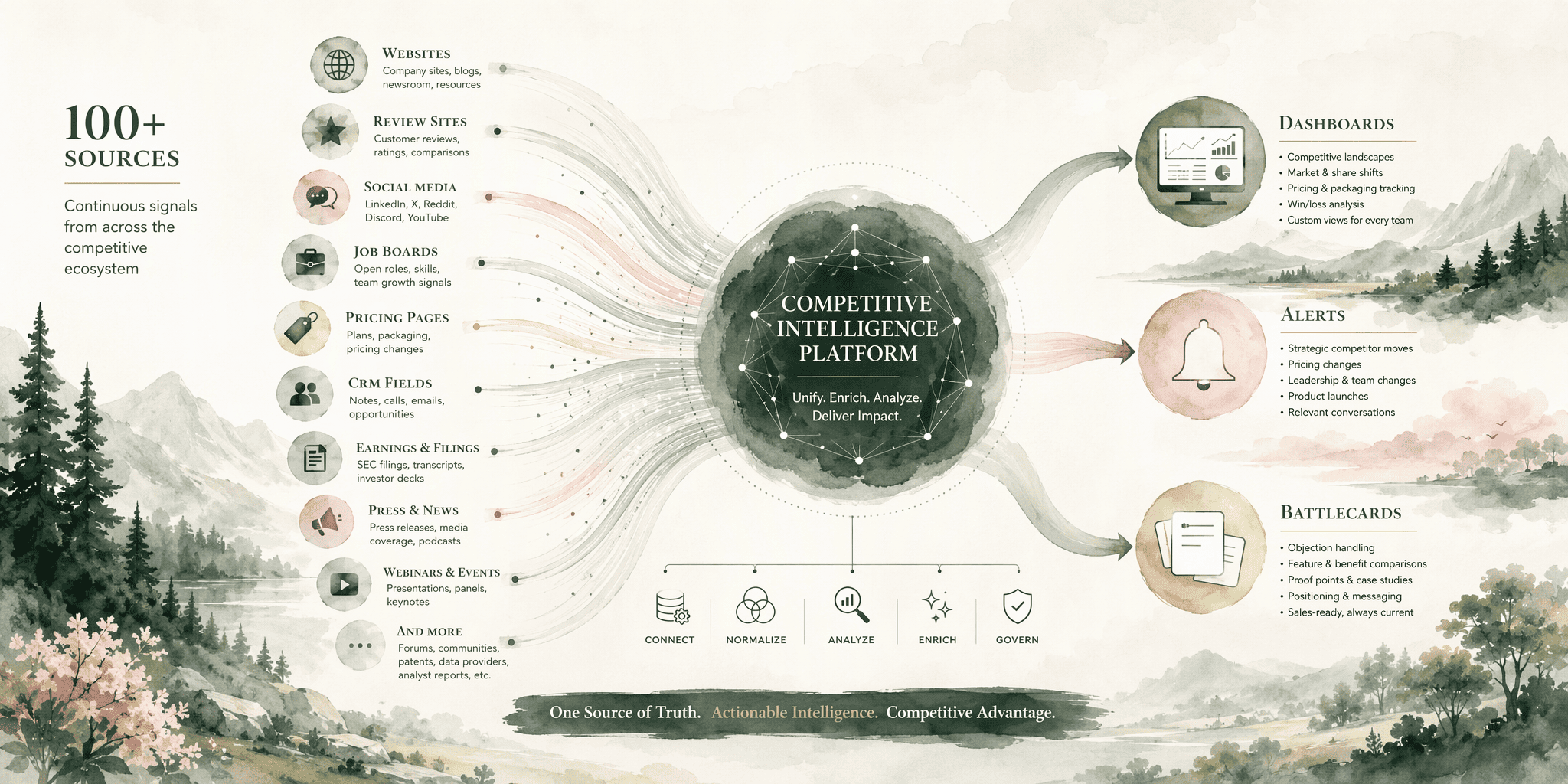
Crayon defines the ceiling of what a CI platform can do when budget and headcount are not constraints. The product aggregates intelligence from an ecosystem of over 100 data sources, websites, review sites, social media, job boards, pricing pages, CRM fields, and synthesizes it into dashboards, alerts, and battlecards that flow into where teams already work.
This is the platform a startup graduates to, not the one it begins with. Crayon's architecture assumes an intelligence aggregation model where a competitive enablement manager or product marketing owner configures what gets tracked, curates the signal from noise, and trains customer-facing teams to use the battlecards and talking points in live deal cycles. The average sales team already rates itself just 3.8 out of 10 for competitive preparedness, and no software alone closes that gap without a human operator bridging intelligence and execution.
At $20,000 to $40,000 annually, Crayon's price is a line item that requires dedicated sponsorship from a revenue or product leader who can defend the ROI. A 25-person startup with a founder-led sales team does not yet have the deal volume or the competitive complexity to generate that ROI.
For most under-50-person teams, Crayon is the right benchmark to understand when CI infrastructure becomes necessary, just not the right tool to buy today.
7. Owler, Freemium company profiles and news alerts for early discovery
If your startup has no CI budget, Owler is the only genuinely free way to monitor competitors at the company level. The freemium tier includes company profiles, funding announcements, CEO changes, and market activity alerts. The signals are basic, but they keep you from operating in the dark.
Scope and depth is where Owler stops. It aggregates public news and structured company data. It will not surface a competitor's new pricing page, track the battlecards your reps actually need, or tell you whether a rival is showing up in AI answers to your buyer's questions.
What Owler does well is the early-warning job. You learn a competitor closed a Series B or expanded into a new geography before it lands in a deal conversation. For that narrow use case, the freemium profile works. For anything beyond it, pair Owler with one of the paid platforms above.
Conclusion
For startups under 50 people, the right CI stack starts with the function closest to your competitive pain. Pick one anchor tool and build outward.
Sales-led teams should begin with LinkedIn Sales Navigator at $960 per year to capture personnel and account signals. Marketing-led teams should begin with Semrush at $139.95 per month to own digital channel intelligence.
Every startup should strongly consider adding Kompyte at $300 per year. It is the only budget platform that delivers dedicated automated competitive tracking and battlecards.
Layer in Siftly's AI citation monitoring if you are losing deals because competitors own the AI-search answer for your category.
Defer Klue and Crayon until you have a dedicated competitive enablement function and the deal volume to justify the five-figure price tag.
Frequently Asked Questions
What are the most affordable competitive intelligence platforms for startups with under 50 employees?
The most affordable CI platforms each serve a different function:
- Kompyte at $300 per year, automated tracking and battlecards
- LinkedIn Sales Navigator at $960 per year, personnel signals
- Semrush starting at $139.95 per month, digital footprint analysis
How much do AI-native competitive intelligence tools cost per month in 2026?
AI-native CI tools range widely in price and target audience:
- Klue and Crayon start around $20,000 to $40,000 annually and target enterprise teams
- AI-search monitoring platforms like Siftly offer Growth-tier pricing with a 14-day free trial
- Most mid-market AI visibility tools fall between roughly $29 and $200 per month
What features should a startup prioritize in a competitive intelligence platform?
Startups should focus on three priorities when choosing a CI platform:
- Prioritize automated monitoring over manual curation
- Ensure battlecard generation for sales enablement
- Pick tools that surface competitive moves before they appear in deal cycles, and avoid platforms that assume a dedicated CI operator until your team has the headcount to support one
How does Siftly compare to other affordable CI tools for AI search monitoring?
Siftly monitors brand and competitor citations across nine AI engines including ChatGPT, Google AI Overviews, Gemini, and Perplexity with daily automated queries. Traditional CI platforms miss AI-search visibility entirely, making Siftly a distinct category tool rather than a direct Kompyte or Semrush replacement.
Can startups access free competitive intelligence tools before paying?
Yes, several CI tools offer free trials or freemium tiers to get started:
- Owler offers freemium company profiles and news alerts at zero cost
- Siftly provides a 14-day free trial with no credit card required
- Competely costs $39 per month with no long-term commitment and generates analysis across 100-plus data points per competitor
What drives competitive intelligence pricing up as a team grows?
Three factors typically drive CI pricing higher:
- Tracked prompts or data sources: More tracked prompts or data sources increase costs.
- Workspaces or brands monitored: More workspaces or brands monitored raise the price.
- Historical data depth retention: Deeper historical data retention drives higher pricing.
Sources
- 4 Best AI Competitive Intelligence Tools for SMBs - siftly.ai
- Competitive Intelligence Tools: 10 Compared for Startup Sales Teams (2026) - www.miniloop.ai
- 11 Best Competitive Intelligence Tools (2026) - www.contify.com
- Competitive Intelligence for Startups - Competely - competely.ai
Keep exploring
More from the blog.

Oct 20, 2026
How to Get Real-Time Alerts When Competitors Change Their Messaging
Your top competitor just repositioned their entire product line around a new AI feature. Your sales team will find out in three weeks when a prospect parrots

Oct 20, 2026
Track Competitor Pricing Without Ever Visiting Their Sites: A 7-Step Guide
You know the burnout. Opening twenty browser tabs every morning, copying prices into a spreadsheet that is already out of date by the time you finish

Oct 17, 2026
How to Measure AI Share of Voice in 2026: The 7-Step Execution Plan
Your brand might be mentioned in a ChatGPT answer right now, but you have no dashboard that shows it.