Aug 5, 2026
6 Tools That Show Exactly What AI Says About Your Brand
AI search engines don't index content, they extract it. When a prospect asks ChatGPT or Perplexity for a recommendation and your competitor's brand surfaces

Introduction
AI search engines don't index content, they extract it. When a prospect asks ChatGPT or Perplexity for a recommendation and your competitor's brand surfaces in that answer, you lose a deal before your website even enters the conversation. Most marketing teams have no instrumentation for this channel. They operate blind while AI search visitors convert at 4.4 times the rate of traditional organic visitors.
The problem isn't theoretical anymore. OpenAI reported surpassing 100 million weekly active users for ChatGPT in late 2023, and Google surfaces AI Overviews across a growing share of commercial queries. These systems make citation decisions based on probabilistic generation models, not your carefully optimized landing pages. Traditional web analytics fail to capture AI-powered brand discovery because the impression, the click path, and the conversion attribution sit inside a black box.
A new category of tools has emerged to solve this. AI brand monitoring platforms systematically query models like ChatGPT, Gemini, Perplexity, and Google AI Overviews, then record what they say about your brand versus competitors. This article breaks down the platforms that show you those answers, ranked by how well they deliver the visibility data marketing teams actually need.
Key Takeaways
Two purpose-built platforms lead the market for AI answer monitoring, and the rest fill complementary or adjacent spaces. Here is what the landscape looks like in 2026:
- SE Visible is the best weekly monitoring tool: It samples about 27,000 AI answers per month across 450 prompts on the $99/month Starter plan, covering ChatGPT, Gemini, Perplexity, and Google AI Overviews with multi-country support.
- InfluenceAI wins for deep competitive intelligence: Monitoring over 20,000 prompts monthly, it benchmarks against five competitors, adds Claude and Grok coverage, and provides citation source intelligence with an enterprise pricing model.
- Sampling frequency is the core differentiator: SE Visible updates weekly for ongoing visibility snapshots; InfluenceAI reports monthly, suited to strategic competitive analysis cycles.
- Adjacent platforms cover pieces of the puzzle: Semrush tracks AI Overviews within a broader SEO suite, Brandwatch and Sprinklr offer social and customer experience monitoring without systematic LLM querying, and Siftly provides AI-referred click tracking with a competitive intelligence layer.
Verdict
SE Visible is the right starting point for most marketing teams. For $99 a month, you get weekly snapshots of what ChatGPT, Gemini, Perplexity, and Google AI Overviews say about your brand, covering roughly 27,000 AI answers sampled across 450 prompts. That is enough coverage to catch displacement events before they compound, and enough frequency to act on trends rather than autopsy them.
InfluenceAI takes the lead when your competitive intelligence demands are heavier. Its monthly reporting covers over 20,000 prompts and benchmarks your brand against five competitors, which makes it ideal for a structured quarterly or monthly brand perception audit. The platform also includes Claude and Grok, which broadens the model coverage materially.
Those systems serve distinct user demographics and their citation patterns drift independently. InfluenceAI surfaces which sources the models pulled when they cited you or your competitor. That source-domain intelligence tells you whether your earned media is converting into AI citations, or whether your rival's PR push just captured the recommendation slot you were targeting.
The choice reduces to cadence and depth. Buy SE Visible if you need weekly check-ins, accessible pricing, and the core LLM set. Buy InfluenceAI if you need broader model coverage, formal competitor benchmarking, and the source attribution layer that turns a visibility number into an actionable content or PR brief. Either way, you stop guessing what the models say and start measuring it. In a channel where ChatGPT cites pages ranking in traditional positions 21 or lower almost 90% of the time, waiting for rank-tracker data to signal a problem guarantees you arrive late.
Comparison Table
Six platforms surface in any evaluation of AI brand monitoring. Here is how they stack up on the dimensions that matter when you are buying:
| Dimension | SE Visible | InfluenceAI | Semrush | Brandwatch | Sprinklr |
|---|---|---|---|---|---|
| LLM Coverage | Tracks ChatGPT, Gemini, Perplexity, and Google AI Overviews across seven markets. | Adds Claude and Grok to the ChatGPT/Gemini/Perplexity/Google AI Overviews set. | Monitors AI Overviews within search results; does not query LLMs for standalone brand mentions. | Does not systematically query LLMs for brand-specific answers. | Does not systematically query LLMs for brand-specific answers. |
| Sampling Cadence | Weekly snapshots. | Monthly reports. | Refreshes with broader SEO crawl cycles. | Event-triggered social listening. | Event-triggered social listening. |
| Competitor Benchmarking | Tracks named competitors across the US, UK, and five additional markets. | Benchmarks against up to five named competitors with share-of-voice scoring. | Provides competitive keyword data but no AI-answer-specific comparisons. | ||
| Pricing Entry Point | Starts at $99 per month for the Starter plan. | Enterprise pricing; requires a sales conversation upfront. | Bundled with the broader Semrush SEO suite. | Enterprise platform pricing. | Enterprise platform pricing. |
| Standout Capability | Weekly multi-country AI-answer snapshots at an accessible price point. | Broadest LLM coverage paired with citation-source granularity. | Connects AI Overviews tracking to full-funnel SEO data. | Unifies AI monitoring with cross-channel listening and CX data. | Unifies AI monitoring with cross-channel listening and CX data. |
1. Siftly

Siftly comes at the AI visibility problem sideways. It does not sit there pinging models with the same queries week after week. Instead, it watches how AI systems find, judge, and cite content across the major conversational platforms.
The focus is on AI-referred clicks and the actual prompts shoppers type before they buy. You get competitive intelligence and a visibility benchmark against your competitors, broken out by query type. For a marketing team, that is a useful directional snapshot of where the brand shows up in AI-generated answers.
Siftly is not a systematic sampling engine. Its GEO-first approach and citation tracking layer help teams that want AI visibility data paired with optimization workflows they can act on. The methodology is different from what SE Visible does with its weekly 27,000-answer sampling engine, or what InfluenceAI does with its 20,000-plus-prompt competitive audit model. Single-prompt checks are unreliable because AI responses drift. Siftly is built for ongoing visibility intelligence and competitive benchmarking, not the kind of fixed-interval snapshot reporting that lets you chart a brand's citation share week over week.
If your team already works with feed-level pricing data and wants an AI visibility layer, Siftly fits into that stack without much friction. If your main question is "what exactly did ChatGPT say about my brand versus my three closest competitors yesterday," the tools that query on a set schedule give you a straighter answer.
2. SE Visible

SE Visible sends you a snapshot of what AI models say about your brand every week, not once a month when the damage is already done. It queries ChatGPT, Gemini, Perplexity, and Google AI Overviews against 450 prompts on the Starter plan, pulling roughly 27,000 AI answers per month. The numbers refresh weekly, so you see a competitor's content push claiming your citation slot before it calcifies into the model's default answer.
The tool monitors brand visibility across seven markets: the US, UK, Canada, France, Germany, the Netherlands, and Spain. Geographic coverage is not a checkbox here. The same prompt routed through a different region often returns different brand citations, because the models pull from locally indexed sources. A brand selling in three countries but measuring only one is flying with a broken altimeter.
At $99 per month for the Starter tier, SE Visible puts AI brand monitoring within reach of teams that cannot justify a five-figure enterprise contract. The platform does one thing and does not pretend to be an SEO suite with an AI tab tacked on. Its dashboards surface sentiment, citation rate, and source domain data in a layout built for the workflow, without the clutter of unrelated metrics.
The weekly cadence is what keeps the tool honest. Brand displacement in AI answers is not a quarterly event. A rival drops a detailed comparison guide, earns a handful of citations from authority domains, and the models begin shifting their recommendations within days. Weekly sampling catches the pivot early, while a monthly report turns AI search into a lagging indicator that tells you what happened last cycle instead of what is happening now.
3. InfluenceAI

InfluenceAI is the enterprise-grade option for teams that need the broadest model coverage and the deepest competitive intelligence layer. It monitors over 20,000 prompts per month across six LLMs, adding Claude and Grok coverage that SE Visible does not currently offer. Here is what sets it apart:
- Citation source intelligence: Reports identify which domains the models pulled when citing your brand or a competitor. That turns a visibility number into an actionable brief: if your earned media is not converting into citations, you know exactly where the gap sits.
- Claude and Grok coverage: These models serve distinct user bases and their citation patterns can diverge significantly from ChatGPT and Gemini. Monitoring only the two largest LLMs leaves a blind spot that InfluenceAI specifically closes.
- Monthly reporting cadence: This suits quarterly brand perception audits, executive reporting, and structured competitive analysis cycles rather than week-over-week tactical monitoring.
InfluenceAI carries enterprise pricing, which means it requires a sales conversation rather than a self-serve checkout. For brands where AI-generated recommendations directly drive revenue and competitive displacement costs are measurable, that investment justifies itself quickly.
4. Semrush
Most marketing teams already have Semrush. Its AI Overviews tracker surfaces Google-generated AI answers that include or relate to your tracked keywords, folding that visibility data into the SEO dashboard your team already uses.
Semrush is not a dedicated LLM query engine. It tracks AI Overviews inside Google search results pages. It does not track independent conversations happening inside ChatGPT, Perplexity, or Gemini's standalone interfaces.
That gap matters. Google AI Overviews are one surface inside one model ecosystem. ChatGPT and Perplexity answer millions of purchase-intent questions every day and often cite completely different sources from Google's model. If you rely on Semrush alone to monitor AI visibility, you see maybe a third of the picture. The platform's AI Overviews tracking works best as a complementary signal layer on top of the SEO data you already pay for, not as a standalone answer to "what do AI models say about my brand versus competitors."
5. Brandwatch
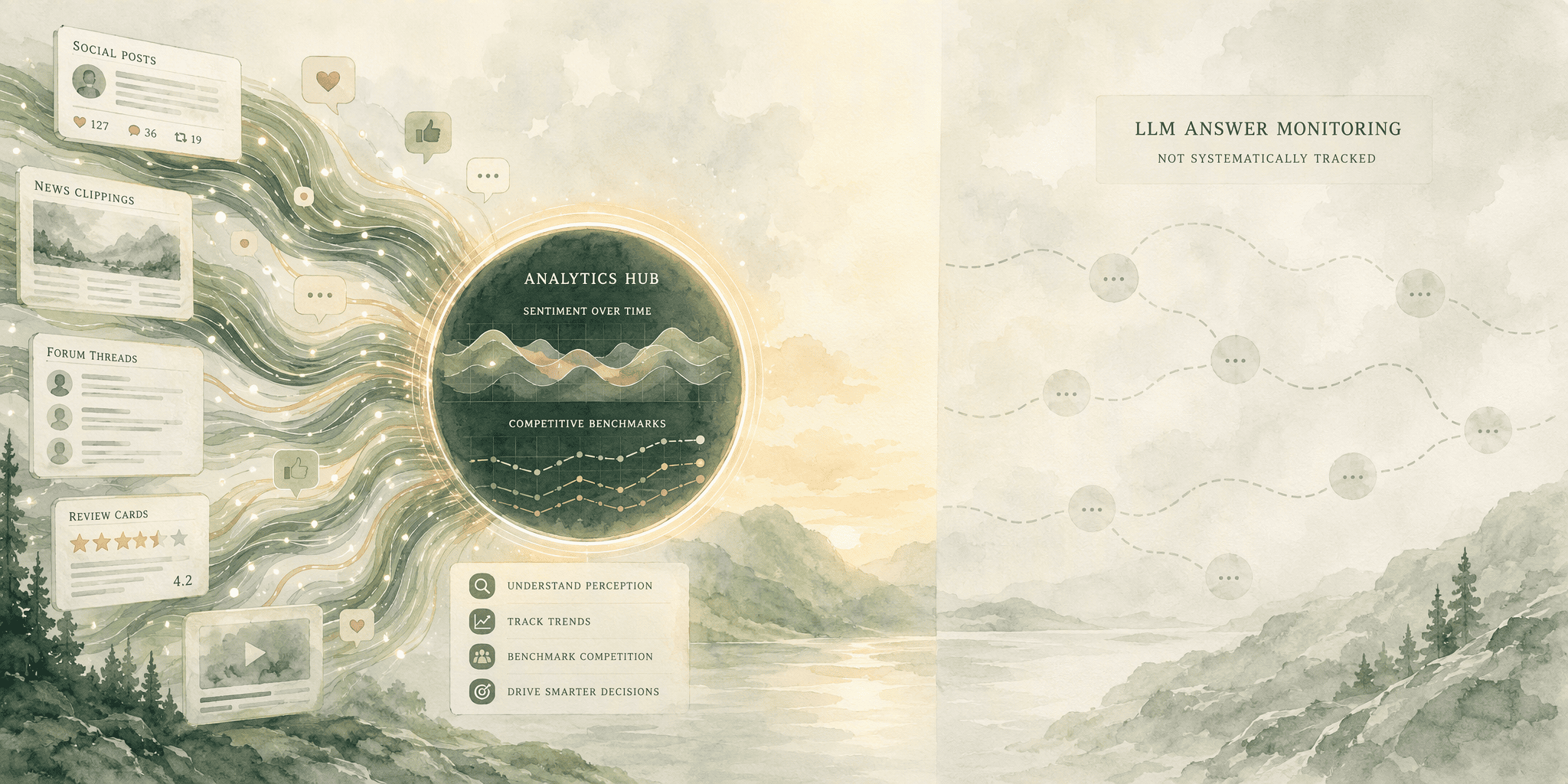
Brandwatch is a social and web listening platform. It does not monitor AI answers. The tool tracks brand mentions across social media, news sites, forums, and review platforms, applies sentiment analysis, and runs competitive benchmarks on those conversations. Its AI-related features flag AI-generated social content and analyze public chatter about AI. It does not query LLMs systematically and record what they say about your brand.
Social listening and AI answer monitoring pull from separate data sources and produce different signals. The first measures what people post about your brand in public forums. The second measures what language models extract, synthesize, and recommend when someone asks a direct question. Conflating the two leads to gaps you will not see until a competitor's visibility data lands on your desk.
If your core question is "what are ChatGPT and Perplexity telling potential buyers about my category," Brandwatch will not answer it. The platform still works for traditional share-of-voice measurement and crisis detection. It just belongs in a different product category from the dedicated LLM query tools this article evaluates.
6. Sprinklr

Sprinklr brings together data from social, messaging, review, and owned channels inside a single platform. Its AI does sentiment analysis, picks up intent signals, and reports on content performance across those channels. But the platform does not systematically query LLMs for brand-versus-competitor answers, and that capability isn't listed as a core feature.
| Capability | Sprinklr | Dedicated AI Monitoring (SE Visible / InfluenceAI) |
|---|---|---|
| Systematic LLM querying | Not supported | Core functionality with scheduled sampling |
| AI-answer brand citation tracking | Not a product feature | Primary metric tracked across models |
| Competitor citation share in AI answers | Not measured | Benchmarked against 1 to 5 named competitors |
| Pricing model | Enterprise CX platform pricing | Starts at $99/month or enterprise annual |
| Primary use case | Cross-channel customer experience and social management | AI-specific brand visibility and answer monitoring |
Enterprise buyers looking at Sprinklr shouldn't assume its AI reaches into the systematic LLM answer monitoring that SE Visible and InfluenceAI deliver. The platform works well as a cross-channel intelligence layer. For the specific question at hand, it leaves a gap that calls for a supplementary tool.
Conclusion
You can track what AI models say about your brand. SE Visible charges $99 per month and pulls weekly snapshots from ChatGPT, Gemini, Perplexity, and Google AI Overviews. It answers the basic question: are we showing up.
That covers the baseline. InfluenceAI adds Claude and Grok, benchmarks against five competitors, and maps which sources the models are citing. The output is not just a report. It is a brief that tells you what to do next.
Start with SE Visible. Set it up for your primary market and your two closest competitors. Run four weekly snapshots so you have a real baseline, not a single noisy data point. Once you see the patterns, you can decide whether the wider model coverage and monthly competitive reports from InfluenceAI are worth the enterprise price.
The math has changed. Visitors arriving from AI search convert 4.4 times more often than organic visitors from traditional search. Intuition cannot keep up with that gap, and guessing is no longer free.
Frequently Asked Questions
How can I monitor what AI platforms like ChatGPT and Google AI Overviews say about my brand?
Use a dedicated AI brand monitoring platform like SE Visible or InfluenceAI. These tools systematically query LLMs with your target prompts on a scheduled cadence, then record the answers, track sentiment and citation rate, and benchmark your visibility against competitors. Single manual checks are unreliable because AI responses vary.
What are the best tools for comparing my brand's AI visibility with competitors?
SE Visible and InfluenceAI offer the most direct competitor benchmarking for AI answers. InfluenceAI tracks up to five named competitors and reports their citation share alongside yours. SE Visible supports competitive tracking across multiple countries. Both measure citation rate, sentiment, and source domains for each brand compared.
How do platforms like Siftly track how often a brand appears in AI-generated responses?
Siftly tracks AI-referred clicks and captures the prompts shoppers ask before making purchase decisions, combining that visibility data with competitive intelligence and benchmarked performance across query types. Its GEO-first approach monitors how AI systems discover, evaluate, and cite content rather than running scheduled batch-queries against LLM APIs on a fixed interval.
What is the difference between live AI browsing and scheduled sampling for brand monitoring?
Scheduled sampling queries AI models at fixed intervals with a standardized prompt set, producing consistent time-series data you can trend. Live browsing checks a response on demand. Scheduled sampling is the more reliable approach because AI responses vary with each query; a single check cannot distinguish between a trend and normal variability.
How can marketers measure the ROI of improving their brand's AI citation rate?
Start by tracking AI search visitor conversions, which Semrush research found convert at 4.4 times the rate of traditional organic visitors. Monitor your citation rate baseline, then measure uplift as you invest in content that earns third-party validation and cross-platform consistency. No platform currently offers a fully validated citations-to-revenue attribution model.
What content strategies improve a brand's likelihood of being cited by AI answer engines?
AI systems cite content based on entity recognition, third-party validation, cross-platform consistency, content relevance, and credibility. Build clear, structured content with FAQ and How-To schema, earn mentions on authoritative third-party domains, and maintain consistent brand entity information across the web. Product categories respond more quickly than trust-heavy financial categories.
Sources
- How to build brand visibility in AI search - www.semrush.com
- Compare the best AI brand monitoring tools in 2026. See features, pricing, and best-fit use cases for tracking visibility in ChatGPT, Gemini, etc. - slatehq.com
- SE Visible — An AI Visibility Tool Made to ... - SE Ranking - visible.seranking.com
Keep exploring
More from the blog.

Oct 24, 2026
7 Best AI Optimization Platforms for B2B SaaS Startups on Tight Budgets in 2026
ChatGPT named your B2B SaaS startup during a buyer's evaluation, then told them to go with a competitor.

Oct 24, 2026
7 Best Platforms for Monitoring How AI Perceives Your B2B SaaS Brand in 2026
Your B2B SaaS brand is being evaluated by machines right now. A prospective buyer asks ChatGPT to “compare the top data onboarding tools for mid-market

Oct 23, 2026
How to Optimize Your Brand Presence in Generative AI Search Results
The uncanny silence of organic traffic in analytics dashboards isn't a tracking bug; it's the sound of a fundamental shift.