Aug 21, 2026
6 Reasons Your Website Traffic Is Falling While Rankings Hold
Your organic traffic charts a downward slope while your keyword rankings hold steady. The same positions that once delivered reliable visitors now generate

Introduction
Your organic traffic charts a downward slope while your keyword rankings hold steady. The same positions that once delivered reliable visitors now generate silence. This is the structural reality of AI-powered search in 2026, where answer engines like ChatGPT and Google AI Overviews satisfy user intent directly on the results page, eliminating the need for a click.
Major retailers, news publishers, and marketing agencies absorbed traffic drops of 20 to 40 percent in 2025 as this shift accelerated. The mechanism is brutal in its simplicity: a user asks a question, an AI synthesizes an answer from multiple sources, and the user leaves satisfied without visiting a single website. This phenomenon, widely termed "zero-click search," has rewritten the rules of digital visibility.
The underlying problem is not that your content has lost value. It is that discovery has migrated from a link-based economy to a citation-based one. Traditional analytics were built to measure clicks from ten blue links.
AI answer engines show between two and five links, and the presence of an AI Overview pushes the zero-click rate from 54 percent to 72 percent. The visitors who do arrive, however, represent qualified intent.
An experimental study with 1,065 U.S. participants found that removing top-position AI Overviews from a search nearly doubled outbound clicks, and yet those clicks did not improve user satisfaction. The researchers concluded that these summaries "divert traffic away from publishers without delivering measurable improvements in user experience."
The path forward is not about clawing back lost clicks. It requires Generative Engine Optimization, AI citation monitoring, and a new measurement framework oriented around engagement quality rather than traffic volume. This article examines the tools and tactics that let you diagnose the damage and rebuild visibility where your audience now encounters your brand: inside AI-generated answers.
Key Takeaways
- AI search engines are not trimming your traffic around the edges. They are rewiring who sees your content and how. The shift is structural, and its numbers are sharp.
- A 2025 field study by Search Engine Journal measured what many marketers now feel in their own analytics: Google AI Overviews cut organic clicks by 38 percent. Retailers, publishers, and agencies lost 20 to 40 percent of their organic search traffic that year as query volume shifted to AI answer engines.
- When an AI Overview appears on a results page, the click-through picture changes overnight. Forrester found that the zero-click rate jumps from 54 percent on standard queries to 72 percent when an AI-served answer sits at the top of the page.
- That dynamic demands a different playbook. Generative Engine Optimization is the discipline of structuring content so large language models cite it in their answers. It is distinct from traditional keyword-centric SEO, and it is the practical replacement for a shrinking click-based funnel.
- The visitors you do get from AI search behave differently. SE Ranking research found that AI-referred traffic generates sessions 68 percent longer than standard organic search visits. These are people reading, not quick-bouncing.
- That changes which numbers matter. Time on page, conversions, and AI citation share replace raw click counts as the metrics you track. Impressions and conversions often rise even as clicks fall.
- A focused GEO effort can move the needle fast. One company using AI-powered optimization tools increased its appearances in Google AI Overviews by 61 percent, a margin that shows what deliberate optimization can produce when the strategy shifts from fighting the AI layer to earning a place inside it.
Verdict
The traffic erosion you are seeing is not a temporary dip. It is a permanent shift in how users encounter information. When Google began layering AI Overviews onto U.S. search results on May 14, 2024, the traditional SERP began its transformation from a directory of links into an answer destination. Marketers who treat this as a transient algorithm update will watch their visibility steadily contract. Research from Forrester projects that brands unprepared for AI-powered search could see traditional search traffic decline by 20 to 50 percent by 2028.
The sustainable response is Generative Engine Optimization, the discipline defined by Kellogg professor Kelly Cutler as "a new version of SEO that really takes into account the fact that we are absolutely going to see these dips." The objective shifts from ranking in ten blue links to earning citations inside AI-generated answers. One company Cutler advised used an AI-powered optimization tool to restructure its content and grew its AI Overview appearances by 61 percent. The same pattern appears across clients: impressions and conversions rise even as raw clicks contract, because the remaining traffic carries stronger intent signals.
Winning requires two simultaneous moves. Second, reorient your analytics stack around attention minutes, conversion rate, and scroll depth. Clicks are no longer the primary currency. Citations are.
Comparison Table
Each tool solves a different part of the AI visibility problem. Siftly and Profound track whether your brand shows up in generative answers. BrandVerity checks if those mentions are accurate. Semrush and Google Search Console bridge the old SEO world and the new one. Chartbeat tells you whether anyone actually reads what the AI sends over.
| Dimension | Siftly | BrandVerity | Semrush | Profound | Google Search Console | Chartbeat |
|---|---|---|---|---|---|---|
| Primary function | Real-time AI citation monitoring | Citation accuracy and compliance | Traditional SEO plus AI Overview tracking | AI answer benchmarking | Traditional search performance | Content engagement analytics |
| GEO capability | Built ground-up for generative engines | Citation verification only | AI Overview tracking added to existing platform | Built ground-up for generative engines | None native | None |
| SEO metrics depth | Minimal | Minimal | Full keyword, impression, and click data | Minimal | Full keyword, impression, and click data | None |
| Engagement analytics | Basic referral tracking | None | None | None | None | Attention minutes and scroll depth |
| Free access | Free trial | No free tier | No free tier | Free trial | Fully free | Basic tier free |
| Best fit | Marketing teams needing live AI visibility data | Compliance-sensitive brand teams | SEO practitioners transitioning to AI tracking | Analysts benchmarking AI answer presence | Every site operator | Editorial teams measuring AI-referred attention |
1. Siftly
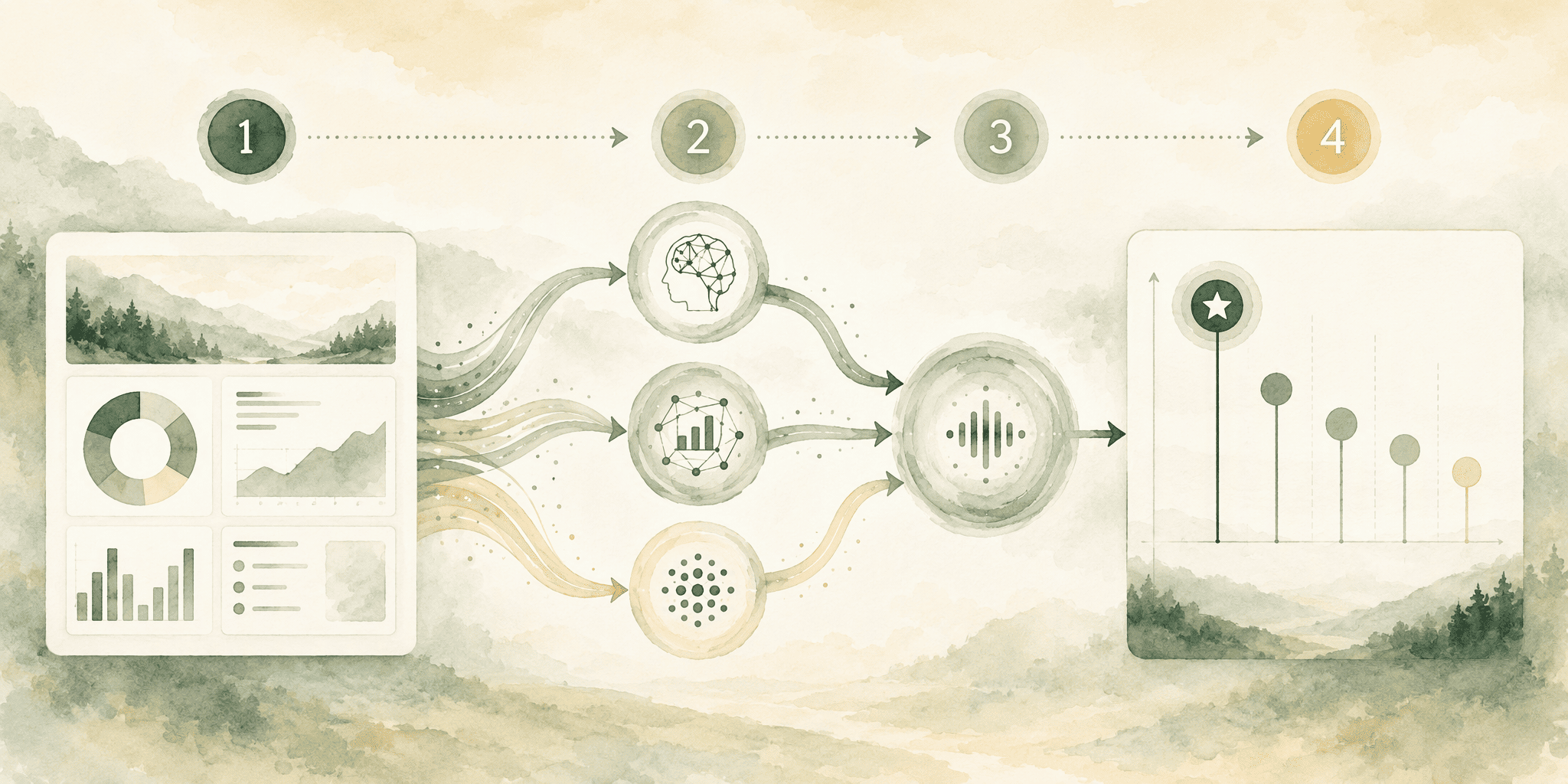
Siftly is a Y Combinator-backed platform that monitors how AI engines cite your brand and flags what you need to change to get cited more often. It runs thousands of queries across ChatGPT, Perplexity, and Google AI Overviews and benchmarks your visibility against competitors. Key capabilities include:
- Free audit: Give the tool your domain and three to five prompts that sound like real customer questions; the analysis shows which queries your competitors appear in but you don't, and recommends specific content changes to close those gaps.
- Breakdowns by AI model, geography, and topic: Results split visibility data so you can pinpoint where adjustments are needed.
- Content workflow: Produces structured, cited copy designed for LLMs.
- 14-day free trial: Runs without a credit card.
- Measurement layer, not revenue attribution: Siftly does not claim to trace a citation all the way to revenue, its own documentation notes that nobody yet has a fully validated citations-to-revenue model. What the tool does is give you the measurement layer that Google Search Console cannot: it tells you whether your brand shows up inside the answers that now intercept your former search traffic.
2. BrandVerity

BrandVerity addresses the downstream risk of AI-generated citations: not just whether you appear, but whether you appear accurately. As large language models stitch answers from multiple sources, they can misattribute a claim, conflate brands, or surface outdated compliance language. BrandVerity's monitoring infrastructure detects unauthorized or contextually incorrect brand mentions within AI-generated content and affiliate-driven placements, flagging violations before they scale.
Forrester research underscores the stakes, finding that 89 percent of B2B buyers now use generative AI in their purchasing process. When a model mischaracterizes your pricing, compliance status, or competitive position in an answer to a buyer, the resulting damage compounds without a visible correction path. BrandVerity closes that gap by scanning model outputs for deviations from approved language and surfacing them in a remediation workflow that brand-safety teams can operationalize.
3. Semrush
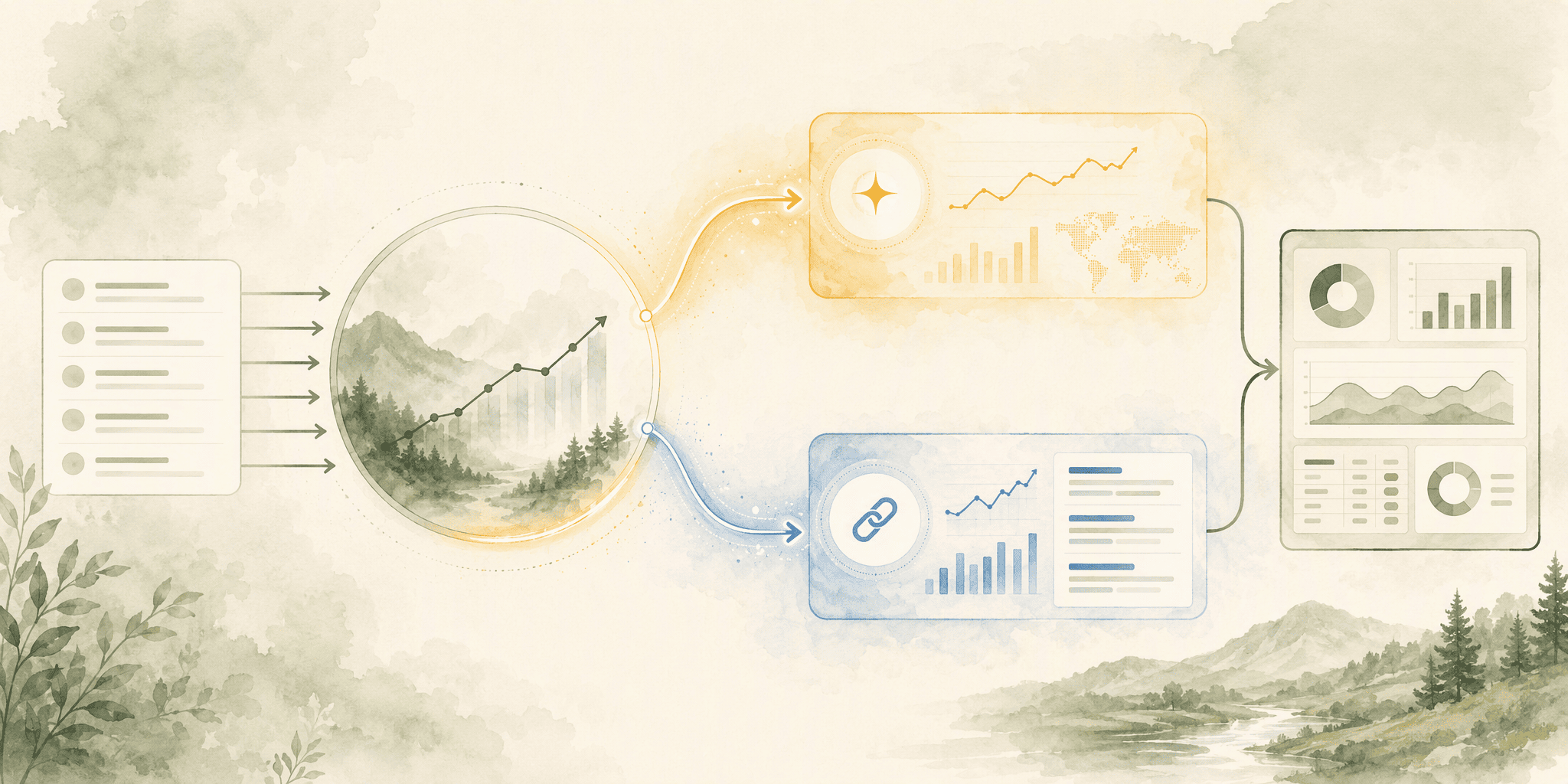
Semrush has taken its established SEO platform and extended it into AI tracking territory with an AI Overview rank tracker and keyword-visibility segmentation that isolates impressions coming from AI-generated results versus standard blue-link SERPs. Here is where the platform fits the 2026 AI visibility workflow:
- AI Overview rank tracking: Identifies which of your keywords trigger an AI Overview and whether your domain appears in the cited links within it.
- Click-type segmentation: Separates standard organic clicks from AI-served impressions, addressing a gap that raw GSC data cannot resolve alone.
- Competitor benchmarking inside AI results: Shows which domains are cited alongside or instead of yours in AI-generated answers for your tracked keyword set.
- GEO content recommendations: Surfaces keyword and structural adjustments, guided by the same platform logic that produced a 61 percent increase in AI Overview appearances for one of Kelly Cutler's clients.
Two features matter most. The click-type segmentation closes a measurement blind spot that frustrates every SEO team right now, standard analytics lump AI-served impressions in with regular organic traffic, but Semrush splits them apart so you can see what is actually happening. The GEO content guidance is the other one. It is not generic advice; it produced a 61 percent lift in AI Overview appearances for a real client account, and it suggests specific structural changes rather than broad best practices.
One limitation to know: Semrush tracks Google AI Overviews thoroughly but does not yet provide equivalent depth inside ChatGPT, Perplexity, or Claude. AI-native tools built specifically for those models cover that territory. If Google is where your audience searches, Semrush covers the right ground.
4. Profound
Profound measures how changes in search result presentation across AI answer engines translate into changes in organic click-through behavior. Its methodology centers on tracking your brand's visibility within AI-generated overviews and benchmarking that visibility against competitors to isolate the effect of AI answer placement on your traffic curves.
The core insight Profound delivers is directional attribution: when your AI citation share rises or falls, you can see precisely how much click-through and impression volume follows. This removes the guesswork that plagues teams who can see their traffic declining but cannot separate the AI Overview effect from ranking fluctuations or seasonal noise.
Profound is not an SEO platform with added AI reporting. It is built for the zero-click measurement problem directly. The tool remains specialized: it excels at AI answer visibility benchmarking but does not layer on traditional keyword research or content-generation workflows. For a team that already has an SEO stack and needs rigorous AI impact measurement, Profound fills that gap precisely.
5. Google Search Console
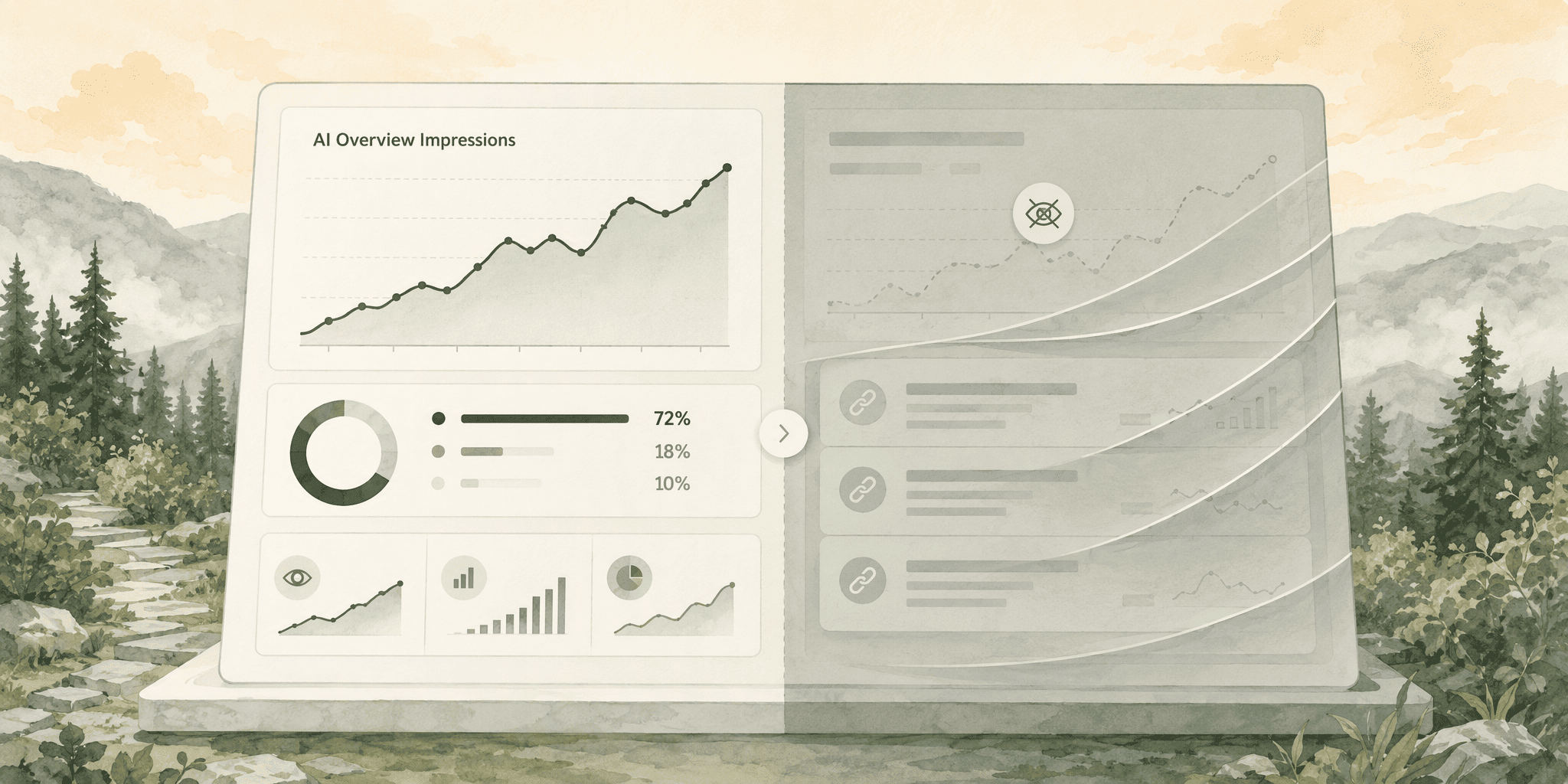
Google Search Console is where you look first, but what you see by default tells you almost nothing about AI traffic. The data is there. You just have to pull it out of the noise.
| Feature | What GSC Shows | What GSC Does Not Show |
|---|---|---|
| AI Overview impressions | Impressions from queries where an AI Overview appeared, distinguishable from standard web results with the search appearance filter | Attribution of which specific link inside the AI Overview generated the impression |
| Click and CTR segmentation | Click rates segmented by search-appearance type, revealing whether AI-served impressions convert to clicks at a lower rate | Click data from non-Google AI engines such as ChatGPT, Perplexity, or Claude |
| Position tracking continuity | Your average position for tracked queries, still the backbone of visibility measurement | Indication of how AI answer engines weight or cite your content outside the Google ecosystem |
| Zero-click behavior insight | Indirect evidence through impression-to-click ratios where impressions are high but clicks are low | Direct zero-click measurement, which requires a third-party tool layered on top of GSC export data |
| Query-level AI presence | Which specific queries triggered an AI Overview, enabling you to build an AI-impacted keyword list | The content of the AI Overview itself or which of your competitors were cited alongside or instead of you |
Filter by search appearance to isolate AI Overview impressions. That column shows you which queries fired an AI snapshot, and you can compare the click-through rate against queries where no overview appeared.
The gap is where you do the math. High impressions with low clicks on AI-present queries is your zero-click signal. You don't get a direct count, so you layer on a rank tracker or third-party click estimator to put a number on what you lost.
Position data still matters, but differently. A steady drop in position on a query that now triggers an AI Overview hurts harder than an equivalent drop on a query that doesn't. Context changes the cost of every rank shift.
6. Chartbeat
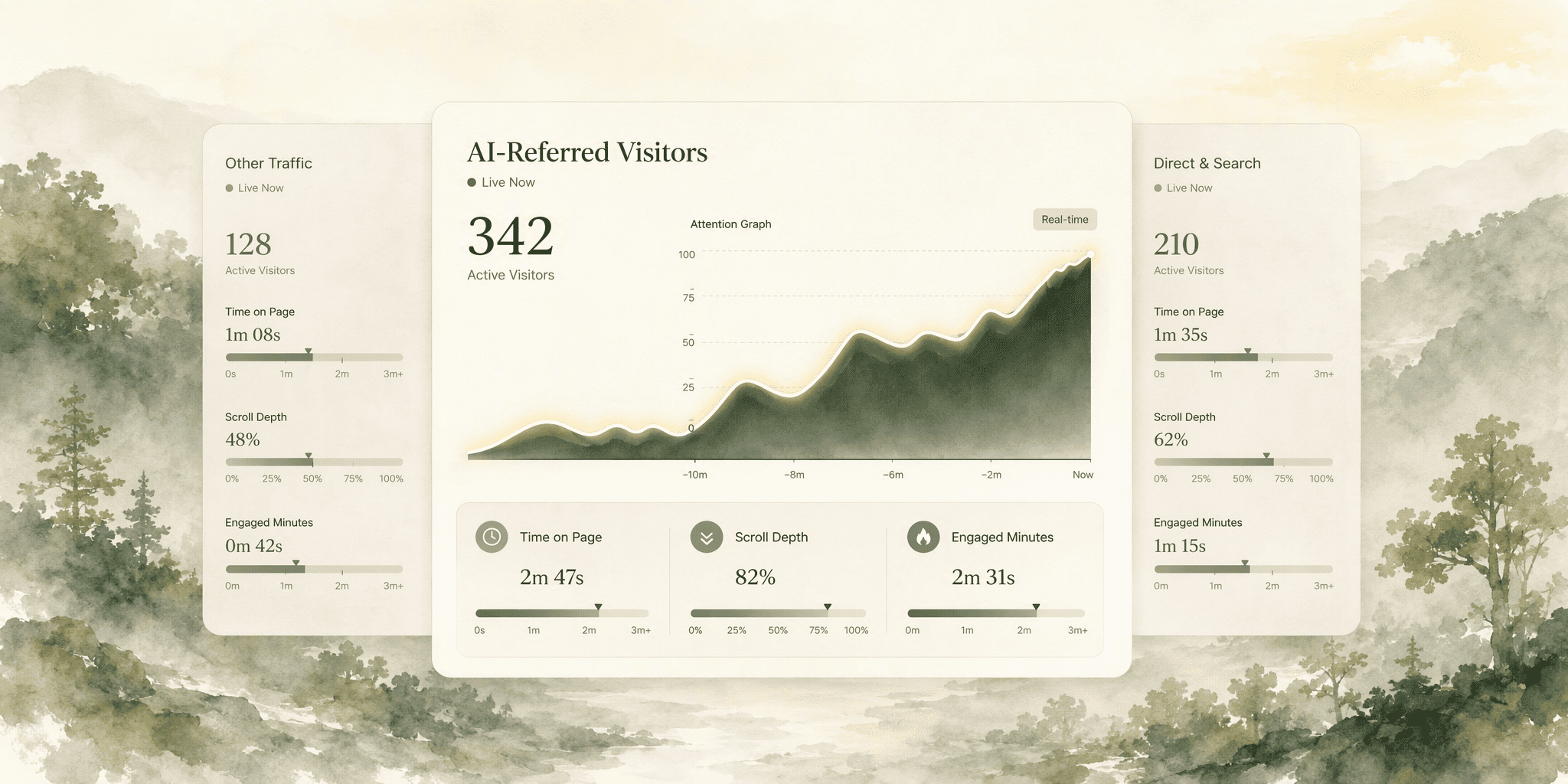
Chartbeat solves a problem that no search-side tool addresses: validating that the smaller volume of AI-referred traffic actually carries more value.
When AI-referred visitors arrive on a page, Chartbeat's real-time attention analytics measure time on page, scroll depth, and engaged minutes rather than the vanity metrics of sessions and pageviews. The SE Ranking research confirms the pattern: visitors referred by AI engines spend 68 percent more time on websites than those arriving from standard organic search. Your total traffic number declines, but the per-visitor engagement metric rises, a trade-off that only becomes visible when you switch your measurement lens.
Chartbeat surfaces this shift by segmenting referral source in its attention reports, letting you compare AI-referred visitor engagement directly against organic search and social traffic. For editorial and content teams who need to justify investment in GEO when click-based reports show losses, Chartbeat provides the counter-narrative: traffic is falling, but the remaining readers are reading more deeply.
Conclusion
In 2025, retailers, publishers, and agencies lost 20 to 40 percent of their organic traffic. That traffic isn't coming back. AI answer engines now resolve queries that used to land on your site.
From 2024 to 2026, AI-driven referral traffic jumped 16x. ChatGPT alone accounts for 74.78 percent of it, and Claude grew 320 percent year over year. The volume has already shifted.
The fix is two pieces of infrastructure. First, you need AI citation monitoring. You can't recover visibility inside an answer engine you aren't tracking.
Siftly handles real-time competitive intelligence. Profound benchmarks answer visibility. BrandVerity focuses on citation compliance.
Pick the tool that fits the gap you actually have. Second, pair Google Search Console impression data with Chartbeat attention analytics. Search Console still matters, but it tells you what might have happened.
Chartbeat tells you whether the traffic you kept actually read anything. The measurement shift from click volume to citation reach and engagement quality is the biggest change in search since the pageview was invented.
Frequently Asked Questions
Why is my organic website traffic declining even though my search rankings haven't changed?
AI-generated search summaries now answer queries directly on the results page, eliminating the need for a click even when your page ranks well. When Google AI Overviews appear, the zero-click rate rises from 54 percent to 72 percent. Your ranking is unchanged, but user behavior has shifted around it.
How are AI-powered search engines like ChatGPT and Google AI Overviews changing user search behavior in 2026?
Users increasingly receive complete answers from AI models without visiting a source website. ChatGPT leads with 74.78 percent of all AI referral traffic, and zero-click searches dominate AI-served queries. The remaining visitors carry higher intent, spending 68 percent more time on site than organic search visitors.
What is Generative Engine Optimization and how does it differ from traditional SEO?
GEO structures content so large language models cite it inside AI-generated answers rather than optimizing for a position in ten blue links. It targets visibility in ChatGPT, Perplexity, and Google AI Overviews by emphasizing citation-worthy structure over keyword density. Research from Princeton demonstrates GEO can boost visibility by up to 40 percent in generative engine responses.
How can I measure how my brand is cited and described by AI answer engines?
Use AI citation monitoring tools that query models like ChatGPT, Perplexity, and Google AI Overviews with your target keywords and report whether your brand appears in the generated responses. Platforms like Siftly and Profound benchmark your visibility against competitors and surface gaps where your content is absent from AI answers.
What practical steps can I take to optimize my content so it appears in AI-generated answers?
To restructure content for AI visibility, follow these steps:
- Restructure content to answer specific queries directly with clear, cited, structured prose that LLMs can extract.
- Run a free AI visibility audit with your brand domain and three to five real customer prompts.
- Identify gaps where competitors appear in AI answers and you do not, then adjust keyword positioning and content structure accordingly.
- Apply the approach that one company used to increase AI Overview appearances by 61 percent.
What metrics should I track to understand the business impact of people using AI instead of Google for search?
Shift your measurement from raw click volume to these metrics:
- AI citation share and impressions from AI-served queries: Track how often your brand appears in AI answers.
- Time on page, scroll depth, and conversion rate: Focus on engagement rather than clicks alone.
- Google Search Console isolation of AI Overview impressions: Separate AI-served visibility from standard search.
- Chartbeat measurement of AI-referred visitor engagement: Validate whether those visitors engage more deeply.
- Kelly Cutler's reported client pattern: Impressions and conversions often rise even as clicks decline.
Sources
- As AI Eats Web Traffic, Don't Panic—Evolve - Kellogg Insight - insight.kellogg.northwestern.edu
- GEO: Generative Engine Optimization - Princeton University - collaborate.princeton.edu
- Analysis of Top AI Search Engines: Who Is Catching Up to ChatGPT? - seranking.com
- Study Confirms Google AI Overviews Cut Organic Clicks 38% - Search Engine Journal - www.searchenginejournal.com
- Will Zero-Click Search Kill My B2B Website? - www.forrester.com
- Is AI Killing Web Traffic? How AI Overviews Impact Organic Website Traffic - HubSpot Blog - blog.hubspot.com
Keep exploring
More from the blog.

Oct 21, 2026
Can I Get Alerts When an AI Hallucinates About My Brand?
A prospect asks ChatGPT for the best enterprise security software. The AI states your company discontinued its core product line last quarter

Oct 21, 2026
8 Most User-Friendly Brand Tracking Platforms for Beginners in 2026
You launched the product, optimized the site, and started posting. A week later, the question hits: is anyone actually talking about my brand

Oct 21, 2026
7 Best AI Brand Monitoring Tools for 2026
AI search engines don't index content; they extract it. For a brand manager, that shift creates a painful blind spot