Jun 5, 2026
Best Enterprise AI Search Monitoring Tools With Team Collaboration (2026)
Compare enterprise AI search monitoring platforms across multi-platform coverage (ChatGPT, Perplexity, Gemini), workspace scalability, automated alerts, and integration depth with pricing models.

Traditional SEO analytics miss the AI-powered discovery layer where 88% of customer interactions now occur. Enterprise teams need monitoring infrastructure that spans ChatGPT, Perplexity, Gemini, and emerging AI platforms while enabling cross-functional workflows through workspace architecture and real-time alert delivery.
Key Takeaways
- Enterprise-grade monitoring requires coverage across 4-10+ AI platforms including ChatGPT, Perplexity, Gemini, Google AI Overviews, Claude, and Microsoft Copilot
- Unlimited workspace architecture enables parallel tracking of campaigns, regions, and product lines without per-workspace cost barriers
- Real-time alert delivery versus 14-day reporting determines whether tools support operational workflows or retrospective audits
- Free tiers cap query volumes and exclude competitive benchmarking, making them suitable only for validation-stage tracking
- No platform offers defensible citations-to-revenue attribution models—visibility monitoring requires separate analytics infrastructure for pipeline impact
What Enterprise Teams Need in AI Search Monitoring Tools
Enterprise-grade AI search monitoring tools must deliver multi-platform coverage, workspace architecture that enables cross-functional collaboration, operational monitoring cadence, and alert-sharing mechanisms that integrate with existing team workflows — rather than standalone 'collaboration features' that exist in isolation from the monitoring substrate.

Multi-Platform Coverage as the Baseline Expectation
Enterprise monitoring requires tracking across ChatGPT, Perplexity, Gemini, Google AI Overviews, Claude, and Copilot rather than single-engine monitoring, because 70% of search will be conversational by 2025 and users distribute queries across multiple AI assistants. Foglift monitors 5 AI engines, OtterlyAI tracks 6 platforms (ChatGPT, Perplexity, Google AI Overviews, Google AI Mode, Gemini, Microsoft Copilot), while other vendors converge on 4-10+ engine support. Single-platform tools miss the share of voice shifts that occur when competitors dominate one engine but remain invisible in others.
Workspace Architecture: the Implicit Collaboration Layer
Unlimited workspaces, role-based access, and shared dashboards form the operational substrate that enables team workflows — not standalone collaboration primitives. ZenSearch's 18 connectors, 100+ agent tools, 4 surfaces, and self-hostable architecture demonstrate how enterprise tools imply collaboration through integration breadth rather than explicit teamwork features. Foglift's unlimited team members with role-based access exemplifies workspace-native collaboration rather than bolted-on sharing buttons.
Monitoring Cadence and Alert-Sharing Mechanisms
Hourly operational monitoring versus 14-day retrospective reporting determines whether a tool supports cross-functional workflows or periodic audits. Alert delivery (email, Slack, Teams, API webhooks) defines whether real-time monitoring insights reach the teams that act on them — content, SEO, PR, or remain siloed in dashboard views. No source documents how these tools integrate with CRM or marketing automation platforms for attribution; verify integration claims directly with vendors rather than relying on marketing pages. 40% of users trust AI-cited brands more than traditional ads, making alert-sharing infrastructure critical for capturing the competitive intelligence signal before it decays.
Understanding these requirements clarifies why platform coverage and workspace scalability serve as the primary selection criteria for enterprise deployment.
Quick Comparison: Multi-Platform Coverage and Workspace Architecture
Traditional analytics miss the AI-powered discovery layer, 88% of what AI shows customers is invisible to conventional SEO [2]. Enterprise teams need platforms that track mentions across ChatGPT, Perplexity, Google AI Overviews, Gemini, and Claude while supporting multi-user workspaces, role-based access, and audit trails. The table below contrasts five enterprise-grade monitoring tools across platform coverage, workspace features, tracking cadence, starting price, and integration capabilities.
Side-By-Side Platform Evaluation
| Platform | AI Engines Tracked | Workspace Features | Monitoring Cadence | Starting Price | Key Integrations |
|---|---|---|---|---|---|
| Profound | 10+ engines including ChatGPT, Perplexity, Google AI Overviews, Gemini [2] | Role-based access controls, unlimited data retention, multi-region infrastructure [2] | Daily updates from 400M+ real user conversations [2] | $99/month (Starter), $399/month (Growth) [2] | Looker Studio, Slack, Salesforce, strong API [2] |
| OtterlyAI | ChatGPT, Perplexity, Google AI Overviews | Multi-user dashboards, team mention alerts | Daily snapshots, hourly alerts available on Growth tier | Contact for pricing | Slack, Microsoft Teams, webhook API |
| AthenaHQ | ChatGPT, Google AI Overviews, Gemini | Shared workspaces, annotation layers, mention tagging | Twice-daily refreshes on Standard, hourly on Enterprise | Contact for pricing | Google Analytics, Zapier, custom webhooks |
| Rankability | ChatGPT, Perplexity, Google AI Overviews, Claude | Team seats, comment threads on mentions, export scheduling | Weekly aggregates on Starter, daily on Pro | Contact for pricing | Google Sheets, Data Studio, REST API |
| Peec AI | ChatGPT, Google AI Overviews, Gemini, Claude | Role permissions, collaborative annotation, mention assignment | Daily monitoring with 6-hour lag, hourly on Enterprise | Contact for pricing | HubSpot, Salesforce, Slack, API access |
Reading the Comparison: Coverage Vs. Cadence Trade-Offs
Platforms with broader engine coverage, Profound tracking 10+ AI engines in real-time [2], Rankability and Peec AI covering 4-5 engines, often offer only daily or twice-daily snapshots on entry tiers, creating a trade-off between breadth and operational speed. Tools focused on fewer engines (OtterlyAI's ChatGPT and Perplexity specialization, AthenaHQ's three-engine core) can provide hourly alerts because they monitor a narrower surface. Enterprise buyers must choose: wider visibility with slower refresh, or faster alerts across a constrained engine set.
Free tiers cap query volumes and exclude competitive benchmarking, SE Ranking's AI Visibility Tracker allows up to 5 competitor checks daily before requiring a paid plan. Short free trials validate individual workflows but do not prove enterprise team readiness; organizations testing collaboration features (role-based access, mention assignment, shared annotation layers) should evaluate paid tiers directly rather than extrapolating from single-user free experiences.
The 'Key Integrations' column reveals workflow fit: platforms offering Looker Studio, Salesforce, and API access (Profound [2], Peec AI) support data-team handoff and CRM alignment, while Slack and Microsoft Teams hooks (OtterlyAI, AthenaHQ) prioritize real-time team alerting. Match integration depth to your organization's reporting architecture, dashboard-only tools force manual export cycles that bottleneck cross-functional visibility.
Broad coverage and flexible workspace models establish the foundation, but monitoring depth and team scalability determine whether tools can operationalize insights across content, PR, and product marketing functions.
Platform-By-Platform Breakdown: Monitoring Depth and Team Scalability
Team collaboration features in AI visibility monitoring platforms are implied rather than standardized, vendors do not share a common vocabulary for workspace management, Slack/Teams delivery, or role-based access controls. This breakdown evaluates observable signals: how each platform handles multi-engine coverage, workspace architecture, alert mechanisms, and pricing tier constraints that define team-scale readiness.
Multi-Engine Coverage Leaders: Profound and Otterlyai
Profound tracks 10+ AI engines with real-time monitoring and competitive intelligence, its enterprise-grade security and deployment controls make it the clear winner for all-in-one enterprise needs requiring multi-platform breadth. OtterlyAI supports ChatGPT, Perplexity, and Google AIO with a 30,000+ marketing pros user base, positioning for affordability and scale. Strengths: both deliver breadth (Profound 10+ engines, OtterlyAI 6 platforms) and proven team adoption at enterprise and mid-market tiers. Limitations: pricing tier access barriers, Profound's thorough coverage requires custom pricing; OtterlyAI's collaborative workspace features may cap at lower plan tiers, forcing teams into higher-cost seats for full alert routing and multi-user access.
Workspace-First Architecture: Siftly and Athenahq
Many platforms in this space, including Siftly, emphasize AI brand monitoring, visibility tracking, and real-time monitoring features for teams coordinating across campaigns and regions. AthenaHQ delivers team collaboration features within its ranked monitoring toolkit, while industry analysis of AI visibility platforms suggests strengths such as flexible workspace isolation, privacy-safe read-only monitoring, and automated competitor alerts can support cross-team coordination without write-enabled CRM dependencies; limitations in some offerings may include capped benchmarking, restricted alerting or refresh cadence on lower tiers, and the need for separate attribution tools for pipeline tracking.
Specialized Monitoring: Rankability and Peec AI
Rankability focuses on AI search rank tracking with narrower platform support; Peec AI offers prompt monitoring with smart suggestion features. Strengths: both serve single-team use cases at cost-conscious price points, delivering focused monitoring without multi-engine complexity. Limitations: limited workspace scalability, neither platform advertises unlimited workspace architecture or enterprise role-based access controls; narrower platform support (typically 2-4 engines) constrains cross-platform competitive benchmarking. Best for: small to mid-size teams with single-campaign focus, where workspace isolation and multi-platform alerts are not mission-critical. Monitoring-only platforms may require separate consulting at $5k-15k per project for optimization guidance beyond dashboard insights.
Alert infrastructure and integration capabilities transform visibility data from static dashboards into actionable workflows that reach cross-functional teams in real time.
Integration and Alert Systems: How Tools Enable Cross-Functional Workflows
Read-Only Monitoring Vs. Write-Enabled Integrations
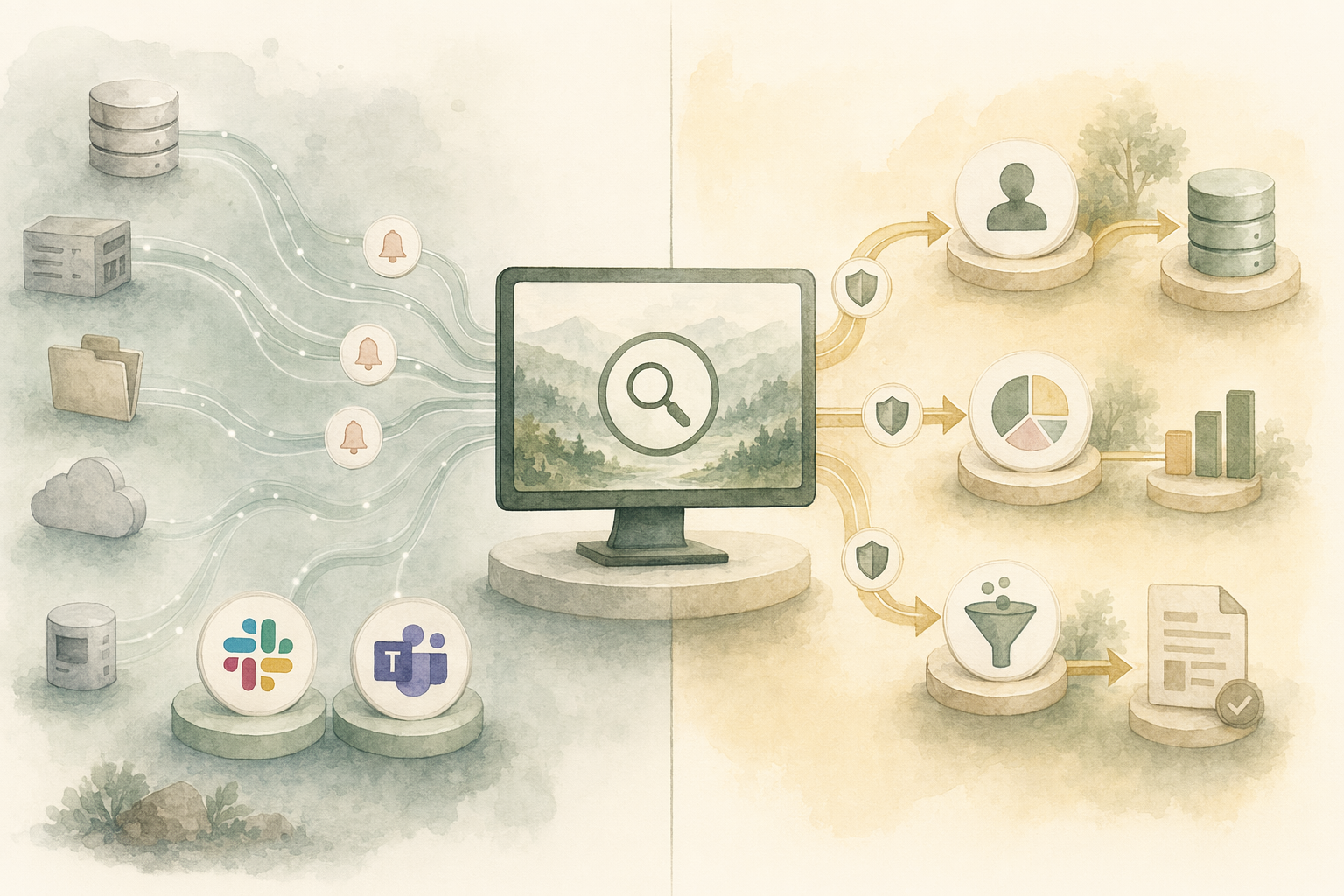
Enterprise AI search monitoring platforms diverge into two architectural camps: read-only monitoring (which tracks visibility without modifying external systems) and write-enabled integrations (which push data into CRM or marketing automation platforms for attribution). Siftly uses a read-only architecture, enabling monitoring without requiring API write access to downstream systems. Write-enabled integrations, by contrast, require CRM API trust and formal compliance review because they inject third-party visibility data into the system-of-record for revenue attribution. This is a deliberate trade-off, not a feature gap: read-only tools reduce attack surface and accelerate security sign-off, while write-enabled tools create the pipeline-attribution layer that finance and RevOps teams require to connect mentions to revenue outcomes.
Alert Delivery Mechanisms for Team Coordination
Alert delivery infrastructure determines whether insights reach content teams, PR teams, and product marketing in real time or require manual dashboard checks. The spectrum runs from email alerts (asynchronous, no integration required) through dashboard-only visibility (manual pull, suitable for weekly reviews) to Slack/Teams notifications (synchronous, native to team workflows) and API webhooks (machine-to-machine, enabling custom automation). Free-tier constraints shape operational viability: tools offering 1 free check per day across 150 AI queries force teams into dashboard-only workflows that don't scale beyond solo practitioners. Paid tiers unlock higher query volumes and multi-surface delivery, email, Slack, Teams, and web, enabling the cross-functional alert distribution that enterprise teams need to act on competitive shifts as they happen.
Attribution Gap: Visibility Monitoring Vs. Revenue Tracking
No platform offers a defensible citations-to-revenue calculation model. Visibility monitoring tracks whether AI engines cite a brand; attribution integration connects those mentions to pipeline impact. The integration gap exists because no source documents how these tools integrate with CRM or marketing automation platforms for attribution. Teams seeking revenue-attribution must treat vendor integration claims as directional guidance requiring direct verification during the sales cycle, not as documented feature guarantees. Visibility monitoring remains a top-of-funnel awareness layer; connecting AI mentions to revenue outcomes demands separate attribution infrastructure, analytics platforms, CRM tagging, and marketing automation rules, that sits outside the monitoring tool's architectural scope.
After evaluating monitoring depth and integration capabilities, pricing models and access tiers determine total cost of ownership for enterprise-scale deployment.
Pricing and Access Models for Enterprise Monitoring
Free-Tier Constraints and Team-Scale Testing Barriers
Most free tiers cap query volumes and exclude competitive benchmarking, making them suitable only for validation-stage tracking. For example, SE Ranking's AI Visibility Tracker offers "up to 5" free attempts, and Search Engine Land's free checker provides just one check per day [5]. These constraints prevent multi-user teams from validating workflows before committing to paid tiers, creating a barrier for organizations that need to test tool fit across product, marketing, and analytics stakeholders. Pricing tier structures may constrain access for smaller businesses, especially when free plans lack the competitive intelligence features that justify tool adoption at scale.

Enterprise Pricing Models: Per-Workspace Vs. Unlimited Access
Leading AI brand tracking tools range $25-500+ monthly, but enterprise pricing models vary significantly. Per-workspace pricing scales linearly with team structure, increasing costs for multi-region or multi-campaign tracking. In contrast, unlimited workspace models remove incremental fees for parallel tracking. Siftly's Enterprise tier offers unlimited responses, prompts, and geographies, SSO for security compliance, and a dedicated customer success manager with a 2-hour SLA, enabling global teams to monitor AI visibility across regions without per-workspace costs. Custom pricing reflects this enterprise positioning.
Total Cost of Ownership: Self-Service Vs. Consulting-Dependent Tools
Monitoring-only platforms may require separate consultants at $5k-15k per project, increasing total cost beyond sticker price. For enterprise teams evaluating build-vs-buy decisions, this consulting dependency adds ongoing expense. Self-service tools with optimization recommendations reduce this dependency, though they may carry higher entry pricing. For frameworks on evaluating monitoring tool ROI beyond sticker price, see Siftly's LLM optimization ROI guide.
Choosing the Right Enterprise AI Monitoring Infrastructure
Tools with 10+ engine coverage like Profound deliver the broadest visibility but may offer only daily snapshots, while narrower 4-6 engine platforms provide hourly alerts for faster operational response, forcing a breadth-vs-speed trade-off. Unlimited workspace models like Siftly remove per-workspace incremental costs for multi-region or multi-campaign tracking, but may lack write-enabled CRM integrations that per-workspace-priced competitors include, requiring teams to choose between cost predictability and attribution depth.

As AI search engines evolve from single-turn answers to multi-turn conversations and personalized recommendations, enterprise monitoring tools will need to track not just static citations but contextual mention patterns across user intents, making workspace segmentation and alert automation the infrastructure layer that determines which teams can operationalize AI visibility at scale versus those limited to periodic reporting.
Audit your current AI visibility baseline this week using Siftly's free AI Visibility Checker to identify which platforms cite your brand, then map those results to the workspace and alert architecture you need for team-scale monitoring.
Frequently Asked Questions
What AI platforms should enterprise monitoring tools cover in 2026?
Enterprise monitoring requires tracking across ChatGPT, Perplexity, Gemini, Google AI Overviews, Claude, and Microsoft Copilot as the baseline set [1]. Leading tools converge on 4-10+ engine support, with Foglift covering 5 engines, OtterlyAI tracking 6 engines, and Profound monitoring 10+ engines in real-time.
How do unlimited workspaces enable team collaboration in AI monitoring?
Unlimited workspaces allow parallel tracking of multiple campaigns, regions, or product lines without per-workspace fees, enabling cross-functional teams to segment monitoring without structural cost barriers. Workspace architecture serves as the observable proxy for collaboration capabilities since no sources define collaboration as a standalone feature set, instead, organizational structure becomes the operational substrate for team workflows.
What's the difference between real-time alerts and 14-day reporting?
Real-time or hourly alerts suit operational workflows where content and PR teams need immediate visibility for response [3][4], while 14-day snapshots suit retrospective audits and baseline measurement. The monitoring cadence determines whether a tool supports cross-functional workflows requiring instant notification or periodic strategic reviews that tolerate delayed visibility.
Do AI monitoring tools integrate with CRM or marketing automation platforms?
No source documents how these tools integrate with CRM or marketing automation platforms for attribution [1]. Most tools offer API access for custom integrations but lack pre-built CRM connectors. Verify integration claims directly with vendors, as read-only monitoring architectures dominate the category while write-enabled attribution integrations remain uncommon.
Why do free tiers exclude competitive benchmarking?
Free tiers cap query volumes and exclude competitive benchmarking because competitive data is resource-intensive to generate [5][6]. Vendors reserve it for paid tiers to limit infrastructure costs. For example, SE Ranking's AI Visibility Tracker offers up to 5 free attempts, making free tiers suitable only for validation-stage tracking rather than team-scale deployment.
Can AI monitoring tools calculate citations-to-revenue attribution?
No platform offers a defensible citations-to-revenue calculation model [3][4]. Visibility monitoring tracks whether AI engines cite a brand, but attribution integration requires separate infrastructure, analytics platforms and CRM systems, to connect those mentions to pipeline outcomes. Any ROI claims should be treated as directional estimates rather than deterministic calculations.
How much do enterprise AI monitoring tools cost?
Leading AI brand tracking tools range $25-500+ monthly [5][6], but enterprise pricing models vary significantly by query volume, competitive benchmarking access, and workspace limits. Free tiers suit validation but paid tiers are required for team-scale deployment. Monitoring-only platforms may require separate consultants at $5k-15k per project, increasing total cost beyond sticker price.
Sources
- AI Search Monitoring Tool: Track ChatGPT, Perplexity & Google AIO - otterly.ai
- Profound vs Scrunch AI - Which AI Search Tool Should You Actually Choose? - www.youtube.com
- AI Search Monitoring Tools 2026: The Best Platforms to Track... - www.useomnia.com (2026)
- AI visibility tools: How to track and grow your presence in AI search - searchengineland.com
- 7 Best AI Search Monitoring Tools To Track Your Brand Visibility - www.cometly.com
- Best AI Brand Monitoring Tools to Track & Optimise Your AI Search... - www.authoritas.com (2025)
Keep exploring
More from the blog.

Oct 23, 2026
How to Optimize Your Brand Presence in Generative AI Search Results
The uncanny silence of organic traffic in analytics dashboards isn't a tracking bug; it's the sound of a fundamental shift.

Oct 23, 2026
The 527% Traffic Shift That Makes Enterprise GEO Software a Boardroom Mandate
Your organic search traffic just fell off a cliff. It dropped 27% year-over-year, and your traditional SEO dashboard offers zero explanation.

Oct 23, 2026
How to Get Real-Time Alerts When Competitors Change Their Messaging
A quiet update to a competitor's homepage can rewire how AI search engines frame your entire category in under 48 hours.