Answer Engine Optimization: The Practical Playbook
Last updated June 2026 · By Chalam Vatti
Answer engine optimization is the practice of making your brand and content easy for AI answer engines to understand, trust, cite, and recommend. This playbook focuses on the operating workflow: choosing prompts, structuring pages, building evidence, and measuring whether your citation rate improves.

How This Playbook Differs From The GEO Guide
Generative engine optimization and answer engine optimization describe the same broad discipline. The GEO guide explains the category and core concepts. This playbook is narrower: it turns those concepts into a repeatable workflow your team can run across pages, prompts, and competitors.
Use this page when you need to decide what to change this week. Use the glossary entry for a short definition of answer engine optimization.
Step 1: Pick The Prompts That Matter
Start with prompts that map to actual buyer research. Include questions about categories, problems, comparisons, alternatives, pricing, implementation, and use cases. Do not optimize only for your brand name. Branded prompts tell you whether AI knows you. Category prompts tell you whether AI recommends you when it matters.
Group prompts by intent so you can see where the gap sits. A brand may win "what is" prompts and lose "best tool for" prompts, or rank well in ChatGPT and disappear in Perplexity. Those patterns need different fixes.
Step 2: Write Answer-First Pages
AI answer engines need extractable answers. Put the direct answer near the top, use descriptive headings, and separate definitions, steps, examples, and comparison criteria. A page that hides the answer under a long intro makes the model work harder and gives a cleaner competitor page an opening.
Good AEO content is not keyword stuffing. It is structured usefulness. Every section should answer a question a buyer might ask.
Step 3: Add Evidence Around The Claim
AI engines do not only read your page. They look for supporting evidence across the web. Strengthen your content with examples, original frameworks, customer proof, product documentation, reviews, comparison pages, and consistent third-party mentions. If your own claim is not supported anywhere else, it is harder for an answer engine to trust.
Step 4: Make The Page Easy To Parse
Technical clarity matters. Use schema where it fits, especially Article, FAQ, Product, HowTo, and Breadcrumb structured data. Keep important content in crawlable HTML, avoid hiding key answers behind heavy scripts, and make sure robots rules allow the AI and search crawlers you want to reach the page.
Step 5: Track Before And After
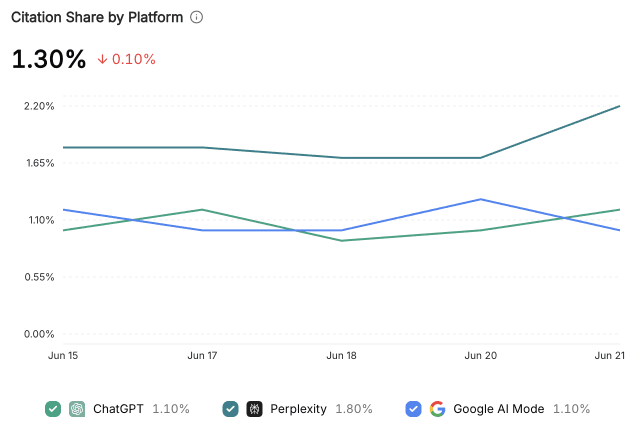
Do not ship AEO changes without measurement. Track mention rate, citation rate, share of voice, sentiment, and cited URLs before the edit and after the edit. The goal is not to publish more pages. The goal is to increase how often AI engines cite, name, and recommend you across the prompts that influence customers.
AEO Readiness Checklist
- Prompt coverage: You have a fixed prompt set for your category.
- Answer-first structure: Each target page opens with a direct answer.
- Question-led headings: Headings match real questions and comparison criteria.
- Evidence depth: Claims are supported by examples, sources, or product evidence.
- Schema support: Schema is present where it helps parsing.
- Crawler access: Crawlers can access the page.
- Competitor context: Competitor mentions and citations are tracked on the same prompt set.
- Measurement loop: Changes are measured after publishing.
Where AEO Usually Breaks
Most AEO programs fail because they treat the work as a writing exercise only. The team rewrites a page, adds a few FAQs, and waits for AI engines to notice. That can help, but it misses the harder part: the model also needs trusted evidence around the answer. If competitors are cited by review sites, documentation pages, forums, listicles, and partner pages, your own page has to be clear and your broader web presence has to support the same claim.
The second failure point is measurement. Without a before-and-after prompt set, teams cannot tell whether the change improved visibility or simply looked better in a CMS preview. AEO should be managed like an experiment: define the prompt, record the current answer, ship the improvement, wait long enough for the page to be crawled, then compare citation rate, share of voice, and sentiment.
How Siftly Fits The Workflow
Siftly tracks how your brand appears across AI answer engines, finds prompt-level gaps against competitors, generates GEO-ready content briefs, and measures whether published changes improved citation rate and share of voice. That closes the loop between AEO planning and actual visibility movement.
Frequently asked questions
What is answer engine optimization?
Answer engine optimization is structuring content and brand signals so AI answer engines can understand, cite, and recommend your brand in generated answers.
Is AEO the same as GEO?
They are closely related and often used interchangeably. GEO names the broader generative-search discipline. AEO emphasizes being selected as the answer.
How do I measure AEO?
Track mention rate, citation rate, share of voice, sentiment, cited URLs, and competitor presence across a fixed prompt set.
Does AEO replace SEO?
No. SEO still supports discoverability and authority. AEO adds answer-first structure, citation tracking, and AI-specific measurement.
Related reading
Your Next Customer Is Already Asking AI
See if AI recommends you — or your competitors.
Get Started